Louis Pasteur
Pasteur studied microorganisms, developing early vaccines against anthrax and rabies. But his publications didn’t always align with his private research notes.
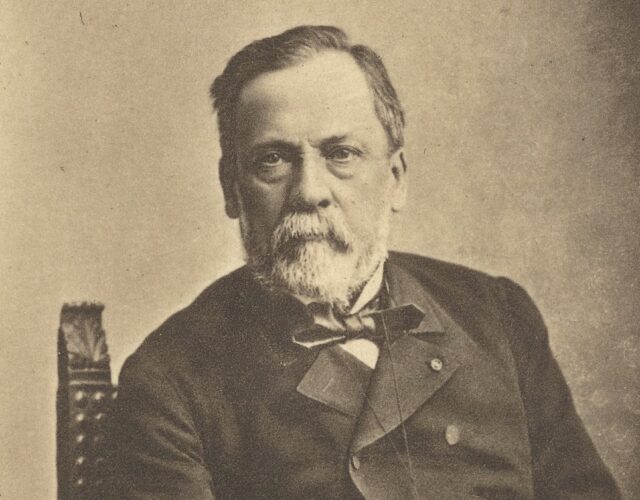
Today, the legacy of Louis Pasteur (1822–1895) looms large. Pasteurization, the Pasteur Effect, Pasteurella (a genus of bacteria), and an international network of biomedical research institutes all bear his name. In some circles, he is recognized as the “father” of microbiology. But Pasteur’s laboratory notebooks reveal important differences between his public reports and his “private science.” While his research had a huge impact on public health and biomedicine, these sources show that Pasteur, motivated by competition with other scientists, altered or exaggerated results in landmark publications about his experimental activities. They show that the world of biomedical research as Pasteur experienced it was complex and often cutthroat. His biography can help us understand that world, in addition to his personal achievements.
Education
Louis Pasteur was born in Dole, France, on December 27, 1822, to Jean-Joseph Pasteur, a leather tanner, and Jeanne-Etienne Roqui. As a young student, he enjoyed drawing and painting. Many of the artworks he produced in his teens still hang in the institute that bears his name today.
Pasteur spent his early school years in the rural town of Arbois and in nearby Besançon, close to the border of Switzerland. He earned a bachelor of arts degree from the Collège Royal of Besançon in 1840 and a bachelor of science degree in 1842. After failing the entrance exams for the École Normale Supérieure, a famous teacher’s college in Paris, Pasteur spent another year studying. This preparation helped him to pass the exams in 1843.
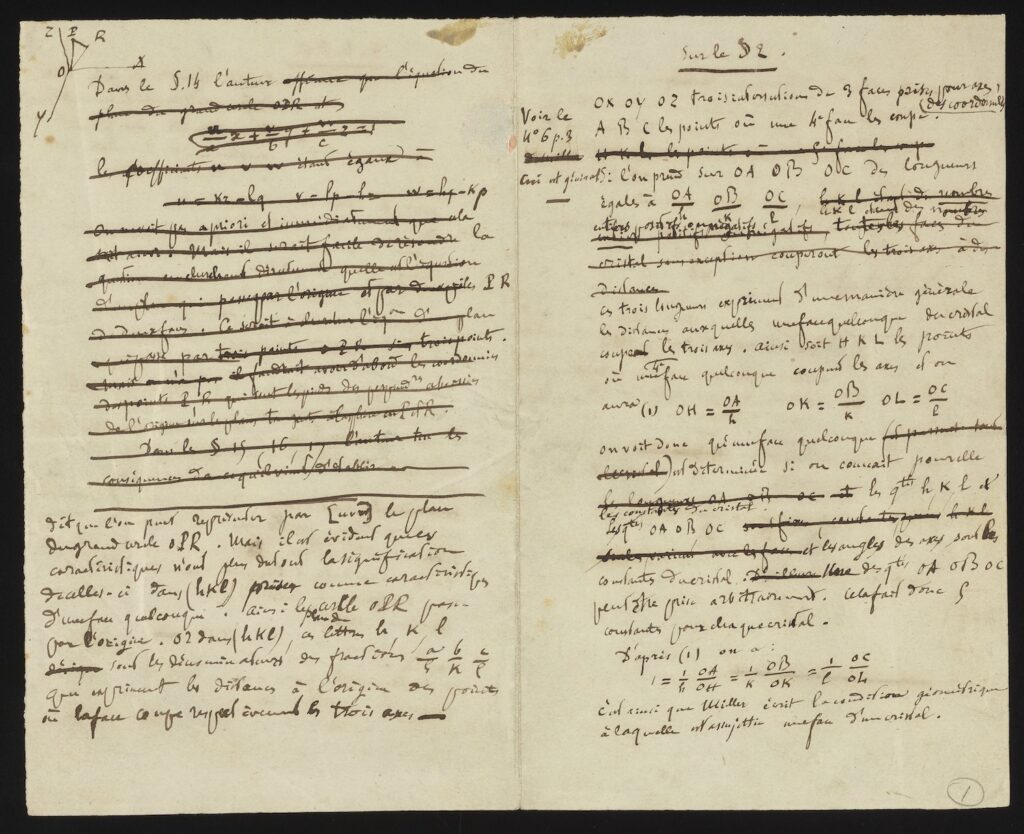
While enrolled at the École Normale, Pasteur established several significant connections. He became a teaching assistant to Jean-Baptiste-André Dumas, a chemist who was well known for his contributions to organic chemistry. Pasteur’s studies at the École Normale centered on chemistry and physics, leading to a PhD in 1847. After graduation, he began researching the ways in which certain crystals and solutions appear to twist the light coming through them. Pasteur traced this optical activity to underlying structural asymmetries, helping to define stereochemistry, the subfield that focuses on the three-dimensional characteristics of molecules.
Revolution was brewing in Paris around this time. What began as a protest turned into the French Revolution of 1848, leading to the abdication of King Louis Philippe I from the French throne and the creation of the Second Republic. That April, Pasteur volunteered for France’s National Guard.
In May 1848, Pasteur’s mother died from a sudden illness. He believed that the stress of knowing her son was living in revolution-torn Paris was a contributing factor. Grieving the loss of his mother and hoping to ease concerns about his safety among surviving family, Pasteur requested that the Ministry of Public Education reassign him to the Lycée in Dijon—a placement much closer to home. But Pasteur’s time at the Lycée was short-lived. He soon moved to the University of Strasbourg, where he became a professor of chemistry in January 1849.
Microorganisms
After six years at Strasbourg, Pasteur had achieved national recognition as a chemist. He was promoted to the Dean of the Faculty of Science at the University of Lille in 1854. It was during this appointment that Pasteur’s research interests shifted to fermentation, a process involving the conversion of carbohydrates into alcohols or acids. Some historians suggest that Pasteur was inspired to take up the study of fermentation when the father of one of his students, wine maker M. Bigot, asked him to figure out why bottles of wine were going sour. Pasteur, on the other hand, argued that his work on fermentation was a natural outgrowth of his earlier research on optical activity.
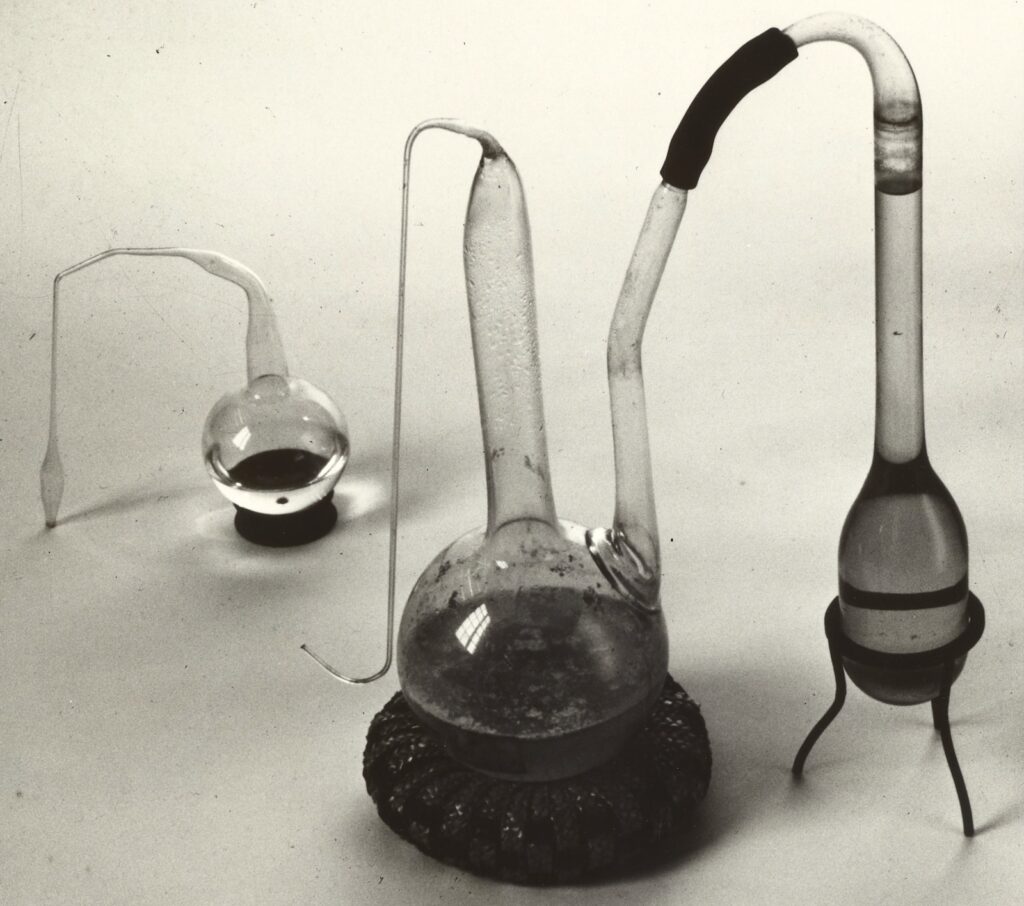
By this time, German scientist Justus von Liebig had theorized that fermentation was a chemical process, involving the decomposition of the fermented substance. Challenging Liebig’s theory, Pasteur demonstrated that it was yeast, a living organism, that was responsible for alcoholic fermentation. He was building on and confirming the earlier work of German physician and life scientist Theodor Schwann, who had shown that yeasts were living organisms. Similarly, Pasteur demonstrated that a living organism was responsible for the conversion of sugar into lactic acid in milk. Pasteur and von Liebig corresponded throughout the 1850s and 1860s, each one challenging the credibility of the other’s research on fermentation.
Pasteur also showed that oxygen slowed the rate of fermentation, something now known as the Pasteur Effect. Based on this observation, he theorized that the organisms responsible for fermentation were anaerobic, meaning the presence of oxygen was harmful to their development. In 1864, Pasteur found that heating wine to a minimum of 50–60° C (or 122–140° F) killed the microorganisms responsible for spoilage. He patented this process of “pasteurization,” which was used to preserve wine and beer until the mid-20th century. At that point, it became common practice to pasteurize cow’s milk as well.
Just as Pasteur found that microorganisms caused fermentation, he also believed that they were the cause of infectious diseases. This came to be known as the “germ theory of disease.” Pasteur was not the first to say that pathogens caused disease. But his experiments, which involved killing microorganisms to prevent infectious diseases, gave the theory strong support. In the mid-1800s, many people subscribed to the “miasma theory” instead, which argued that diseases were caused by bad air. Pasteur helped win broader acceptance for germ theory through research and carefully crafted public relations campaigns.
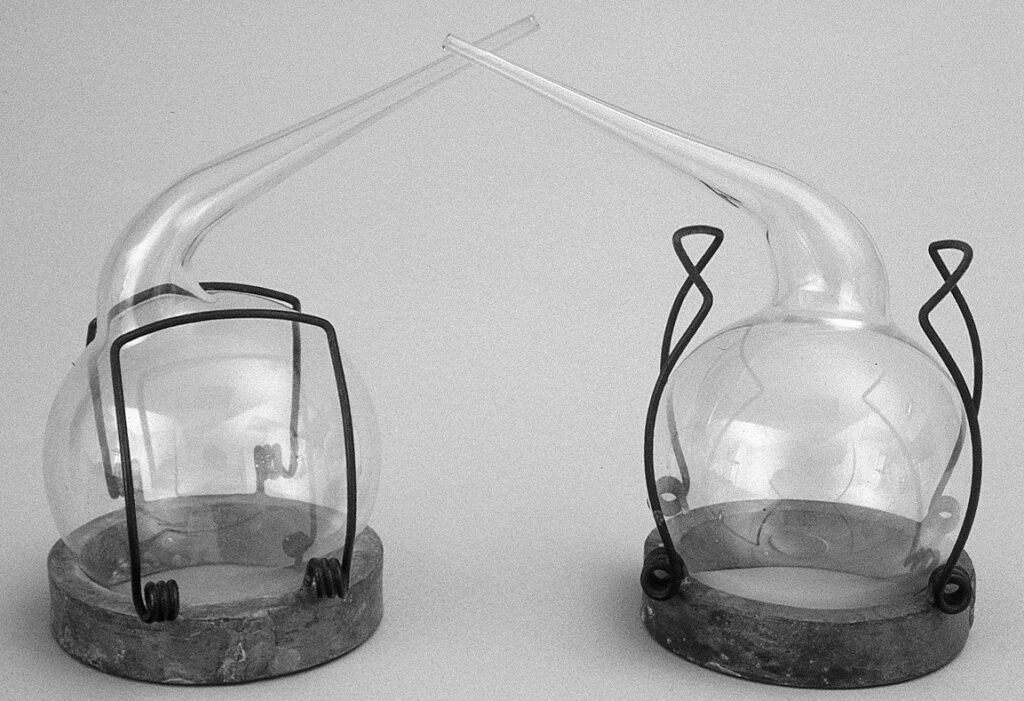
Pasteur’s work also opposed the theory of spontaneous generation. This was a widely accepted belief that certain organisms could arise from inorganic matter. One of the most vocal proponents of spontaneous generation at the time was French naturalist Félix Archimède Pouchet, who made the case for it in his book, Heterogenie (1859). Pasteur’s publications on fermentation, which argued that microorganisms traveled to fermented substances through the air, directly challenged Pouchet. Throughout the early 1860s, Pasteur conducted a series of experiments, aiming to prove the validity of his atmospheric germ theory.
Vaccines
Pasteur worked to understand and develop vaccines for a variety of infectious diseases. Edward Jenner had pioneered the use of vaccines in 1796, when he injected James Phipps with a serum containing cowpox to protect the boy against smallpox. Such early approaches involved infecting patients with a mild disease to help them build immunity against related, but more deadly, diseases. By the mid-1800s, however, scientists like Pasteur were seeking to create vaccines for infectious diseases using weakened versions of disease-specific agents.
Pasteur began with chicken cholera. He worked closely with assistants Emile Roux and Charles Chamberland to culture the bacteria that caused the disease, thinking this culture could be used as an effective vaccine. Pasteur’s team exposed the disease-causing bacterium to the air to weaken it in a process he called atmospheric attenuation. He believed that injecting chickens with a vaccine containing attenuated bacteria would protect them from the disease by exciting a more powerful immune-system response. This approach was later found to be ineffective.
Then, in a widely publicized experiment in 1881, Pasteur gave an experimental anthrax vaccine to livestock at Pouilly-le-Fort. Anthrax was wreaking havoc on French agriculture at the time: it was responsible for the loss of millions of grazing animals each year. Scientists were racing to develop a vaccine. Though German researcher Robert Koch would be recognized as the discoverer of the bacterium that causes anthrax, Pasteur has often been credited with the discovery of the vaccine involving that bacterium. Pasteur’s experiment was a huge public success: the 25 animals that received his anthrax vaccine survived infection, while those that did not get it died.
Pasteur reported these findings in the pages of the Proceedings of the Academy of Sciences, claiming to have weakened the anthrax bacterium as he had done before—by exposing it to the air. But his notebooks later showed that he had actually attenuated the bacterium chemically, by exposing it to the antiseptic potassium-bichromate. The discrepancy was significant: one of Pasteur’s rivals, the veterinary surgeon Jean Joseph Henri Toussaint, had developed an effective vaccine against anthrax using a similar antiseptic method. Pasteur’s claim to have attenuated the vaccine atmospherically overstated the uniqueness of his approach in a competitive bid for priority.
Rabies
Louis Pasteur’s final vaccine project targeted rabies, also known as “hydrophobia” at the time. Although we now know rabies is caused by a virus, Pasteur believed a bacterium was responsible. Collaborating with Emile Roux, he infected rabbits with rabies and removed their spinal cords. He attenuated the rabies virus to make a vaccine by placing the infected spinal cords in containers of dry air. Pasteur claimed that he tested the vaccine in about 50 dogs with complete success. But later accounts questioned the number of test subjects and level of success of these trials.
LEARN MORE
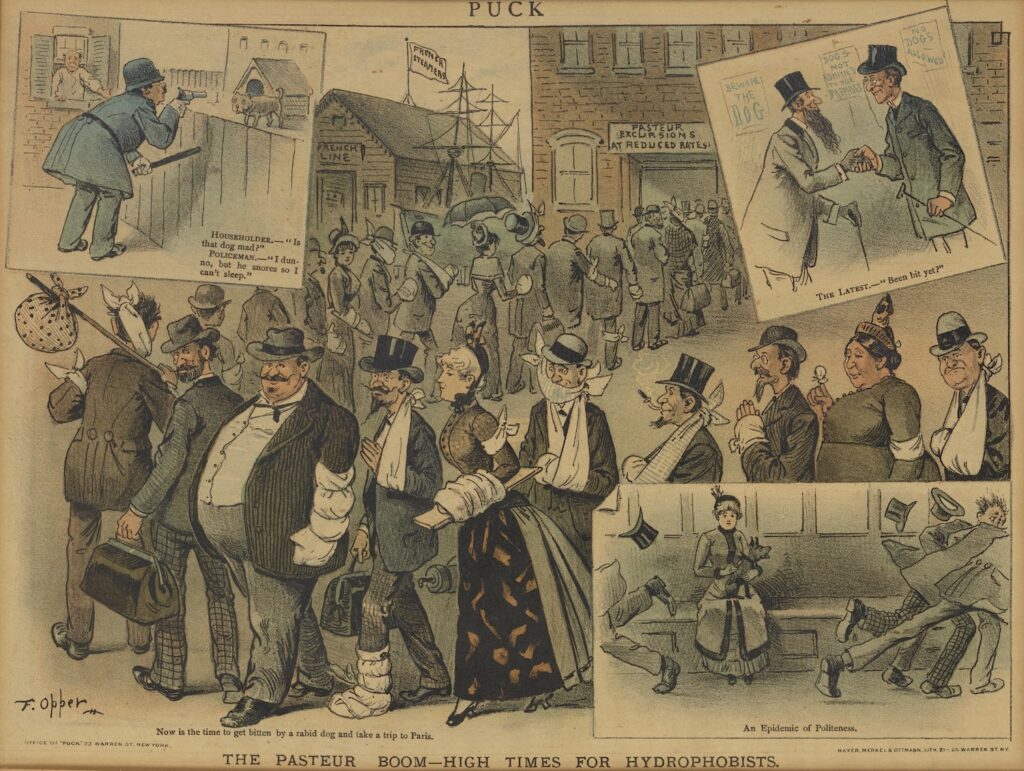
Look carefully at the cartoon above. What do you notice about the people it represents? Who, or what, is being mocked and how do you know? Could you imagine a cartoon like this being made about the treatment a disease today? Why or why not?
Undiscouraged, on July 6, 1885, Pasteur vaccinated 9-year-old Joseph Miser after he was bitten by an infected dog. When Miser did not develop rabies, news of an effective rabies vaccine spread rapidly. The following year, Pasteur’s new vaccine was administered to 2,500 patients throughout Paris. From there, the vaccine soon spread around the world.
Legacy
Following the success of the rabies vaccine, Pasteur and Roux sought to establish an institute that would continue to develop vaccines and support research on infectious diseases. After securing financial support from international donors, the Pasteur Institute opened its doors in November of 1888. The Institute quickly developed a reputation as one of the world’s leading biomedical research institutes. It remains so to this day, with 32 research institutes spread across 25 countries on 5 continents.
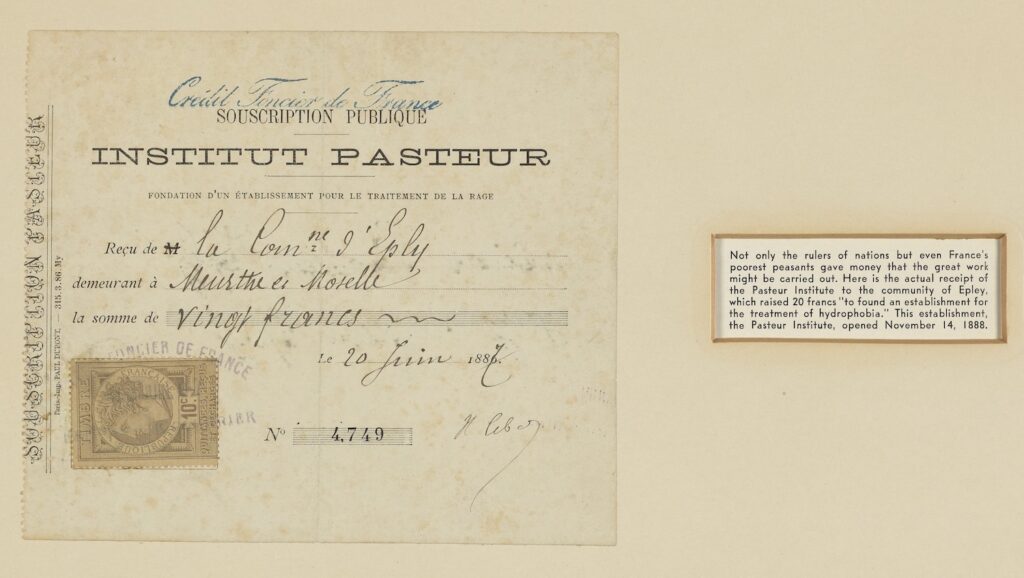
Pasteur’s pioneering work depended on networks that were defined by the carefully controlled flow of information. The contributions we remember Pasteur for today—fermentation, pasteurization, and vaccination—required equal measures of collaboration and competition.
Glossary of Terms
Lycée
The modern system of French education, which is highly centralized, began in the late 1800s. Students often begin primary school at age 3, followed by the collège (middle school) and the lycée (high school) before moving onto higher education, apprenticeships, or the workforce.
Back to top
Spontaneous generation
This theory, that life can arise from nonliving matter, can be traced back to the ancient Greek philosopher Aristotle. It was common knowledge until scientific discoveries began to raise doubts in the 1600s. Recent developments in biotechnology may usher in a new version of the theory today.
Back to top
Attenuation
The gradual reduction of strength or intensity. In medicine, this can mean a reduction in the likelihood of infection (pathogenicity) or in the severity of illness once infection occurs (virulence).
Back to top
Further Reading
American Medical Association. The History of Inoculation and Vaccination for the Prevention and Treatment of Disease. Burroughs Wellcome and Company, circa 1913.
Geison, Gerald L. The Private Science of Louis Pasteur. Princeton University Press, 1995.
Hansen, Bert. “Does Louis Pasteur Still Matter?” Distillations magazine. November 17, 2022. https://www.sciencehistory.org/stories/magazine/does-louis-pasteur-still-matter/.
“Louis Pasteur, Up Close.” Institut Pasteur, Google Arts & Culture. https://artsandculture.google.com/story/XAXBwj6OxM9xKA.
You might also like
THE DISAPPEARING SPOON PODCAST
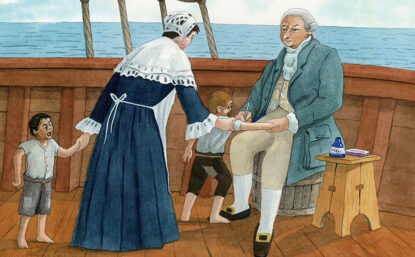
Orphan Vaccines
When the global vaccine supply chain depended on children.
DIGITAL COLLECTIONS
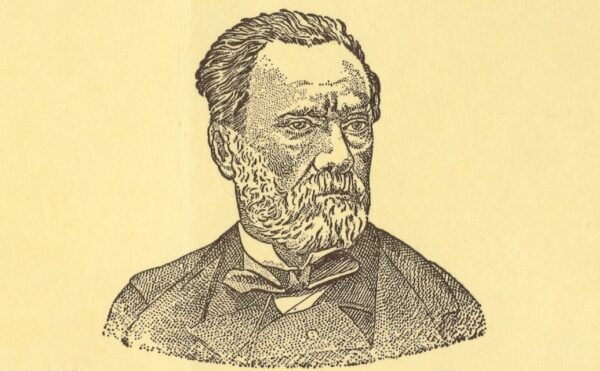
Fisher-Pasteur Memorial Collection
This collection consists of an assortment of archival material related to Louis Pasteur.
DIGITAL EXHIBITIONS
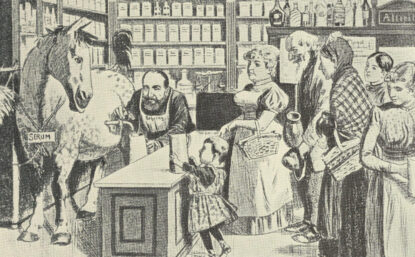
Animals and the Making of Human Vaccines
Learn about the role of animals and their cells in the development of lifesaving vaccines.