Judging Sinclair Lewis’s ‘Arrowsmith’ by Its Cover
Public perceptions of 20th-century medical science as seen through book cover illustrations.
Public perceptions of 20th-century medical science as seen through book cover illustrations.
In a previous collections blog post, I chronicled the story of how microbiologist-turned-science-writer Paul de Kruif and acclaimed novelist Sinclair Lewis joined forces to produce Arrowsmith (1925), the definitive template for the medical research adventure story.
The book follows a young doctor named Martin Arrowsmith as he faces ethical quandaries in the world of American medicine. Although he starts out as a physician, Arrowsmith is inspired by the possibilities of biomedical research and switches to lab work. Along the way, he confronts corrupt physicians and researchers driven by profit. Arrowsmith develops a potential cure for the bubonic plague, which will go to trial with human subjects on the fictional Caribbean island of St. Hubert. Here, Arrowsmith must make an impossible choice: to conduct a controlled study (in which half the participants receive his treatment and half receive no treatment), maintaining his commitment to the principles of scientific research but likely condemning the control group to death; or to administer the unproven treatment to everyone, possibly curing all participants but compromising the integrity of the study.
Lewis and de Kruif created Arrowsmith in response to major issues they saw in contemporary American medicine: doctors who prioritized profit over patients’ needs and researchers who “irresponsibly” administered experimental vaccines and treatments to patients without confirming their efficacy. For more information on de Kruif’s fraught relationship with the medical profession in the United States, you can read his scientific biography.
But Arrowsmith also started the much larger and enduring trend of the medical research adventure story. Literary explorations of scientific research predate Arrowsmith, of course. Lewis and de Kruif’s novel, however, helped to popularize dramatic retellings of medical advancements, centering physician-researchers as daring protagonists. Many of these newer books followed its narrative structure: a truth-seeking scientist relentlessly pursues a solution to a major medical problem, defying doubters and cynics.
As the popularity of this form of storytelling increased, Arrowsmith continued to hold its own. The book was required reading for many grade school students in the mid- and late-20th century, inspiring future professional scientists. Over the past century, various publishers have produced new editions of Arrowsmith, appealing to contemporary audiences with new cover art, forewords, and afterwords.
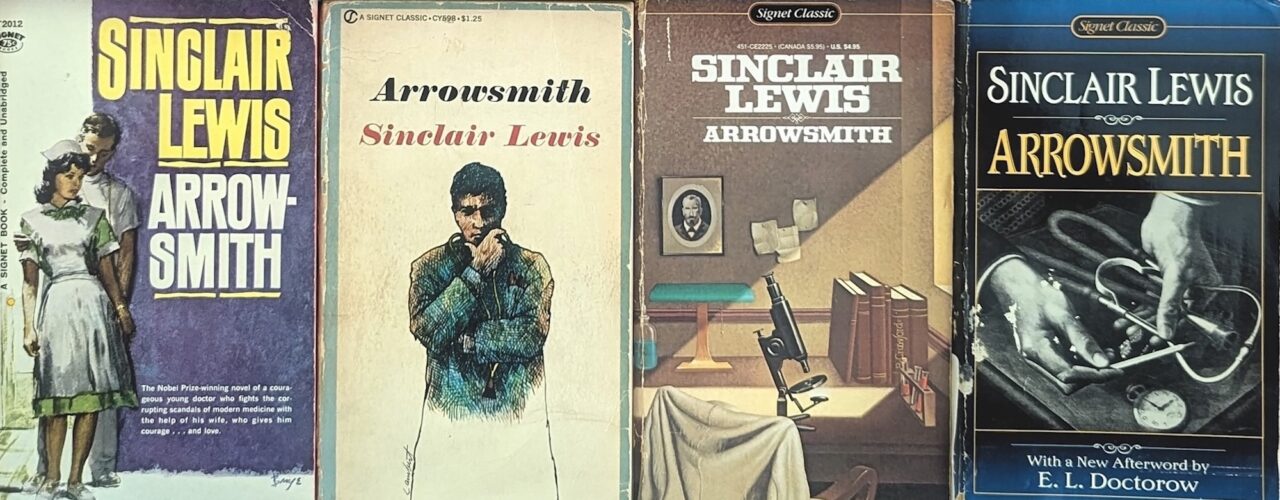
The Science History Institute recently received a donation of eight different editions of Arrowsmith (along with some other Paul de Kruif works) from historian of science Bert Hansen. The variations in the cover art are striking. Some copies depict the “hard tools” of medical research—glassware and a microscope—and others illustrate tender moments between a doctor and a nurse.
Handling the books and examining their covers left me with many questions: Why are they so different? What was Arrowsmith about, anyway—romance or research? These questions scratched at bigger-picture concepts in the history of science and literature: How did publishers decide what was relevant to readers in this medical adventure story? Looking at some of the different cover designs provides a window into the publishing industry’s fluctuating portrayals of medical science over the course of the 20th century.
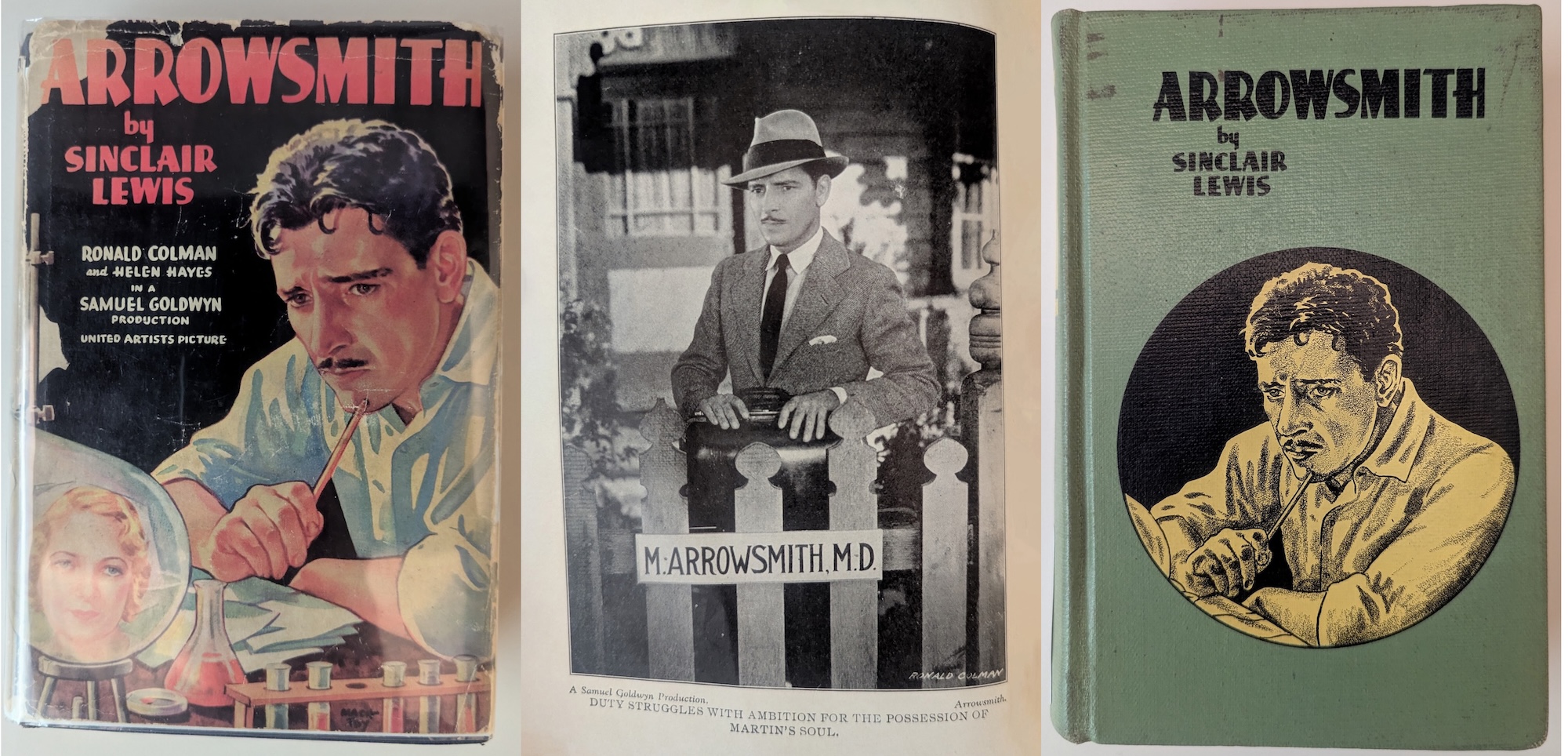
When Arrowsmith was adapted into a movie by United Artist Pictures in 1931, publishers moved to incorporate elements from the film into the book’s visual elements. The circa 1930s Grosset and Dunlap edition features a colorful dust jacket with Arrowsmith (Ronald Colman) and his wife, Leora Tozer (Helen Hayes), accompanied by black and white stills from the movie on the inside cover. Hailing Arrowsmith as a “modern hero,” this imprint gives readers a more tangible version of the protagonist to hang on to, depicted by a “real” person.
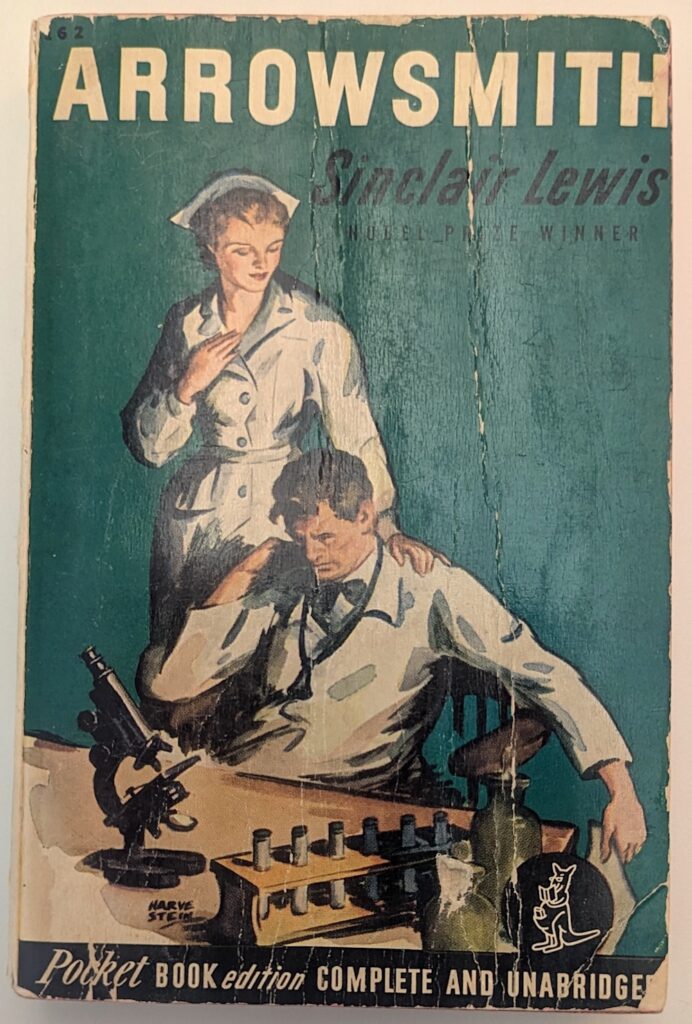
Several editions of Arrowsmith take the classic pulp novel form that was popular in the 1930s, 1940s, and 1950s. Pulp novels used flashy, vibrant cover art to draw in customers, especially young men, often including stereotypical, sexualized illustrations of women. A World War II-era Pocket Book edition published in 1942 features a pulp-style cover with a serene Leora Tozer, described on the back cover as “the plucky, good-humored comrade of a wife,” comforting a frustrated Arrowsmith. The back cover of this edition, intended for both civilian audiences and U.S. soldiers, highlights Arrowsmith’s “faith” and “courage” in the face of danger, presenting him as a pulp hero and paragon of wartime masculinity.
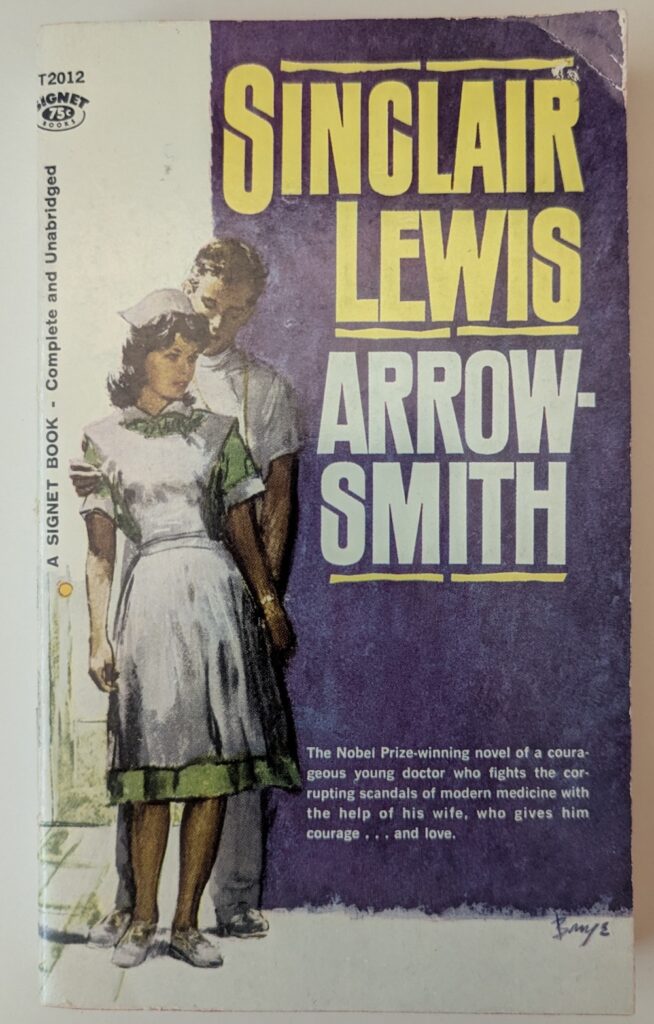
A 1961 Signet Books edition of Arrowsmith depicting a doctor and nurse on its cover carries a different tone. The cover text shifts the focus from Arrowsmith’s virtues to American medicine’s vices:
What might explain this alternate emphasis? Examining the state of health and medicine in the 1950s and early 1960s provides some insight.
In the late 1950s, a series of scandals rattled public faith. Perhaps the best known of these was the revelation that thalidomide—a drug prescribed to pregnant women in Europe as an antiemetic (a type of medicine that reduces nausea)— caused severe birth defects. Crises in medical safety at home and abroad increased Americans’ anxieties about the stability of the medical field, raising questions as to the intentions of doctors and the level of involvement big pharmaceutical companies had in influencing treatment options. Arrowsmith, construed as a story about the evils of “the money-hungry doctor” and “big-business medical men” would have hit close to home for mid-century readers.
Hansen maintains that the era of the medical history story ended in the mid-20th century, as enthusiasm for heroic medical researchers waned and optimism about medicine’s ability to solve humanity’s problems declined.
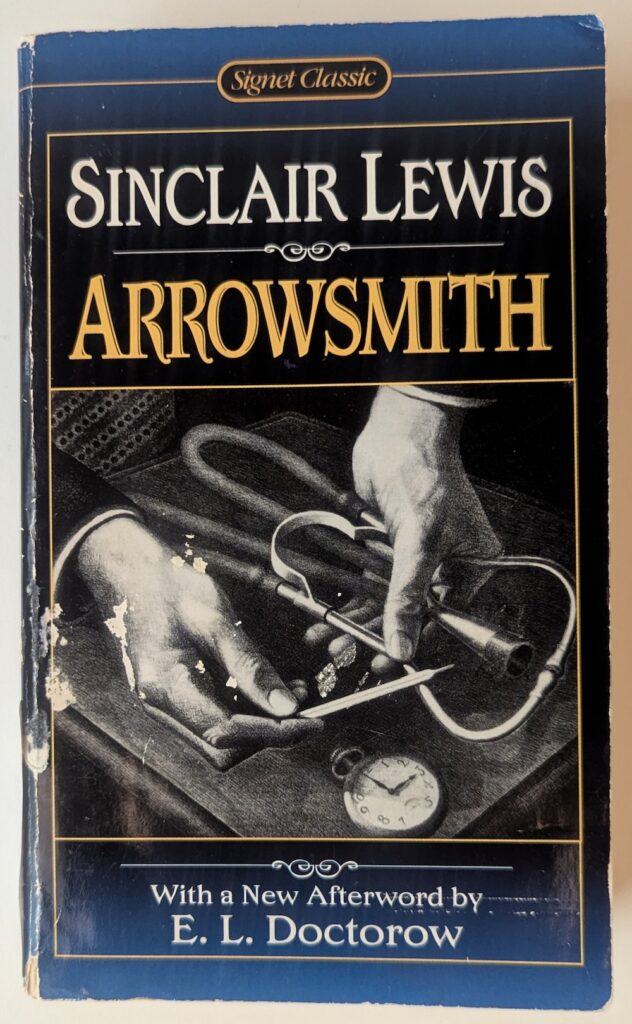
Indeed, this 1998 edition of Arrowsmith has relatively little to say about medical triumphs. The back matter casts the primary conflict of the book as one man’s quest for “integrity and intellectual freedom” amid “societal forces of ignorance, corruption, and greed.” The book’s new introduction, written by novelist E. L. Doctorow, focuses primarily on the literary value of Sinclair Lewis’s prose, extoling the author’s “fierce moral nature.” For an audience less engrossed with the lives and conflicts of medical researchers, the perceived value of the book at the end of the 20th century seems to lie in the general theme of integrity battling corruption. So rather than foregrounding people or characters, this edition’s cover art simply shows depersonalized hands grasping a stethoscope.
Today, Arrowsmith does not hold the same grip on popular audiences as it did in the mid-20th century. Several elements of the book render its continued use in the classroom problematic. It repeats colonial characterizations of the Caribbean, juxtaposing the islands’ promise of wealth for settlers with rampant disease. Indeed “conquering” infectious diseases like yellow fever and dengue was seen as a key part of European colonization of the Caribbean. Arrowsmith also assigns responsibility for the transmission of disease to various ethnic groups, including East and South Asians. (For a more detailed look at the ways Arrowsmith both repeats and reshapes discourse on race and disease, see this article.) Additionally, the women in Arrowsmith—strongly praised when the book was released in 1926—read as shallow today. Leora’s defining character trait is her unwavering faith in her husband. She exists, as the 1940s and 1960s covers suggest, to prop up her husband when he is discouraged.
And yet, Arrowsmith is the book that inspired numerous young readers to pursue careers in science, including Mary Maynard Daly, Joshua Lederberg, and many others. For these scientists and countless other readers, Martin Arrowsmith took on a life of his own, beyond what Lewis or de Kruif could have planned or imagined. At various times, the protagonist has served as an exemplar of heroic masculinity in times of trouble, creator of scientific knowledge in times of medical optimism, or opponent of profiteering in times of doubt.
De Kruif, Paul. The Sweeping Wind. Harcourt, Brace, & Co, 1962.
Gerald, James Fitz. “‘These Jests of God’: Arrowsmith and Tropical Medicine’s Racial Ecology.” Literature and Medicine 39, no. 2 (2021) 249-272.
Gest, Howard. “Dr. Martin Arrowsmith: Scientist and Medical Hero.” Perspectives in Biology and Medicine 35, no. 1 (1991): 116-124.
Greenberg, Stephen. “Microbe Hunters Revisited – Paul de Kruif and the Beginning of Popular Science Writing.” Houston History of Medicine Lectures. 7. 2020.
Hansen, Bert. Picturing Medical Progress from Pasteur to Polio: A History of Mass Media Images and Popular Attitudes in America. Rutgers University Press, 2009.
Kohler, Robert E. “A Policy for the Advancement of Science: The Rockefeller Foundation, 1924-29.” Minerva 16, no. 4 (1978). 480-515.
Lewis, Sinclair. Arrowsmith. Harcourt, Brace, and Company, 1925.
Löwy, Ilana. “Martin Arrowsmith’s Clinical Trial: Scientific Precision and Heroic Medicine.” Journal of the Royal Society of Medicine 103, no. 11 (2010) 461-466.
Mason, Michael York. “Middlemarch and Science: Problems of Life and Mind.” The Review of English Studies 22, no. 86 (1971). 151-169.
Rosenberg, Charles E. “Martin Arrowsmith: The Scientist as Hero.” American Quarterly 15, no. 3 (1963): 447-458.
Scott, Philip A. The Medical Research Novel in English and German, 1900-1950. Bowling Green State University Popular Press, 1992.
Tobin, James. “The Michigan Scientist Who Was Arrowsmith.” Michigan University: Heritage Project.
Verhave, Jan Peter. A Constant State of Emergency: Paul de Kruif: Microbe Hunter and Health Activist. Van Raalte Press, 2020.
Featured image: Various editions of Sinclair Lewis’s Arrowsmith (1925), dating from 1931 to 1998. Many of the cover illustrations use similar images, such as laboratory glassware, stethoscopes, microscopes, a doctor, and a nurse.

A visit to Knoebels Amusement Resort and chemist Joseph Priestley’s historic home in PA inspires a closer look at the Institute’s rare book collection.
The Institute’s museum education team partners with Philly Touch Tours to offer a more meaningful history of science experience.
Mapping Philadelphia’s industrial past with digital tools.
Copy the above HTML to republish this content. We have formatted the material to follow our guidelines, which include our credit requirements. Please review our full list of guidelines for more information. By republishing this content, you agree to our republication requirements.