Blue Silk Dress
How should we think about the lives of objects? This biography offers three paths to understanding an artifact from the 1700s.
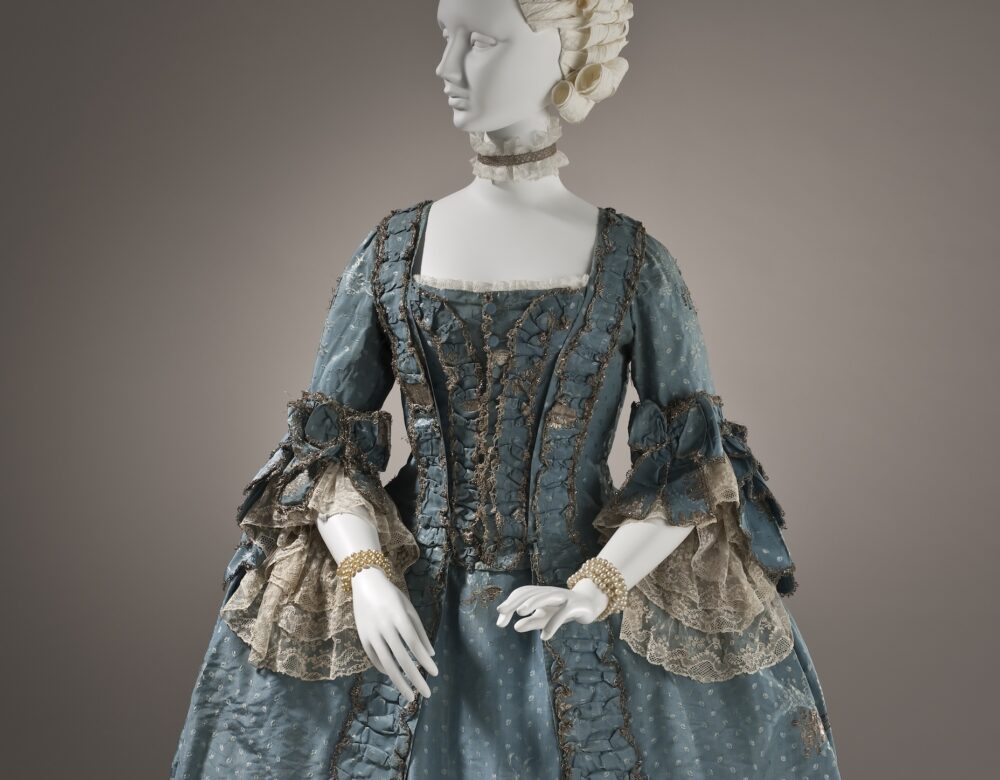
Biographies usually tell the life story of a person—when that person lived, something about their education and career, and the impact they had on their field or on the world. We wondered: Can you write a biography of an object, rather than a person? What would this tell you about science and the world? Made up of three biographies, this entry aims to provide readers with an understanding of the complicated “life story” of a historic artifact—an indigo silk dress that might have been worn by a wealthy white woman in the British Atlantic colonies on the eve of the American Revolution.
These three biographies provide different ways of understanding the artifact, drawing on natural history, archaeological evidence, and textual records. Together, they tell a complicated story of gender, enslaved labor, and natural history. While Eliza Lucas Pinckney (1722–1793) is often portrayed as a hero who opened up new economic opportunities in South Carolina through large-scale indigo production, here we relate her accomplishments to the expertise of enslaved laborers on her plantation and the natural history of indigo-producing plants.
Click on the boxes in between the images below to read the stories of Indigofera, a plant that was cultivated in the Atlantic colonies to make indigo dye; enslaved experts who were directly responsible for indigo production; and Pinckney, who defied social expectations by becoming a plantation manager as a teenage girl.
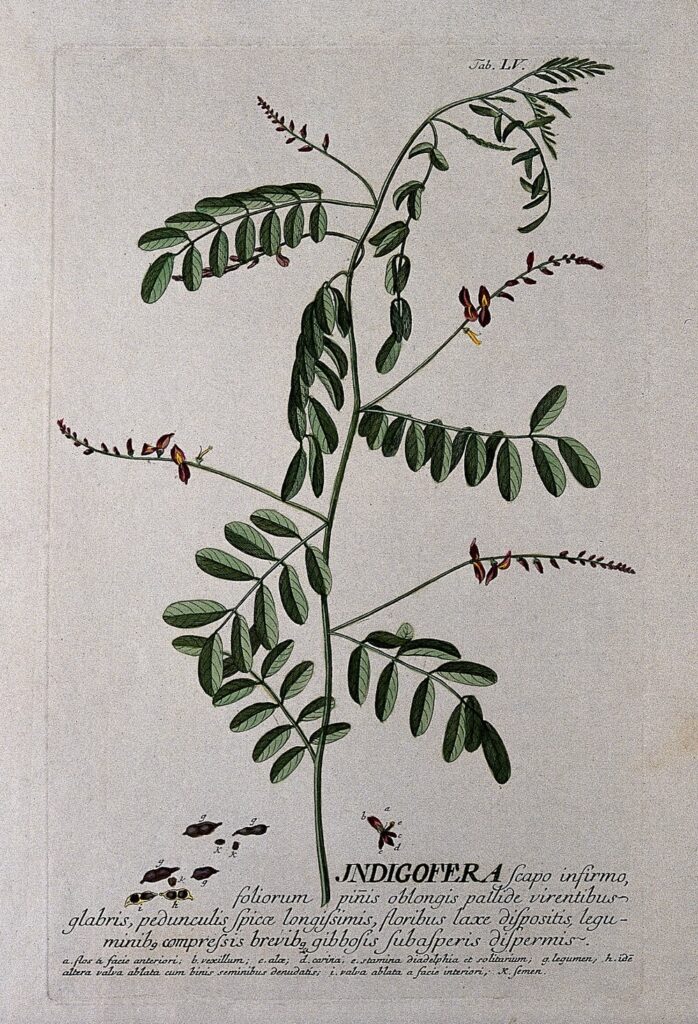
Indigo, a blue colorant, has been one of the most important and widely used dyes in history. It can make a spectrum of shades from the light blue of a robin’s egg, to the vibrant blue of a summer sky and the deep, almost blue-black of the night sky as the last hints of sunlight fade from view. While indigo has been used in a number of industries including culinary and medical science, it is primarily used to dye textiles because it is colorfast. Highly prized but temperamental to work with, the physical properties of indigo-rich plants have made the plant an active agent in its own history.
The “Family History” of Indigo
Indigo comes from indican, a colorless glycoside that produces the dye when indican-rich plants are fermented in water. One of the few naturally occurring blue colorants, the dye can be extracted from several species of plants native to Asia, Africa, the Middle East, the Americas, and Northern Europe. Archaeological evidence suggests that indigo originated in numerous places around the world. Textile fragments from regions as diverse as Egypt, China, Peru, and India show that people in each of these regions produced a blue dye. As a result, indigo’s history and impact covers the globe, and it has given life to a number of regionally specific cultural practices.
Colonial Cultivation
But while indigo has had a global reach, it can also be traced to specific contexts of production. In the English-speaking world, indigo became bound up with Britain’s early colonial and economic ambitions. Before the second half of the 1800s, Britain sought to cultivate Indigofera, one of the best natural sources for the dye, on colonial plantations in the Caribbean and North America. The desire to grow the plant contributed to networks of seeds, plants, tools, knowledge, and people that moved across the globe as part of the trans-Atlantic slave trade.
On British plantations in Jamaica, Barbados, and South Carolina, Indigofera emerged as a viable crop under the care and labor of both indentured and enslaved women and men. Because the plants could be easily damaged by a cold-snap or late frost, the seeds were sown in the spring. The rows of vibrant green bushes that sprang up did not need much attention for the first several months of their lives. This meant that Indigofera could be raised in the drier soil alongside other economically significant crops like rice. But as the plants matured in the hot summer months, they required more attention.
In ideal conditions, these Indigofera plants grew to nearly six feet tall. Once the pink or violet flowers started to bloom, often in early July in Caribbean and South Carolinian climates, the first growth was cut. This pruning needed to be done carefully: if the leaves were handled roughly, they were easily bruised and risked losing some of the dye-producing indican compound.
Once the leaves were cut, they were quickly transferred to vats to be fermented into the vibrant blue dye. If the season was good and the plants had found the weather favorable, this process of careful pruning could take place a second time in late summer and a third time in the early autumn. In this way, producers extracted as much dye as possible from a single crop.
From Plant to Dye
The transformation of indigo from a green plant to a richly pigmented blue dye has been described as magical: green plants are fermented in water to create a yellow-green liquid that, when exposed to oxygen, turns deep blue. For British planters who were not used to working with Indigofera, the process was hard to comprehend. However, enslaved experts on Britain’s plantations already knew Indigofera and its temperamental properties from West Africa. They ushered the plant into the next stage of life using their knowledge of its behaviors.
Once the plant’s leaves had been carefully cut, they needed to be quickly transferred to a series of vats to make the dye. In the first and largest vat, the plant steeped and fermented. Enslaved indigo experts knew that the plant needed to steep for anywhere from 6 to 24 hours as it fermented, depending on factors like temperature and humidity. They paid close attention to the plant as it broke down, looking for changes in colors, bubbles, scum, and heat to tell them how the fermentation was progressing. Indigo was notoriously smelly, but that smell was also an important indication of the passage of time. Skilled workers used changes in the smell and color of the fermenting plant to determine when the colorant had been extracted. At this point, the liquid was ready to be transferred to the next vat.
Once the indican was extracted from the leaves, the mass of fermented dye was drained into a second vat where it was stirred, or “beaten,” to oxidize the particles. Again, enslaved indigo experts needed to work with the plant at this stage in the process, taking their cues from the plant itself to ensure the best possible dye. As with fermentation, the plant enacted a series of changes in the physical state of the liquid. It was during this stage that the indican transformed into indigo dye. The water was strained off in a third vat where dye particles were congealed into a thick mud that was pressed and dried into cakes that were shipped to Britain’s dyers.
Travels in the British Empire
Indigofera’s life cycle—from seed to dye—was broadly similar across British plantations in the Caribbean and South Carolina because plantation owners transferred people, plants, and tools from one location to another attempting to ensure the plant’s success. After a bit of a rocky start, indigo was successfully raised in South Carolina during the second half of the 1700s. This success was due In large part to the skill that enslaved people who were transported to the region brought to the cultivation of the plants and the dye.
But when Britain lost its colonial holdings in North America at the end of the American Revolution in 1783, the empire shifted its attention to India. Indigofera was native to the region, and the plant thrived in the warm, humid climate of places like Bengal. As had been the case in the Caribbean and South Carolina, Indian famers knew how to work with the temperamental plants. Their skills and labor were exploited by the British to produce the dye until the second half of the 1800s.
Epilogue
Indigofera continues to be cultivated and used by both large- and small-scale consumers. However, since the late 1800s production of natural indigo has declined significantly.
This decline is partially due to Indigofera’s success: Indigo dyed the world blue, and consumers wanted more and more of it. In response to this demand, chemists began looking for a synthetic alternative. German chemist Adolf von Baeyer began synthesizing indigo in 1865. After a series of trials and errors, the first synthetic indigo went on the market in1897. In a little over a decade, synthetic indigo had overtaken the natural dye.
While it would not be feasible to substitute natural for synthetic indigo in large-scale production today, there is an increasingly strong demand for natural and sustainable dyes. As more people look to natural alternatives to fast-fashion, Indigofera may be starting a new life.
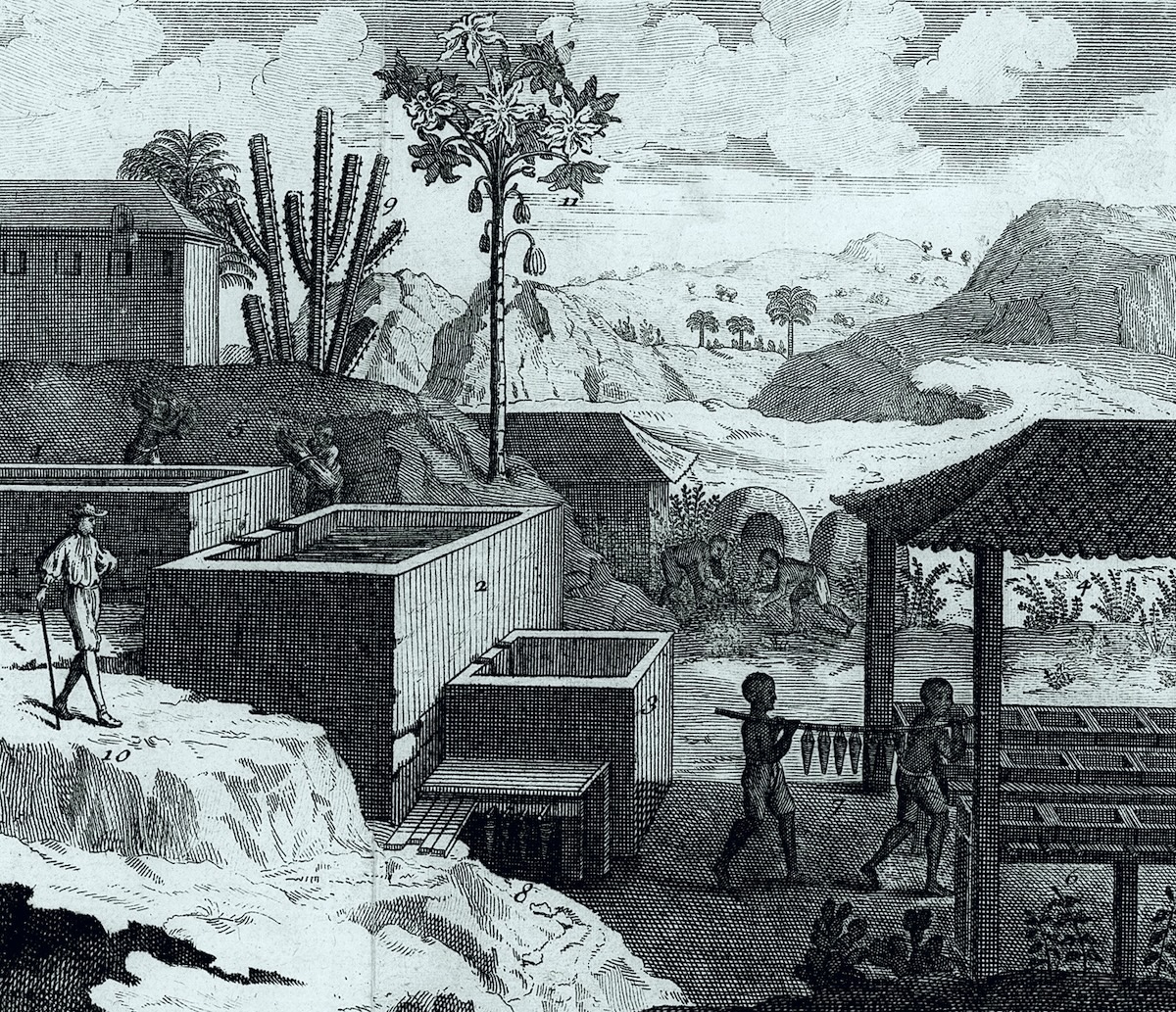
The 1700s were awash in a sea of blue. For much of that period, the blue dye that colored textiles across the British Empire was produced on colonial plantations, first in the Caribbean and by the second half of the century, in South Carolina. Indigo was notoriously fussy to produce, requiring close attention to the bubbles and scum that appeared as the plant was fermented into a thick paste. To British planters, who often lacked practical knowledge of how to make indigo dye, this process was magical and confusing. However, for John “Quash” Williams, a woman known as Hagar, and other experts enslaved on British plantations, the alchemy of indigo would have been familiar. At every stage in the process, their knowledge and skill made indigo a viable cash crop. Whether they brought knowledge from West Africa or acquired it while they were enslaved, these experts transformed the green Indigofera plants into “blue gold.”
John “Quash” Williams
Plantswere not the only material that mattered in the process of producing indigo dye. On the South Carolina plantations of Eliza Lucas Pinckney (1722–1793), high-quality wooden indigo vats were also essential. These were made by John “Quash” Williams, an expert woodworker.
As with many of the women and men enslaved on colonial plantations, little is known about Williams’s early life. He was most likely born sometime between 1720 and 1725 to a Black mother and a white father. New research suggests that he may have been born at Wappoo Plantation, one of the Lucas family’s plantations in South Carolina. Williams’s birth name, Quash, means “Sunday” in several West-African languages. This sheds light on where his mother was from: in West Africa, there is a tradition of naming a child after the day of the week on which they were born. Williams took the name John at his baptism later in life.
We lack written sources to help us understand Williams’s childhood and adolescence. This stands in stark contrast to the wealth of documents written about and by Pinckney, his enslaver. While research has shown that Williams eventually wrote on his own behalf, insights into his early life come from letters written by members of the Lucas and Pinckney families. In a 1743 letter, Pinckney tells her father that Williams was accused of trying to self-emancipate, but that he was found innocent. While Williams likely spoke on his own behalf at his trial, his words have gone unrecorded. Pinckney attended the trial and her presence there, along with the letters that survive, make it clear that Williams’s skill and knowledge were vital to her efforts to cultivate indigo on family plantations in South Carolina.
Once Indigofera plants were harvested, they needed to be fermented to produce dye. On colonial plantations, this was done using a series of vats, or tubs, arranged from smallest to largest. This system of vats traveled across the British Empire, from India to the Caribbean islands and to South Carolina. However, the transmission of knowledge is not always smooth: initially some planters in South Carolina constructed their vats using brick. This caused a number of problems during the dye-making process. Indigo is highly susceptible to contamination and the iron in red brick often leached into the liquid as it fermented, producing a low-quality blue dye. Pinckney learned this firsthand when her early attempts yielded textiles with red, brown, and blue stains.
To solve this problem, Pinckney turned to Williams. He worked both as a driver, overseeing the labor of other enslaved indigo experts, and he built at least two sets of wooden vats for processing indigo. As a testament to his skill, but also highlighting Pinckney’s exploitation of his labor, Williams was sent to other plantations owned by her family to build more vats.
While Williams was one step removed from the Indigofera plants themselves, his skill was essential to the success of South Carolinian indigo. In modern scientific experiments, the tools and apparatus in which chemical reactions take place are often as important as the chemicals themselves. This was also true for indigo production in the 1700s: Williams’s wooden vats ensured that the chemical reactions required to produce the best indigo dye could take place.
In his later life, Williams continued working for the Pinckney family as a skilled craftsman, eventually obtaining his freedom. But Williams was not the only person who ensured the success of South Carolina indigo. His life story cannot be untangled from the countless other enslaved indigo experts who worked at Wappoo and on other plantations.
Hagar
The labor conventions of colonial plantations meant that enslaved and free Black men like Williams came to occupy a prominent place in indigo production. But women were not strangers to the process; it is possible that the men who came to be recognized as indigo experts were trained initially by women. While many of their names and stories were not recorded, the story of Hagar shows how enslaved women contributed to the production of indigo on plantations in the Americas.
It appears that women’s involvement with the process of making indigo could vary based on where they were enslaved. It seems likely that when they were involved, enslaved women took part in two crucial stages of production: cultivating the plant and managing the process of drying the thick blue sludge into stable indigo cakes to be shipped to dyers in Britain.
Hagar, an indigo expert enslaved on a Laurens plantation in South Carolina, was known for her extraordinary skill in managing the drying process by which indigo sludge was formed into bricks. Like other female experts whose names were not recorded, Hagar worked in close physical contact with the indigo liquid. She carefully watched as the water was seeped out of the final vat and the sludge was transferred to cloth bags or wooden boxes to dry. Her hands would have been stained blue as she kneaded the dye on boards and formed it into cakes that she then ensured were protected from the sun and dried thoroughly before being packed into barrels and shipped to Britain. While only one step in the process, Hagar’s skill was essential: if the indigo dye rotted during shipment, it would lose value.
Hagar’s skills were part of a longer tradition of indigo production by African women. In West Africa, women were the primary producers and users of the dyestuff. Women like Hagar understood how to cultivate, harvest, and ferment the plant using clay pots. They also knew when and how to dip cloth in order to achieve the best color. Working closely with indigo dyeing allowed female indigo experts to develop incredibly detailed understanding of the sights and smells that mystified British planters. On British plantations in the Caribbean and South Carolina, by contrast, men typically undertook the hard physical labor of fermenting the plant into a usable blue sludge.
Personal Creativity in a Plantation System
While much of the indigo women and men like Hagar and Williams produced was packaged and sent to Britian, they also continued to produce indigo for their own use, adapting their knowledge to the plantation landscape. Hollowed-out logs on Caribbean plantation sites and depressions in the ground on plantations in South Carolina reflect this use: these discoveries suggest that enslaved people worked with the dyestuff when it was still fresh, in line with traditional West African practices. It may be that in their personal dyeing, women’s roles were more closely aligned with those in Africa and that women like Hagar continued working with indigo from seed to finished garment.
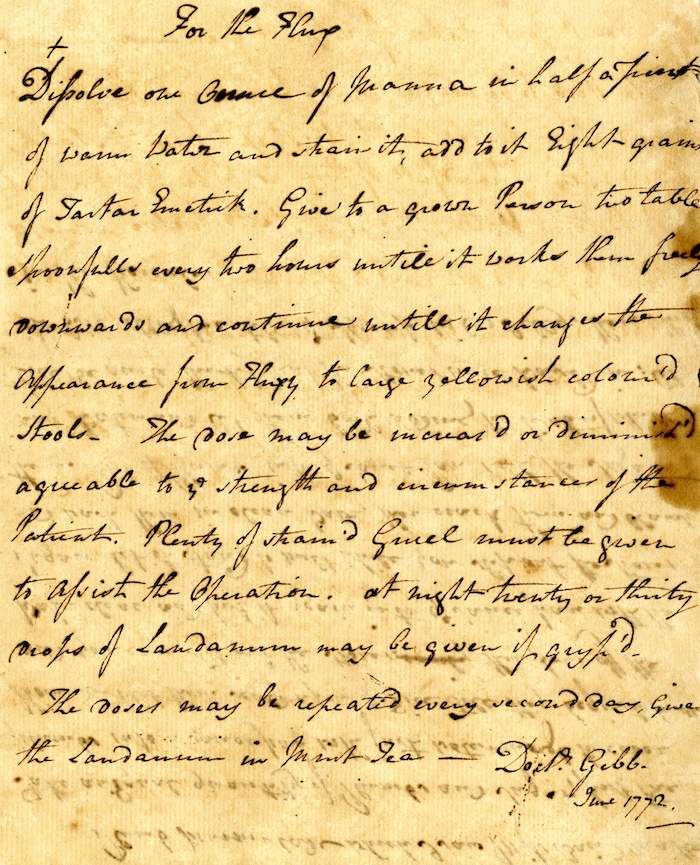
Detail from Eliza Pinckney Receipt Book, 1756.
Women in Britain and colonial America explored the natural world in their kitchens, gardens, and family workshops during the 1700s. Elite white women took part in trans-Atlantic exchanges of letters, seeds, plants, and botanical sketches, expanding their scientific inquiries beyond their homes. Their participation in these botanical networks often depended on the labor and knowledge of others. From her family’s plantations in the Caribbean and South Carolina, Eliza Lucas Pinckney (1722–1793) actively participated in networks of exchange, enslavement, and exploitation that drove botanical curiosity and transformed indigo, for a time, into one of South Carolina’s most profitable crops.
Early Life
Pinckney was born in 1722 on the small Caribbean island of Antigua. As the daughter of the colony’s British governor, George Lucas, and his wife Ann, Pinckney’s life was defined by social, economic, and racial privilege. She spent the first 10 years of her life at Cabbage Tree (Palm) Plantation, a 380-acre sugar plantation that was one of three owned by the Lucas family on Antigua.
Pinckney explored her family’s plantation from an early age, nurturing her curiosity about the natural world. She remarked in a letter later in her life that she “loved the vegetable world extremely,” and that she spent time watching the family’s agricultural practices as a child. Sugar was a highly labor-intensive crop that she learned was sensitive to time and climate. As the plants sprouted, they needed to be carefully tended until they were large enough to compete with the weeds. When the canes grew tall enough to harvest, they were cut down and processed quickly to maximize sweetness. Pinckney would have watched enslaved laborers carry out the often-deadly work of transforming the canes into muscovado, a semi-refined brown sugar, as she surveyed her family’s property. In the 1700s, sugar drove the British Empire, and the Lucas family was at the heart of this empire of sweetness and power.
Pinckney’s position in Antiguan society motivated her later choices in South Carolina. She was cared for by enslaved women from her earliest days, and as she grew older, she learned that she could use enslaved labor for her botanical curiosity and her family’s financial gain.
When Pinckney was 10 years old, she was sent to school in London to receive a “proper education” like other daughters of the Caribbean elite planter class. During her time there, she lived with sugar merchant Richard Boddicott and his wife Mary. The Boddicotts taught Pinckney how to manage the business side of a colonial plantation. At school, she learned dancing, needlework, geography, and French, as well as bookkeeping and botany.
Pinckney left London in 1737 at age 15. She returned to Antigua with a deepened interest in botany and strategies for using enslaved labor to cultivate indigo.
Indigo: A Brilliant Scheme
In addition to their holdings on Antigua, the Lucas family had three plantations in South Carolina: a 3,000-acre rice plantation on the Waccamaw River, a smaller inland plantation that produced commodities including lumber, and a 600-acre plantation that sat on the banks of Wappoo Creek just outside of Charleston.
In 1738, with Ann’s health failing, the Lucas family moved to the Wappoo Plantation. While she said she preferred England to South Carolina, Pinckney wrote long letters to friends detailing the natural world she found there. She wrote admiringly of the scents (jasmine and myrtle), tastes (oranges, peaches, and melons), and sights (forests, sandy soils, and wild turkeys) of her new home. However, a year after uprooting his family, George Lucas was called back to Antigua to deal with the War of Jenkin’s Ear (1739–1748). He left his daughter in charge at Wappoo.
Pinckney drew on her experiences at Cabbage Tree and her London education to manage her family’s affairs on the plantation. As early as 1739, she began experimenting with rice, ginger, cotton, alfalfa, and cassava crops at Wappoo. But by 1740, the ongoing war had drastically reduced the value of South Carolina rice crops. Pinckney shifted her attention to indigo cultivation to try to preserve her family’s income.
Pinckney and the people she enslaved were not the first to try to cultivate indigo in South Carolina. European settlers had tried as early as the 1670s, but indigo failed to take hold in the colony at first. Like them, Pinckney struggled to get the fussy plant to thrive. For example, in a letter to her father dated June 4, 1741, she reported that her crop had been killed by an early frost. A year later, she wrote that the indigo had been left in the field too long to make a good dye. Like the sugar cane she grew up around, timing mattered a great deal.
Bookkeeping and Correspondence
The eventual success of Pinckney’s agricultural experiments depended on trans-Atlantic networks that brought seeds, knowledge, and enslaved labor to Wappoo. We know this because she copied her correspondence into letterbooks, which was an unusual practice for a woman in the 1700s. While some women kept diaries, the detail with which Pinckney recorded her correspondence set her apart from her peers. Nevertheless, as a planter, enslaver, and merchant immersed in trans-Atlantic networks, it was expected that Pinckney would keep a record of letters sent and received. In addition to her father, she was also in touch with local planters, scientists, and merchants, all of whom promoted indigo cultivation in South Carolina.
Pinckney described herself as a hands-on indigo researcher in her letters. However, it is unlikely that she was in physical contact with the dye. She participated in the saving and distribution of seeds, but Wappoo did not produce a viable dye until an enslaved man, John “Quash” Williams, began working on the plantation. He and another unnamed expert from the Caribbean turned things around.
Married Life: Indigo, Sericulture, and the Power of Botanical Silk
Eliza Lucas married Charles Pinckney in 1744 at age 22; her husband was 23 years her senior. Charles seems to have supported his wife’s interest not only in indigo but in botany and the natural world more broadly. She later wrote about working alongside her husband to save and distribute indigo seeds to other South Carolina planters. Following their marriage, Charles set aside some land at Belmont, his family’s South Carolina plantation, so that Pinckney could cultivate raw silk.
At Belmont, Pinckney studied how enslaved women carefully handled the delicate cocoons of silkworms that lived on mulberry trees around the plantation. In 1753, Eliza and Charles moved to London and brought some of this silk with them. Here it was woven into cloth with botanical designs by Spitalfields weavers. This cloth was made into a dress that was dyed with indigo, the plant Pinckney had helped to establish in South Carolina.
Pinckney’s dress is a testament to her interest in the natural world and to her role in the history of botany. But it is also a record of natural history and enslaved labor. Throughout her life, Pinckney actively participated in elite networks of exchange that stretched across the Atlantic, bringing seeds, hands-on knowledge, and enslaved indigo experts to South Carolina. The fabric, like Pinckney’s life, weaves together cultures of curiosity, exploitation, and plant life.
LEARN MORE
Compare the three biographies above. What kinds of stories do they tell? What sources are used to tell each of the three stories? How do you think the stories and the sources relate?
Glossary of Terms
Colorfast
Having color that does not fade or bleed.
Back to top
Glycoside
A compound that contains a sugar molecule bonded to a non-sugar group. These often occur in pigments derived from plants and are often of significant value in medicines and dyes.
Back to top
Oxidize
A process of combining with oxygen.
Back to top
War of Jenkin’s Ear
A conflict between Spain and Great Britain mostly in the Caribbean between 1739 and 1748. Fighting was said to have started when the ear of British Captain Robert Jenkins was cut by the Spanish coast guard. The British waged war in retaliation.
Back to top
Spitalfields
A section of London that was at the heart of the silk industry. It was home to silk weavers, winders, dyers, and designers.
Back to top
Sericulture
The cultivation of silkworms and the related production of silk.
Back to top
Further Reading
Balfour-Paul, Jenny. Indigo. London: British Museum Press, 1998.
Feeser, Andrea, Red, White & Black Make Blue: Indigo in the Fabric of Colonial South Carolina Life (Athens: University of Georgia Press, 2013).
Glover, Lorri. Eliza Lucas Pinckney: An Independent Woman in the Age of Revolution (New Haven: Yale University Press, 2020).
Momon, Tiffany. “John ‘Quash’ Williams, Charleston Builder,” Journal of Early Southern Decorative Arts, 42–3 (2021–2022).
The Papers of Eliza Lucas Pinckney and Harriott Pinckney Horry, accessed February 13, 2026.
The American Yawp Reader, “Eliza Lucas Letters, 1740–1741,” accessed February 13, 2026.
Support
Support for this biography was made possible by the Wyncote Foundation.
You might also like
DISTILLATIONS PODCAST
The Word for Blue
From Homer’s ‘Odyssey’ to the internet’s great dress debate, our perception of the color blue has both fascinated and frustrated us.
SCIENTIFIC BIOGRAPHIES
Francisco Hernández
The Spanish physician and natural historian led the first European state-sponsored scientific expedition to the Americas in the 1570s.
DIGITAL COLLECTIONS
Badische Anilin & Soda-Fabrik Dye Labels
Established in 1865, BASF focused on aniline dyes in its early years. In 1897, the company won the race to manufacture synthetic indigo dye.