
America’s Scientific Revolutionaries
In “America’s Scientific Revolutionaries,” a multiyear project funded by the Richard Lounsbery Foundation in the lead up to the 250th anniversary of the Declaration of Independence, the American Philosophical Society will illuminate that overshadowed scientific revolution that ran between 1763 and 1804. By fueling the launch of the Society’s Center for the History of Science, this project elevates the vast contributions of members and their under-recognized contemporaries in forging an American scientific community with international influence.
This conversation highlights—and begs comments about—our attempt to reach a broad audience in service of this mission. Listen, lament, celebrate, and opine as we take stock of our progress over the last 10 months in our efforts to reach middle schoolers, the educated public, and Nobel laureates alike. See you there!
Seating is available on a first-come, first-served basis. Tickets are not required for this event.
About the Speaker

Jeffery R. Appelhans specializes in the political and religious culture of colonial, Revolutionary, and early America, as well as book history and bibliography. He is currently the Richard Lounsbery Postdoctoral Fellow at the American Philosophical Society preparing “America’s Scientific Revolutionaries” in anticipation of the 250th anniversary of the Declaration of Independence. Since 2019, he has worked on the Society’s Members Bibliography and Biography, 1743–1865, launching soon.
He is otherwise revising his book manuscript, tentatively titled “The Creation of American Catholicism: From the Revolution to the Early Republic,” a story of how the Revolution and the early republic created American Catholicism by unleashing the forces that established Catholics as accepted and influential citizens in early America. The novelty of this research has generated wide and generous support, most notably and recently a year-long writing fellowship from the National Endowment for the Humanities.
His work appears in the Journal of the Early Republic, the Proceedings of the American Philosophical Society, The Public Historian, Church History, and public venues.
About the Series
Science on Tap is a monthly speaker series that features brief, informal presentations by Philadelphia-based scientists and other experts followed by lively conversation and a Q&A. The goal is to promote enthusiasm for science in a fun, spirited, and accessible way, while also meeting new people. Come join the conversation!
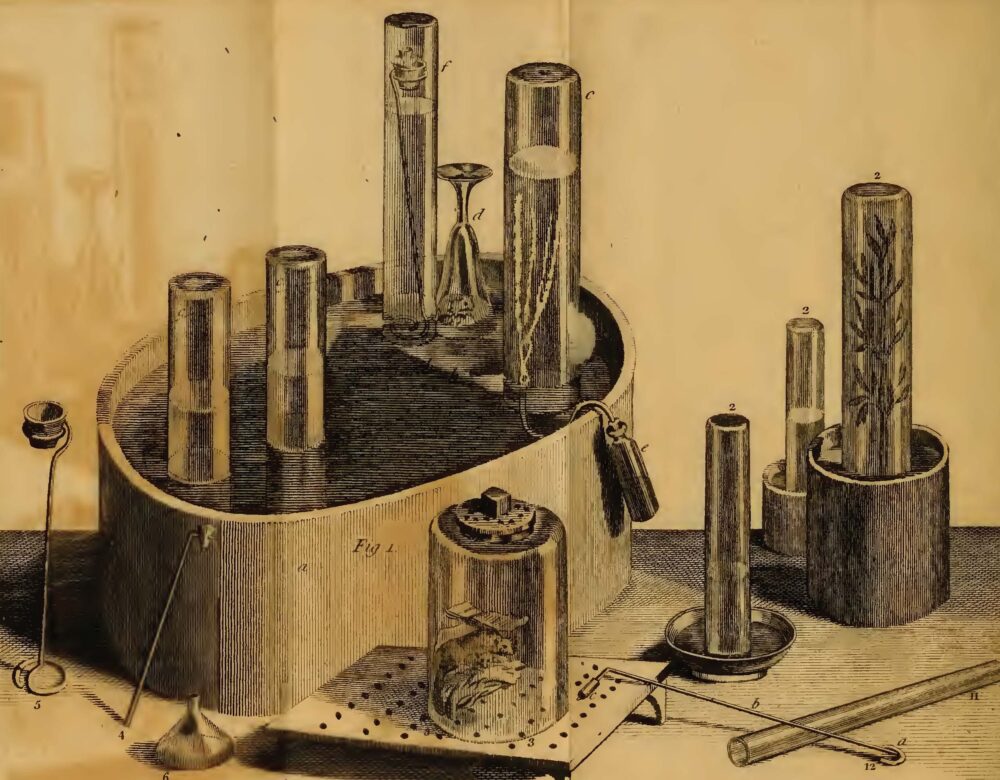
Featured image from Joseph Priestley’s Experiments and observations relating to various branches of natural philosophy; with a continuation of the observations on air (London: Printed for J. Johnson, 1779), courtesy of the American Philosophical Society.
More events
Unwell Waters Highlights Tour
Join our museum educators as we visit the history of medicine exhibit to learn about waterborne epidemics from Pennsylvania’s past.
Stories of Science: Craft-tober
Join us in our museum EVERY SATURDAY for a family-friendly program that highlights strange and surprising stories from the history of science!
Art of Alchemy Self-Guided Visit
Step into the age of alchemy and explore works in our new permanent exhibition, Fire and Gold: The Art of Alchemy (1450–1850).