
Rukh or Aepyornis: Mythical Birds, Extinction, and the Creation of Knowledge
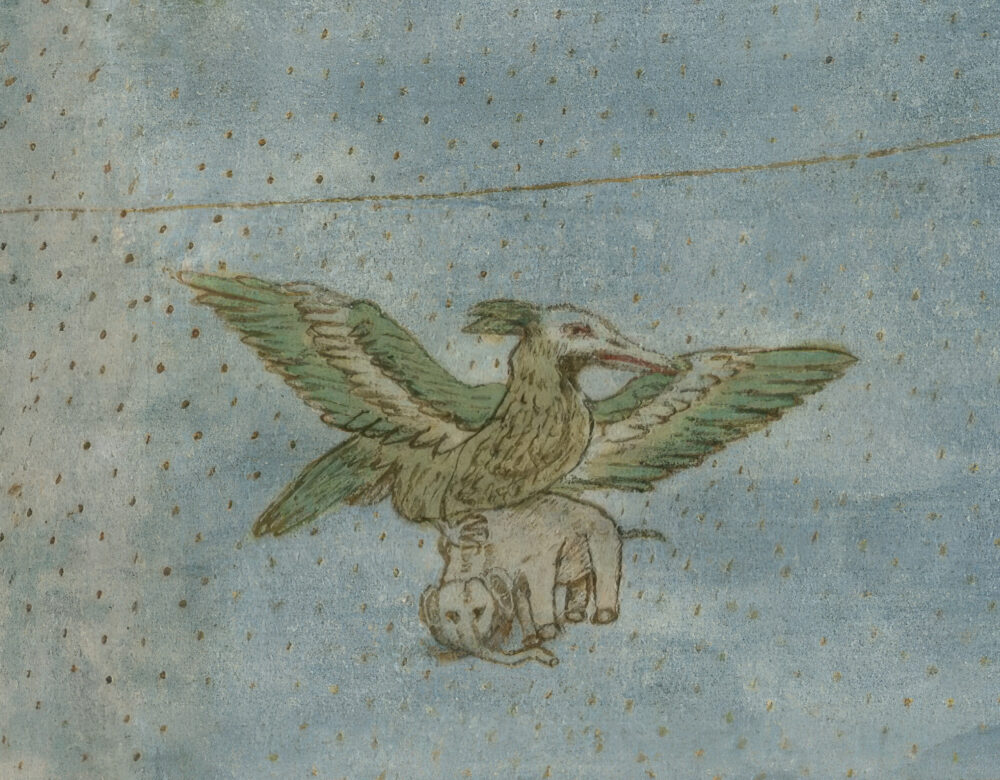
How did mythical birds help shape our scientific understanding of the natural world?
On many maps from the Renaissance, there is a strange bird flying in the southern Indian Ocean. This bird, called the rukh (also known as the roc or ruc), was a mythical, massive raptor that was thought to be powerful enough to carry an elephant. This legend of this bird originally entered the European imagination by stories from medieval travelers, like Marco Polo. By the 16th century, global travelers continued to report witnessing the rukh on their journeys. The rukh served as a tool for European natural philosophers, sailors, and mapmakers, as they sought to understand areas in what were viewed as the “edges” of the world and the creatures that resided there.
While the rukh was mostly forgotten by the end of the 17th century, the bird would have a lasting legacy. In the mid-19th century, anti-Darwinian scientists attempted to prove that the rukh was a real, extinct bird. While the Aepyornis maximus, also known as the elephant bird, went extinct on Madagascar around the year 1000, it was not until the middle of the 19th-century that its bones, fossils, and eggs began to capture European scientists’ imagination and promote scientific investigations in hopes that myths might be made real. This massive, ostrich-like bird became aligned with the flying, elephant-carrying, mythical rukh, which is a rumored relationship that neither bird has ever managed to completely shake off.
Seating is available on a first-come, first-served basis. Tickets are not required for this event.
About the Speaker

Jessica Hogbin is a PhD candidate at Syracuse University, where she researches Renaissance science and medicine. This year, Jessica is an Allington Dissertation Fellow at the Science History Institute and an American Dissertation Fellow with the American Association of University Women. Prior to coming to the Science History Institute, Jessica spent two years conducting research in Europe. Her research has been supported by the Fulbright Program, the Gladys Krieble Delmas Foundation, and the Council of American Overseas Research Centers. While in Philadelphia, Jessica looks forward to attempting to visit all of the city’s incredible museums.
About the Series
Science on Tap is a monthly speaker series that features brief, informal presentations by Philadelphia-based scientists and other experts followed by lively conversation and a Q&A. The goal is to promote enthusiasm for science in a fun, spirited, and accessible way, while also meeting new people. Come join the conversation!
More events
Art of Alchemy Self-Guided Visit
Step into the age of alchemy and explore works in our new permanent exhibition, Fire and Gold: The Art of Alchemy (1450–1850).
Stories of Science: Feasting on Chemistry
Join us in our museum EVERY SATURDAY for a family-friendly program that highlights strange and surprising stories from the history of science!
From Nature to Nylons Highlights Tour
Join our museum educators as we explore the history of the materials that fashion our clothes.