Joseph Priestley
Priestley was a pioneering chemist and an infamous supporter of revolutionary causes. Ironically, he did not support the Chemical Revolution, which was based in part on his own discoveries.
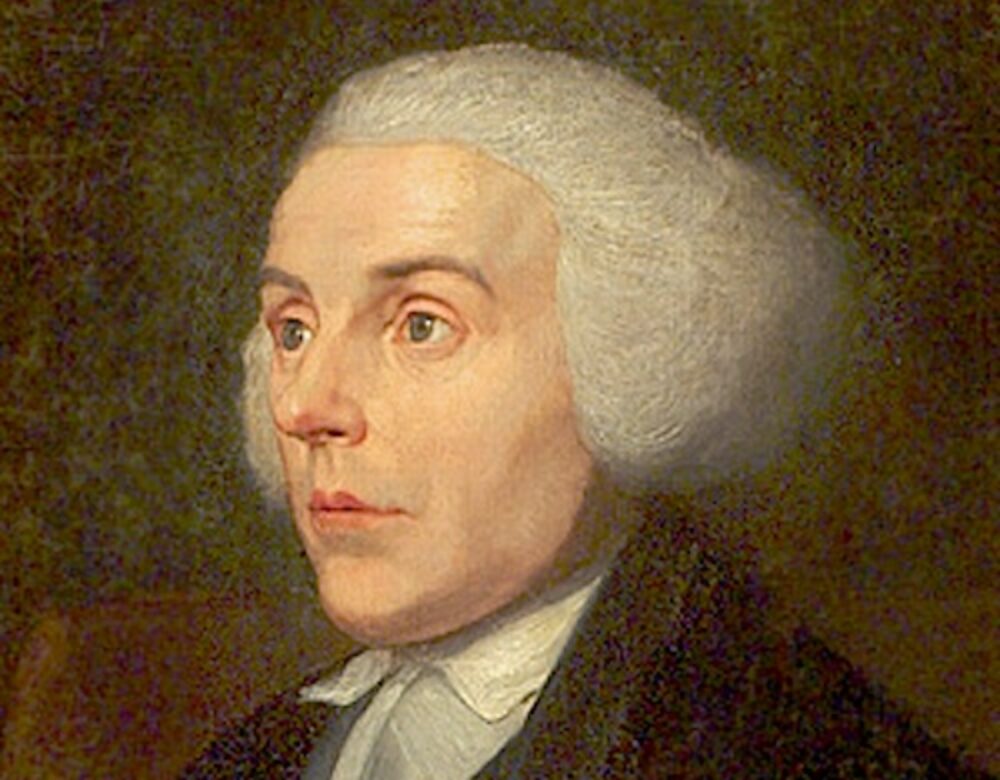
Joseph Priestley (1733–1804) isolated the gas we now call “oxygen” in 1774. He interpreted this discovery within the dominant framework for understanding how and why things burn at the time: the “phlogiston” theory. A few months later, he demonstrated the isolation of this substance to a group of French chemists who used Priestley’s insights to revolutionize chemistry on the basis of a new theory of combustion.
Although he is often remembered for his experimental work on such “airs,” Priestley was primarily a minister with strong interests in education and politics. He made significant contributions to theology, philosophy, history, English grammar, and the physics of electricity. He was also a political activist who supported religious freedom and the right of both the American colonists and French citizens to rebel against their monarchs.
In the early 1790s, as political tensions between Britain and France heated up in the wake of the French Revolution, a political mob burned Priestley’s home, church, and laboratory. Seeking safety, Priestley and his family emigrated to the United States in 1794. They eventually settled in rural Pennsylvania. He continued his critique of the new chemistry from his new home, confident that phlogiston would be restored to its proper place in chemical theory.

Religion and Dissent
Priestley was born in the north of England to a Calvinist family. As Calvinists, Priestley’s family dissented from the state-sponsored Church of England, which meant that he was barred from most government positions and from England’s traditional universities. Instead, he studied at Daventry Academy, a dissenting school, where he cultivated a new approach to religion based on reason and his own scholarly analysis of the Bible. After Daventry, he spent most of his professional life as a minister for dissenting congregations throughout England.
As a minister, Priestley produced a steady stream of sermons, pamphlets, and books aimed at presenting and defending his “rational” version of Christianity. In the 1770s, he collaborated with fellow dissenting minister Theophilus Lindsey (1723–1808) to found the first Unitarian congregations in England. Priestley’s multivolume Institutes of Natural and Revealed Religion (1772–1774) became a widely studied introduction to this religious tradition.
A key aspect of Priestley’s ministry was his commitment to education, which was practically oriented and reinforced his religious values. Wherever he landed during his career as a minister, he strove to establish a school for both religious and general education. In 1761, he published an innovative and wildly successful grammar book, The Rudiments of English Grammar, which attracted an offer to teach at the Warrington Academy, the most prestigious school for dissenters in Britain. As a full-time educator, Priestley taught grammar, history, and rhetoric. He published several textbooks on these subjects, as well as works on educational theory. These texts aimed to show young readers that the progress of humanity and civilization from ancient times to the present was an expression of God’s will.
Natural Philosophy and Airs
In Priestley’s view, another way to understand God’s will was through the study of nature. He began studying natural philosophy seriously while teaching the subject at Warrington. With the encouragement of Benjamin Franklin (1706–1790), whom he met on a trip to London, Priestley began writing a history of electricity. For this project, he replicated “historical” experiments that illustrated key principles. He then conducted novel experiments to address unanswered questions. His book, The History and Present State of Electricity (1767), was favorably received and earned him election to the Royal Society of London, the top scientific society in Britain.
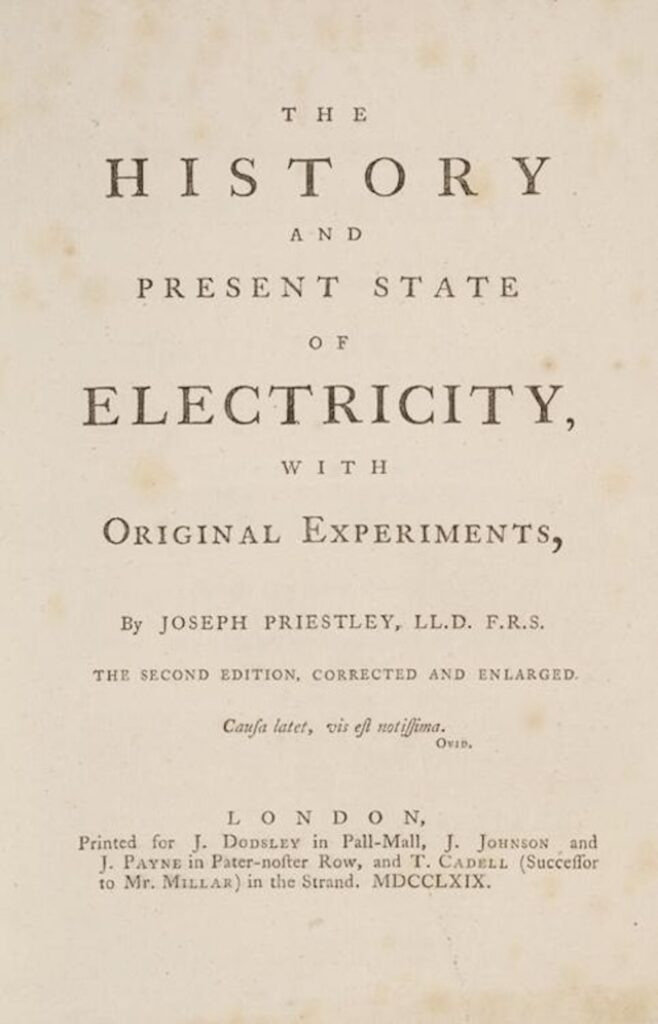
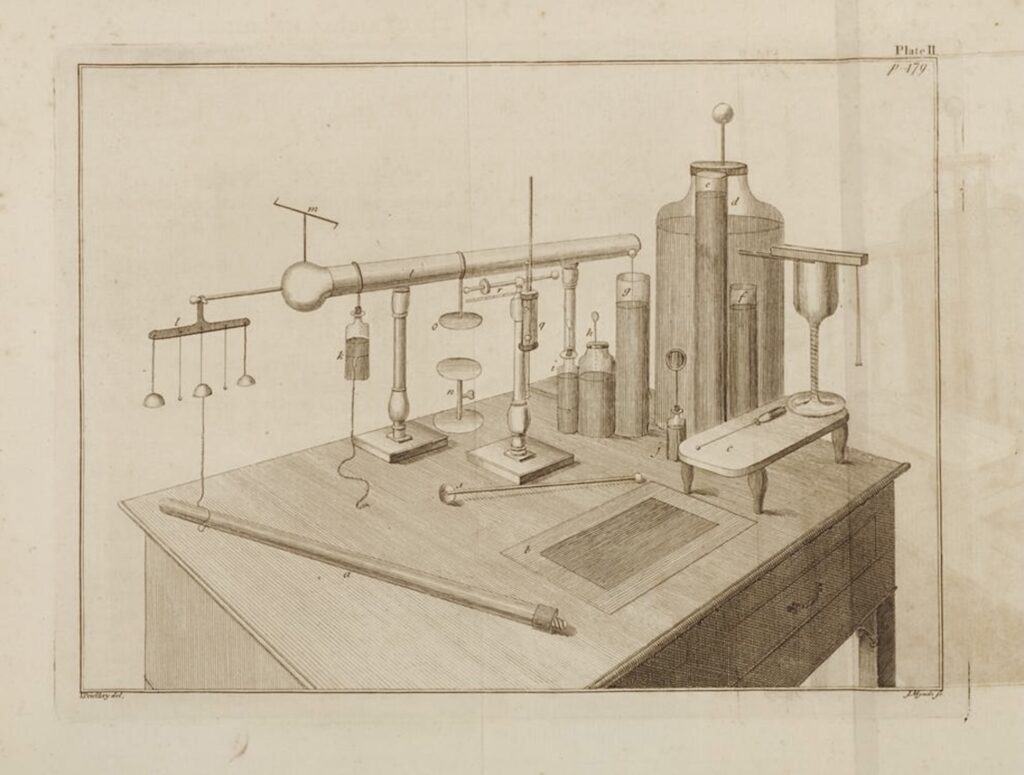
Title page and plate from Joseph Priestley’sThe History and Present State of Electricity. This illustration shows Priestley replicating historical experiments while pushing the limits of what was known in his day.
Priestley began to study different kinds of “air” in the late 1760s. He took an interest in the air that was generated during the fermentation of beer, which was known to make it foamy. This gas, at the time called “fixed air” (modern carbon dioxide), was first identified in 1755 by Joseph Black (1728–1799). Priestley devised several methods to produce fixed air, as well as a method to dissolve it in water, thus creating the first carbonated water. He hoped this new water might have a practical use to treat and prevent scurvy, a disease that plagued thousands of English sailors, but this proved not to be the case. Nevertheless, the Royal Society gave him top honors in 1773 for this experimental work.
Throughout the 1770s, Priestley expanded his experiments on airs. He identified at least eight new types of air, establishing experimental protocols and techniques in the process. Notable among these was his nitrous air test designed to measure an air’s “goodness” (its breathability or ability to support combustion). In addition, he conducted early experiments on the ability of plants to refresh the quality of air, work that contributed to the understanding of photosynthesis.
In effect, Priestley’s work on airs helped to establish a new experimental field, which we now call pneumatic chemistry. He pieced this field together from existing theories and techniques, combined with his own pragmatic solutions to difficult problems. Priestley presented hundreds of experiments, along with reflections on how he interpreted his results, in his monumental, six-volume Experiments and Observations on Different Kinds of Air (1774–1786).
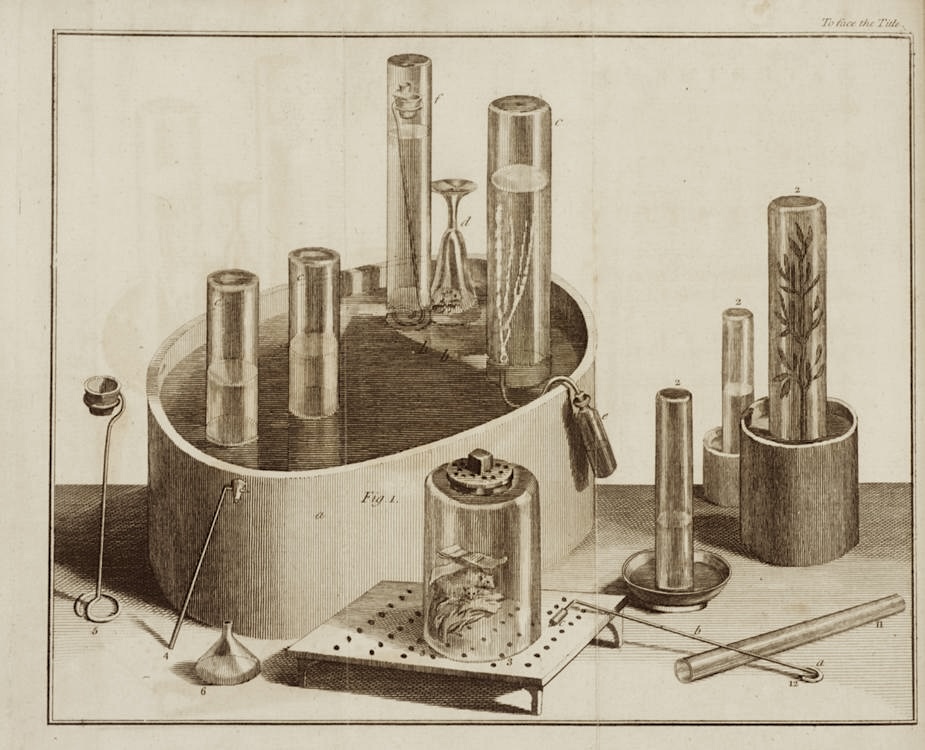
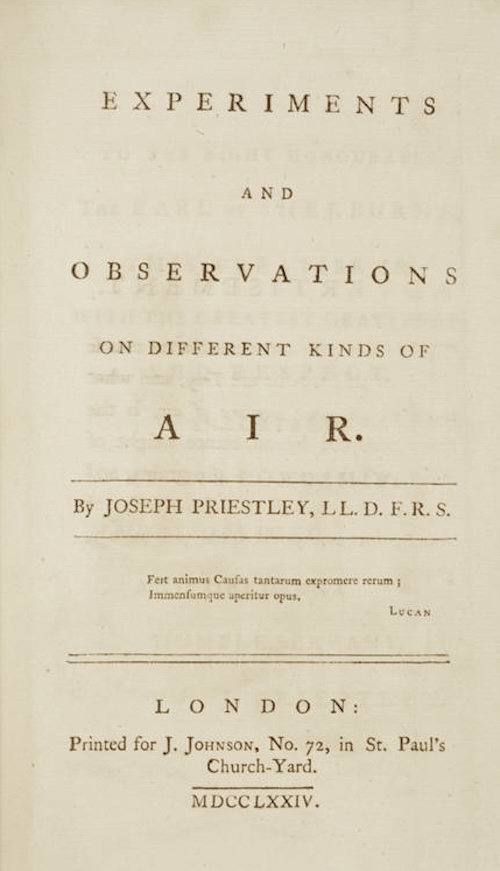
Frontispiece and title page from Jospeh Priestley’s Experiments and Observations on Different Kinds of Air. Where in this image can you spot Priestley’s interest in the “goodness” of air?
Oxygen and the Chemical Revolution
On August 1, 1774, Priestley isolated a new air that had some amazing properties. This mysterious air could support a burning candle or red-hot ember much longer and more strongly than any other air he had previously tested. He demonstrated the generation and properties of this new air to several scientific notables, including Antione-Laurent Lavoisier (1743–1794), showing that it could support combustion five times better than the “common” air we breathe. Priestley named this new air “dephlogisticated air” because following the prevailing theory of combustion of his day, the phlogiston theory, this air could absorb the most phlogiston from a burning substance.
LEARN MORE
In Priestley’s time, phlogiston functioned as the principle of flammability, meaning that substances that contained phlogiston could burn, while those without phlogiston could not. It was a “subtle” fluid, meaning it was weightless, so adding or taking away phlogiston to a body did not affect the body’s weight. When combustibles burned, phlogiston was released into the surrounding air and the combustion could continue until the air became saturated with phlogiston, at which point the combustion stopped. Within this system, Priestley’s “dephlogisticated air” was the species of air that could absorb the most phlogiston.
Lavoisier quickly came to see that Priestley’s new air was one of the gasses that made up the atmosphere: specifically, it was the part that united with substances as they combust and increased their weight. Lavoisier built a new chemical system around this insight. Priestley’s “dephlogisticated” air, which Lavoisier renamed “oxygen” (Greek for “acid-generator”), became the key principle in explaining combustion, respiration, and also acidity in this new system.
Lavoisier saw the phlogiston theory as the main obstacle to acceptance of his new chemical system, so he started a campaign in the 1780s to convince chemists to abandon Priestley’s framework. During the course of the subsequent debate, Lavoisier and his allies called themselves the “antiphlogistans.” They were successful: by the 1790s, most chemists accepted Lavoisier’s “antiphlogistic” chemistry.
Priestley resisted the new chemistry because it ignored many firsthand experiences that chemists had in their laboratories and was full of inconsistencies. The new chemistry focused on establishing the composition of substances by measuring weights in chemical processes. Priestley argued that this approach overlooked empirical phenomena that chemists observed in the lab, such as changes in color, texture, and smell. In addition, the new chemistry could not provide coherent explanations for some common chemical processes: for example, it could not explain how gunpowder worked. As Priestley pointed out, Lavoisier rejected phlogiston partly on the grounds that it was weightless, but the new chemistry included weightless substances, such as light, among its accepted principles.
Coming to America
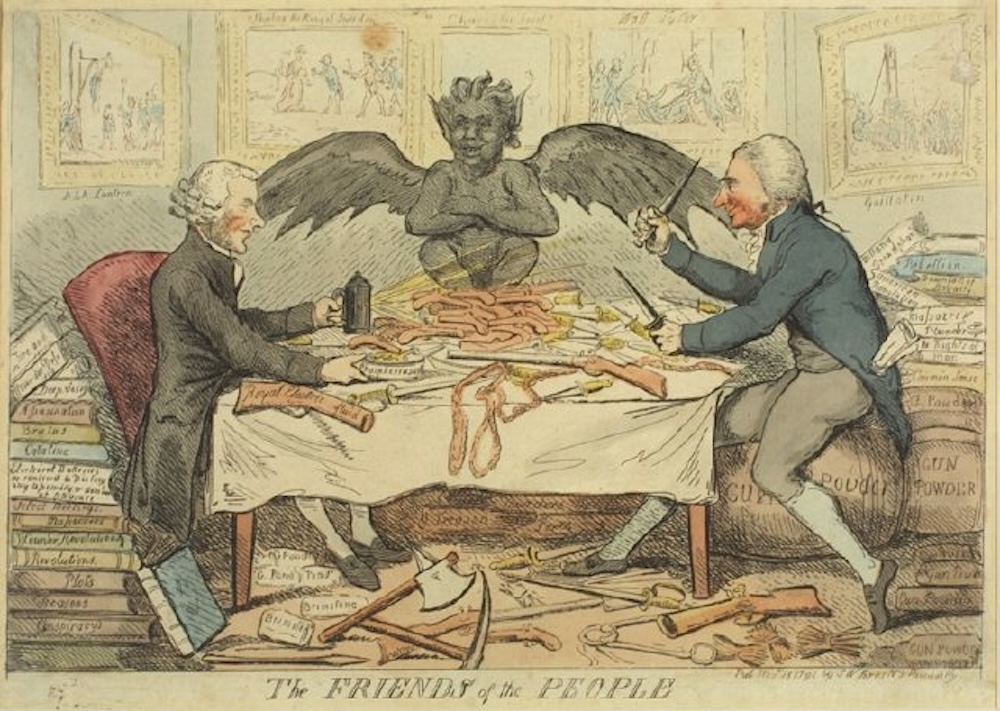
In 1791, as tensions rose in Britain from the spread of the French Revolution, a “church and king” mob burned Priestley’s house, church, and laboratory in Birmingham. He resettled with his family outside of London, where he taught at a newly founded dissenting academy. As relations between France and Britain worsened, Priestley’s friends advised him to leave the country for his own safety. So, in April 1794, the family boarded a ship bound for the United States.
In the U.S., Priestley ultimately settled in Northumberland, Pennsylvania, where he hoped to establish a community for British dissenters and exiles. Although he vowed not to get involved with politics in his new country, the pressure to do so was too great. He was a controversial political and religious figure, even in America, and this made him a target of journalists and politicians alike. For example, when relations between the U.S. and France soured in 1798, Priestley had to answer to public accusations of being a French spy. His political troubles continued until his friend, Thomas Jefferson, was elected president of the United States in 1800.
Priestley was able to make the weeklong journey from Northumberland to Philadelphia a few times a year, where he visited friends, preached sermons, and participated in scientific meetings. His main scientific output in America was his renewed attack on “antiphlogistic” chemistry, presented in several long pamphlets and public debates. Although he was unable to convert anyone to his phlogiston theory, Priestley introduced pneumatic chemistry to America and energized the chemical community. He died in 1804 still hoping that phlogiston would be restored to what he saw as its rightful place in chemistry.
Glossary of Terms
Unitarian
A Christian tradition and system of belief that does not uphold the trinity (God, Jesus, Holy Spirit). In its commitment to the oneness of God and the inherent goodness of human nature, it starkly opposes Calvinist doctrine.
Back to top
Natural philosophy
This term was used to refer to the systematic study of nature from ancient Greece until the mid-1800s. It encompassed fields now considered to fall under the umbrella of science including chemistry, physics, and astronomy.
Back to top
Further Reading
Graham, Jenny. 1995. Revolutionary in Exile: The Emigration of Joseph Priestley to America, 1794–1804. Philadelphia: American Philosophical Society.
Rivers, Isabel and David L. Wykes, eds. 2008. Joseph Priestley, Scientist, Philosopher, and Theologian. Oxford: Oxford University Press.
Schofield, Robert E. 1997. The Enlightenment of Joseph Priestley: A Study of His Life and Work from 1733 to 1733. University Park, PA: Pennsylvania State University Press.
Schwartz, A. Truman and John G. McEvoy, eds. 1990. Motion Toward Perfection: The Achievement of Joseph Priestley. Boston: Skinner House Books.
Support
Support for this biography was made possible by the Wyncote Foundation.
You might also like
VIDEO
Politics, Chemistry, and Oxygen Theory During the French Revolution
Explore how natural philosophers of the 18th century sought to unlock nature’s mysteries.

COLLECTIONS BLOG
Air Time
A visit to Knoebels Amusement Resort and chemist Joseph Priestley’s historic home in Pennsylvania inspires a closer look at the Institute’s rare book collection.
DISTILLATIONS MAGAZINE
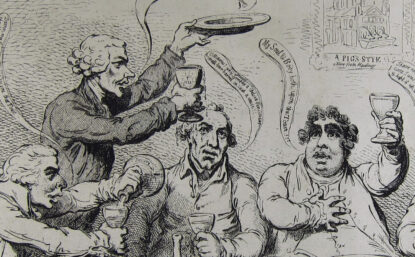
Birmingham Toast
Famed British caricaturist James Gillray targets famed scientist Joseph Priestley after the devastating Priestley Riots.