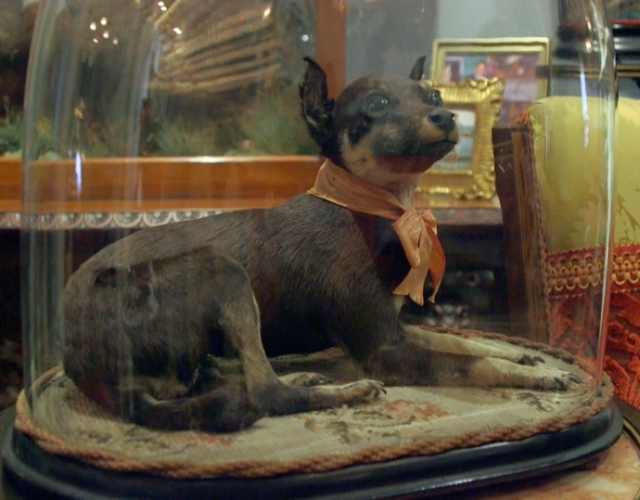
The compulsion to keep animals intact after death goes back to ancient Egypt, where animals of all description were mummified. Though the methods and motivations have changed, the desire has remained pretty constant.
Meet Beth Beverly, a young taxidermist turning the craft on its head; John Whitenight, a faithful and eccentric collector of Victorian taxidermy; and the polar bears and gorillas that stand motionless at Philadelphia’s Academy of Natural Sciences of Drexel University. Together they relay taxidermy’s long history of combining art and science.
“I loved this film. It is an interesting perspective on an element of science that is generally unfamiliar to people so it ends up being both educational and highly entertaining. As the film ends, we’re told there’s nothing frightening about taxidermy, but rather, something wonderful. I couldn’t agree more. The use of animation to visualize the more gruesome bits was well done and the history was fantastic.”
—David Brin, scientist and award winning science-fiction author
—David Brin, scientist and award winning science-fiction author
Credits
Directed and produced by Mariel Carr
Animations by Jacob Rivkin