Due to exhibition construction, the museum will be closed through Saturday, March 7.
Our First Friday event has been rescheduled to March 13.

Distillations magazine

Unexpected Stories from Science’s Past
March 5, 2026 People & Politics

When Electricity Met Democratic Revolution

The science that animated a political idea.

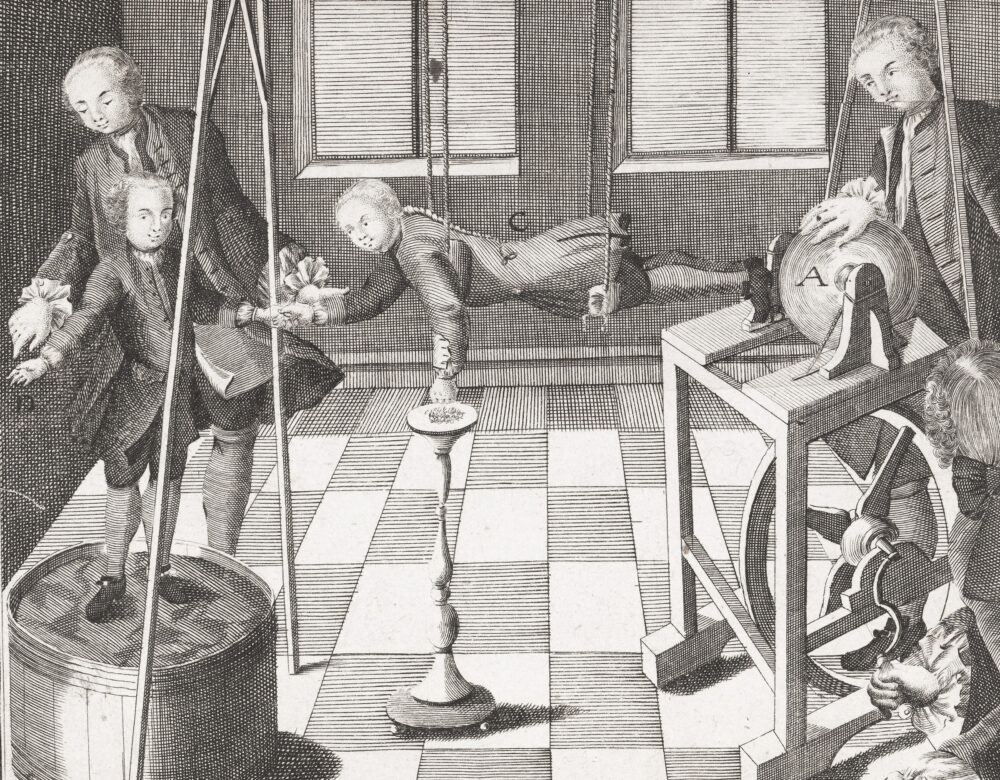
Illustration of a boy suspended by silk cords hanging from a ceiling while a man next him operates an electrostatic generator.
About SUPPORT OUR WORK

We are used to the idea that political performance can electrify. “Sanders and Ocasio-Cortez Electrify Democrats Who Want to Fight Trump,” the New York Times announced in April 2025. A few months later a letter to the editor described how “a joyous 33-year-old democratic socialist from Queens electrified progressive voters” in New York’s mayoral race. The previous year, a pre-K teacher in Georgia had found herself torn between Biden and Trump, “but Harris had electrified her.”

These electrical metaphors evoke excitement and enthusiasm. But what do we imagine when we say a politician “electrifies,” and where does this idea come from?

Long before Russian leader Vladimir Lenin argued that “Communism is Soviet power plus the electrification of the whole country,” another set of revolutionaries set about electrifying their country. To furnish the conceptual power needed to bring a radical political system into being, revolutionaries in 18th-century France turned to the nascent science of electricity for new expressions of patriotic enthusiasm.

The electrical metaphors that abound in the mainstream press today can be traced back to this explosive moment. When electricity met democratic revolution, it came both positively and negatively charged, embodying the hope of a revolutionary generation alongside the fears of electricity’s dangerous potential—and of ideas taken too far.
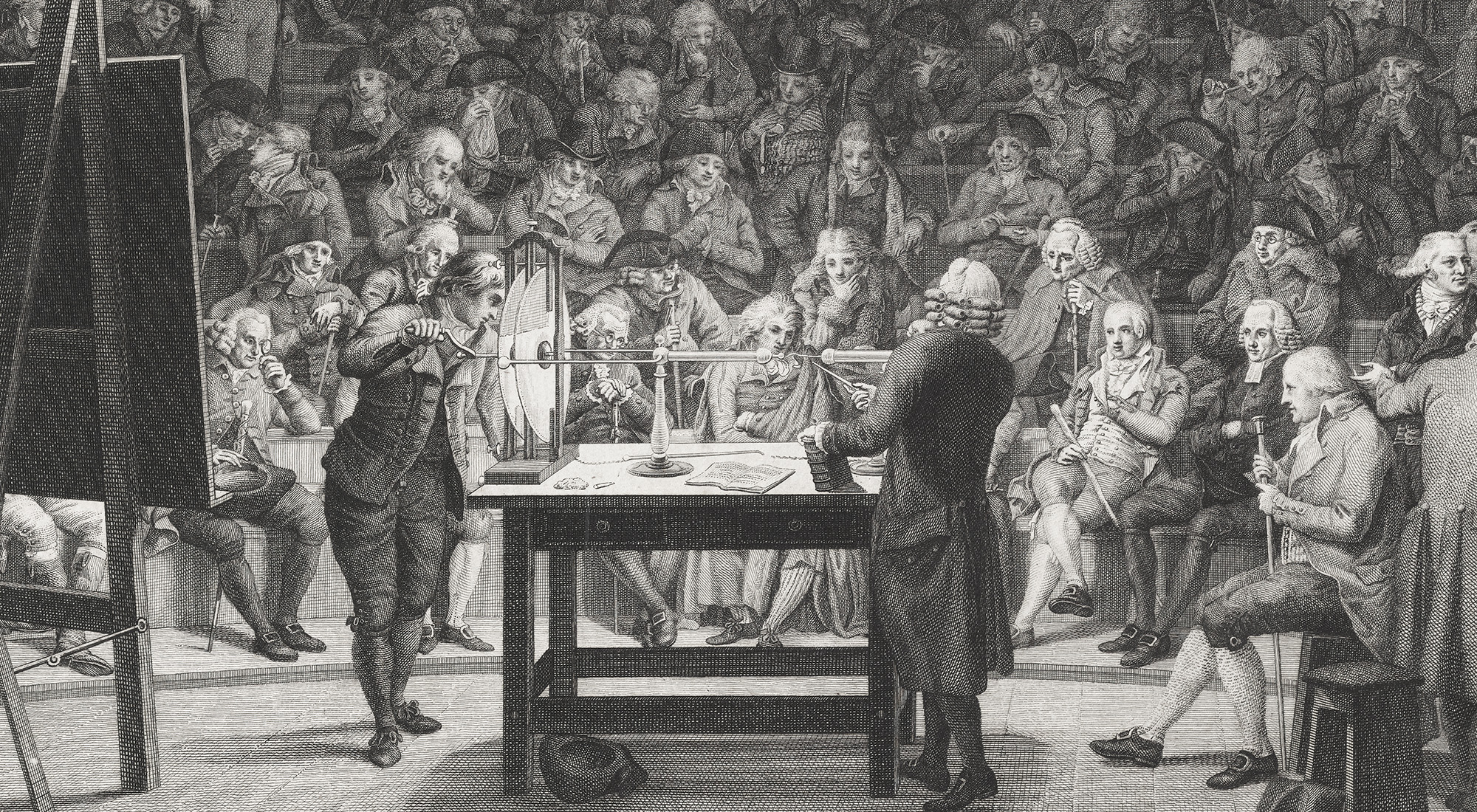
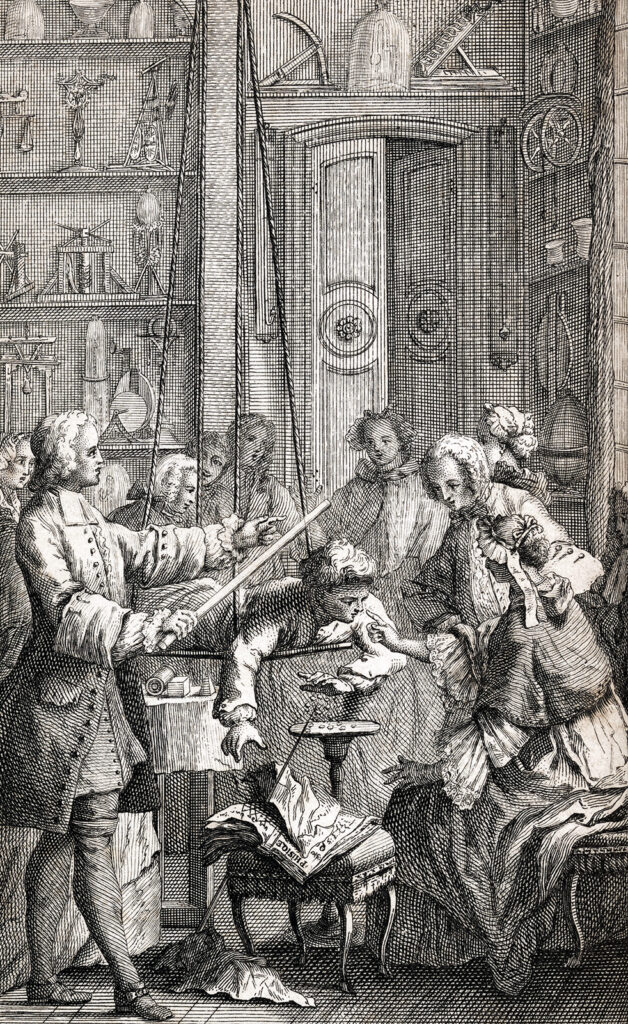
Illustration of two men operating an electrostatic generator in front of a crowd in a lecture hall
Dutch mathematician and physicist Jean Henri van Swinden demonstrates the generation of electricity before the Felix Meritis Society in Amsterdam, 1801.

Pinpricks and Flying Boys

Amber pulled electricity into the English language. Mystified by how pieces of fossilized tree resin emitted sparks and attracted small bits of gold leaf when rubbed, natural philosophers gave these phenomena a Greek name, ήλεκτρο, meaning “of amber.”  By the turn of the 17th century, William Gilbert, physician to Queen Elizabeth I, had coined the neo-Latin electricus in his foundational treatise on magnetism. The term soon migrated into English; the Oxford English Dictionary records the first use of electricity in 1646.

Natural philosophers defined electricity as “that weird thing amber does,” but they began to suspect there was more to it than that. In 1675, Robert Boyle summed up contemporary hypotheses: experimentation revealed that electricity was not simply an attribute or quality of amber; it was its own substance, one that seemed to pass through some classes of objects and not others.

This observation supported Boyle’s broader project to overhaul Aristotelian physics. For millennia, philosophers had explained natural phenomena through forms and qualities—hot, cold, wet, dry. The new mechanical philosophy, instead, described a world of matter and movement that followed calculable laws. Where an Aristotelian might say a stone fell to the earth because it possessed the quality of heaviness, under the new philosophy the stone fell because gravity acted on it with a force inversely proportional to the square of the distance between stone and earth.

Electricity, therefore, entered the enlightened age as something weightless, but material—a super-fine fluid that emanated and moved according to as-yet-unknown laws. Natural philosophers spent the 18th century pondering the electrical fluid’s connection to a host of phenomena—fire, heat, light, and gravity—in pursuit of a kind of cosmic organizing principle. Or, as Isaac Newton had it, the evidence of God’s hand in the world.

Illustration of a boy suspended from the ceiling surrounded by a crowd of onlookers. The boy is lifting pieces of metal using static electricity.

Electrical experiments proved useful not only for understanding how the Great Designer had organized the physical world. They also made for a good show. As president of the Royal Society, Newton looked for a way to keep society members engaged. To this end, he revived an earlier tradition of weekly demonstrations and employed Francis Hauksbee, a skilled experimenter, to come up with something to wow the members. Hauksbee invented two machines.

The first, known as the electrostatic generator, consisted of a hollow glass sphere, 20 cm in diameter, set atop a spindle and spun rapidly against silk or the hands of the experimenter. With friction, the buildup of static electricity caused the sphere to glow an eerie purple. The second was a glass tube about 2.5 cm wide and 75 cm long. With the application of friction, this tube transformed into an electric wand, able to attract bits of metal and other material. Both contraptions became mainstays of 18th-century electrical science, but before long the human body claimed center stage.

Royal Society member Stephen Gray discovered that electric “vertue” could be communicated to a suspended human body without direct contact through a process we now call electrostatic induction. Using large silk ribbons, Gray suspended a young boy from the ceiling. Then, with a metal rod electrified with Hauksbee’s generator, he stirred the air around the “flying” boy as if performing a magic trick. The boy now could make bits of metal leaf rise to his fingertips with a wave of his hand, evidence that he had been successfully electrified. (In other words, he could now do all the weird things amber could do).

Across the channel, Charles Dufay, head of Louis XV’s royal gardens, performed the same experiment with a key distinction. He suspended and electrified himself. When another, non-electrified person approached him, Dufay reported, “there immediately issues from my body one or more pricking shoots, with a crackling noise, that causes to that person as well as to myself, a little pain resembling that from the sudden prick of a pin.” Little did Dufay suspect, electricity was about to get a lot more painful.

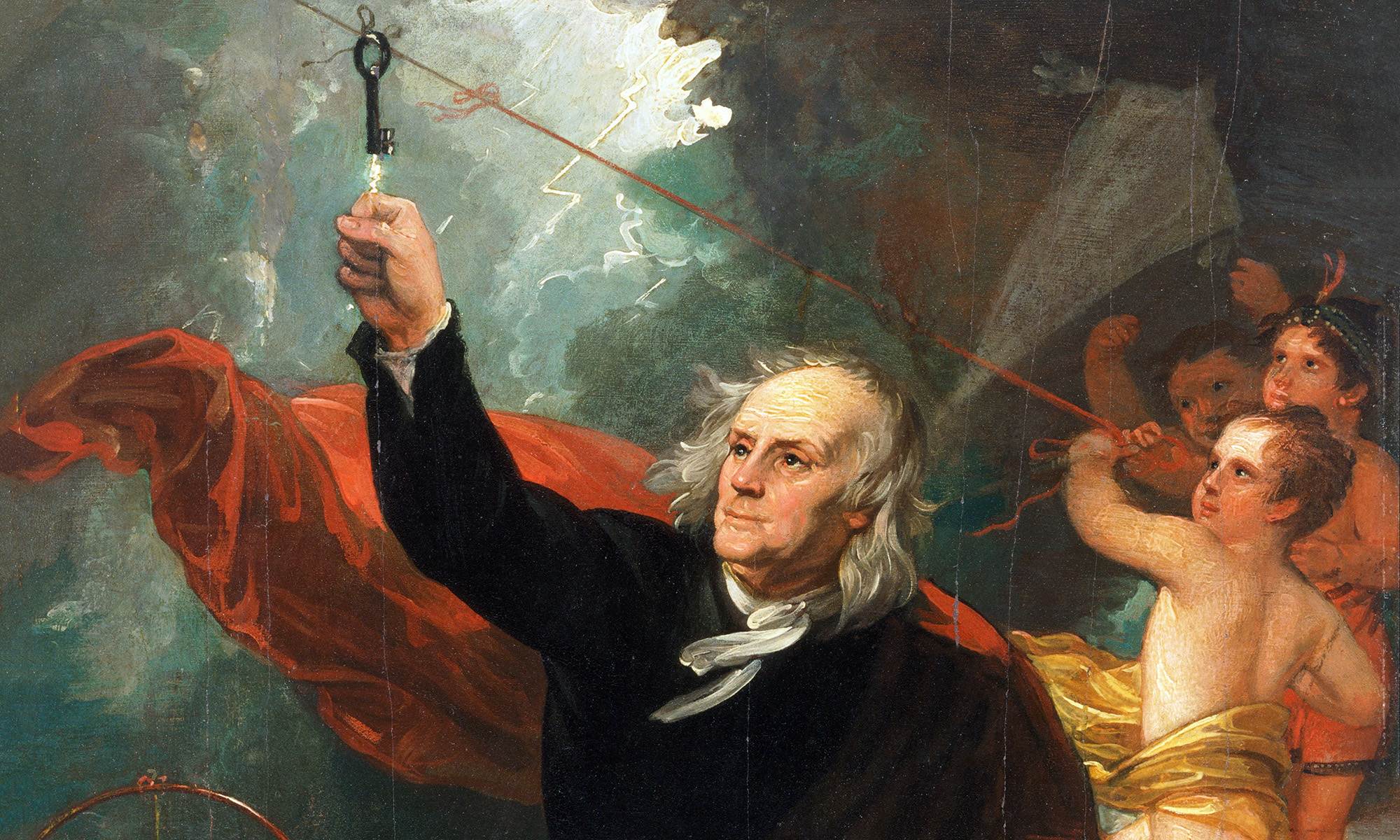
Painting of a man touching an electrified key on a kite string in a storm. The man is surrounded by cherub-looking creatures known as putti.
Franklin’s famous kite and key experiment, as depicted by American painter Benjamin West, 1816.

Musschenbroek’s Wonderful Bottle

“I would like to tell you about a new but terrible experiment,” Pieter van Musschenbroek wrote in 1746. “I advise you never to try yourself, nor would I, who have experienced it and survived by the grace of God, do it again for all the kingdom of France.”

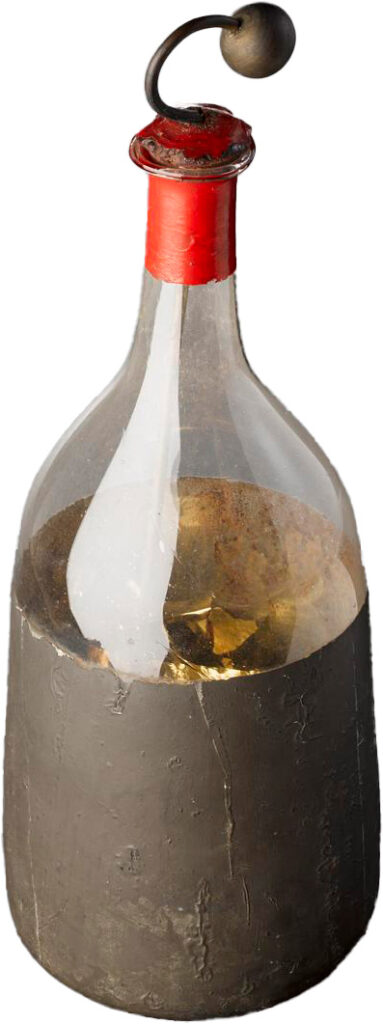
What elicited such alarm? The Leyden jar.

Where Gray’s and Dufay’s electrostatic instruments had elicited harmless zaps and stings, Musschenbroek’s Leyden jar summoned formidable powers. The Dutch experimenter invented it almost by accident. He used an electrostatic generator to charge an iron rod suspended by silk ribbons. To this rod, he attached a wire, which he dipped into a glass flask half filled with water. He then tried to draw sparks from the iron rod, while holding the bottom of the flask. What followed left Musschenbroek stunned.

“My whole body quivered just like someone hit by lightning,” he wrote. “I thought I was done for.”

A glass jar with the bottom half lined with gold leaf and a red stopper at the opening. A metal rod is inserted into the jar

Musschenbroek’s provocative account set off a burst of interest within the scientific community. Benjamin Franklin, for one, wasted no time experimenting with what he called “Musschenbroek’s wonderful bottle.” Franklin’s interest in electricity had been piqued years earlier after an American friend in London sent him one of Hauksbee’s wands.

“It is amazing to observe in how small a portion of glass a great electrical force may lie,” Franklin marveled in a letter to Peter Collinson, a London botanist and supporter of Philadelphia’s burgeoning scientific community. “A thin glass bubble, about an inch diameter . . . gives, when electrified, as great a shock as a man can well bear.”

The potency of the Leyden jar clearly needed to be mitigated. As it turned out, there was strength in numbers. “I do not wish to be taken for someone who has shown you the way to the next world,” French physicist Jean-Antoine Nollet warned a friend before describing his own tantalizing experiments. “I have found a means of making the disturbance felt safely by dividing it amongst several persons who hold each other by the hand.”

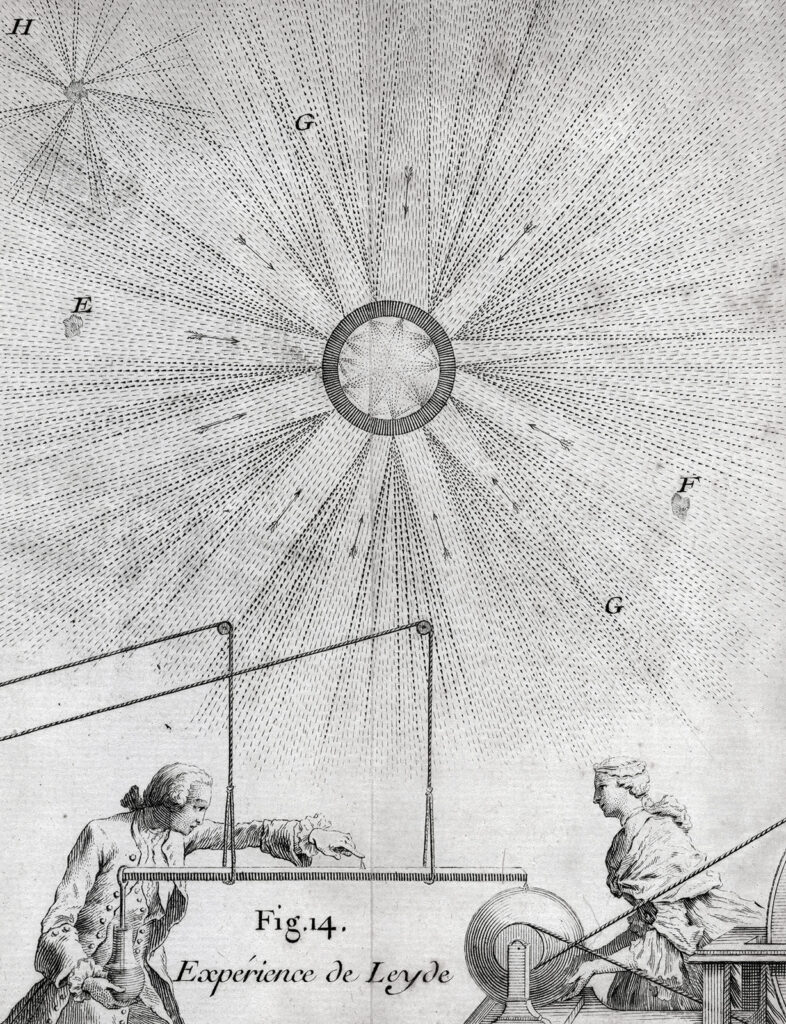
Nollet became famous for this hair-raising demonstration, in which a chain of people held hands while the shock of the Leyden jar coursed through them like a lightning strike. Nollet added to his chains over a series of performances. In the best-known instances, he passed an electrical shock through 180 soldiers for a royal audience and 200 Carthusian monks at their monastery. According to some reports, he once jolted more than 600 people in one go.

The innocent-looking Leyden jar also sent a shock through the era’s most fundamental ideas about electricity. Electricity, it was clear, could be bottled and stored, even transported, all of which lent credence to the notion that electricity was a kind of fluid. But was it one fluid, or two? Here, Nollet and Franklin split along partisan lines.

Nollet embraced a Cartesian worldview, seeing all physics as matter in motion, particles bumping into particles. To account for electricity’s ability both to attract and repulse, Nollet proposed that electricity was composed of two fluids, one moving in either direction. He called them effluence and affluence. As Nollet imagined it, the bits of gold leaf that rose to the flying boy’s hand were carried aloft on an affluent current of particles.

Illustration of two people performing an electrical experiment. One is operating an electrostatic generator, and the other is holding a jar in one hand and touching a rod in the other.

Franklin cleaved closer to the Newtonian idea of action at a distance. That bent of mind led Franklin to imagine electricity as a single fluid that caused objects to behave differently even from far away, just as the sun acts on the earth through gravitational pull.

In the case of the Leyden jar, an excess of electricity collected in the water or metal inside the jar, making it “positively” charged. This, in turn, caused a corresponding deficit on the other side of the glass, forming a “negatively” charged electrical atmosphere on the jar’s outer surface. (As critics pointed out, he was less clear on how exactly this happened.)

The plus (+) and minus (-) states of the electrical fluid on either side of the impermeable glass, Franklin explained, wanted to balance themselves out, like credits and debits in a checkbook. When Franklin connected the two sides of the glass with his hands, the Leyden jar suddenly had a way to rectify its electrical imbalance, and it did so, right through the body of the experimenter.

Over time Franklin’s elegant explanation won out and gave us the now-familiar notions of positive and negative electric charges. He would soon use Musschenbroek’s wonderful bottle during his most famous experiment. Flying kite and key in stormy weather, Franklin bottled lightning in a Leyden jar, confirming suspicions that lightning and electricity were one and the same.

When Nollet died in 1770, Franklin’s career as a leader of American independence was just beginning. As the century progressed, Franklin’s status as scientist became inextricable from his revolutionary legacy.

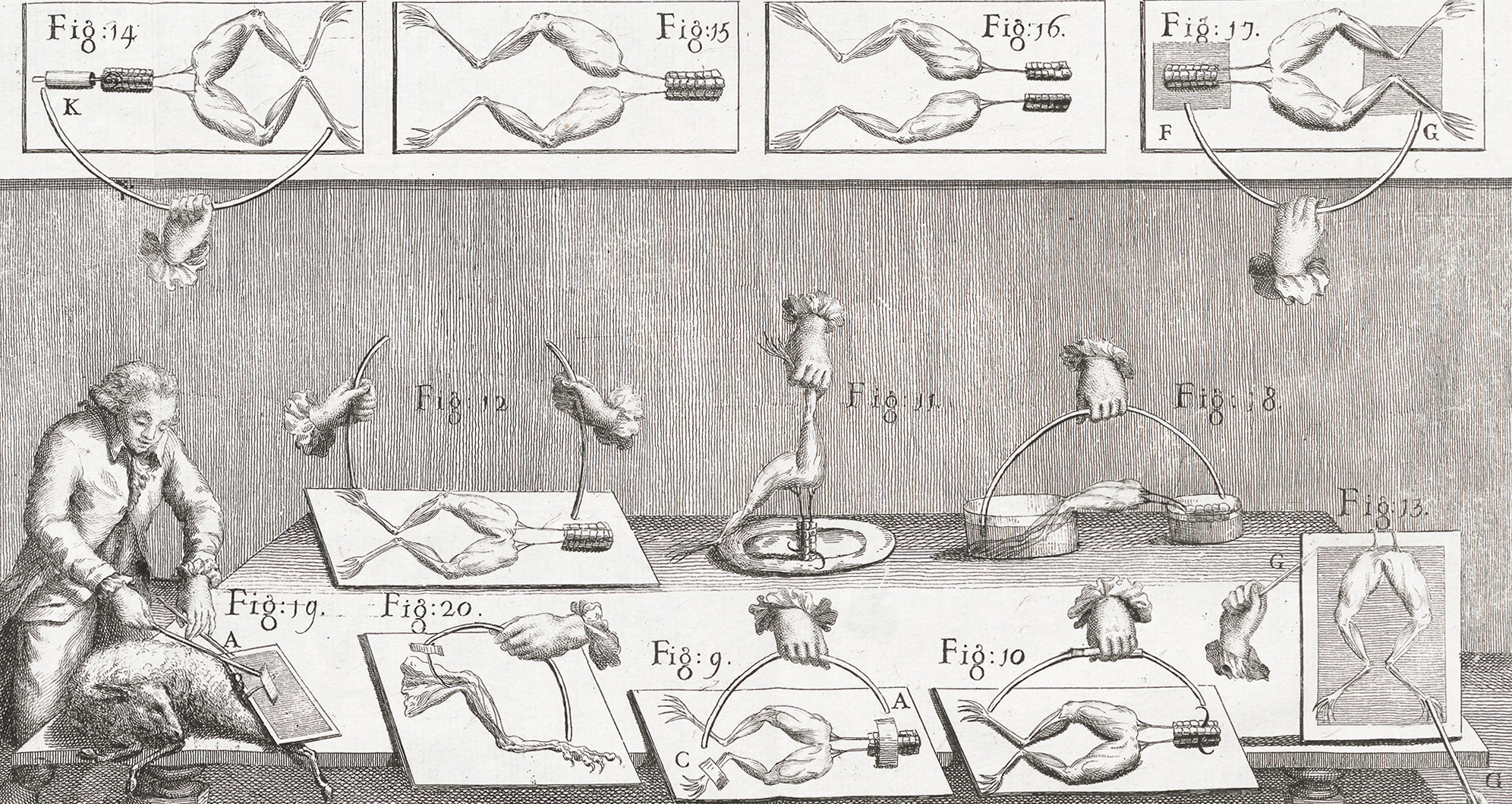
Illustration of man attaching electrical equipment to a lamb corpse on a table. The table also contains numerous pairs of frogs’ legs with various electrical instruments attached.
Electrical experiments from Galvani’s De Viribus electricitatis in motu musculari, 1792.

Bodies Electric

During the 1770s and 1780s, physicians began to apply electrostatic generators and Leyden jars to the human body not to entertain and edify, but to heal. Franklin’s proof that lightning and electricity were one and the same led physicians to connect the electricity they believed was latent in the atmosphere to the electricity manually generated and applied to the body in the experiments of Gray, Dufay, Nollet, and others.

French clergyman and experimenter Joseph Sans, author of Healing of Paralysis by Electricity, recorded barometric readings alongside clinical notes on how his paralyzed patients responded to the controlled application of electric shocks. Perhaps if applied correctly, electric atmospheres could cure any number of maladies, from paralysis, to epilepsy, to menstrual abnormalities.

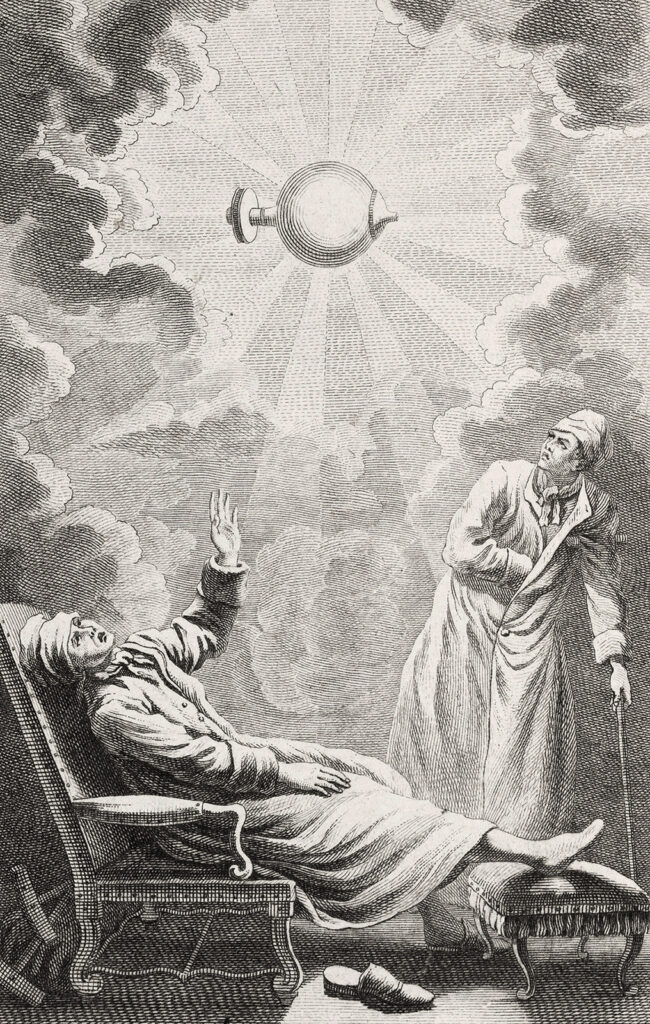
Illustration of two men experiencing electrical energy emanating from a device above them surrounded by clouds.

Anatomists took a cue from the physicians’ experiments. In the mid-1770s, Jacques-Fabien Gautier d’Agoty, known for his lurid illustrations of flayed and dissected corpses, developed a theory that the body was fully animated by electricity. Human beings walked around breathing in atmospheric electricity from the air. This electricity was then carried through the body by the arterial blood. Pumped by the left ventricle of the heart, electrified blood flooded the brain. There in the brain, d’Agoty wrote, “the electricity is retained as in the Leyden jar.” (He did not speculate on what thoughts it might trigger there.) Observing through dissection that nerves were hollow, he theorized that the electrical fluid flowed through them, thus carrying energy and liveliness throughout the body.

The anatomist went even further: electricity taken into the human body through the lungs perpetuated itself through reproduction. “The blood of the mother electrifies the fetus,” d’Agoty declared. Human life was electricity all the way down.

By 1780, Italian physician and professor of anatomy Luigi Galvani was hard at work on his groundbreaking theory of so-called animal electricity. His ideas drew upon a range of meticulous experiments on frogs. Galvani observed that, even after death, the leg of a frog would jolt to “life” if an electrified apparatus was brought near it or was properly connected to a dead frog’s exposed spinal column. Essentially, Galvani proposed that electricity was not something only breathed into the body, but something the body generated itself. Muscles, he wrote, functioned much like little Leyden jars.

By the end of the century, anatomists, physicists, and electro-medical practitioners alike believed that electricity was physiologically necessary for liveliness, thought, sentiment—and much more.

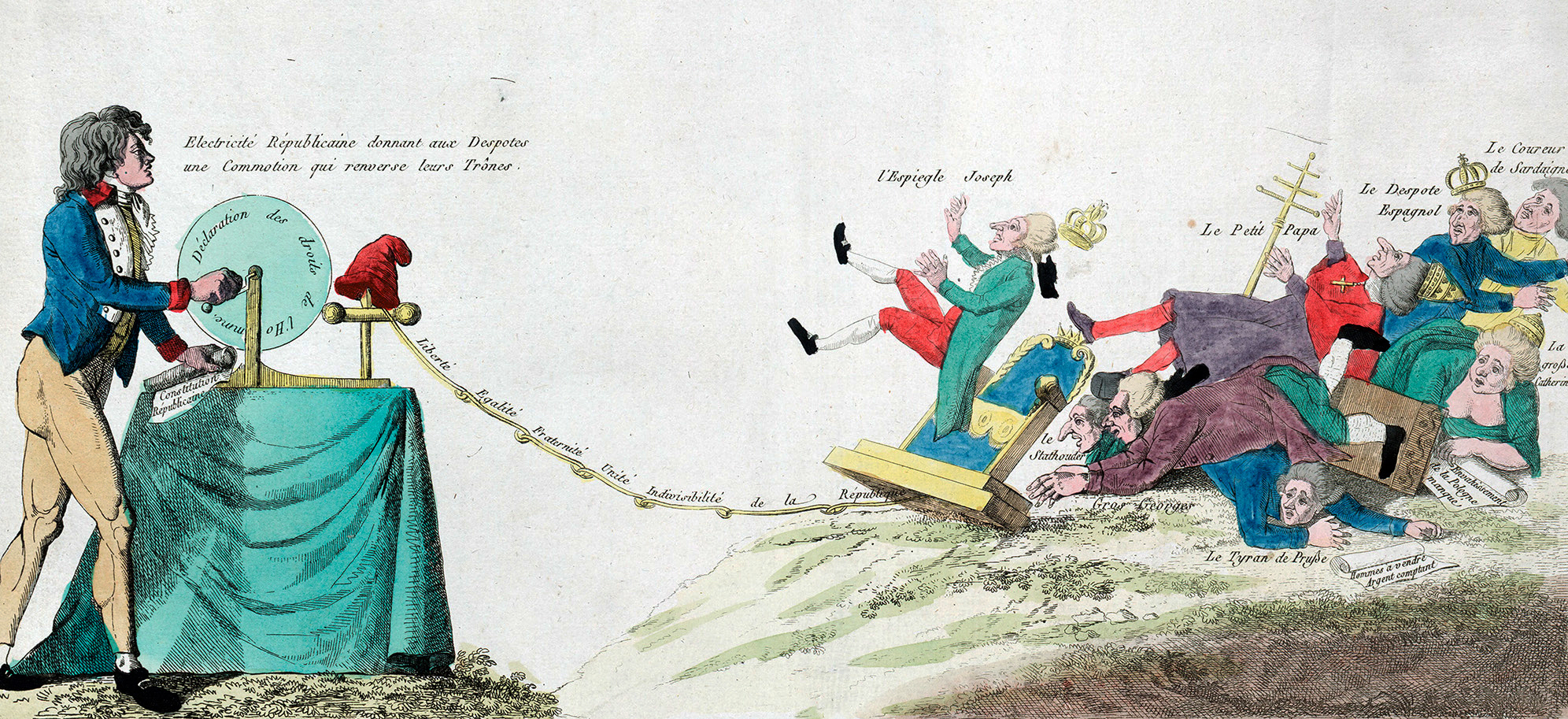
Illustration of a man operating an electrical generator that is causing a group of kings, queens, and religious leaders to fall.
Republican electricity overthrows European monarchs in this cartoon by French artist François-Marie-Isidore Queverdo, 1794.

The Patriot Flame

Just as Galvani was setting out to publish his findings, another kind of experiment shocked Europe to its core. On July 14, 1789, with a constitutional crisis brewing at the royal court in Versailles, a crowd of angry Parisians stormed the fortress known as the Bastille. The French Revolution had begun. Two years into the turmoil, Galvani’s treatise De viribus electricitatis in motu musculari commentarius appeared in print. Galvanic, animal electricity—an electricity of the body and the atmosphere, the stuff of ideas, feelings, and even life itself—soon entered revolutionary politics and became the metaphor we use today.

English thinkers linked electricity to the revolutions in America and France through the figure of Benjamin Franklin. As French reformer Turgot’s famous epigram had it, Franklin “snatched lightning from the sky and the scepter from tyrants.”

In his 1791 poem The Economy of Vegetation, Erasmus Darwin, grandfather to Charles, imagined an electrified American Revolution, ignited by Franklin, sending sparks across the Atlantic:

The patriot-flame with quick contagion ran,
Hill lighted hill, and man electrised man.

Darwin imagines France as a towering human figure, limbs shackled in the thick stone walls of the Bastille until the electrifying flame of the American Revolution breaks him free:

Touch’d by the patriot-flame, he rent amazed,
His flimsy bonds, and round and round him gazed.

English poet Robert Merry toasted the second anniversary of the storming of the Bastille with an electric metaphor and an exuberant scene in which a glass of red wine is passed around a table full of revolutionary sympathizers:

Fill high the animating glass,
And let the electric ruby pass
From hand to hand, from soul to soul;
Who shall the energy controul,
Exalted, pure, refin’d,
The Health of Humankind.

In France, architect Bernard Poyet submitted a plan to build a giant amphitheater for the Festival of Federation commemorating the storming of the Bastille. There, through “a kind of electricity,” the “sentiments of each would become the sentiments of all.” Poyet’s imaginative leap is clear—the same shared shock that coursed through Nollet’s human chains was expected, or even necessary, for the nation-forging moment he aimed to create.

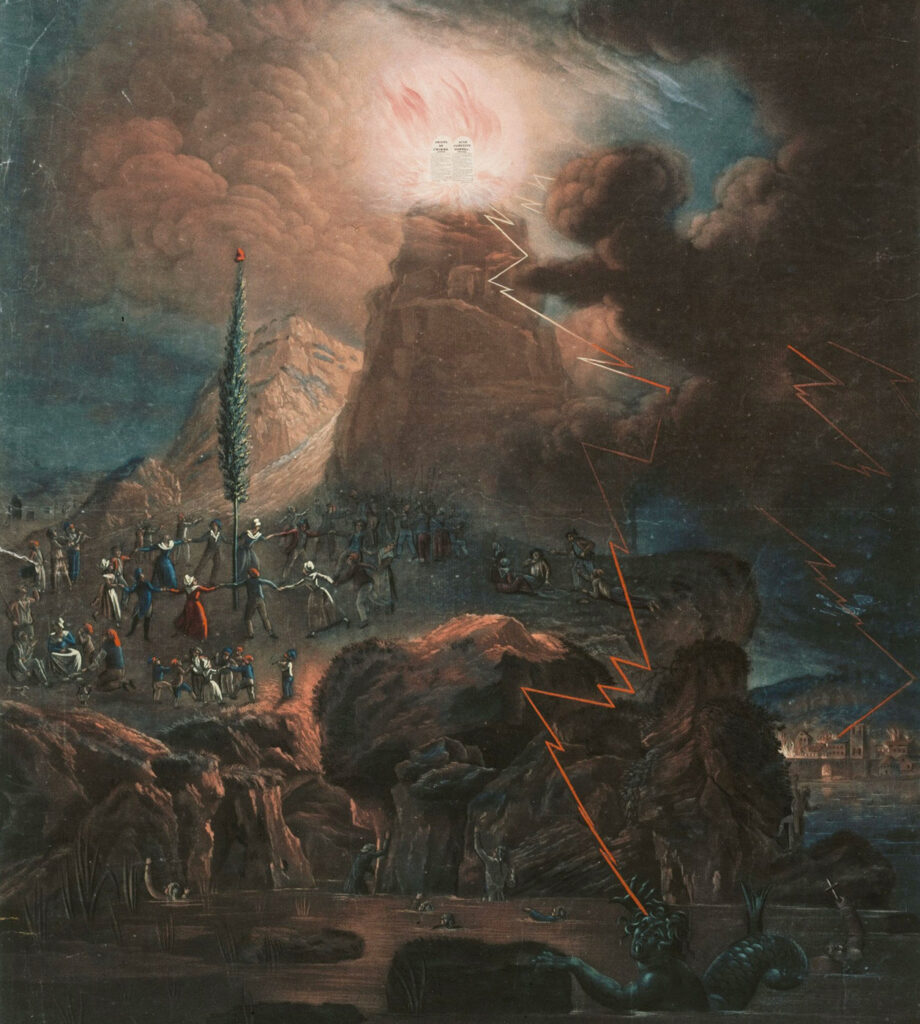
Painting of a mountain with lightning emanating from two tablets at its peak. Dark clouds surround the mountain, and people are visible dancing in a circle around a tree at the base. A dark body of water and a sea monster are visible in the foreground.

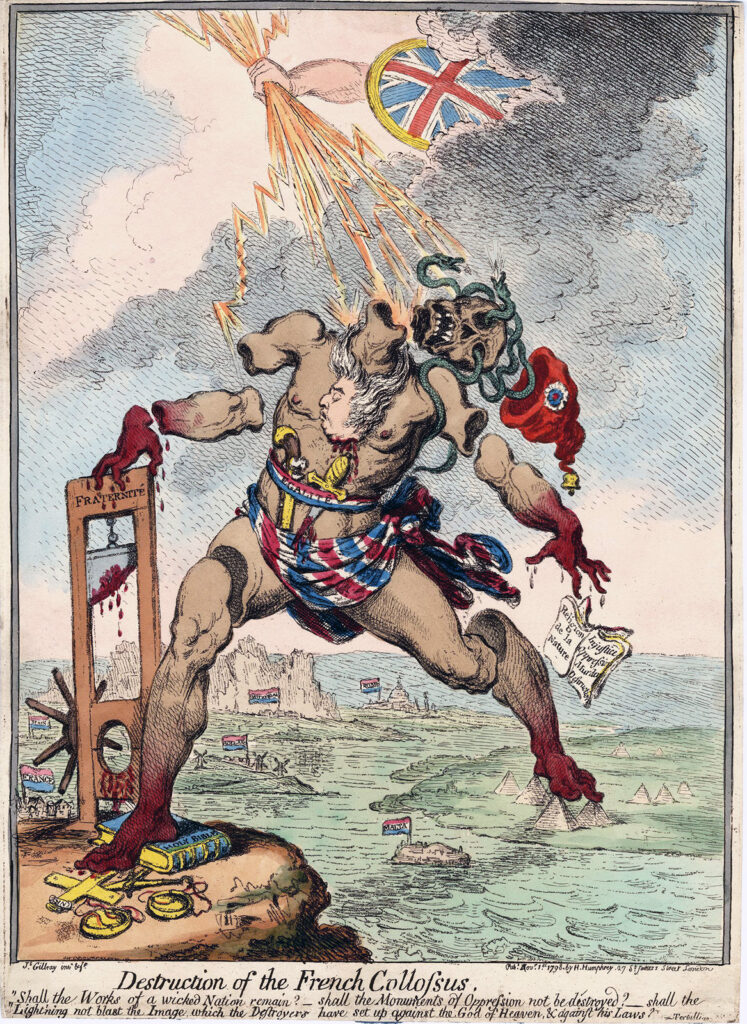
For conservative observers, revolutionary electricity was, to borrow Franklin’s coinage, negatively charged. British lawmaker and political philosopher Edmund Burke feared the “electrick communication” of the press would spread the concept of human rights and other revolutionary thought at such a breakneck speed it would upend the traditional order in which he believed, making every government “in its spirit, almost Democratick.” Other commentators worried that revolution might electrify enslaved populations and overthrow the entire system on which Western empires had been built (a fear, notably, shared by many prominent revolutionaries).

Nevertheless, electrical language exploded in the revolutionary years. The minutes of French revolutionary legislatures show a meteoric rise in the use of electrical language starting in 1792, as France declared preemptive war on Prussia and Austria. It peaked between 1793 and 1794, after the inauguration of the first French Republic and the execution of Louis XVI.

A decapitated and dismembered colossus (representing France) being struck by lightning from the sky (Great Britain)

The sudden prominence of electrical metaphors in politics dovetailed with the ascent of the far-left party known as the Jacobins and the emergence of Maximilien Robespierre as party leader. The Jacobins pushed for expanded social and economic rights, social equality, and swift, inexorable revolutionary justice meted out to naysayers—aristocrats, recalcitrant priests, moderate politicians, and anyone else who might try to short-circuit their newborn egalitarian republic.

On August 10, 1793, the Jacobins, now in full political control, threw another party, this time to celebrate the first anniversary of the storming of the Tuileries palace and the subsequent arrest and trial of the king and the royal family—the so-called Second Revolution. Accounts of the Festival of Reunion, as it was officially called, crackled with electricity. The ceremony “electrified our souls and overwhelmed our existence,” remarked one observer. In Auxerre, a city in Burgundy, the energy of the official speech “electrified all hearts.”

Jacobin representatives sent from radical Paris to more conservative provinces wrote back that they had “electrified” the towns and cities they passed through. Electrical fervor reached the battlefields as well. A French colonel wrote that the revolutionary army needed to give enemy nations a “great shock of civic electricity to establish equilibrium of happiness in the machine of the world.” The bright, electrified future Jacobin rhetoric imagined, however, could not withstand war against Europe’s crowned powers. With the strain of constant battle against enemies within and without, repression grew until Jacobin representatives in Paris had only themselves left to purge.

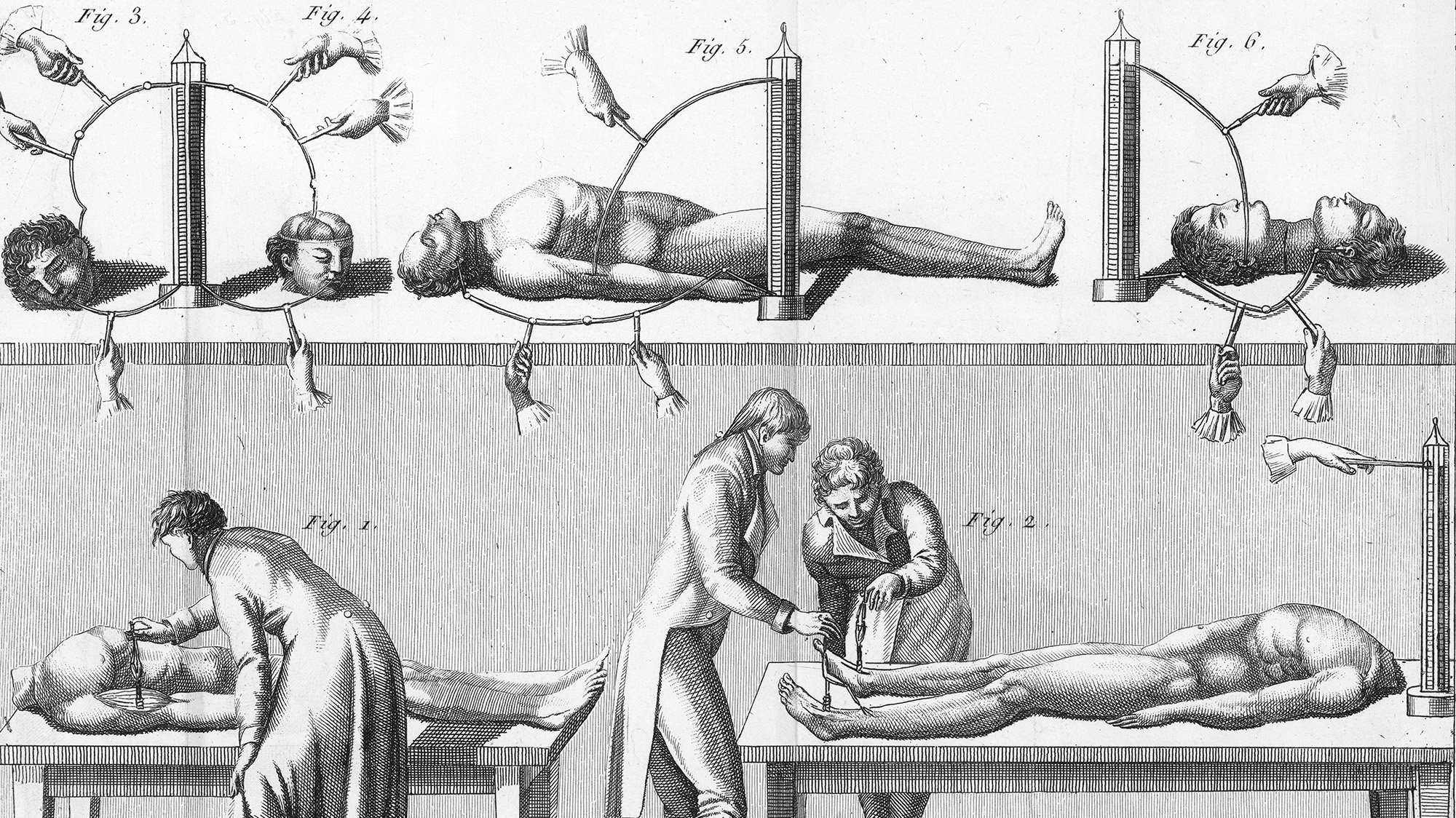
Engraving of scientists testing electrical equipment on human limbs, muscles, and heads on laboratory tables.
Galvanic experiments on human body parts, from Essai theorique et experimental sur le galvanisme by Galvani’s nephew Giovanni Aldini, 1804.

Positive and Negative

The heyday of electrical metaphor, and the galvanism that inspired it, was short-lived. With the fall of Robespierre and the end of Jacobin dominance in 1794, electrical metaphors fell out of favor in political language. Concurrently, animal electricity fell out of scientific favor.

Alessandro Volta argued that his fellow Italian Galvani had gotten it all wrong. The electricity Galvani had observed in frog muscles had instead come from the chemical interaction between two different kinds of metal in the apparatuses Galvani used in his experiments. (In fact, they were both right; animals do generate and run on internal electricity.)

In 1800, the disagreement inspired Volta to invent a new instrument that would jolt electrical science forward. To prove electricity could run through two metals without the aid of any animal parts, Volta stacked zinc and copper plates in a saline solution. The first modern battery was born and with it a continuously flowing current of electricity.

Napoleon, wielding dictatorial power after a 1799 coup, celebrated the birth of the Voltaic pile and its inventor along with it. Volta basked in the glory bestowed on him by the new regime. Galvani, who had refused to swear allegiance to Napoleon’s new Cisalpine Republic, died in 1798. He did not live to see either Napoleon’s coup in France or Volta’s coup in the electrical sciences.

Animal electricity, meanwhile, went underground. It became associated with occultism and attempts to electrify the corpses of hanged men back to life by Galvani’s nephew Giovanni Aldini, whose efforts to prove his uncle right did as much harm as good.

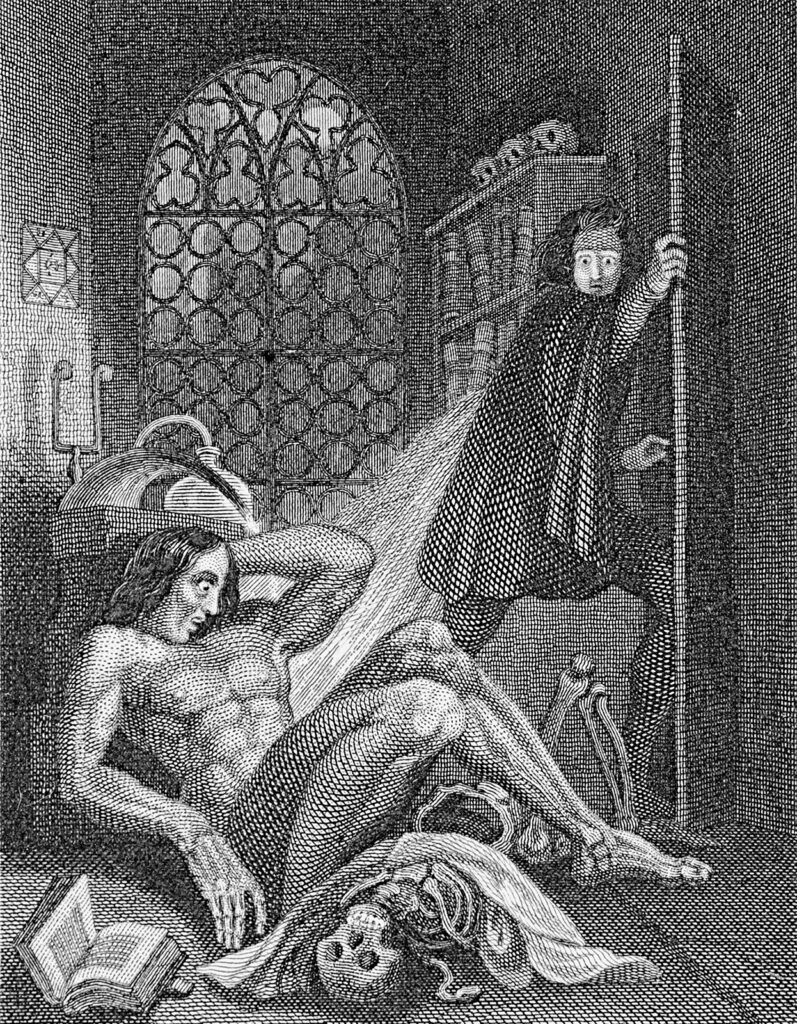
Engraving of two men in a small room with a skeleton lying on the floor. One is lying on the floor on top of the skeleton. The other is staring aghast, holding open a door.

Aldini’s brand of animal electricity found enduring form in Mary Shelley’s 1818 novel, Frankenstein, which implies that Victor Frankenstein had electrified, or galvanized, life into his stitched-together creature. The novel’s alternative title, The Modern Prometheus, casts Shelley’s archetypal mad scientist as the Greek mythological titan who stole a spark of fire from the gods and gave it to humankind, with positive and negative results in equal measure.

For Mary Shelley’s husband, the Romantic poet Percy Shelley, the story of Prometheus was one of revolutionary liberation, in which Prometheus heroically overthrows tyrannical Jupiter. Percy delighted over electrical experiments as a university student at Oxford, running through the repertoire developed by Nollet, Franklin, and others over the course of an enlightened century.

Mary Shelley focused on the other electricity, the electricity of the body, of Galvani’s frog legs and Aldini’s corpses, and of Jacobin metaphor. This electricity, Frankenstein suggests, irreversibly awakens something new in the world—something that, without proper care, terrorizes its own maker.

More from our magazine

A large white bird standing near a chick on a ground nest with the ocean and a ship are visible in the background.
DISTILLATIONS MAGAZINE

A Game of Cat and Mouse

A predator stalks Marion Island, and it weighs less than an ounce. Scientists are racing to stop it.

Sésamo seco en manojos en el campo contra un cielo azul profundo
DISTILLATIONS MAGAZINE

Parcelas de ajonjolí

Una diáspora en veintiún movimientos.

A series of photos showing a worker putting a sport coat in plastic film using a freestanding dispenser
DISTILLATIONS MAGAZINE

This Bag Is Not a Toy

The plastics industry’s early scare.

    Republish

    Copy the above HTML to republish this content. We have formatted the material to follow our guidelines, which include our credit requirements. Please review our full list of guidelines for more information. By republishing this content, you agree to our republication requirements.