
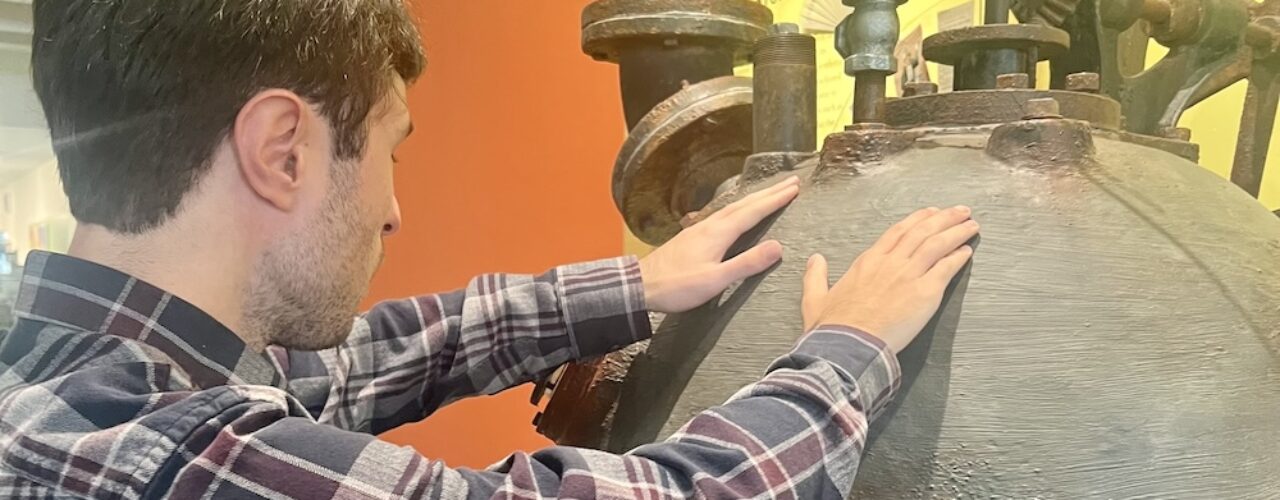
Institute Launches New Museum Tours, Including Touch-Based Program for the Visually Impaired
Unique learning experiences for students, adult clubs, and special groups highlight the science behind minerals, textiles, and fireworks.
The Science History Institute has announced the launch of several new group tours available in our museum:
Programs are geared toward middle, high school, and college students in history, social studies, environmental studies, general science, or chemistry. Tours are also available for adult, senior, and non-school groups, clubs, and organizations of all kinds. Advanced registration is required for all tours; admission is free. School field trips are available Wednesday through Friday, from 10am to 3:30pm. For more information and to book a tour, please visit sciencehistory.org/tours.
Artisans, Alchemists, Chemists: Highlighting Minerals & Us
This three-part “highlights” tour is specifically designed for school groups (grades 6–12 and postsecondary), who will learn how minerals have been used and studied throughout history. Part 1 takes students on a guided tour through our permanent exhibition to hear stories about how early scientists identified the chemical elements. In Part 2, students will independently explore our new Earthly Matters minerals exhibition and complete a worksheet that sparks curiosity and tests observational skills. Part 3 features an interactive game evaluating the characteristics of gold, one of the most valued elements in history.
“Artisans, Alchemists, Chemists: Highlighting Minerals & Us” meets educational standards for science and history in Pennsylvania. Due to exhibit space limitations, this 45-minute tour is capped at 30; students will be divided into smaller groups to rotate through each station. School groups require an 8:1 student-to-chaperone ratio.
From Nature to Nylons: A Touch-Based History of Textiles
Blind and low-vision guests can sign up for our new touch-based tour, which offers visitors a private learning experience that combines a personally guided exploration of select gallery exhibits and a hands-on study of objects from our collections. Specifically designed for the visually impaired, “From Nature to Nylons: A Touch-Based History of Textiles” provides guests with a better understanding of how natural and synthetic fibers changed our world and how the changing world influenced our desire for advanced high-tech textiles.

This exclusive program takes place from 10:30am to 12pm on the second Tuesday of each month when the Science History Institute Museum is closed to the public. Touch tours last approximately 1.5 hours depending on engagement and can accommodate up to 10 guests. Individual registrations are accepted. Early registration is encouraged, but drop-ins are welcome. Please note that our touch-based tours are not available for school groups at this time.
From Nature to Nylons: Highlighting the History of Textiles
This school group version of our textiles tour begins with an introduction to natural fibers, such as wool and linen, before moving on to the development of plastics and synthetic materials like nylon and spandex. Best suited for grades 7–12 and college groups, students will learn how events like the Industrial Revolution and World War II shaped the clothing they wear. Following the tour, one of our museum educators will introduce objects from our handling collection. Multiple themes are available—you can choose from the chemistry of dyes, the science of stretch, or the machines that drove the Industrial Revolution.
There is a 50-student maximum for this 45-minute tour; one chaperone per eight students is required.
Flash! Bang! Boom! A History of Fireworks
Explore the fascinating international origins of fireworks with a tour of Flash! Bang! Boom! A History of Fireworks, the Institute’s new exhibition celebrating America’s 250th birthday. Learn the difference between a firecracker and a rocket—and how each works. Discover how fireworks have come to represent events as diverse as the Chinese New Year, Italian saint days, and the 4th of July. Our Fireworks Tour dives deep into the chemistry of how they go “boom,” the factory laborers who churn them out, the pyrotechnicians who light the match, the migrants and business leaders who made them famous, and the innovators lighting up a new future.
There is a 50-student maximum and an 8:1 student-to-chaperone ratio required for this 45-minute tour, which is aimed at grades 7–12 and postsecondary school groups.
The Institute also offers self-guided activities and in-person tours on “Women in Chemistry,” “Science & Activism,” and “Unwell Waters: Highlighting Health & the Environment,” as well as virtual programs and virtual classroom visits. Visit sciencehistory.org/tours for more information.
Featured image: A visually impaired guest takes a touch-based tour of the Science History Institute Museum.
More News
Applications for 2027–2028 Beckman Center Fellowships Now Open
Researchers can apply by January 15 for various long- and short-term programs, including two-year curatorial fellowships.
New Alchemy Exhibition Draws Sold-Out Crowd to Opening Celebration
Attendees take an up-close look at paintings and rare books from the Institute’s Fire and Gold exhibit while enjoying a curator’s talk, activities, and light bites.
New Research Challenges Misconceptions about Rosalind Franklin’s Famed ‘Photo 51’ and the Discovery of DNA’s Double Helix
Paper by the Science History Institute’s Alistair Sponsel and King’s College London’s Brian Sutton uncovers the significance of her previously captured Photo 49.