
Science History Institute and Fondation de la Maison de la Chimie Name William R. Newman Winner of 2026 Franklin-Lavoisier Prize
The science historian will be honored for his contributions to the history of alchemy on October 7 in Philadelphia.
The Science History Institute and the Paris-based Fondation de la Maison de la Chimie announce William Royall Newman as the winner of the 2026 Franklin-Lavoisier Prize. The American historian of science is being recognized for his remarkable contributions to the history of alchemy. Educated and trained as a textual scholar and medievalist, his books offer groundbreaking insights into the essential texts of alchemical literature, shedding new light on several authors, including American alchemist George Starkey and English physicist Sir Isaac Newton.
In addition to his scholarly works, Newman has also put alchemical experiments to the test in the laboratory. His close collaboration with history of alchemy expert Lawrence M. Principe—winner of the 2016 Franklin-Lavoisier Prize—underscores the very real chemical transformations alchemists were able to execute. As coauthors of two books, they advocated for the return of the archaic term “chymistry” to refer broadly to the practice of alchemy and early modern chemistry. Usage of the word is now widely recognized and has even been officially acknowledged by the Oxford English Dictionary.
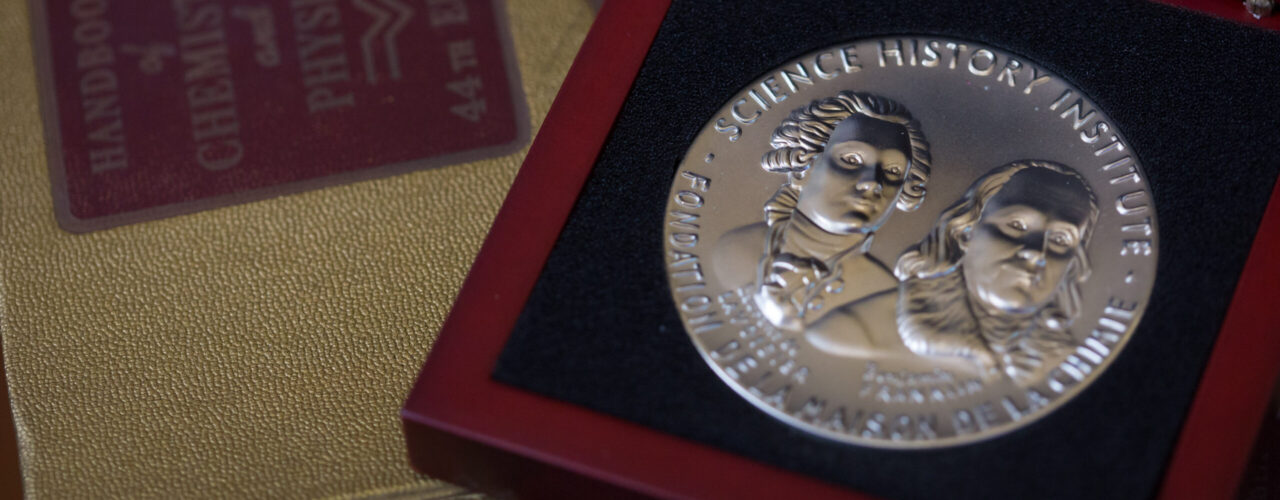
Newman will receive a specially cast silver medal during a ceremony at the Institute in Philadelphia on October 7, 2026, where he will also deliver a presentation.
Presented jointly every two years, this international prize is awarded to individuals and organizations from around the world that have contributed to and continue to create original and innovative work that opens new areas and perspectives in the preservation, interpretation, and sharing of our collective chemical heritage.
About William R. Newman

William “Bill” R. Newman has spent most of his career at Indiana University, where he has investigated major themes in the history of alchemy. In his 1991 book, The Summa Perfectionis of Pseudo-Geber: A Critical Edition, Translation & Study, he revealed the presence of a corpuscular theory of matter in medieval alchemy, which also formed the foundation of his later book, Atoms and Alchemy (2006). There Newman charted the heavy influence of Geber on the atomism of Daniel Sennert and on the matter theory of Robert Boyle, showing how alchemical corpuscular theory was appropriated and transformed by the mechanical philosophy.
A second theme of Newman’s work is the striking focus that medieval alchemy provided to the traditional Western idea of competition between art and nature. Newman’s 2004 Promethean Ambitions describes figures ranging from the medieval French poet Jean de Meun to his later compatriot, the ceramicist Bernard Palissy, who both viewed alchemy as the apex of human claims to outdo nature, although they reached opposite conclusions about its value. Even Francis Bacon, the champion of experimental science, found inspiration for his claim that nature differs from art “not in form or essence, but only in the efficient,” in alchemical exemplars.
Yet another theme in Newman’s work has been the pervasive impact of Joan Baptista van Helmont and the Helmontian tradition on the development of principles crucial to experimental science, such as the concept of mass balance. Van Helmont’s prominent influence appears in Newman’s 1994 biography of George Starkey, Gehennical Fire, as well as in Alchemy Tried in the Fire (2002), coauthored with Lawrence M. Principe. More recently Newman has been working with a team of dedicated scholars (including Jim Voelkel, the Institute’s curator of rare books) to produce The Chymistry of Isaac Newton, an online edition of Newton’s alchemical papers. This edition made it possible for Newman to shed considerable new light on Newton’s “chymical” activities in his 2019 book, Newton the Alchemist.
About the Franklin-Lavoisier Prize
Named for Antoine-Laurent Lavoisier and Benjamin Franklin, two of the 18th century’s greatest minds, the Fraknlin-Lavoisier Prize recognizes outstanding achievements and meritorious efforts that promote and advance the history and heritage of the chemical sciences and technology. Presented alternately in the United States and France every other year, this prestigious prize is awarded to individuals and organizations from around the world that have contributed to and continue to create original and innovative work that opens new areas and perspectives in the preservation, interpretation, and sharing of our collective chemical heritage. Cosponsored by the Science History Institute and the Fondation de la Maison de la Chimie, winners receive a medal and a monetary prize of €15,000, half of which is to be used for a public-facing project in France or the United States.
About the Fondation de la Maison de la Chimie
The Fondation de la Maison de la Chimie was founded in 1928 in Paris with the goal of building and maintaining a central meeting and working space to promote the popularization of science for chemists worldwide. To fulfill this mission, the organization provides several services and activities to facilitate cooperation among all those working to promote chemistry as one of the basic disciplines of science and technology.
More News
Science History Institute Joins ArtPhilly’s Citywide Festival with Unique Museum Tour
What Now: 2026 features artist Aislinn Pentecost-Farren, who will tell the history of the climate crisis through the Institute’s collections.
Institute Launches New Museum Tours, Including Touch-Based Program for the Visually Impaired
Unique learning experiences for students, adult clubs, and special groups highlight the science behind minerals, textiles, and fireworks.

Science History Institute Mourns Death of Pioneering Genome Scientist J. Craig Venter
The 2001 Biotechnology Heritage Award winner, who facilitated the Institute’s acquisition of the famed History of Molecular Biology Collection, was 79.