Distillations magazine

Unexpected Stories from Science’s Past
February 5, 2026 Health & Medicine

This Bag Is Not a Toy

The plastics industry’s early scare.

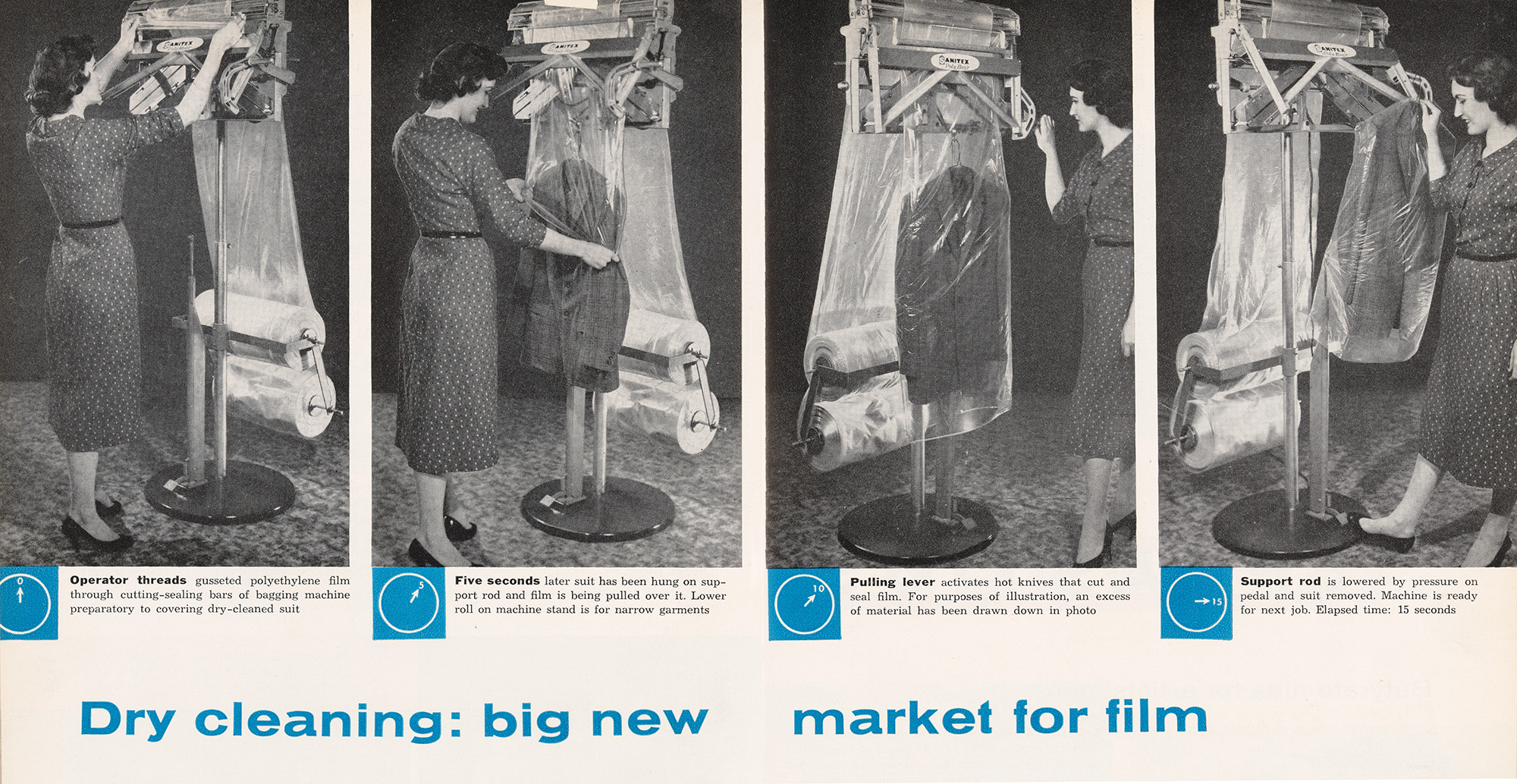
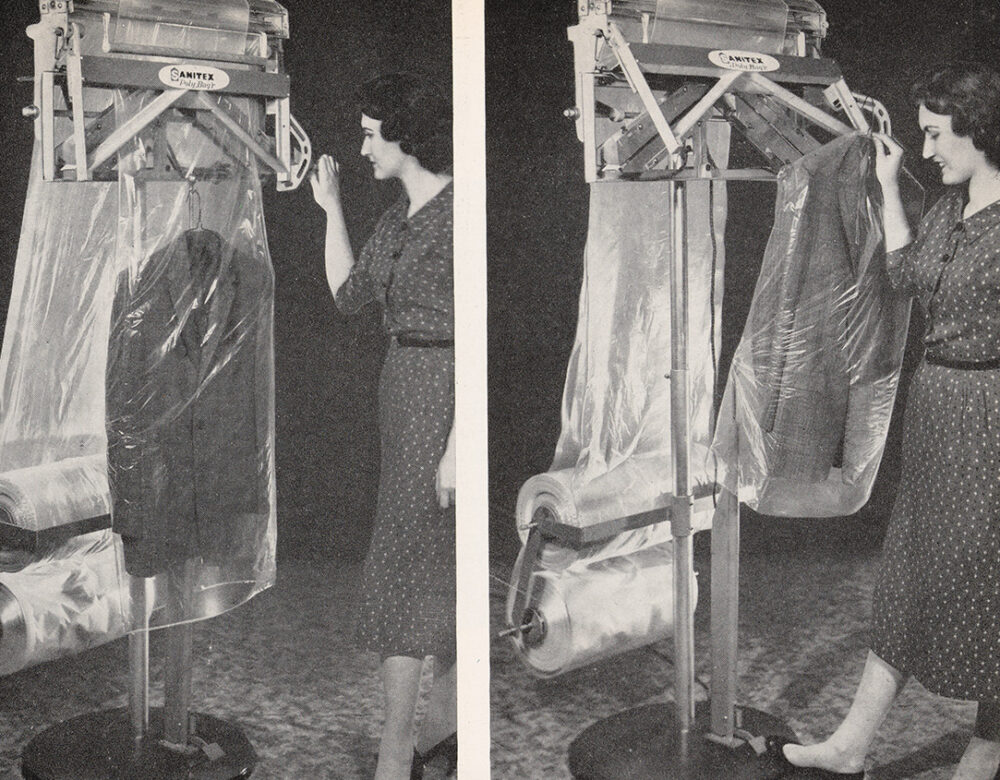
A series of photos showing a worker putting a sport coat in plastic film using a freestanding dispenser
About SUPPORT OUR WORK

SOMETIME AROUND APRIL, the reports started rolling in. They came in from coast to coast, each distinct in its tragedy even as it echoed the rest.

An infant girl in Queens suffocated while laying on a couch used as a makeshift crib. In Memphis, a mother came home, put down her bags, and left the room; by the time she returned, her four-month-old was dead. Two sisters in Rexburg, Idaho, died in a closet while playing dress-up. 

The culprit, in each case, was a plastic garment bag brought home from the dry cleaner. Unwitting parents were reusing the bags as mattress and pillow covers in their babies’ cribs or leaving them about like harmless flotsam, only to find their children ensnared.

As historian Jeffrey Meikle details in American Plastics: A Cultural History, by June more than 50 children had died, most of them too young to crawl, along with seven adults by suicide. In New York City, the chief medical examiner and police responded by investigating the deaths to determine whether crimes had occurred, photographing the scenes and conducting autopsies. As the death toll rose and news spread, the ultrathin sheets of polyethylene took on a haunting aspect.

“An almost invisible peril hangs loosely over the helpless heads of the nation’s infants,” the New York Journal-American declared. Time warned readers about the looming threat of “death by plastic.” In the San Francisco News, an editorial wondered “How Many Must Die?” and demanded plastic disarmament: “BAN THE BAGS!”

In the summer of 1959, the country was in the throes of a crisis—and so was the fledgling plastics industry, still establishing its hold on American life. As the temperature rose, plastic makers stared down their first public reckoning. It was what one industry lawyer later called “the most celebrated debacle of them all,” a fork in the road for the fate of plastics in everyday life.
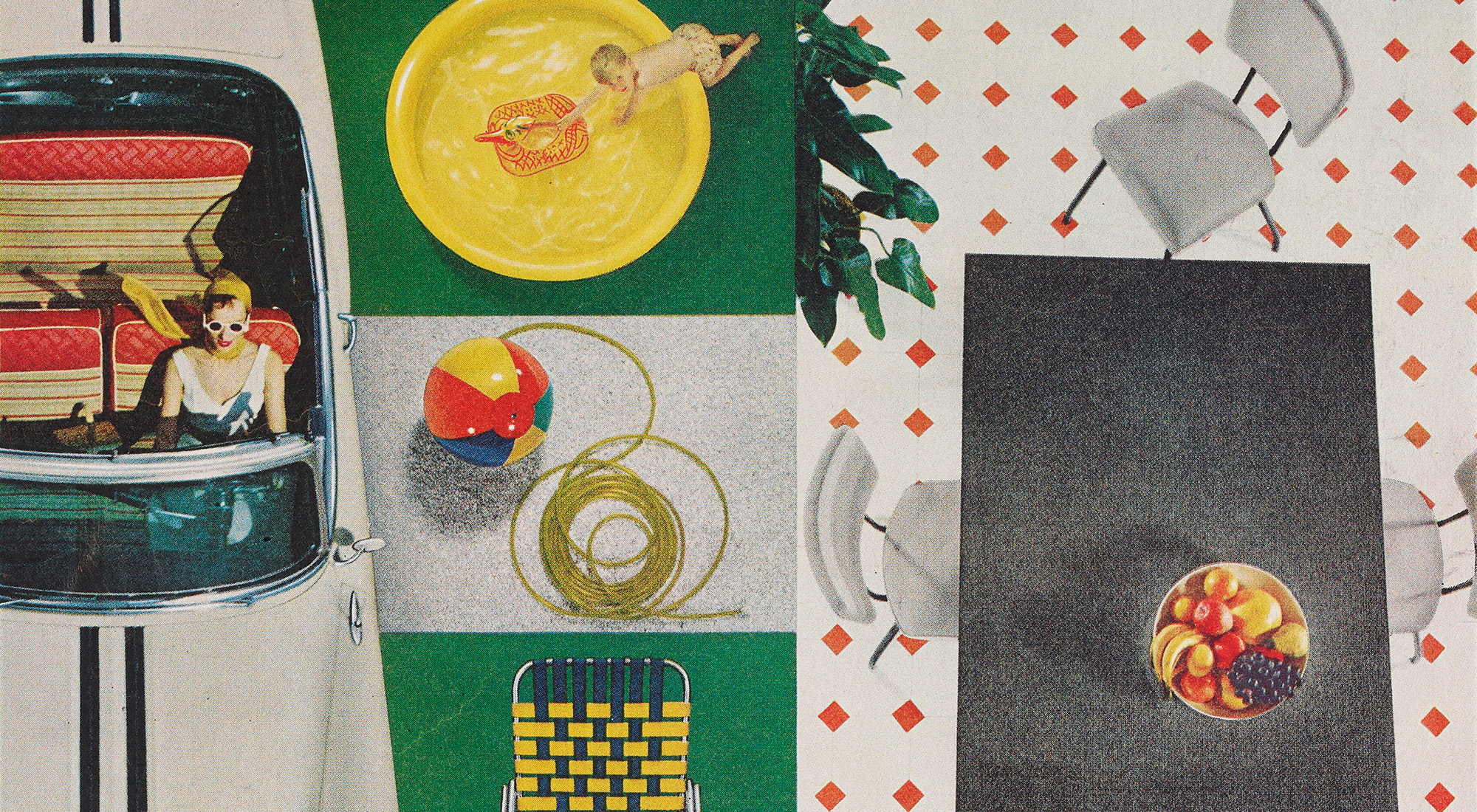
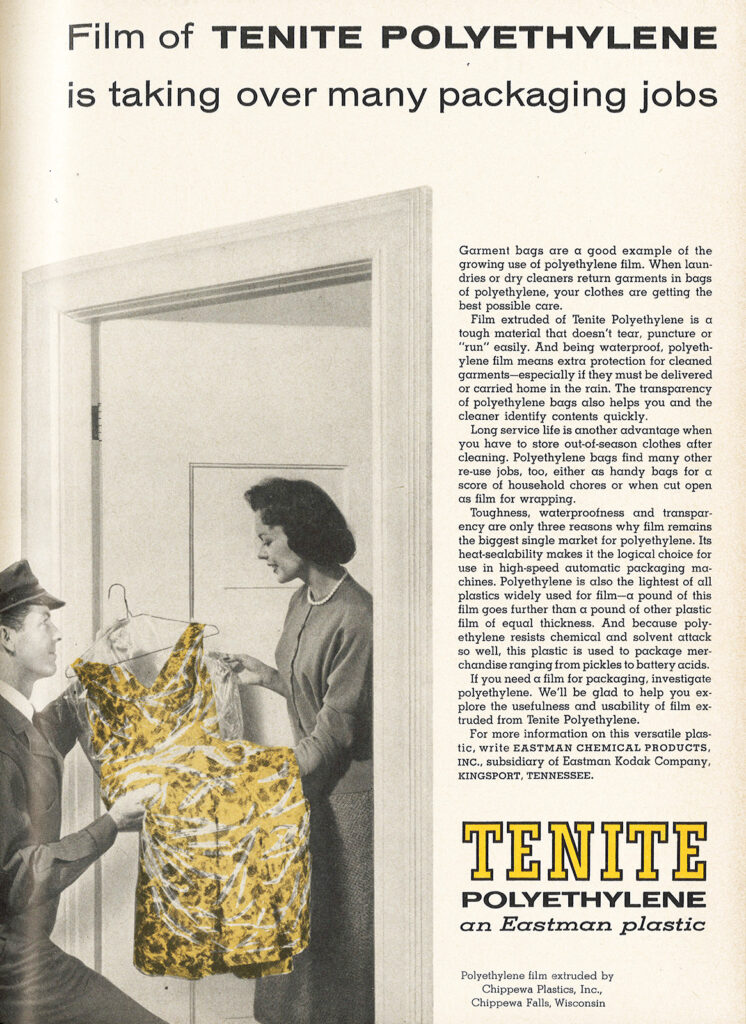
Photo collage of various midcentury consumer plastics
Detail of the Dow ad, “Live a Carefree Life with Trouble-Free Plastics!” from the Saturday Evening Post, June 1953.

LIKE SO MANY chemical breakthroughs, polyethylene was the result of an accident. Two accidents, actually. 

The first came in 1898, when German chemist Hans von Pechmann tried to stabilize diazomethane, an extremely volatile yellow gas he had discovered a few years earlier. After heating it, he found a peculiar white residue at the bottom of his test tube. His investigation concluded, and three decades passed before the material was conjured again.

In 1933, Reginald Gibson and Eric Fawcett, a pair of researchers at Britain’s Imperial Chemical Industries (ICI), happened upon the same residue while investigating high-pressure chemical reactions. Introduced to one another at 1,900 atmospheres and 170°C, the combination of ethylene and benzaldehyde left behind a waxy solid in the reaction tube. Fawcett insisted they had made a solid polymer of ethylene, but the experiment was difficult to recreate; efforts typically ended with a bang. Safety concerns halted their research for two years. Using improved equipment, in 1935 ICI colleagues retraced their steps and learned that a touch of oxygen was needed for polymerization. It turned out Gibson and Fawcett had been fortunate in 1933 to use an ethylene canister with just the right amount of residual oxygen for success. With the process clarified, scientists turned to finding applications for the new material.

Polyethylene offered a solution in search of a problem. It was so unlike other polymers that at its dawn “no one could envisage a use for it,” an ICI researcher said. It served first in World War II, as a lightweight cable insulation that put Britain’s superior radar system inside aircraft. The polymer’s postwar utility remained murky until researchers created a durable and relatively heat-resistant version known as high-density polyethylene. HDPE seemed something like magic—an endlessly moldable material that could be shaped into dinnerware, baby bottles, toys, and so much else. It quickly replaced tried-and-true building blocks of the consumer economy, from glass and metal, to wood and ceramics.

Man handing a woman a dress wrapped in the plastic film under the headline, "Film of Tenite polyethylene is taking over many packaging jobs"

By 1958, polyethylene occupied the largest segment of the plastics industry, and producers including DuPont, Dow, Eastman Kodak, and Phillips Petroleum were churning out 920 million pounds a year. Most of the boom was in HDPE, but plastic makers continued to experiment with the original formulation, low-density polyethylene, whose heavily branched molecular chains gave it a level of flexibility and ductility that made it a plausible replacement for paper packaging. Soon, the material found its purpose at the dry cleaner. 

DuPont’s corporate magazine boasted in 1956 that New England’s largest dry cleaner had wowed its customers with blankets “freshly cleaned and trimly wrapped in clear plastic.” Within two years, makers of polyethylene film had sold a billion garment bags, bringing in some $20 million, more than $200 million today. A two-page spread in the April 1958 issue of Modern Plastics claimed dry cleaning offered a “big new market for film” and suggested “polyethylene film bags seem to have everything” paper and other coverings lacked. Plastic offered transparency for customers to inspect their clothing, protection from wet weather, softness to drape over an arm and avoid wrinkling, and superior resistance to tears. There was one last selling point, the magazine reported: polyethylene bags “can be re-used by the customer to protect clothing between wearings and on auto trips, and in many other ways.” 

Every characteristic that made polyethylene film an attractive alternative for dry cleaners made it a hazard in the wrong hands. It was durable—too durable to be easily torn. It was impermeable, so oxygen couldn’t cross its barrier. And it was flexible enough to take the shape of anything it pressed upon, wrapping its subject in a thin cocoon. Parents weren’t ready. 

Series of photos showing a worker putting a sport coat in plastic film using a dispenser
Modern Plastics, April 1958.

IT’S HARD TO IMAGINE now in an era of plastic ubiquity, but postwar America was still early in its love affair with these materials and the convenience they delivered. Consumers in the 1950s had not entirely embraced the fast-paced and disposable way of life plastic makers promoted. For all their potential to remake the material world, plastics met plenty of skepticism. It didn’t help, Meikle says, that many of the plastics available to consumers during World War II were shoddy imitations of more expensive materials used in the war effort. Plastic products had a reputation for being fake or phony. “People thought there was something unnatural” about the way plastic goods mocked familiar objects, he says. Their eerie, alien otherness took time to wear off.

When children began dying in 1959, enrobed in transparent film, “it had the potential to surface some of those underlying suspicions and fears,” says Susan Freinkel, author of Plastics: A Toxic Love Story. Before long, the danger was imminent.

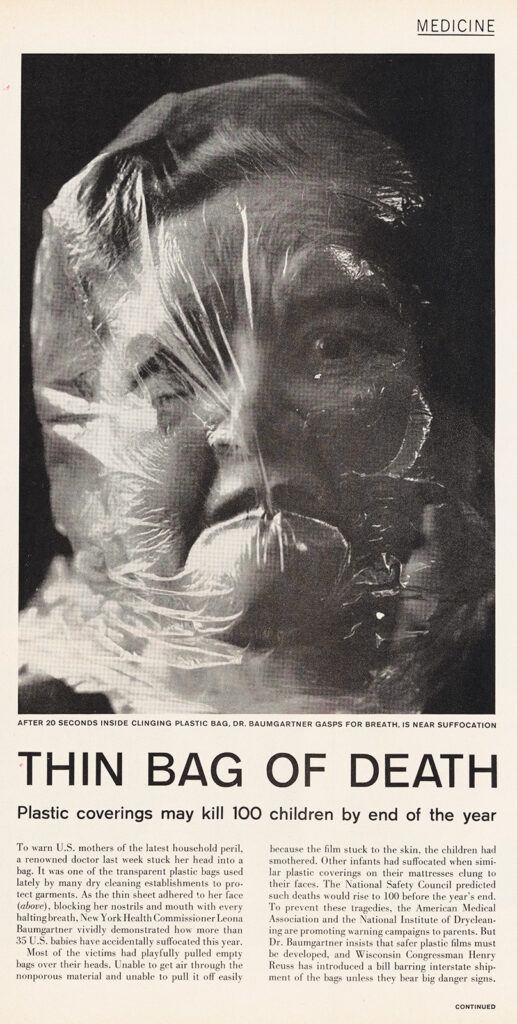
In June, Life illustrated the threat with a terrifying close-up of New York City Health Commissioner Leona Baumgartner wrapped in a plastic bag that disfigured her face. The National Safety Council predicted that by year’s end more than 100 children would be killed by what the magazine called the “thin bag of death.”

New York City Health Commissioner Leona Baumgartner in a photo staged for Life, June 1959.

That same month, Newsweek ran side-by-side photos of a young child, first playing with a polyethylene bag, then fully encased in it. “Don’t let the children do this,” the magazine cautioned. Three weeks later, however, Newsweek reported that authorities across the country were “thoroughly alarmed” by the unfolding tragedy, with three children recently killed by bags in a 24-hour period.

“So far as children are concerned they are no less lethal to have around than a loaded gun,” said San Franciso coroner Henry Turkel after the city’s first death. “It would be criminal not to take active steps to prohibit the bags.

It was, in the words of Modern Plastics editor Hiram McCann, “about as bad publicity as any industry ever had.”

As the public outcry grew more urgent, legislation aimed at regulating or outright banning the bags popped up across the country, from Congress down to city councils. When Congress began weighing a ban in the District of Columbia and mandatory cautionary labeling and restrictions on their interstate sale nationwide, Rep. Charles Bennett of Florida declared that no amount of publicity could take the place of legislation in preventing further tragedy. Plastic bags, he said, were “death traps.”

 “The conviction was growing that the best way to put an end to the deaths once and for all was to stop the use of the bags entirely,” Newsweek reported.

About 60 local, state, and national bills were introduced in all, each of them threatening to set off a regulatory wave that could stymie the polyethylene film industry. If America’s infants needed protection, so too did its plastic makers.

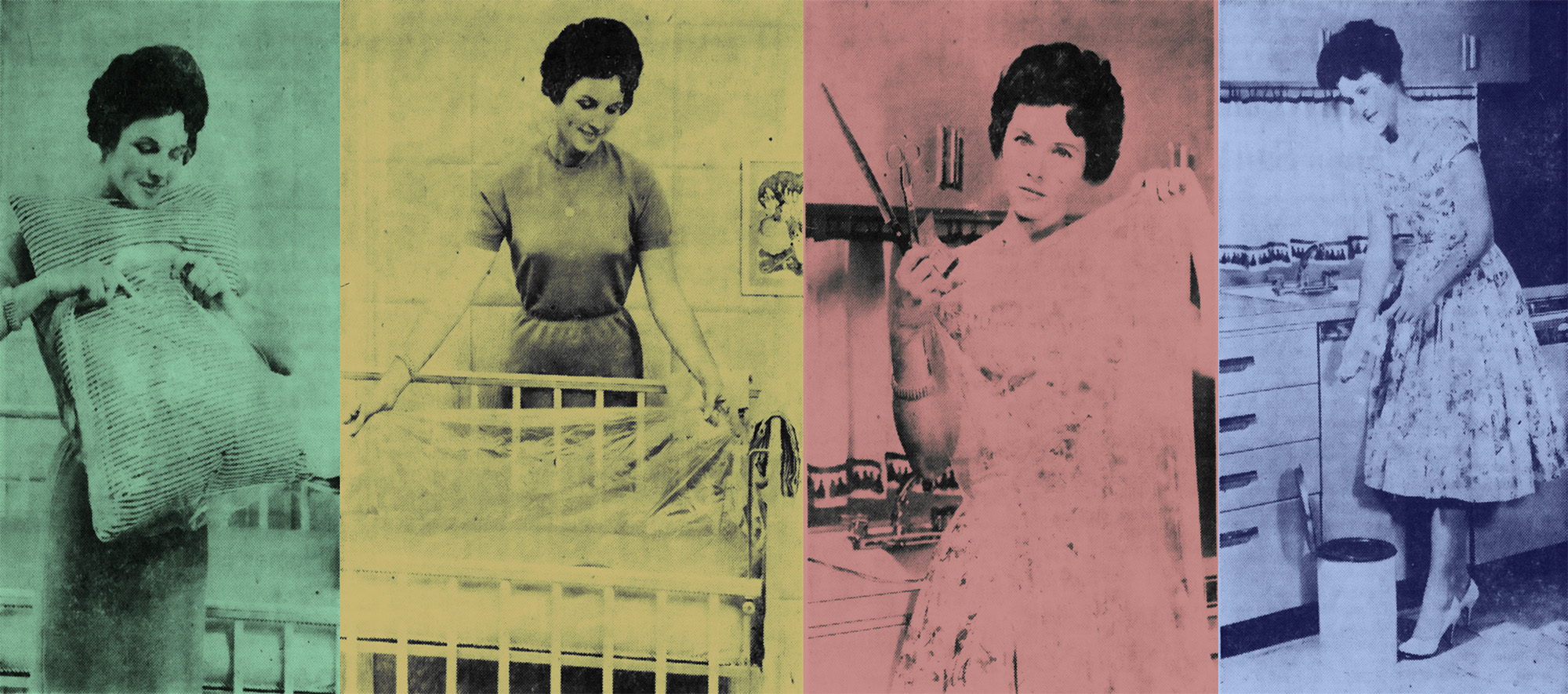
Series of colorized newspaper photos of a woman disposing of a plastic garment bag
Images from “Plastic Bags Can Be Extremely Dangerous,” Hartford Courant, Oct. 1959.

BY THE END of his career, attorney Jerome Heckman considered himself a “true disciple” of the plastics industry and its leaders, “a plastician who also worked on legal problems.” But in 1959, just six years out of Georgetown Law with a specialization in FCC regulations, he may have seemed an unlikely savior for a $2 billion industry destabilized by scandal.

By then, however, Heckman had risen to general counsel for the Society of the Plastics Industry (SPI), a motley alliance of producers that ordinarily focused on freight charges and trade regulations. The year before, he had helped plastic food packagers dodge safety regulations targeting artificial food additives. His second major task for SPI was to pull the industry back from the brink.

The garment bag deaths presented a problem unlike any plastic producers had faced. In the late 19th and early 20th centuries, fires at celluloid factories were an all-too-common occurrence, including a 1909 disaster at a Brooklyn comb factory that killed 10 people. But those calamities had never fomented public anxiety on this scale.

As the crisis deepened, Meikle says, “the industry recognized that they could be doing things that would lead a huge social movement to rebel against them.” Heckman and his colleagues feared the negative publicity and legislative activity might eat into the industry’s long-term profits.

“It was widely suspected that parts of the paper industry were cheering wildly,” he later said. This sentiment wasn’t entirely without merit. Fearful dry cleaners were destroying their supply of plastic bags. Some consumers applauded efforts to return to paper. “Why have these bags, anyway?” a letter to the editor in the San Francisco Chronicle wondered. “For years we did without them. Why can’t we do without them now?”

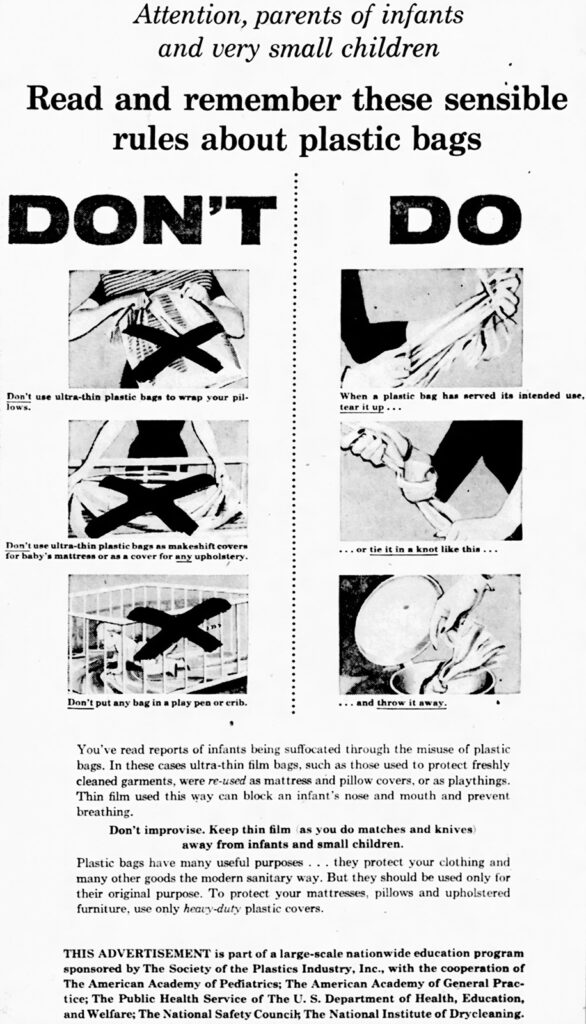
newspaper clipping showing do and don't illustrations for garment bag disposal

Everywhere a new bill appeared, so did Heckman, pleading with lawmakers to forgo any regulations that would slow the plastics industry’s ascent. “Our job was and should always be to open plastics markets and keep them open,” Heckman later said. He traveled some 40,000 miles in 1959—on one eventful day he visited Boston, Cleveland, and Chicago—to deliver a clear argument to legislators: plastics weren’t the problem; people were. The country needed education, not regulation.

SPI hired an ad agency to develop a million-dollar campaign that would ensure “there is not a mother, father, boy, or girl in this country who does not know what a plastic bag is for—and what it is not for,” as William Cruse, SPI’s vice president, said that June.

The organization printed five million warning pamphlets for hospitals, doctor’s offices, and public health clinics and 60,000 placards for dry cleaners to make them and their customers aware of the risks.

SPI-sponsored announcements ran in 164 metropolitan dailies and on hundreds of radio stations, telling parents what they shouldand should not do with polyethylene bags. Bags should be torn up, tied in a knot, and tossed in the trash. “Don’t improvise,” ads implored.

Throughout 1959, Heckman and his colleagues preserved polyethylene’s future by laying the blame at the feet of grieving parents. Cruse secured a statement from the director of the National Safety Council that said the industry was not “in any way to blame for these reported deaths” and instead lamented polyethylene’s “hazardous misuse.” (SPI, which rebranded as the Plastics Industry Association in 2016, did not respond to requests for comment.)

The SPI campaign was rooted in genuine concern for public health, Meikle says, even if it also served the industry’s long-term interests. “They did what they have done basically throughout the industry’s history,” Freinkel says of the industry’s leaders, “which is to make it a consumer problem.”

Arthur Merrill, editor of Plastics Technology, wrote that all the “hue-and-cry” was the result of “misapplied Yankee ingenuity.” McCann, his counterpart at Modern Plastics, reasoned that thousands of children are killed every day by cars, knives, and cleaning fluids, and plastic shouldn’t be treated any differently. “Are the products blamed? No! Adults are blamed—mainly parents. And rightly so.” Besides, he argued, polyethylene film is “non-poisonous, pretty, and most useful in a thousand places.” Parent education was the only answer.

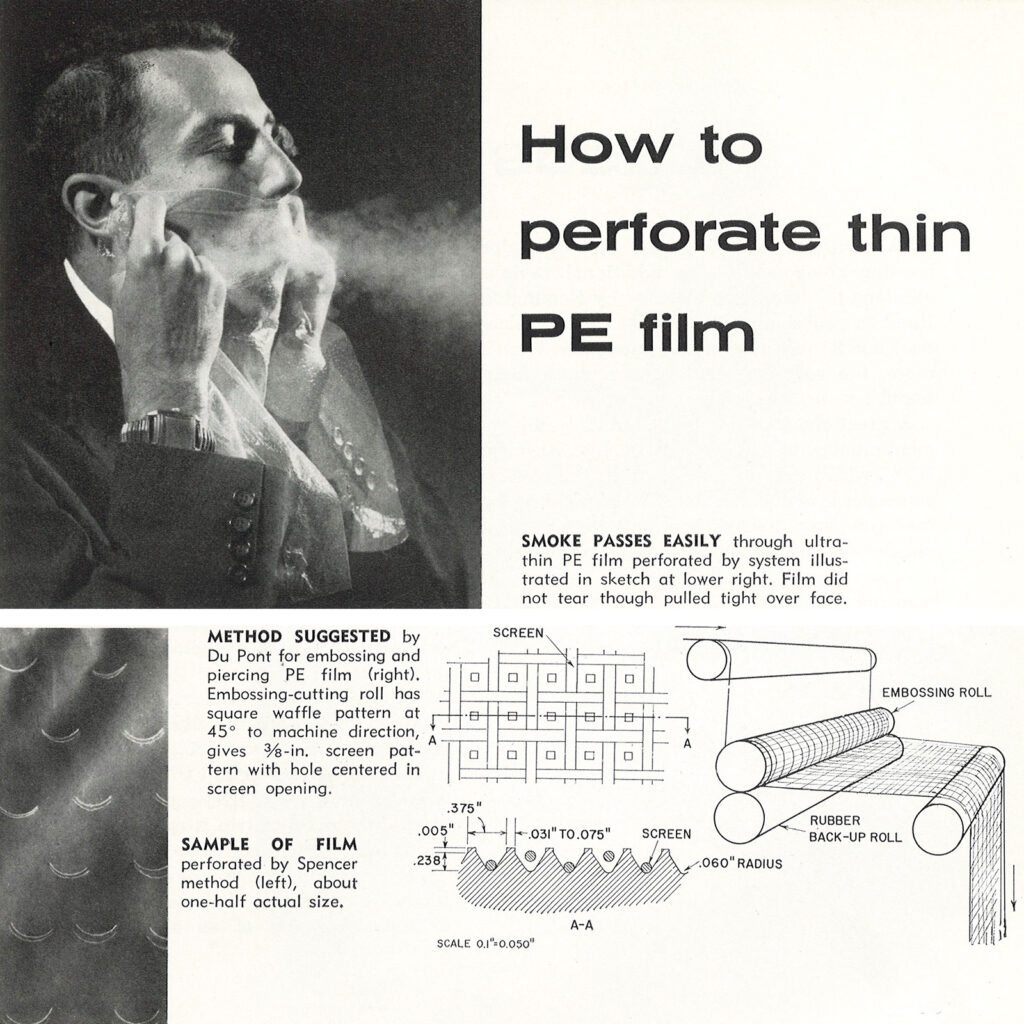
But that claim didn’t stop industry engineers from seeking technical solutions. By June the Technical Tape company was testing perforated, two-ply bags with ridges between the layers to provide “air corridors” for an entangled child. DuPont’s medical division studied the “volumetric breathing habits” of infants and children and determined that bags speckled with 1/32-inch-wide holes would allow a 4-year-old 90% of their normal intake. The company developed film to those specifications and made the production method available for any producer to use. In the fall, SPI introduced a new voluntary standard for polyethylene film thickness for garment bags—no less than one-thousandth of an inch (1 mil)—to keep the film from being sucked into children’s mouths and to keep some manufacturers from cutting costs with thinner stock.

Magazine clipping showing man blowing smoke through plastic sheeting and machine schematics

Where bans were introduced, Heckman and his colleagues successfully quelled their advance or substituted bills requiring bags to be printed with a “sensible warning”—what became the familiar “this bag is not a toy.”

The industry’s strategy had its critics. “What infant can read a suffocation warning?” one dry cleaner asked wryly. Nonetheless, the campaign worked. Once an almost daily occurrence, deaths began to slow. By the end of 1960, the panic receded, but not before the National Safety Council’s fears were confirmed. An exact death count isn’t clear, but records suggest it neared 100, including suicides. 

Heckman later blamed an overeager press for the morass the industry found itself in that year: “The matter broke during one of those times in American history when the media is in special need of material.”

When he was inducted into SPI’s Plastics Hall of Fame in 1986, his handling of the bag episode was recognized as his crowning achievement. But by then Heckman had steered the industry through all manner of quagmires. In the early 1960s, he worked with the FDA to determine an allowable “migration limit” for carcinogenic styrene seeping into foods from plastic packaging. In the 1970s, he was instrumental in clearing the way for soft drinks to be packaged in plastic and in overturning a New York City plastic container tax.

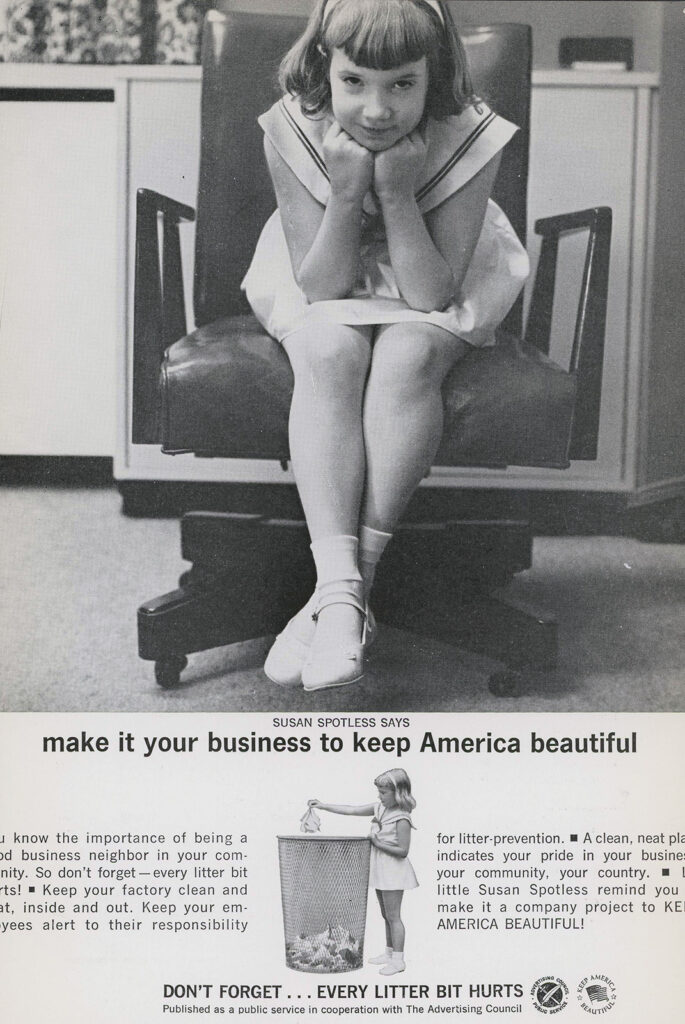
A young girl seated on a office chair over a tagline reading "Susan Spotless says make it your business to keep America  beautiful

As time wore on, the tactics Heckman and his colleagues developed in 1959 proved effective in keeping markets open. When litter began weighing on the public consciousness in the 1970s, the industry knew where to point the finger: “People start pollution; people can stop it,” as an infamous ad funded by the beverage industry declared.

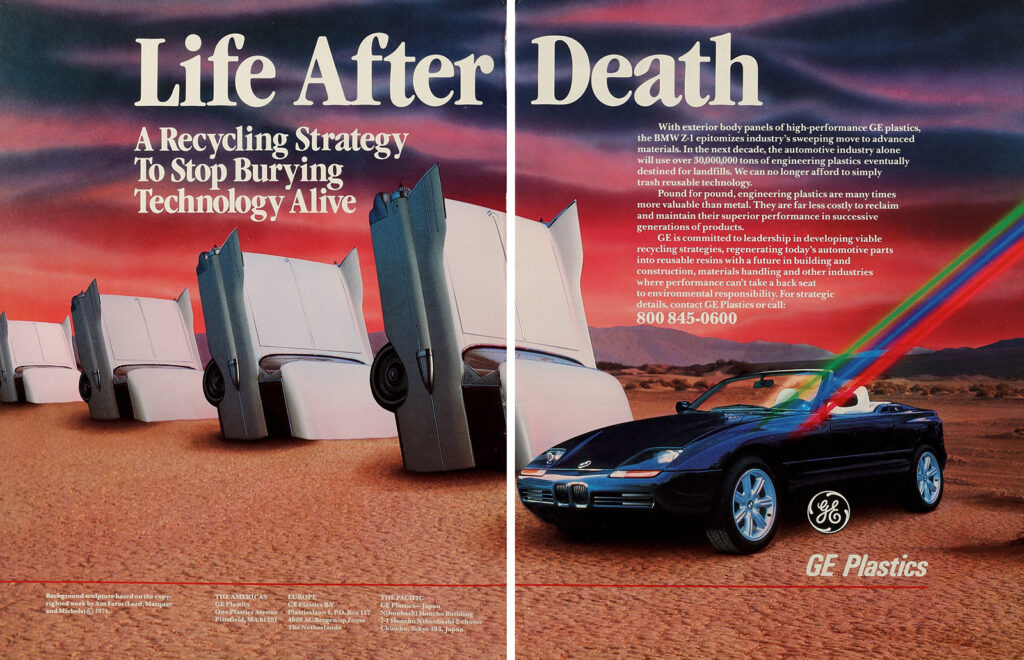
When the public began to worry about the environmental effects of plastics in the late 1980s, SPI created resin ID codes—the numbers tucked inside the familiar “chasing arrows” symbol that encourage individuals to recycle plastic—despite knowing that recycling wasn’t a solution to the plastic waste problem.

The plastics industry “couldn’t help but start to become two-faced,” Meikle says—aware that its products carried real potential for harm, but insistent on promoting their spread regardless.

Global plastic production has doubled nearly once a decade since 1959. The result has been countless conveniences and medical breakthroughs, all while harm is heaped on people and the environment. Microplastic exposure and endocrine disruption threaten our health, and a mountain of plastic waste now occupies nearly one-fifth of landfills used each year.

The garment bag crisis may have been the first glimpse of our reckoning with plastics. In the decades since, Freinkel says, the “love affair has gone south.”

The plastic bag itself remains an icon of both the industry’s success and the public’s unease with plastic. Dry cleaners, of course, still use polyethylene film. Americans consume more than 4 million tons of plastic bags each year, according to EPA estimates. In response, bag bans have returned—this time with concern for pollution and plastic waste. At least 91 countries and 12 U.S. states have instituted full or partial bans. Meanwhile, plastic producers continue to wield heavy influence with legislators, thwarting regulations that aim to address the proliferation of plastic waste.

Desert scene with a line 1950s-era cars half-buried in sand behind a modern roadster under a heading reading, "Life after death"

The garment bag episode offers a reminder that there have always been trade-offs with plastics, Freinkel says, and that we’re still searching for solutions.

For a moment in time, the American public and the plastics industry confronted a weighty question: Will we prioritize innovation or safety? More than 65 years later, the answer still echoes.

“Plastic is us. It’s the ultimate expression of the best and worst of humans,” Freinkel says. “It’s this incredible, ingenious technological marvel. And whether you’re talking about plastics, or atomic energy, or fire, or AI, humans have a way of not being able to foresee or control the technologies that we develop.”

More from our magazine

A person interacting with a large cobra in a jungle-like setting.
DISTILLATIONS MAGAZINE

Venom in His Veins

Bill Haast, the Florida man who tried to milk medical miracles from deadly snakes.


Harvesting and processing of cochineal insects in a cactus field with people working.
DISTILLATIONS MAGAZINE

Red the World Over

How a tiny cactus parasite called cochineal became one of the Spanish Empire’s most lucrative commodities.

People are gathered in front of a mural that reads "#Quito sin minería," signifying protest against mining in Quito.
DISTILLATIONS MAGAZINE

Good Living

Does nature have rights? In 2008, Ecuador said yes. Doing so forced a reckoning with the country’s mining past.

    Republish

    Copy the above HTML to republish this content. We have formatted the material to follow our guidelines, which include our credit requirements. Please review our full list of guidelines for more information. By republishing this content, you agree to our republication requirements.