The Surgeon’s Prosthesis
Morris A. Robbins and a tale of autonomy.
Morris A. Robbins and a tale of autonomy.
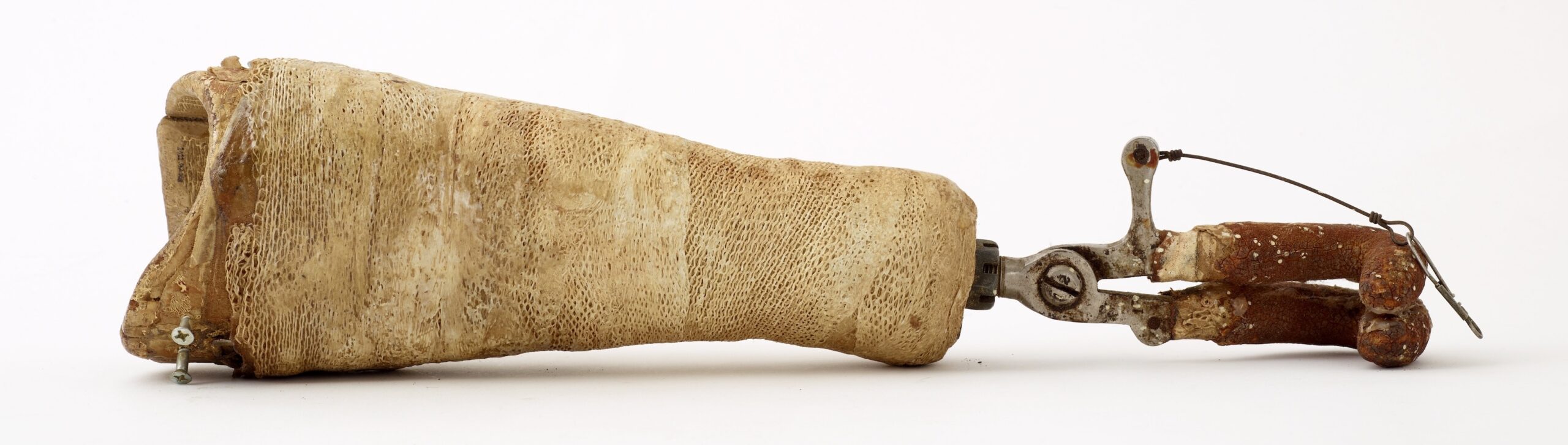
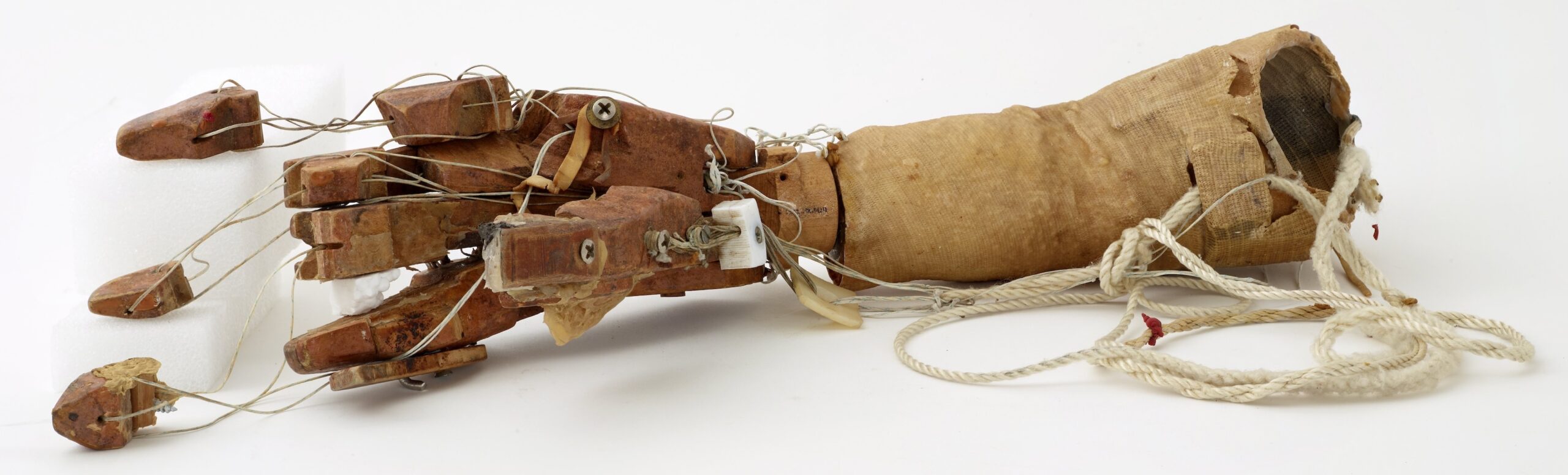
In the summer of 1935, high-schooler Morris A. Robbins made physical contact with an exposed power line, which resulted in the amputation of his left arm below the elbow and severe damage to his right hand. By then, however, his mind was already set on becoming a surgeon: his disability only strengthened his resolve. He spent his life practicing general medicine and surgery in both Pennsylvania and New Jersey, wearing prostheses he designed himself. After his death in 2004, his daughter, Dorothy Robbins Talavera, gave the Science History Institute a collection of his homemade prostheses, along with wooden models, typewritten essays, schematics, and a copy of his autobiography, The Life and Times of a One-Armed Surgeon (2020).
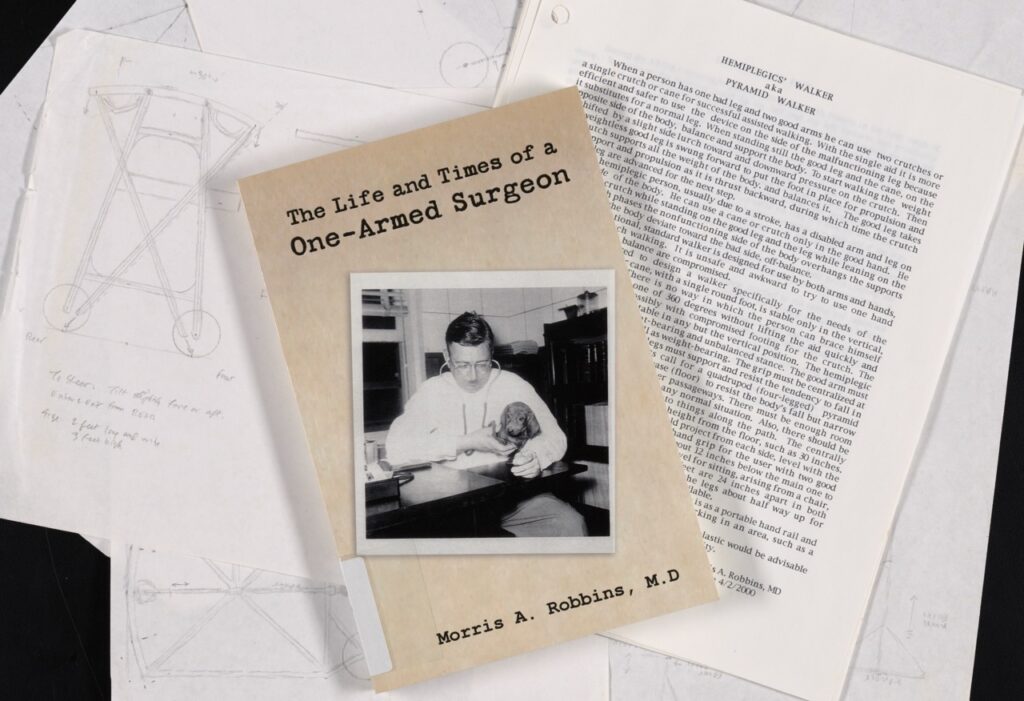
This book contains a letter Robbins wrote as he applied to medical school, from which disabled students were largely excluded. “I invent and construct artificial hands…in order to build self-confidence and ability to manipulate instruments and material, in order to practice techniques which I will use in medical school,” he wrote in his application letter to Jefferson Medical College in Philadelphia in 1941. “I love medicine. I plead for a chance to succeed in it or go down fighting.” The design and fabrication of Robbins’s own prostheses was tied with his practice of “self-confidence.” He did not see his disability as a hindrance, but as an everyday practice that made him especially attentive to his patients’ needs.
Robbins constructed wood-based prostheses throughout his entire life, mostly for himself, although he made a few for his patients, and even for rescued animals! The Science History Institute holds various models ranging from his first experiments in the 1940s to his final prototypes, estimated to date from the early 1980s.
Robbins started with hooks at the ends of his prosthetic arms, then went on to design increasingly complex hands. All of these prostheses were body-powered: a harness around the shoulder and back was strapped to the prosthesis to allow the hand to open and close by shrugging one’s shoulders. Robbins designed his prostheses with surgery in mind—their strong grip was constructed specifically to accommodate tool handles. He theorized about his craft in an essay titled “The Surgeon’s Prosthesis,” published in the Journal of Bone and Joint Surgery in 1994. There, he elaborates on his preference for simple, practical, body-powered prostheses over the “myoelectric” ones, which were entering the market at the time. For Robbins, body-powered prostheses were the manifestation of his ethics of autonomy: I can repair my own body, I know how this part of me functions; I don’t need to charge a battery or have a specialist inspect a part of me I cannot understand.
Autonomy was fundamental to Robbins’s life and practice. As a child, he kept to himself and learned from his father, a carpenter, how to make his own toys. His Christian education and the influence of post-World War II American ideals of masculine self-sufficiency reinforced this perspective. In his view, the duty of a husband and a father was to rely on himself and provide for his family. Being disabled did not change that obligation. Robbins’s prostheses and experiments were founded on an ideal of self-sufficiency anchored in Ralph Waldo Emerson’s concept of “self-reliance”: each individual’s personal responsibility is to invent new paths for their own life, instead of conforming to what society deems normal or accepted. So it makes sense that Robbins often wrote that his disability and his unprofitable experiments made him a “loner,” and he was proud of that.
For Robbins, the functionality of a prosthesis or the accessibility of a vehicle always superseded its appearance, or, in other words, its ability to “pass” as an abled or ordinary body part. In another essay, “Living with One Hand” (1999), Robbins once again opposes the more aesthetically pleasing hand prosthesis in favor of the rougher “hooks” he had been designing and using for decades: “The hand does not hide the deformity but the hook announces that you can handle yourself.” That expression says it all. There is no hiding disability, nor should it have to be hidden; that is not the primary aim of prosthesis. Handling oneself, repairing oneself, and from this state of autonomy, being able to help or repair others, this was the goal of Robbins’s life.
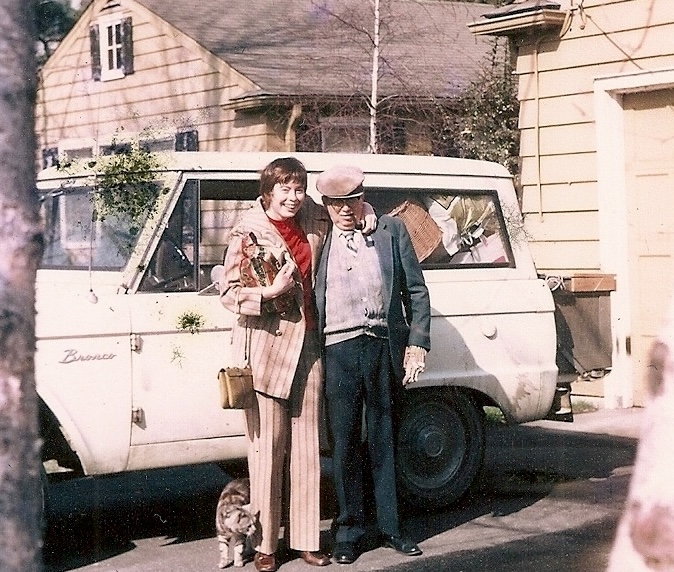
Robbins felt that the medical institutions and specialty organizations of his time kept their distance from him because of his disability and his creative methods. Regardless, it seems he found the most joy when he ran his own practice, where all his activities were “self-contained”: surgery, medicine and experimentation all happening under the same roof. There, Robbins could always count on his family, who repaid his care, craftmanship, and inventions with undying support.
His daughter Dorothy has been a steward of his life and work, entrusting the Science History Institute with his papers and objects, and editing his autobiography. Elizabeth (Betty), his wife, supported him for decades through their many relocations and struggles. One anecdote I found in Robbins’s autobiography proves this perhaps more than any other story I could tell: “Eventually, [Robbins] molded a plaster model of Betty’s left hand, and attached it to his device. That was the hand he used for surgery, because it fit in a surgical glove. Both literally and figuratively, Betty was Morris’ other hand.”
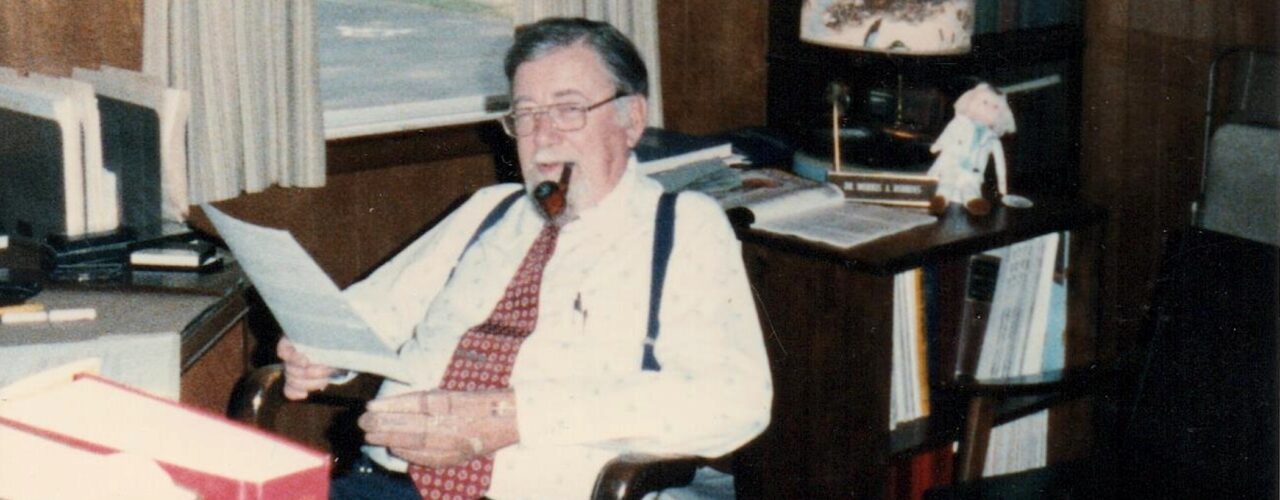
Featured image: Morris A. Robbins in his Burlington, New Jersey, office. Photographed by Betty Robbins, ca. 1965. Courtesy Dorothy Robbins Talavera
Curating an exhibit on student notebooks.
Bringing the past to life with an obsolete video format.
Highlighting the research projects of our current resident scholars.
Copy the above HTML to republish this content. We have formatted the material to follow our guidelines, which include our credit requirements. Please review our full list of guidelines for more information. By republishing this content, you agree to our republication requirements.