You know that dream where you walk into a classroom only to discover it’s exam day? With a flash of terror, you realize you haven’t studied. You’re totally unprepared—a spectator suddenly turned participant. Something like that nightmare came to life for me. And it wasn’t in some classroom. It was during a Nobel Prize ceremony.
My Nobel adventure came about when my wife, Lillian, and I were invited to Stockholm as guests of our PhD adviser, John Fenn, when he was awarded the 2002 Nobel Prize in Chemistry for developing electrospray ionization mass spectrometry (ESI-MS). (I will get to what that is and why it is so important.)
Each laureate party is limited to 16 people. John graciously reserved eight invitations for his ESI-MS co-inventors and their spouses. That’s how Lillian and I snuck in. The laureates and their guests are treated to museum tours, receptions, lectures, and recitals in the days leading up to the award ceremony on December 10, the anniversary of Alfred Nobel’s passing. It is, as one attendee described it, “ground zero for culture and civilization.”
Our Nobel adventure got off to an inauspicious start. A major snowstorm struck New Jersey the day of our departure, severely hampering our drive to the airport. We arrived at the gate mere minutes before it closed.
After arriving in Stockholm and clearing customs, we were surprised to be greeted by a driver named Arne, who led us to a stretch limousine with Nobel Foundation insignias. Each laureate has a limo at their disposal. Since John knew when we would be arriving, he dispatched Arne to deliver us to the elegant Grand Hôtel, where laureates and their guests stay. The laureates are also assigned minders to ensure they get where they need to be on time. John’s minder, or “handler” as he called her, was Ann-Louise Christiansson from the foreign ministry. Ann-Louise was as gracious as she was efficient and went far beyond the call of duty.
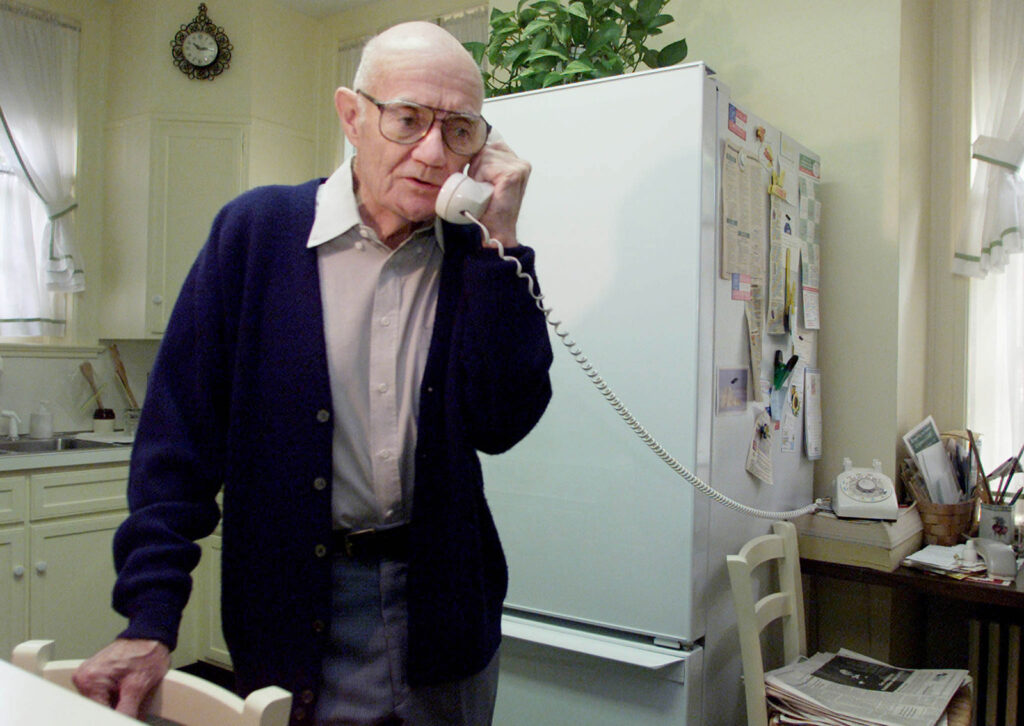
There was a gaggle of spectators, photographers, and TV crews standing in front of the hotel when we arrived. As we walked in, staff members warmly greeted us: “Welcome to the Grand Hôtel.” They then asked if they could take our photo. As Lillian turned to put down her winter coat, the photographer quietly asked if I was Dr. So-and-So. When I said “No,” the greeting party mysteriously vanished. As I registered, a staff member came to apologize. There was no need. They mistook me for a Nobel laureate. If they mistook me for a horse thief, that would have been a different matter.
I have often wondered how different things would have been if I had said, “Yes, indeed I am.” I would at least have a nice photo with Lillian before being carted off after the real Dr. So-and-So arrived. Soon enough, I would get a taste for what a “yes” answer entailed.
Since we were the first of his guests to arrive, John asked us to join a reception for the laureates and their families. We were almost family. After all, John was our matchmaker. Lillian and I defended our PhDs around the same time. When John hosted a celebratory dinner for us at his home, he asked me to pick up Lillian on the way. That was our first date and John’s first attempt at “social engineering.” When we had a family, John was like a surrogate grandfather to our three daughters.
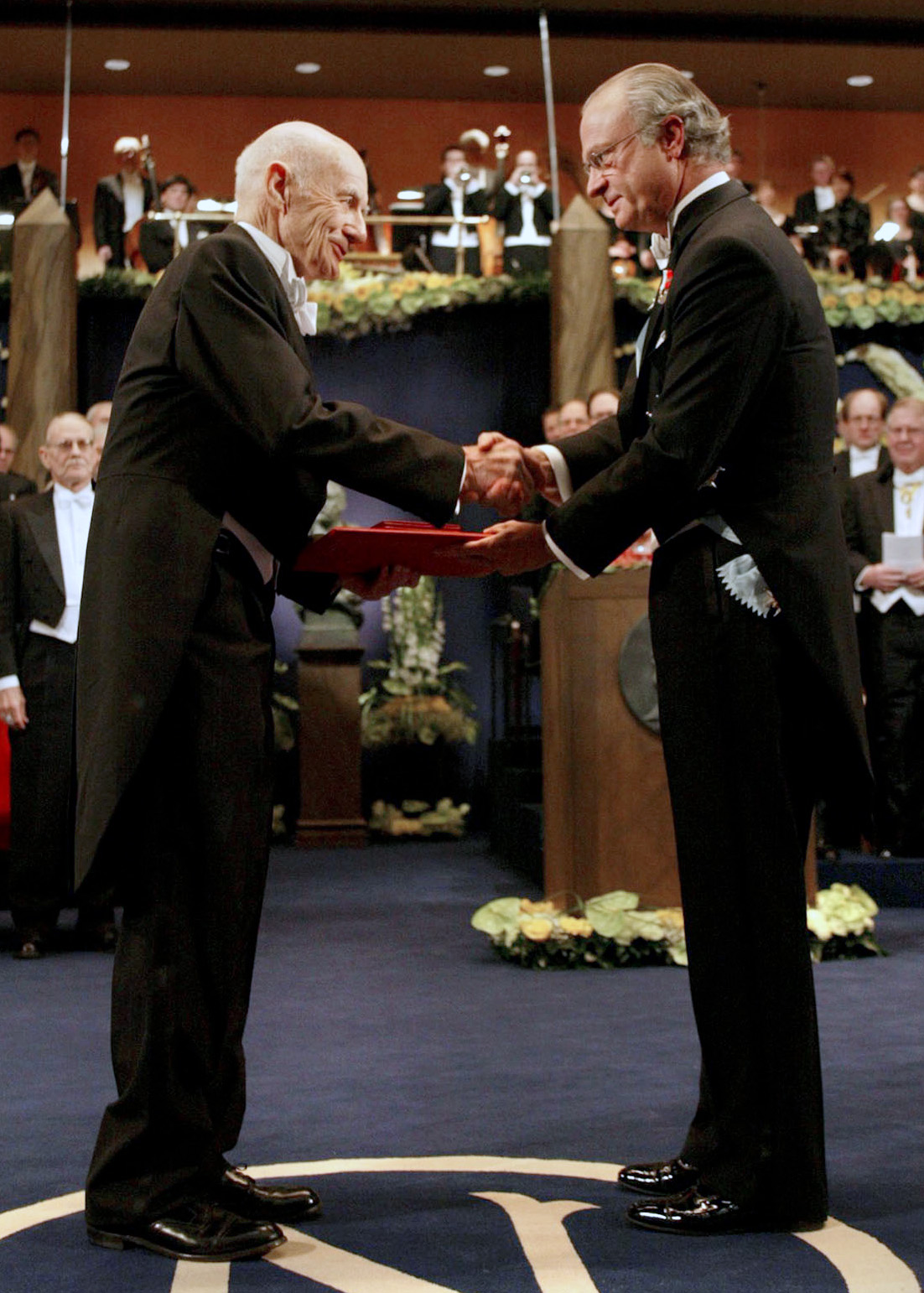
During the reception, the laureates were schooled in the proper ceremony etiquette. As your name is called, you walk to center stage to meet the king, who hands you the medal and a diploma. After shaking hands, you bow to him, bow to the Nobel committee, and then bow to the audience before walking back to your seat—three bows, not two or four. A video was played showing all the laureates who had gotten the bowing thing wrong. The subtle message: bow correctly if you don’t want to be in the next video.
At a press conference that week, John was asked about his greatest discovery: “Discovering I won a Nobel Prize.” He had a way of winning over audiences with his wit and southern charm.
John was born in New York City in 1917 and lived in New Jersey until the age of 11, when the family “lost everything” in the prelude to the Great Depression and moved to Berea, Kentucky. He went through the Berea school system, which was devoted to educating underprivileged students, mostly from Appalachia. John certainly qualified, though he never considered himself deprived. On the contrary, he credited his time at Berea with making him who he was. Berea was his Camelot, with noble, larger-than-life educators he revered.
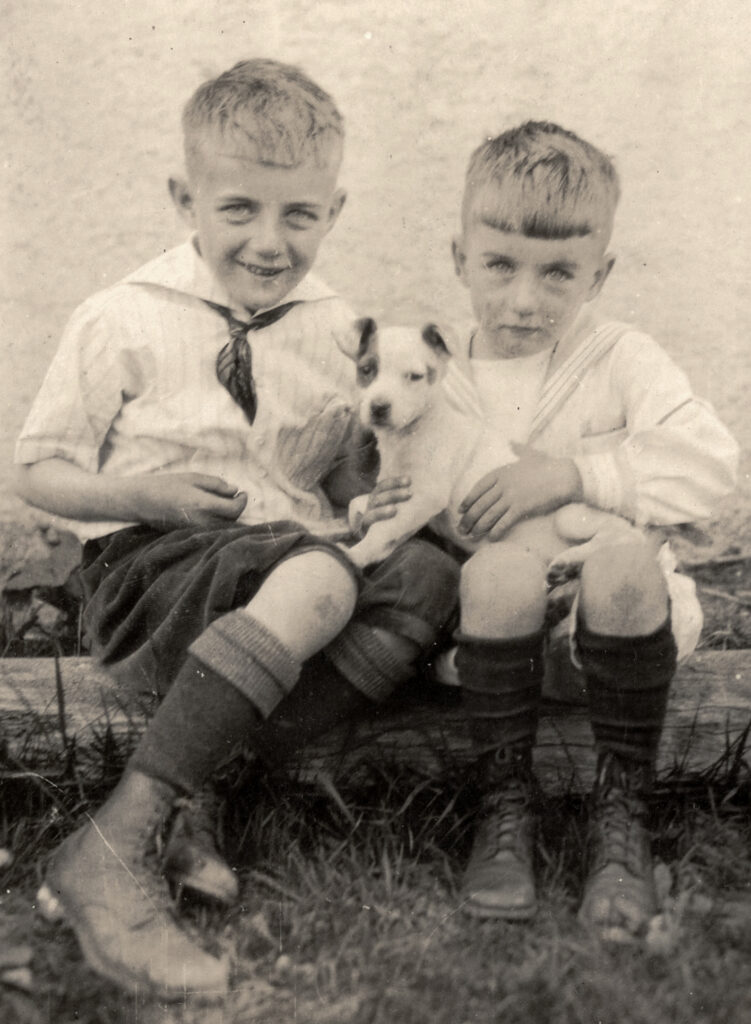
After graduating from Berea College in 1937, John moved on to Yale, where he earned a PhD in chemistry in just three years in 1940. His graduate research, however, was so boring he decided to forgo academia for industry. In time, he gained a reputation as an expert in propulsion and gas dynamics. That reputation propelled him to a directorship of a navy research program, Project SQUID, monitored by Princeton. That, in turn, led to his first academic position as a professor of mechanical engineering.
It was while at Princeton he became the darling of the rarefied gas dynamics community for developing high-intensity, high-energy molecular beams, which are formed by passing a gas through a small hole into a high vacuum. The three 1986 Nobel laureates in chemistry used molecular beams and acknowledged John’s pioneering work. (He was probably fourth on the list that year.) John’s molecular beam career alone is one most scientists would envy. Those who know of John only for ESI-MS, mostly developed in his 70s, might consider him a late bloomer. In fact, he was a double bloomer.
John was lured back to New Haven in 1967 to bolster Yale’s ailing engineering program. Yale was historically strong in the sciences. It had an engineering school before MIT or CalTech even existed, and it awarded the first engineering PhD in the United States to J. Willard Gibbs, one of the country’s greatest scientists. Unfortunately, by the time I was a graduate student in the 1970s, it was common to hear the refrain: “Does Yale have engineering?”
When I first entered John’s lab, it was still very much focused on molecular beams. Mass spectrometry, let alone ESI-MS, was garnering only a modicum of interest.
Mass spectrometry is a method of identifying different chemicals by their mass (or more precisely by their mass-to-charge ratio, m/z). But mass spectrometry has a severe limitation: samples must be in the gas phase. To analyze liquids and solids, they must first be vaporized by heating. As anyone who has fried an egg can attest, large biomolecules like proteins cannot be vaporized by simple heating. This limitation meant mass spectrometry could not be used in medical and pharmaceutical research to analyze complex biomolecules.
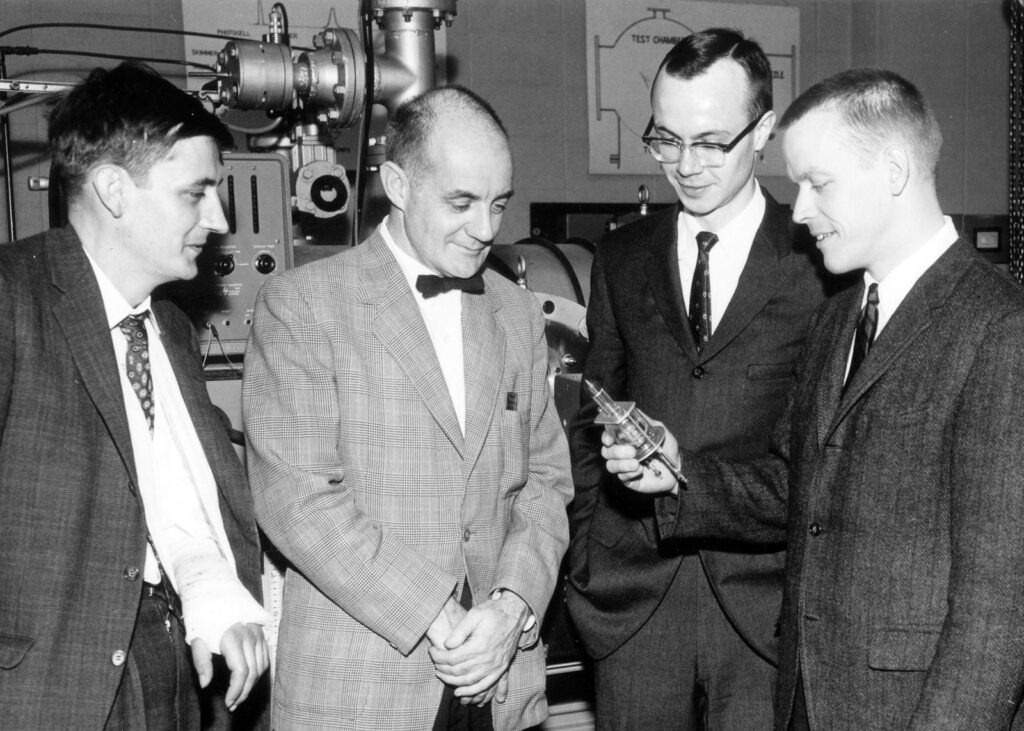
In the late 1960s, Malcolm Dole at Baylor University tried to overcome this limitation by “electrospraying” a protein solution. An electrospray is formed by passing a solution through a hypodermic needle held at high voltage, producing a mist of charged droplets. Dole reasoned that a gaseous suspension of protein ions would form after all the solvent evaporated. That suspension could then be analyzed using a mass spec.
Dole’s mass spec approach, however, failed. The problem, he surmised, was the large size of protein molecules smothered the signal that produces the spectrum used to identify samples: no signal, no spectrum. Dole tried to solve the problem using a method called energy analysis. A molecular beam with protein ions was passed through a repelling electrical field. By noting the drop in signal with increasing voltage, a crude spectrum could be produced. Although the experiment was simple in concept, calculating the mass from a drop in signal was not straightforward. Dole had to cite John’s molecular beam papers to justify his approach.
Those citations formed the nexus between John’s molecular beam and ESI-MS careers. He was intrigued by Dole’s ingenious electrospray idea and sought ways to improve it. He hired a post-doc, who supposedly confirmed Dole’s conclusion about the smothering effect of large proteins on a mass spec’s signal.
As a graduate student, I foolishly asked John whether I could try to reproduce Dole’s energy analysis. John warned that the project was not suitable for an inexperienced student but that I could try—for a while. The request turned into a frustrating year of producing charged droplets, not protein ions. The problem, I reasoned, was one of two things: either the electrospray solvent was not fully evaporating, or the rapid temperature drop of the expanding gas was making vapor condense on the ions, creating droplets. It was only after I reversed the flow of the drying gas to run counter to the electrospray that ions were clearly produced. This counter flow approach enhanced evaporation and prevented vapor from entering the vacuum. I wrote “Hot Damn It Works!!!” in bold letters in my lab notebook. But my “for a while” time ran out. The results were not good enough for a PhD, and I had to change my topic. Oh well.
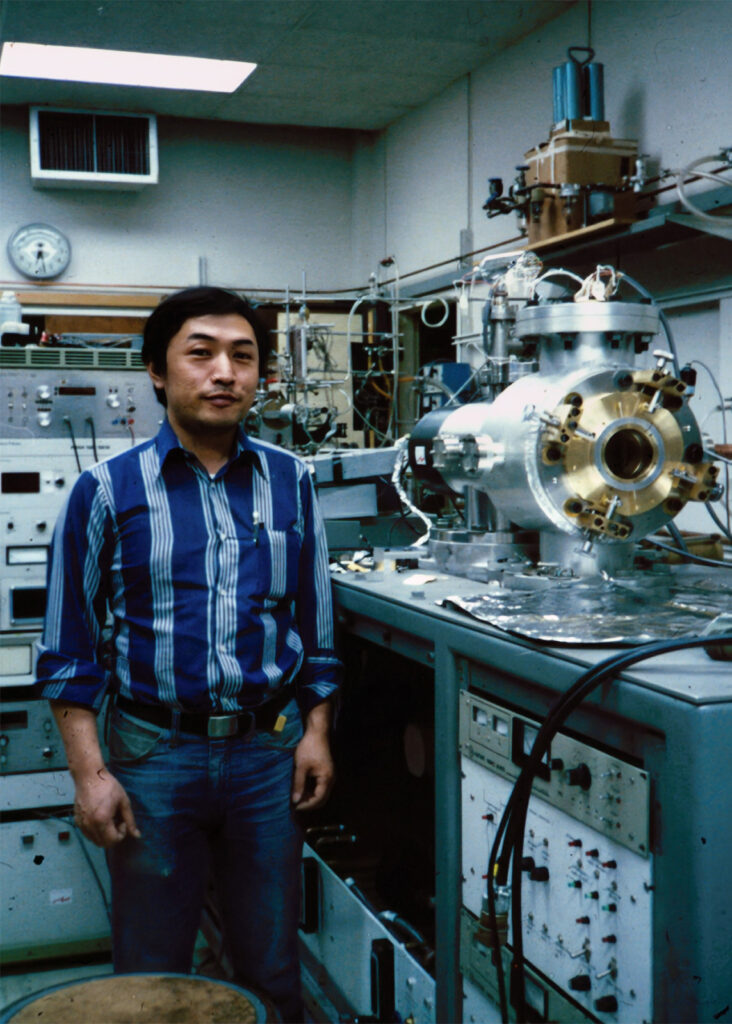
Electrospray lay dormant for a few years until John hired Masamichi “Gado” Yamashita as a post-doc in the early 1980s. John gave Gado a list of possible projects. Luckily, Gado grabbed electrospray. He modified an existing mini-beam system Lillian happened to use for her PhD and added a small quadrupole mass spec. Because of the limited range of the mass spec and with Dole’s conclusions about large proteins in mind, Gado focused on—and successfully analyzed—small biomolecules, such as vitamin C.
Sometime in 1983, several years after I graduated, John mentioned he was going to file for a patent because Gado’s results had commercial value. I was surprised when he claimed the only thing patentable was my counter-current gas flow idea. He then told me he remembered my crazy notebook remark. So, not only would my name be on the patent, it would be first. All of John’s other ESI-MS patents have his name first. When I pointed this out to him, he jested (or I hope he was joking) that putting my name first was a “slip of the pen.” In any event, the guy a high school guidance counselor said had no aptitude for math or science can now tell his grandkids that the original ESI-MS patent is Labowsky et al.
The truth is, John and Gado could have filed without me. We all heard stories about professors stealing credit from students. Here, instead, John was giving the student more credit than the student felt he deserved. Gado, who was much more capable than me, was the real hero. But John was honest and principled. That is why so many of his students and colleagues were devoted to him.
After Gado, Matthias Mann and Chin-Kai “Kai” Meng continued the work as graduate students. With a new mass spec, they noticed spectra of proteins had a series of peaks. This meant electrosprayed proteins were not singly charged, as Dole presumed based on traditional mass spectrometry, but had a multiplicity of charge states. If Dole had considered multiply-charged ions, he, not John, would have been feted in Stockholm. Science can sometimes be cruel.
John had great respect for Dole and was always quick to credit him. He once said that good scientists are often just lucky, or something to that effect. Sometimes they find treasure under a stone they or someone else kicked over. The trick, he said, is recognizing that it is, in fact, a treasure.
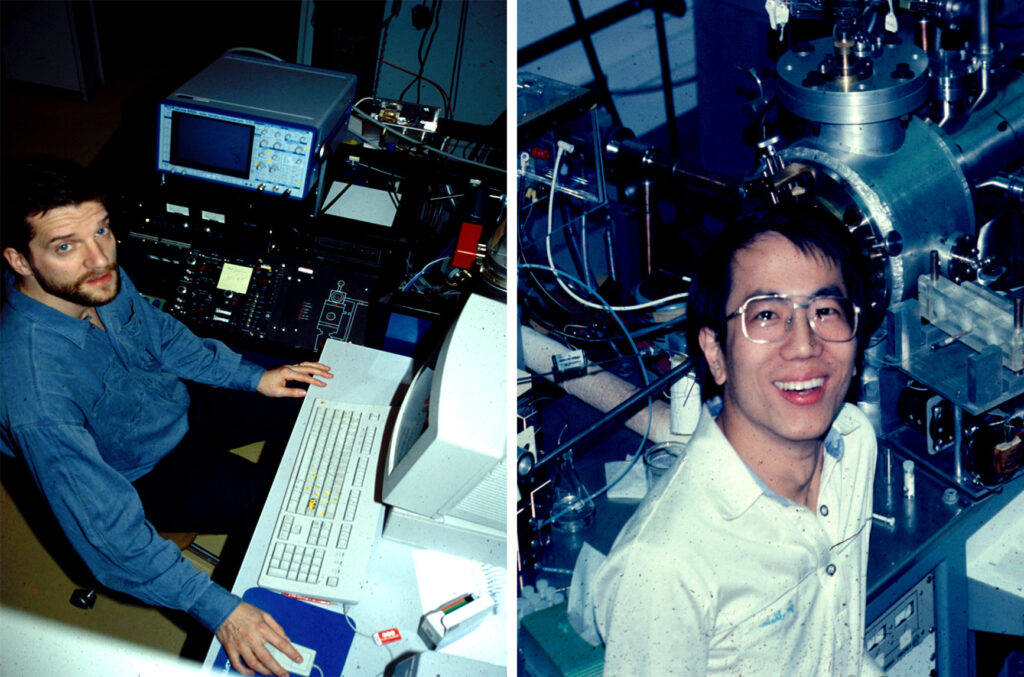
The multi-peaked protein spectra, however, were not much treasured by certain experts. One reviewer commented they were not spectra at all but “dirt in the system.” As a result, ESI-MS remained a scientific curiosity until John mentioned to Matthias that each peak was an independent measure of a protein’s mass. The next day or so, Matthias showed John the results of a “deconvolution” program he and Kai prepared that converted the multiple peaks into a single peak representing the protein’s mass (molecular weight). This was the key discovery. Knowing the molecular weight, a protein could reasonably be identified.
John, Matthias, and Kai presented their work at a mass spec conference in 1988. Though only about 15 people showed up, the presentation ignited the ESI-MS revolution. Today, the technology has morphed into incredibly accurate ways of determining not only a protein’s weight but also its composition and is indispensable in biomedical, proteomic, and pharmaceutical research. That is why John was awarded the Nobel Prize.
ESI-MS was born in Yale’s Mason Lab and may be the only Nobel Prize–winning research conducted exclusively in an academic chemical engineering department. So, yes, Yale has engineering!
Each laureate is asked to give two lectures: a nationally televised one in Stockholm before the ceremony and another, less formal one after the ceremony to students and faculty at Uppsala University.
The first lecture was an indication something was bothering John. He was not his usual eloquent self. Afterward, he appeared exhausted. But at age 85, exhaustion was not surprising.
The ceremony is held in the Stockholm Concert Hall. Men wear white ties and tails; women wear evening gowns. Looking at the stage, the laureates sit on the left, the royal family on the right. Members of the Nobel committees are seated behind them. A full orchestra plays from a balcony above the stage. All of the prizes are awarded in Stockholm apart from the Peace Prize, which is awarded in Oslo. President Jimmy Carter was the Peace Prize recipient that year.
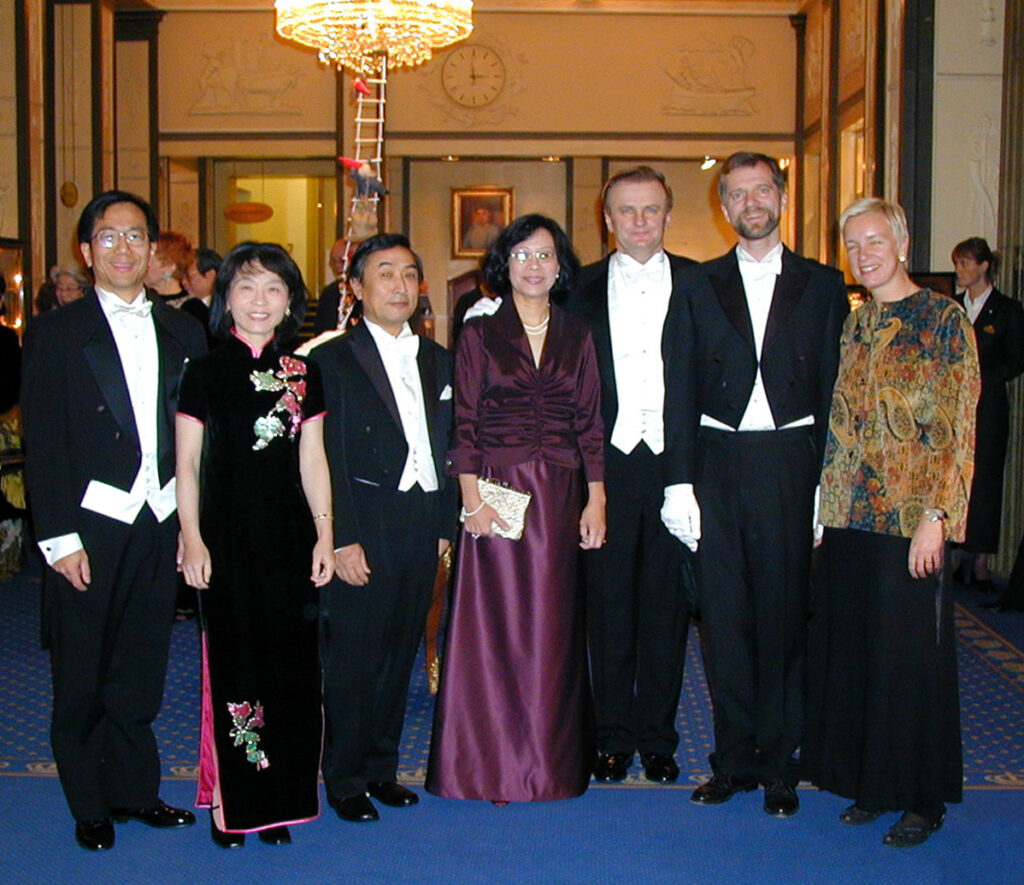
The ceremony is followed by a magnificent banquet in the cavernous Stockholm City Hall. Children line the walkway to the hall holding candles to light the way.
Couples are separated so attendees mingle with strangers, who soon become friends. While the banquet is elegant, you feel right at home.
After dinner, the royal family hosts a reception, where the medals and diplomas are on display. The festivities continue with dancing into the wee hours. Sometime around 2:00 a.m. Lillian and I, not usually night owls, managed to scramble onto a bus back to the hotel. It was a spectacular evening.
The next morning, I took a long walk, still on cloud nine. When I got back, reality dashed me back to earth. John was in the hospital with heart failure.
I learned that during the practice before the ceremony, John felt weak, and Ann-Louise rushed him to the hospital for observation. He returned a few hours later and went to his room to rest. He performed flawlessly during the ceremony, taking his three (and only three) bows and recited a poem from memory during the banquet. He met the royals at the reception and even danced with his granddaughter at the after-party. There was no obvious indication of ill health.
We later found out the doctor who examined him knew he had to be hospitalized but did not want to deprive him of the honor of the ceremony and so arranged for cardiologists to shadow him the entire evening.
After the ceremony, there are no events for the guests, so most leave. There are, however, several remaining events for the laureates, including a banquet with the royal family in the palace and a meeting at the Nobel Foundation for a class photo and to sign for their prizes.
John, unfortunately, missed those events. He was in the Karolinska Institute attached to monitors, IVs, and oxygen. Lillian and I, along with John’s daughter, Barbara, went to visit. As we entered, he turned to Barbara and asked, “Do you think my father would be proud of me?” At age 85, having reached the pinnacle of scientific success, with difficulty breathing and a life-threatening condition, his primary concern was to be a son his father could be proud of.
On Thursday, December 12, I was talking with Ann-Louise in the hotel lobby when she received a phone call. All I could hear was, “Yes, Dr. Labowsky is still here. He can do it.”
Dr. Labowsky can do what?
She explained Uppsala University wanted me to give John’s second Nobel lecture the next morning. Since Gado, Kai, and Matthias—all more qualified—had already left, the choice was me by default. I was stunned. I came for the party. I dread public presentations. When I have to give one, I spend weeks, not hours, preparing.
I fumbled for an excuse—it would be presumptuous to say yes without John’s permission. Ann-Louise called Arne, and we were whisked to the hospital. John said the president of Uppsala was a personal friend and he felt he was letting his friend down by not being there. He would greatly appreciate if I substituted for him.
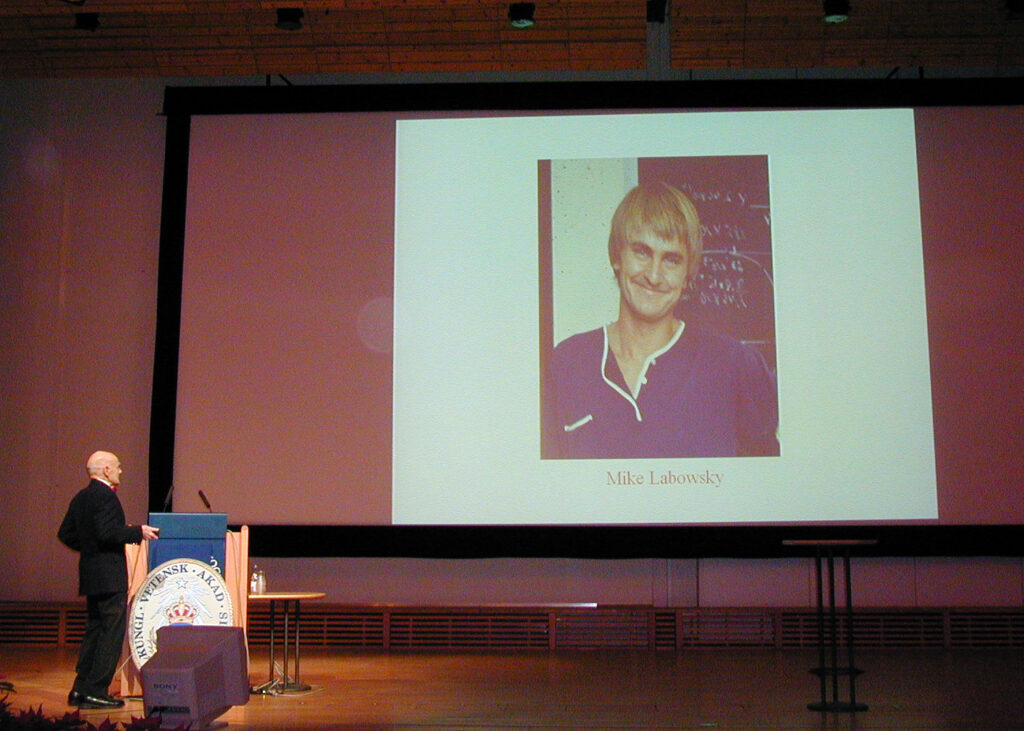
With that, this fish was on the hook. Of course, John’s lecture was in his head. Nothing was written, but there was a CD with slides in his room for me to use. As I left with a sinking feeling, he added, “Have fun!” His concept of fun was far different than mine.
Driving back to the Grand, the fish kept trying to wriggle off the hook. The CD would be of no use because I did not have a computer. Ann-Louise called the hotel. There would be a laptop waiting for me. But . . . I had never used PowerPoint. Another call. The hotel would have someone teach me and would keep the business office open all night, just for me. With that, the fish knew he was cooked.
I arrived back at the hotel sometime after 4:00 p.m. and fetched the CD, which held some 300 slides spanning John’s career. The promised laptop and instructor were waiting. I spent that evening sitting at a small hotel desk with a borrowed computer, a primitive understanding of PowerPoint, a CD with way too many slides, and a totally blank mind. How did I get into this mess? Who could I call to get out of it? It was too late to call even if I knew who to call. That old exam nightmare was coming to life, except I wasn’t sitting brain-dead in some indistinct classroom but sitting brain-dead in a very distinct hotel. As if that was not bad enough, I knew Arne would be picking me up at 7:30 the next morning, which happened to be… Friday the 13th. This was a “dream” from which there was no waking.
At times like this, you count your few blessings. At least this lecture would not be nationally televised—a blessing. If things did not go well, I could quickly escape in Arne’s limo—another blessing.
The audience would be mostly faculty and students, so I decided to talk about John and what it was like to be his student. I finally started to type and grab a few slides. Around 12:30 a.m., Lillian went to the business office in her pajamas and bathrobe to print out a hard copy of my speech—my security blanket.
Even with that blanket, I did not get much sleep. The next morning, Arne arrived promptly to take the prisoner to his execution. My lecture was to be first, so at least the execution would be swift—a final blessing.
When we arrived at the university, I was asked to sign a student’s award certificate, something traditionally signed by the chemistry laureates. Me? Why? I was told this was the first time in some 100 years that there would be a substitute Nobel lecturer. My signature on the student’s award would, therefore, be a novelty. I reluctantly signed but brought the certificate back to the hospital for John to sign.
When I got to the lecture hall, I was somewhat calm, thanks to sleep deprivation. Besides, substituting for John was an honor, especially knowing I was a “novelty.”
I began with an apology for not being John. Once my mouth got going, the 45 minutes passed quickly. The audience was kind enough to laugh at my corny jokes and seemed sympathetic to my plight. Lillian filmed it, but I was too cowardly to watch the video for weeks afterward. I was relieved when I finally did and it was OK.
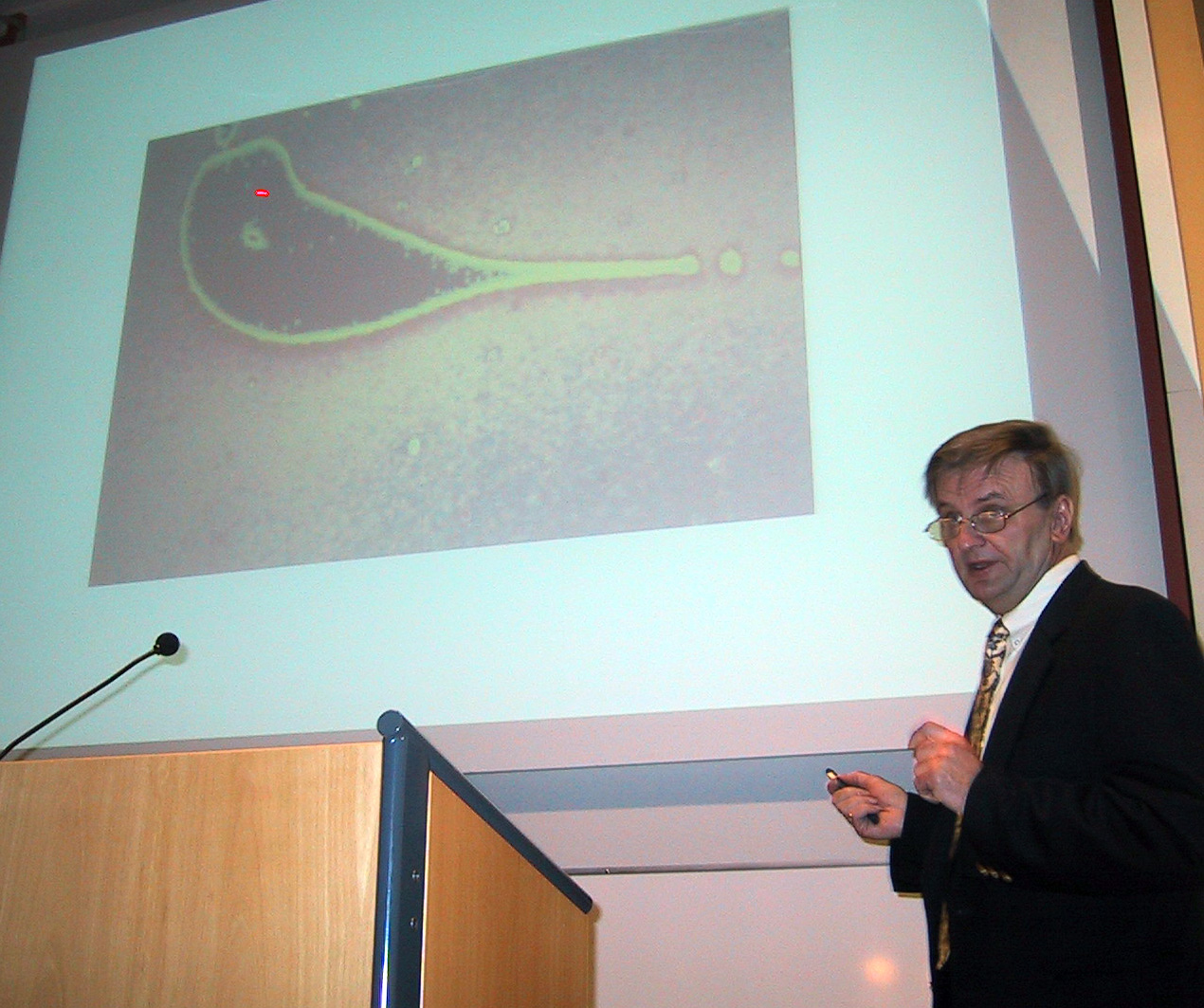
There was a luncheon after the lectures. Eleven long tables were set up in a large hall, one for each laureate. The president had arranged to sit at the head of the table with his friend, John, but he got Lillian and me instead. My burden lifted, I relaxed and enjoyed the meal. It was almost as if I had said “yes” to the hotel’s greeting party with none of the risk.
As Arne drove us back to Stockholm, I asked how many Nobel laureates he had driven. “Five and a half,” he deadpanned.
Lillian and I were supposed to depart the next day, but I felt bad about leaving while John was in the hospital. So Lillian flew home, and I stayed to see whether I could be any help. I, unfortunately, had experience and knew how serious John’s condition could be. On the day the chemistry prize was announced in October, my mother was in the hospital with heart failure. Somehow John found out. In between TV interviews and press conferences, he took the time to call and ask about her. That was John.
John insisted he was OK and that I should go home. I packed my bags, and Ann-Louise made travel arrangements. The night before leaving, I called her to cancel the flight. She then told me John really wanted me to stay, but he did not want to impose on me so close to Christmas. John was always concerned about the well-being of his students, even aged ones.
After a week in the hospital, John had recovered enough to leave in a wheelchair for a few hours to collect his prize at the Nobel Foundation. The foundation, however, did not have an elevator, so we carried him in his wheelchair up the stairs to the inner sanctum where he signed the papers and formally received his medal and diploma. After returning John to the hospital, Arne drove Barbara and me to the hotel with the Nobel Prize in a plastic bag.
By December 20, John was deemed well enough to fly. We took one last limo ride to the airport. Traveling with a Nobel laureate in Sweden is a most pleasurable experience. We went through the airport’s VIP entrance. Our bags were cared for, and we were escorted to the fully stocked VIP lounge as we waited to board. We were asked to sign the lounge’s visitor book. The last person to sign, a few days before, was President Carter. Ann-Louise and representatives from the airline then gently wheeled John to the plane after everyone had boarded.
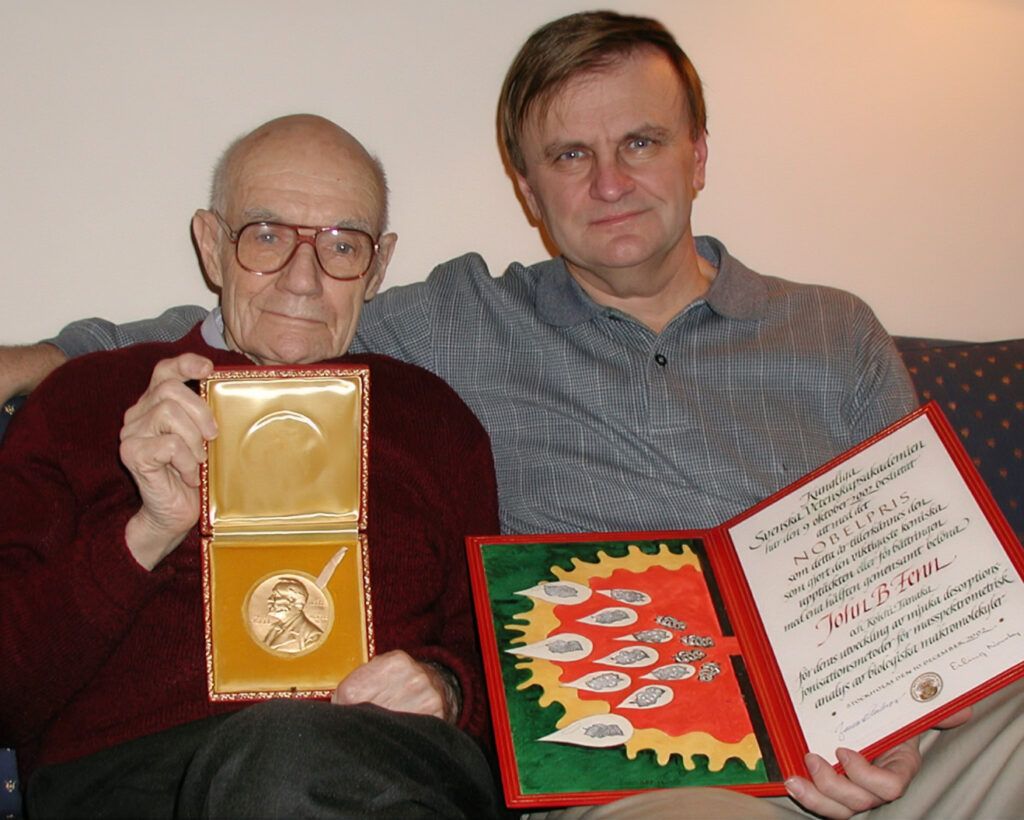
John had triple bypass surgery that New Year’s Eve. In a few months, he was back to his old self. His dance card was always full. He traveled and lectured extensively. Being with him at a conference was akin to standing next to Mickey at Disney World—everyone wanted to talk and take pictures with him. He thoroughly enjoyed the chance to inspire the next generation of scientists and engineers.
John passed away on December 10, 2010, around the time the new class of laureates was being honored. He was a remarkable man who is dearly missed by all who had the pleasure of knowing him.