Distillations magazine

Unexpected Stories from Science’s Past
October 15, 2026 People & Politics

Not So Fast

The limits of racism, power, and the Good Roads Movement in the Americas.

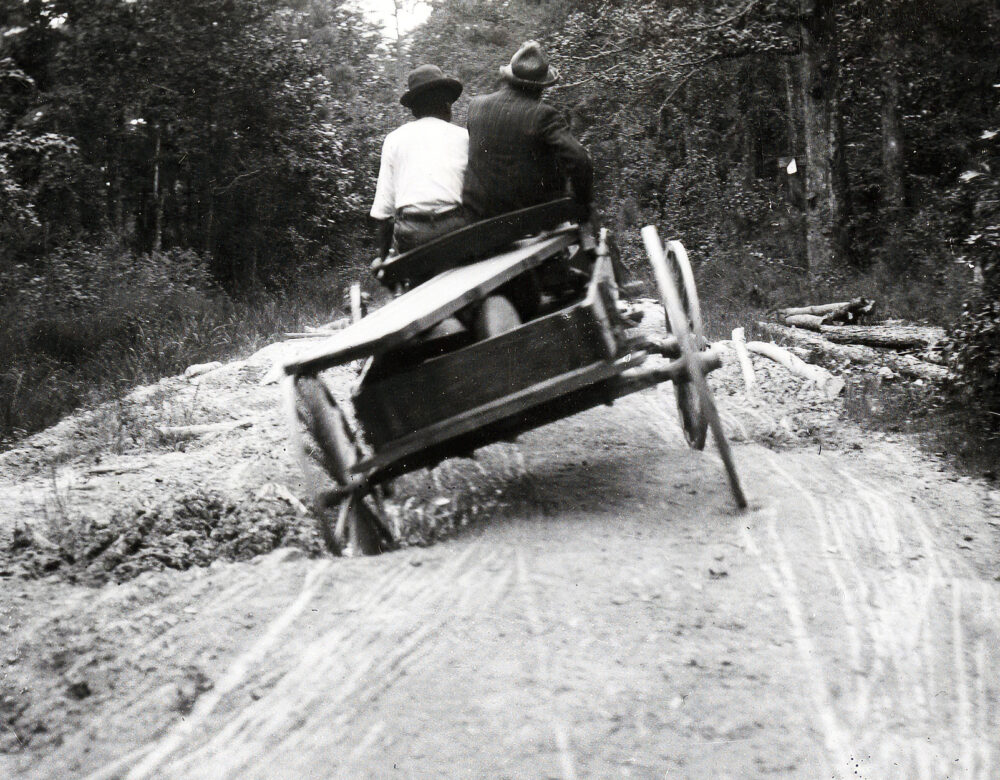
Two men riding in a wagon on a road with deep holes.
About SUPPORT OUR WORK

IT HAD TO HAPPEN AT NIGHT. Dressed in blackface but disguised by darkness, Marine Sergeant Herman Hanneken led a small team into a remote mountain village in northeastern Haiti to assassinate the leader of Haiti’s resistance. From deep within the Massif du Nord mountains bordering the Dominican Republic, Charlemagne Péralte commanded the Cacos, a group of bandits-turned-revolutionaries challenging the occupying forces of Haiti, namely the U.S. Marines, the Marine-trained gendarmerie (military police), and the roads they built and patrolled.

Haitian Cacos saw these officials as just the latest aggressors against Haitian freedom. Modern technology be damned; the Cacos did not need the latest weaponry to refuse occupation. They took their name from the region’s cacos (Hispaniolan trogon), a bird known to ambush its prey. By contrast, U.S. officials painted Péralte and the Cacos as mere criminals who, if not for the Marines, would still be terrorizing isolated communities and transportation routes.

Hanneken and company waited hours for a sign of their elusive target. We know it was early in the morning of October 31, 1919, and already sweltering. Historians will never fully know or agree on what happened next. Let the Marines tell it: Hanneken hid with his team of Haitian gendarmeries in a banana grove until it was safe to walk on foot to Péralte’s location. He noted the smell of beans in the air, but it could have been the burnt cork dripping from his face. According to one military historian, Hanneken’s gendarmes dressed up like peasants (whatever that looked like) to further mask their covert operations. After sneaking past a series of checkpoints, Péralte finally appeared, accessible and vulnerable.

Did the dense overgrowth muffle their gunfire? It’s hard to know. We do know Hanneken and his patrol lugged Péralte’s heavy, lifeless body away on a donkey. Once they had gained the light of the day and distance from the rebel camp, the Marines propped the former chief up for a photo that would circulate in newspapers in many languages but with the same message: do not resist.

This recurring message predates Haiti’s founding, reaching its most aggressive and ironic expression in the Monroe Doctrine. When President James Monroe introduced the doctrine in 1823 to defend burgeoning American republics from European imperialism, the U.S. government still refused to recognize the sovereignty of Haiti, though it had been first in the region to join the United States in independence. Instead, the United States maintained an isolationist policy toward the country until 1862, stifling its political and economic development.
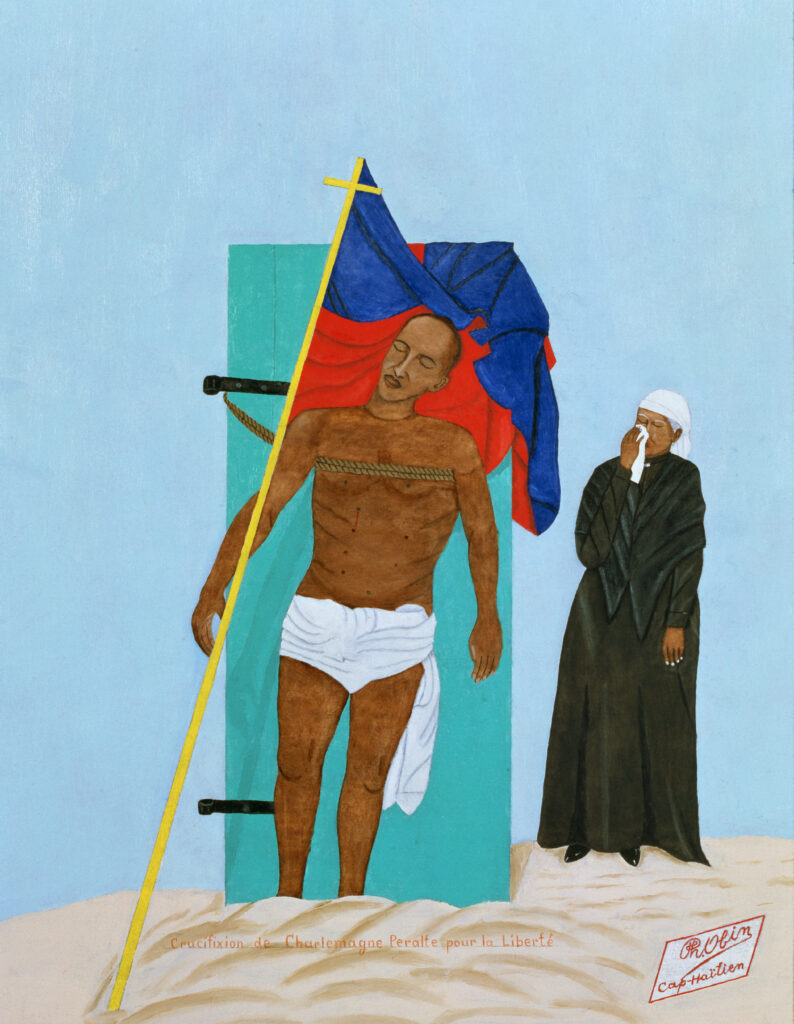
The body of man tied with to a door with a flag draped around his shoulder. A person in the background dressed in a black robe is holding an handkerchief to their face.

U.S. intervention in the Caribbean became more commonplace after the Spanish-American War (1898) and then escalated with President Theodore Roosevelt’s Corollary to the Monroe Doctrine (1904), which asserted that the U.S. had the right to patrol the Western Hemisphere as the preponderant “international police power.” Policing started to bear a closer resemblance to occupation during Woodrow Wilson’s Progressive administration. The opening of the Panama Canal during World War I further emboldened U.S. officials, who believed they had the right to protect their country’s economic interests and for betterment of the whole hemisphere.

The U.S. Occupation of Haiti began in 1915 and would lead to nearly two decades of patrolling. U.S. naval ships patrolled the Windward Passage between Cuba and Haiti after the Panama Canal opened in 1914. U.S. businessmen patrolled the Caribbean for new markets and natural resources. U.S. Marines patrolled the mountainous Haitian countryside for firearms and Cacos.

Wilson awarded Hanneken a Medal of Honor and praised the operation that killed Péralte as the “most singularly important act of heroism in my time.” Five months later, Hanneken received a Navy Cross for returning to blackface to assassinate another Cacos leader, Osiris Joseph. With much of the remaining Cacos leadership in retreat, politicians believed the U.S. Army could continue their work to “stabilize” Haiti through “good roads.”

By the end of the Good Roads Era in the Americas, many officials agreed that “good roads and banditry are antagonistic.” U.S. politicians and military leaders saw a lack of good roads as the most immediate obstacle to their “primary duty of tranquilizing political conditions and re-establishing the economic and social life of Haiti.”

But without racism, as Hanneken knew well, good roads could only carry U.S. empire so far. Racism wasn’t a byproduct of U.S. roadbuilding. Racism was a strategic component that informed who built roads, where roads went, how roads were used, and who benefited from them. Along with raw materials, rare metals, and plantation-grown commodities, the racist divisions of land and labor found in road construction were one of the most important goods exported from the United States during the Progressive Era.
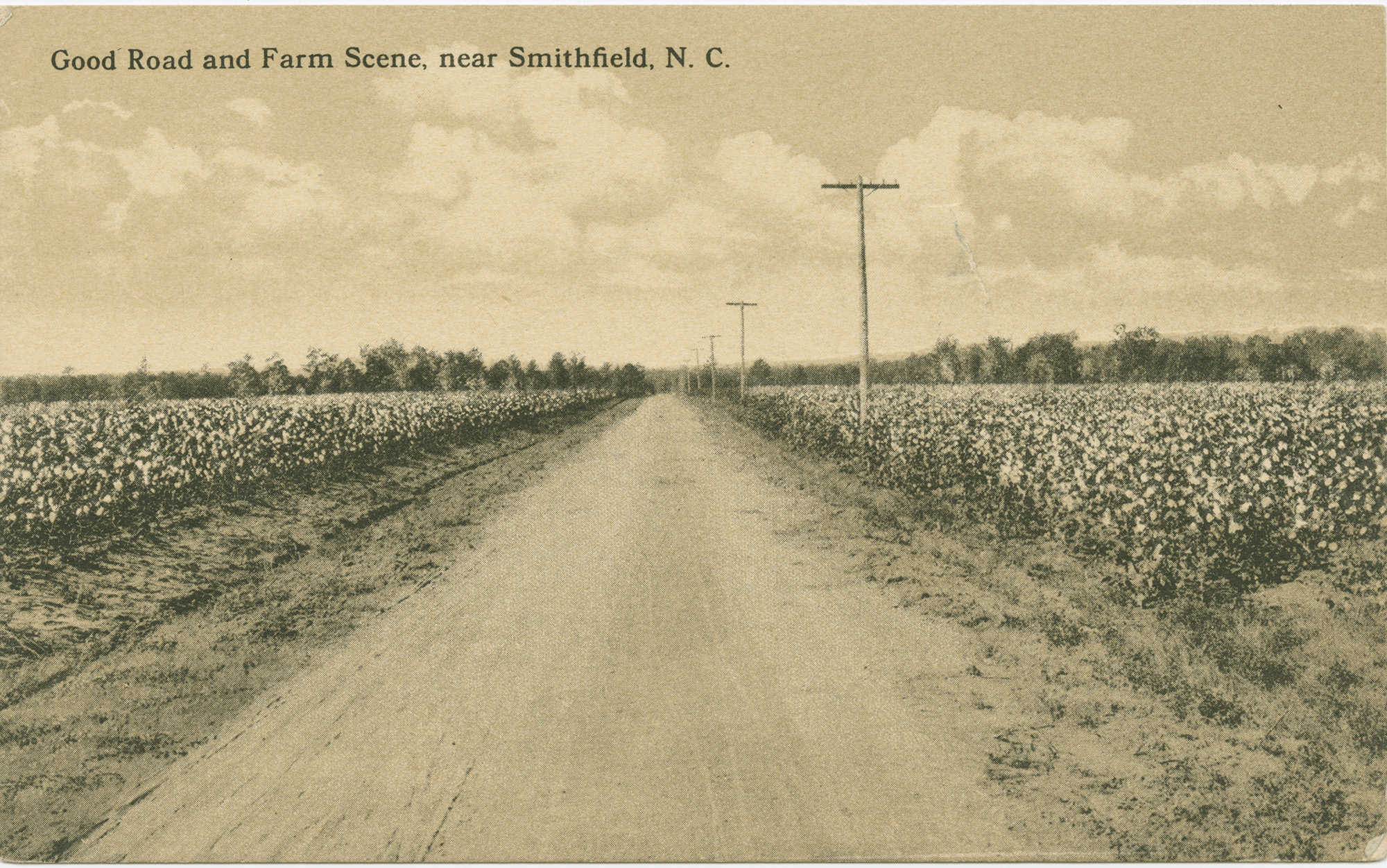
A dirt road with cotton fields on each side. A label reads “Good road and farm scene near Smithfield, N.C.”
Postcard, ca. 1905–1915.

FEW INTERVENTIONS EMBODY Progressive Era politics like the Good Roads Movement. Roads have the reach and poetic latitude to connect disparate and contradictory political goals. They provide a range of sweet and not-so-sweet reminders that most engineering is social engineering.

Progressive politicians ate road rhetoric up and believed that investing in modern roadbuilding and transportation technologies (bicycles and motor vehicles) could help the U.S. government democratize politics, regulate business, and improve social welfare.

Harriet Berry, the mother of North Carolina’s Good Roads Movement, believed that highway construction helped “North Carolina [become] more conscious of herself as a state,” by “connecting county seats and principal towns.” She credited good roads for lifting mountain communities out from “arrested development.” However, she made no mention of the arrested labor central to North Carolina becoming the Good Roads State. This is a curious omission, because her years leading the North Carolina Good Roads Association (1912–1921) saw the state become a model for roadbuilding and racialized labor control.

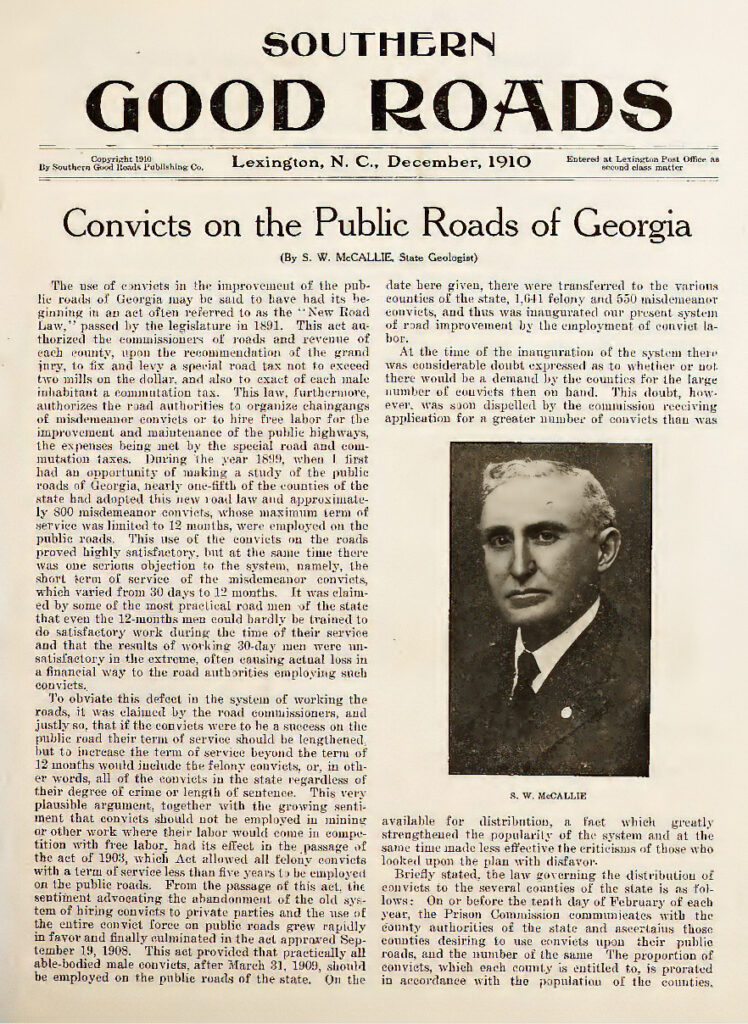
Magazine page with a portrait of a man and an article titled: “Convicts on the Public Roads of Georgia.” The top of the page reads: “Southern Good Roads.”

North Carolina, as scholars Alex Lichtenstein and Darius Scott have insisted, is where the practice of using black prison labor on roads matured. Many southerners saw motor vehicles as the “devil’s wagon in God’s country” and feared modernizing landscapes could jeopardize the racial order. But the Good Roads advocates in North Carolina envisioned roadbuilding as another way to extract value from black labor and Indigenous lands.

For one advocate in the Southern Farm Magazine, “good roads act on the same principle as the enrichment of the soil; they reduce the cost of production while at the same time they increase the value of the land.” It helped that landowners could transform plantation by-products into profit. Some farmers sold rocks in their fields to be hammered into gravel by gangs chained by the ankles. Others sold sugarcane and sorghum waste to road builders, who used the debris to keep wind and water from eroding sandy routes during dry spells. In 1926 road builders and cotton producers in South Carolina even collaborated on experiments that reinforced new roads with layers of cotton.

Prior to the Civil War, there were few prisoners in North Carolina and no state prisons. However, in the wake of slavery, states developed prison and convict-leasing systems to create and channel pools of unfree labor from criminalized black populations. These prison pipelines helped private corporations thrive at the expense of free markets, which led Progressive reformers and labor unions to suggest that convict leasing depressed wages and undermined small businesses.

Wouldn’t it be something, reformers wondered, if states could effectively own and distribute convict labor toward good roads that benefited everyone? If one Progressive asked another, it would likely go unspoken that everyone did not include black people. Progressive white supremacists hoped roadbuilding chain gangs would reconfigure the perceived nuisance value of black people into profits for non-black people. In 1906 the Good Roads Magazine asserted that convict labor for road improvement was “only justified because most of the convicts are negroes . . . and the negro cannot be elevated.” As a form of social welfare, economic modernization, and racial moderation, the chain gang became the ultimate southern Progressive reform.

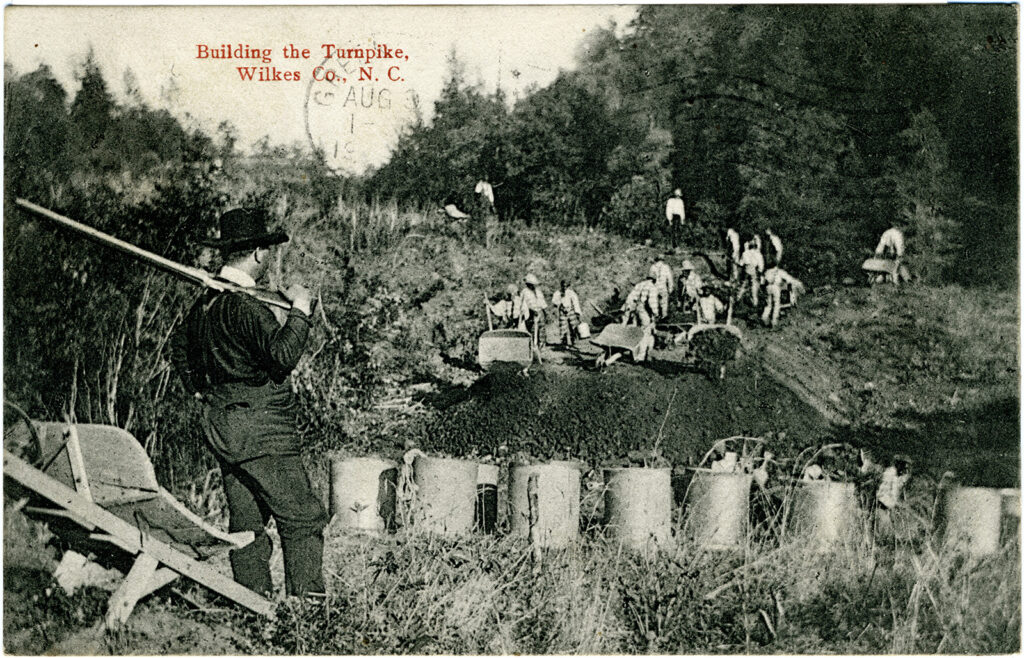
A man with a gun observing a group of men building a road. A label reads, “Building the turnpike, Wilkes Co., N.C.”

But there was no reforming their anti-blackness. Path dependence on unfree labor mapped best onto plantation landscapes with historically large black populations and with the greatest need to transport cotton and tobacco to market. With the chain gang as a prerequisite for modern roadbuilding, plantation zones could—in true Gilded Age form—move simultaneously backward and forward, while counties with fewer black men and women to incarcerate lagged behind.

Justifying and normalizing this modernization came naturally to Good Roads advocates who, in many magazine articles and advertisements, called roadbuilding a healthy, restorative, and natural activity for black people. This reinforced the exploitative belief that black people were accustomed to, and best suited for, outside work. They described it as a “healthful occupation” with more sunshine and fresh air than prison cells, prison factories, and mines. Even better, roadwork in the south was a year-round activity.

The transition to convict-built good roads was fast. Starting earnestly in 1908, North Carolina’s Good Roaders facilitated nearly 6,000 miles of resurfacing within a year using exclusively convict labor in counties with enough black people to incarcerate. When North Carolinians elected Locke Craig as their first “Good Roads governor” in 1912, between 60% and 70% of all state convicts worked on public roads. North Carolina’s second Good Roads governor, Cameron Morrison, a well-known white supremacist who participated in the 1898 Wilmington Insurrection, expanded the chain gang model even further.

Armed surveillance discouraged poor work and escape. In the case of one prison road camp, a former slave catcher and Confederate soldier “adopted the rule that no guard should be employed who is not a good shot.” Even in “experimental” camps that did not force prisoners to “work under the gun,” it was general practice for convicts to be chained to one another through the night.

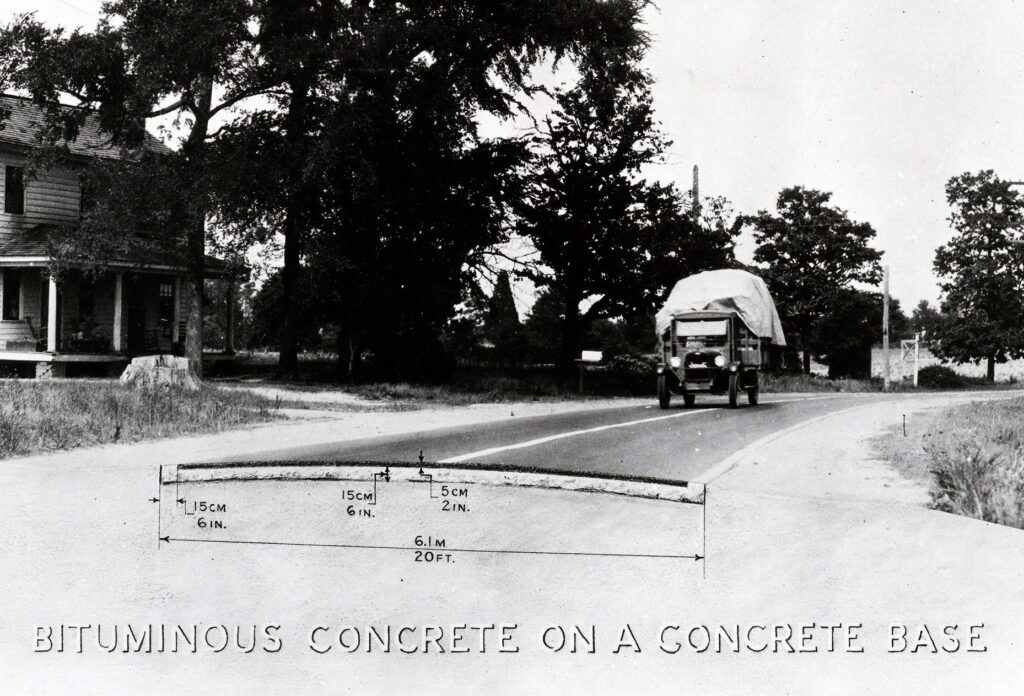
A photograph of a truck on a road with a house on the left. A cross section of the road is shown in the middle of the image. Text at the bottom of the photograph reads: “Bituminous Concrete on a Concrete Base.”

Sociologists from the University of North Carolina who investigated the post-Morrison chain gang found the system rife with “mismanagement, inhumanity, and futility” and suggested that when a county adopts a “convict roads” plan, it becomes necessary to maintain enough prisoners to justify the overhead costs of equipment and supervision. “There is evidence,” they noted, “that in some instances the mill of criminal justice grinds more industriously when the convict road force needs new recruits.” Sanitary conditions were dire in the camps the researchers visited. They concluded the problem was complicated by the “traditional idea that punishment must necessarily be harsh, severe, and painful.”

None of that slowed the convict road’s spread, first around the country, then throughout the hemisphere. And as the Good Roads Movement moved from place to place, North Carolina became a place to showcase the power and potential of roadbuilding in a variety of environments.

In June 1924, in the lead-up to the first Pan American Highway Conference in Buenos Aires the next year, dozens of manufacturers of roadbuilding machinery and automobiles invited 40 Latin American engineers and state officials for a monthlong tour of road-related developments across the United States.

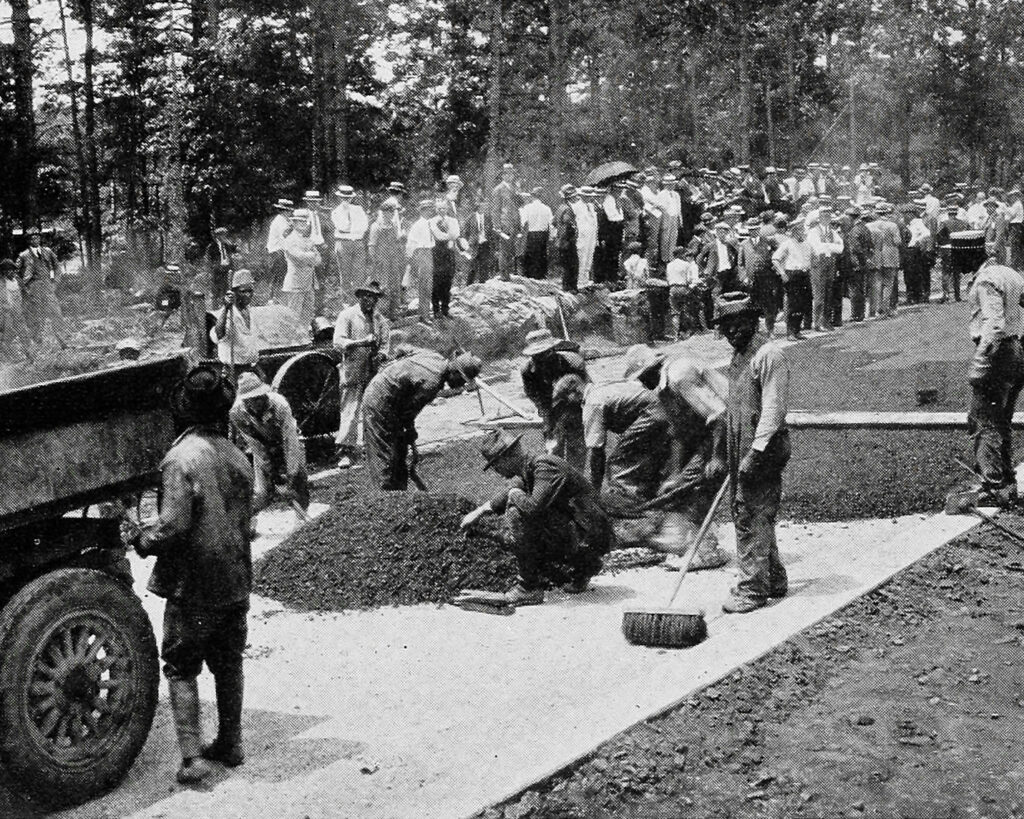
A group of men building a road while a crowd watches in the background.

The tour spent a week in North Carolina, thrice as long as any other state. North Carolina’s climate and geography mattered. U.S. Good Roads diplomats believed that the state had “approximately the same conditions of climate and soil as prevailed in their own countries.” From Asheville to Greensboro, Raleigh to Charlotte, the tour explored mountain roads, discussed coastal roads, and saw roads connecting tobacco and cotton plantations.

Reports from the tour are reminders that the United States never held a monopoly on white supremacy in the Americas. Latin American officials might have been skeptical of U.S. power, but not its racial hierarchies and anti-blackness. It is unlikely that these officials, most of whom were white or white-passing, had any issue staying at the Robert E. Lee Hotel or watching a group of 500 black singers perform “southern folk songs.” Anti-blackness was nothing new. Observing the black chain gangs laying roads throughout North Carolina only helped to normalize and modernize a scene that would become more common as Latin American governments with large, marginalized, Afro-descendant populations increasingly invested in black-built good roads.

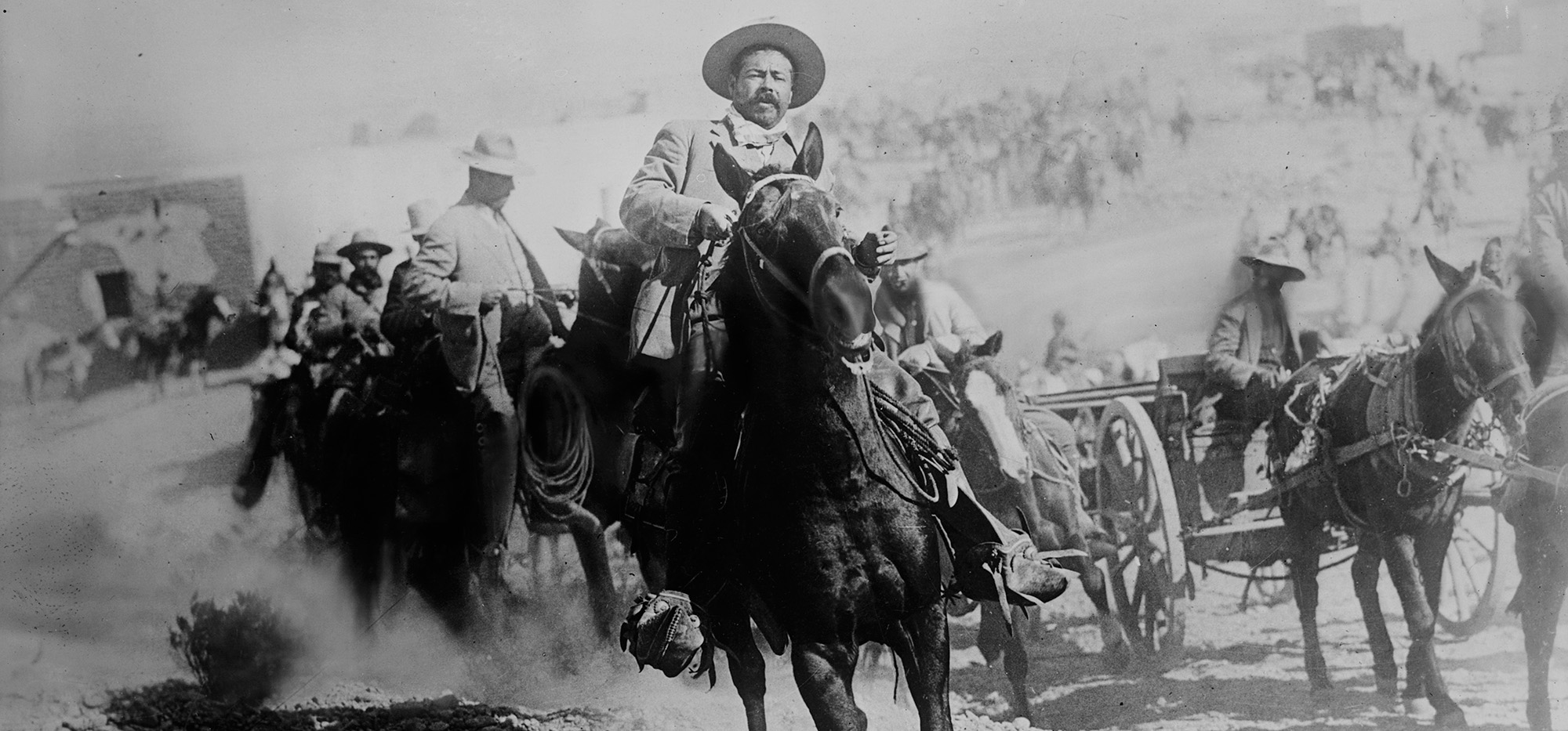
A man riding on horseback with wagons and other riders in the background.
Francisco “Pancho” Villa during the Mexican Revolution, 1914.

IF NORTH CAROLINA MODELED the uncivil engineering of roadbuilding, then the Mexican Revolution helped to inspire how the U.S. government came to invest in military road construction at home and abroad.

The Mexican Revolution started as a widespread uprising against dictator Porfirio Díaz in 1910, but after revolutionaries forced Díaz to flee the country in 1911, Mexico entered nearly a decade of political and armed struggle.

First came the assassination of the revolution’s first president, Francisco Madero, by Victoriano Huerta, who assumed the presidency in February 1913. Four leaders emerged from that chaos—Pancho Villa and Emiliano Zapata on one side and Álvaro Obregón and Venustiano Carranza on the other—who formed an alliance that finally ousted Huerta in July 1914.

However, that alliance began to crumble, and Villa took the worst of the fallout. He lost touch with Zapata by early 1915, lost on the battlefield to Obregón in mid-1915, and finally lost the political backing of the United States when it decided to endorse Carranza that October.

This turn of events sent Villa into a desperate tailspin. He devised a plan to raid a small U.S. garrison town to get munitions and regain favor with a wider Mexican base. In the early morning of March 9, 1916, Villa led several hundred men across the border and into the small town of Columbus, New Mexico. His scouts, however, misjudged the size of the garrison. What was planned as a raid unraveled into a full-out battle. By sunrise Villa was in retreat, having killed 17 U.S. citizens. Villa lost as many as 190 soldiers, but the U.S. military was not done with him. The chase for vengeance was on.

A photograph of trucks, tents, and buildings. A caption at the bottom reads: “Army camp Columbus N.M. / Auto truck suply [sic] train about to leave for Mexico / Shulman”

The purpose of a punitive expedition is to act with violence and go home. Or that’s how it was before punitive expedition became a proper noun in Mexico. What started as a hunt for Pancho Villa became a yearlong engineering challenge, as hundreds of motor vehicles and thousands of men raced from across the United States to the border of Chihuahua. The Punitive Expedition would forever influence the way U.S. engineers built motor roads and how U.S. military occupations operated in the Caribbean and Latin America.

At 3:17 p.m. on Thursday, March 16, just a week after Villa’s attack on Columbus, the U.S. military crossed the border into Chihuahua with an initial force of 4,800 soldiers. Carranza’s government, which acquiesced to the U.S. incursion warily, would not grant U.S. authorities access to Mexican railroads. Frederick Funston, the general overseeing the entire campaign, thought cavalry was the best alternative for the hunt. But Brigadier General John Pershing, who was charged with leading the expedition into Mexico, foresaw a foraging problem. They compromised on a semi-motorized expedition that used more than 8,000 horses and mules.

At first, Chihuahua’s narrow dirt roads stood up to the wear of the cavalry and motor vehicles. However, with 17 automotive companies transporting more than 78 tons of cargo daily, truck convoys soon degraded the roads into impassable ruts. This caught officials off guard. The entire U.S. Army had only 56 automobiles and 105 trucks before the expedition; the heavy wear on roads was a novel hazard. Chasing Villa in motor vehicles, it became clear, would require new roads built in new ways.

Despite his misgivings about the operation, Carranza wanted to punish Villa for challenging his new government. He authorized the U.S. military to use civilian labor in roadbuilding and in militias. The Punitive Expedition would have been impossible without the hundreds of Mexican and Mexican American laborers Pershing and Chief Engineer Ernest Graves hired to build roads and trained to assist in the hunt for Villa.

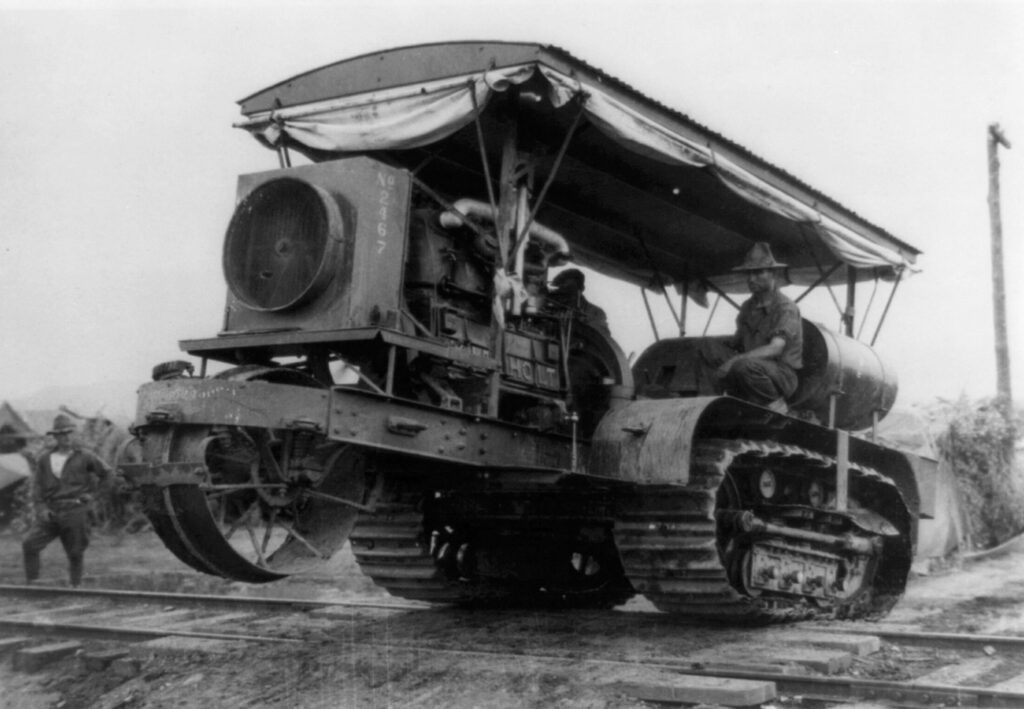
A large vehicle with tracks crossing railroad tracks, with its front wheel in the air.

Engineers stationed in Columbus began to request roadbuilding equipment in late March and started mapping practicable routes in April. As with all road engineers, drainage was a primary concern. Water is normally the enemy of road management. Roads, they say, wear from the top down but fail from the bottom up without stable, compact foundations that can withstand changes in moisture. Road builders deploy crowns, shoulders, ditches, and culverts to control and displace water. However, spring showers are few and far between in the Chihuahuan Desert. Army engineers found themselves in the odd position of longing for their old enemy. With no water, dust ruined machinery, perishables, and roads. They struggled to compact layers of gravel, sand, and rocks.

The army’s first “decided departure from the usual road-making principles” was the sunken road. Because the region’s alkali dust particles could not be packed, molded, or fixed into a graded road, Mexican laborers and black soldiers resorted to “shaving” the road surface down to the bedrock. Because sunken roads required constant shaving, they demanded more labor and new scales of maintenance. Labor demands only increased with the arrival of the rainy season. More Mexican labor was the solution.

At its peak, the expedition employed 1 of every 11 U.S. soldiers. Outside the army, businesses and civilians flocked to the Southwest to support the cause. Within months, more than 100,000 guardsmen “protected” the border. Companies without prior relations to the military sent vehicles, guns, and other machines. With this support, army officials facilitated the construction of 157 miles of new road and repaired another 224 miles, but not one inch of this work helped them catch Villa. Villa and his men knew the land beyond the road better than their enemy.

Even though Pershing’s forces never reached Villa, the expedition helped to discredit him and hurt his chances of regaining national influence over Carranza. The signing of the new Mexican Constitution in early February all but sealed Carranza’s victory over Villa. Not to mention that the Zimmerman Telegram to Mexico a few weeks earlier already helped shift the army’s focus to Germany and the Western Front.

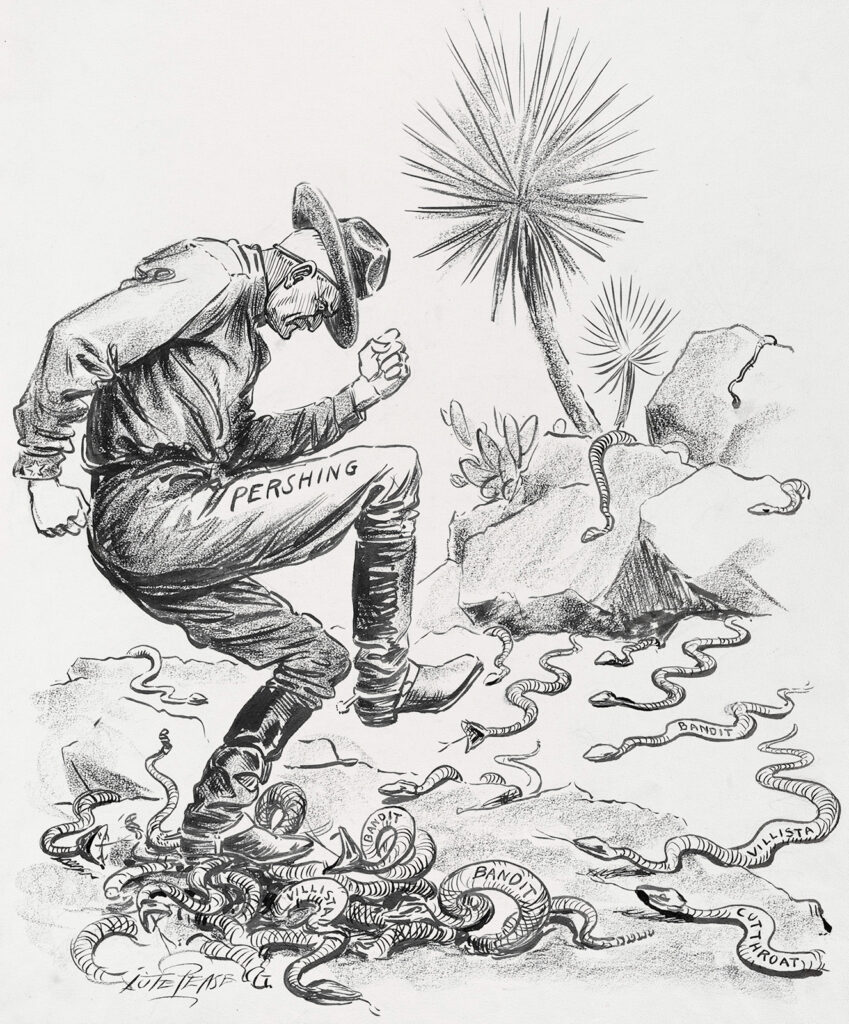
A cartoon of a man in an army uniform labeled “Pershing” stamping a nest of rattlesnakes with his feet. The rattlesnakes are labeled “bandit,” “cutthroat,” and “Villista.”

The lesson for the U.S. public wasn’t that good roads couldn’t catch bad guys. Rather, the expedition’s failure was blamed on a lack of roads. Millions of U.S. citizens came to associate the expedition and roadbuilding with national security. Major newspapers ran articles with titles such as “Good Roads Vital in National Defense Campaign.” The Dixie Highway Association changed its Good Roads promotion model from tourism to national defense.

By the summer of 1916, widespread anxiety about perceived threats at the border inspired new legislation. On July 11, 1916, Congress passed the Federal Aid Road Act in conjunction with the National Defense Act. “As the preparedness tornado has swept over the United States,” one booster cheered in the Chicago Tribune, “the highways of the country have taken on new importance.” Five years later, when Congress expanded the Federal Road Act, army officials were still thanking Pancho Villa for preparing the U.S. military “to meet the great problems confronting us on our entry to the World War.” 

The Punitive Expedition strengthened technical exchange between the U.S. manufacturers and army officials. Khaki paint (to match the dust) and higher chassis became new standards in military vehicles. Automotive companies learned a great deal about the effects of dust on governors, wheels, and transmissions. Within a few years, many companies began adopting new military-grade standards for wheel weight, chassis height, and axle width in commercial vehicles.

But road construction was by far the expedition’s farthest-reaching legacy. When Pershing returned to Washington in early 1917, he commissioned a recent West Point graduate named Dwight Eisenhower to design a national system of military highways. The young lieutenant produced a map of 75,000 miles of strategic roads known as the Pershing Map. Road builders continued to refer to it until the 1950s, when construction of the Interstate Highway System began. President Eisenhower coined the term “military-industrial complex” during his 1961 farewell address, but four decades earlier, the Punitive Expedition marked an important moment in the development of U.S. military-industrial relations.

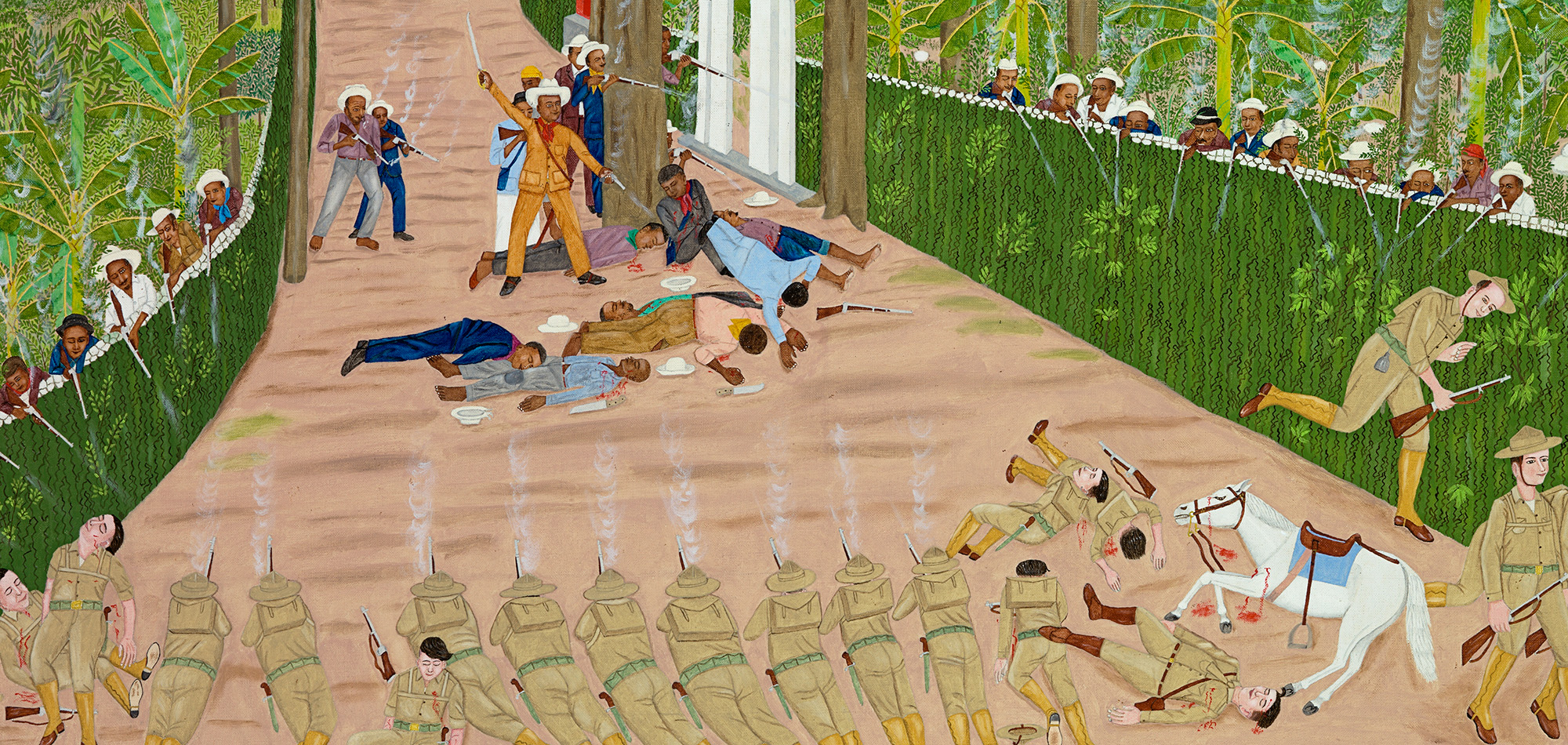
Painting of men fighting with guns on a road in a forest.
Detail of Obin’s Escarmouche entre les hommes du Gal Valev St Amour avec les Marines de Etats Unis, Septembre 1915, 1949.

ROADS ARE MORE THAN MEANS TO ENDS. They are ends with far-reaching ecological and social footprints. They have “depth-of-edge influence” ranging from meters, to miles, to memories. They are places where things happen and things often die: where the rubber meets the road and erodes into surrounding ecosystems; where state-sanctioned gunmen encounter rebels and runaways; where deer and raccoons and opossums become roadkill; where deforestation begins and is most concentrated; where U.S. empire spread through the Caribbean.

The onset of World War I (1914–1918) and the concurrent opening of the Panama Canal only accelerated U.S. anxiety for control in the Caribbean Basin down to Venezuela. While European nations were distracted, U.S. officials and businesses seized the opportunity to extend and solidify their economic, political, and military pull in the region. Infrastructure combined all three.

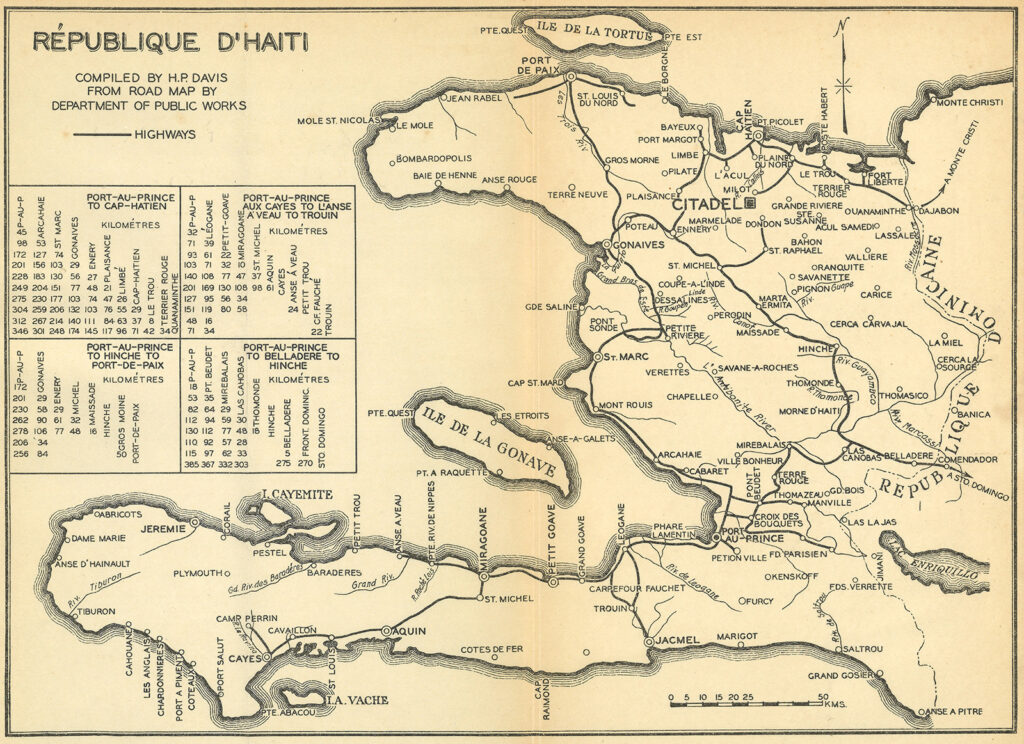
In Haiti, the Marines and their gendarmeries worked to control these spheres through telephones, telegraphs, the sanitation department, and the building and repair of roads. Good roads and their roadblocks were key elements of enforcing control, especially in the Massif du Nord mountains, where people often built their homes out of sight of main trails to avoid local banditry. The Marines placed roads strategically, in places where they could better monitor the movement of people, such as at the narrowest or calmest part of a raging river or where overlapping mountains give way to tight, intricate trails.

Map titled “République d’Haiti” with French placenames and lines showing roads. A box on the left shows the distances between various cities.

Roads worked at first. The Marines made quick work of the First Cacos War in the summer of 1915 and built hundreds of “anti-Cacos roads” to reinforce their victory. To break down and reconstruct raw materials into roads, military officials adopted the old French corvée system, which required all Haitians to “donate” their labor on local public works unless they paid a road tax few could afford. Resurfacing this colonial practice did not immediately incite the Second Cacos War, but it laid the foundation.

Under the law, citizens could not be compelled to work beyond their districts for more than three days. Imagine racist soldiers training new laborers how to build roads every three days. It either did not happen or happened disrespectfully. It is well documented that soldiers made everything worse by lacking patience and integrity and carrying racial antagonism against black Haitians. Reports and investigations revealed a wide range of violence, from accusations of torture to clear-cut extrajudicial executions. And though it left a small archival footprint, an unwritten rule was adopted by many Marines: take no Cacos as prisoners.

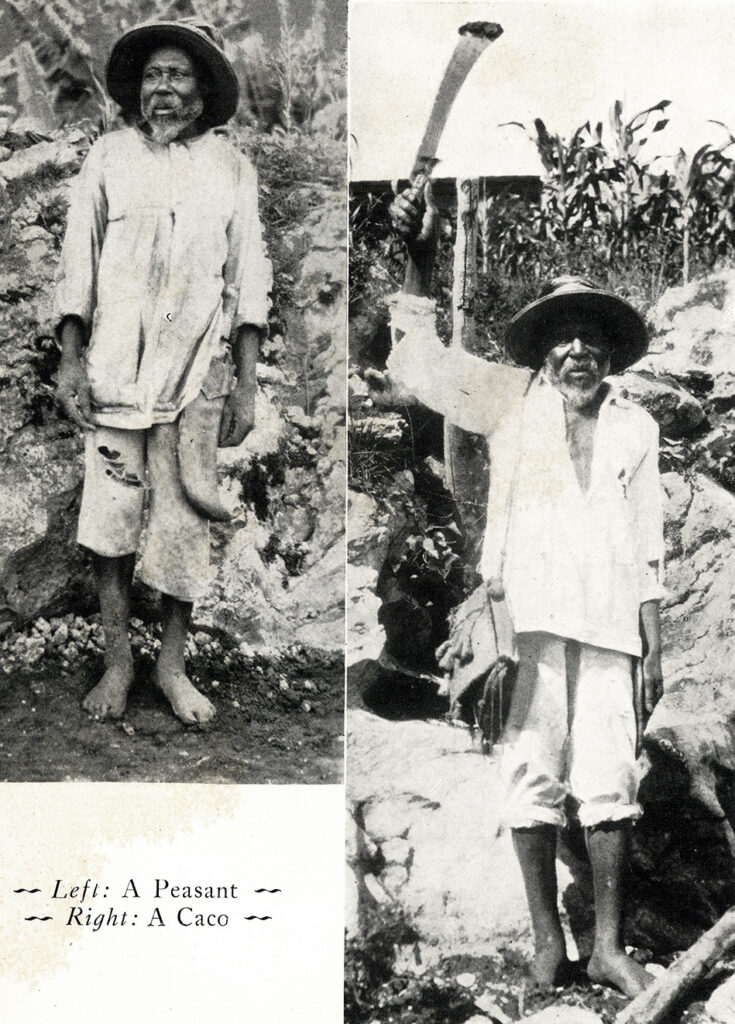
Two photographs of a standing man with worn clothing. In the photo on the left, the man is looking off to the side. In the photo on the right, he is wielding a machete. The caption reads: “Left: A Peasant, Right: A Caco.”

For many rural Haitians, the Marines were the men who disarmed them and then forced them into road gangs to work under the threat of gunfire. Since routes ran through remote, sparsely populated mountains, officials regularly disregarded the three-day limit on work outside of home districts. Infrastructure could not control how people responded to this kind of dehumanization.

Cacos leaders leveraged the shared experience of being occupied into a renewed social movement. The Marines’ practices “afforded an excellent opportunity” for the region’s old Cacos leaders to “spread propaganda that the blancs were reestablishing slavery.” One U.S. investigator called the exploitation of the corvée system “the biggest blunder we have made in Haiti.”

In the end, years of modern roadbuilding created more rebels than they caught. Officials hoped their roads would let them decide when and where violence happened, but roads simultaneously outlined the contours within which refuge could occur. By the time Haitian discontent forced the occupying government to abolish the corvée system on October 1, 1918, Charlemagne Péralte had already mobilized an army and taken to the mountains, where guerrilla warfare raged for a year.

The Marines spent four months planning Péralte’s assassination, but military roads did not factor much into their tactics. Roads and motor vehicles became less useful the closer they got to Péralte’s hideouts. When penetrating a refuge in intimate warfare, the newest technology cannot replace actual boots on the ground. Even still, no external force—small or imperial, hidden or overt—can guarantee victory against local politics of refusal.

A group of men holding guns posing for a photograph.
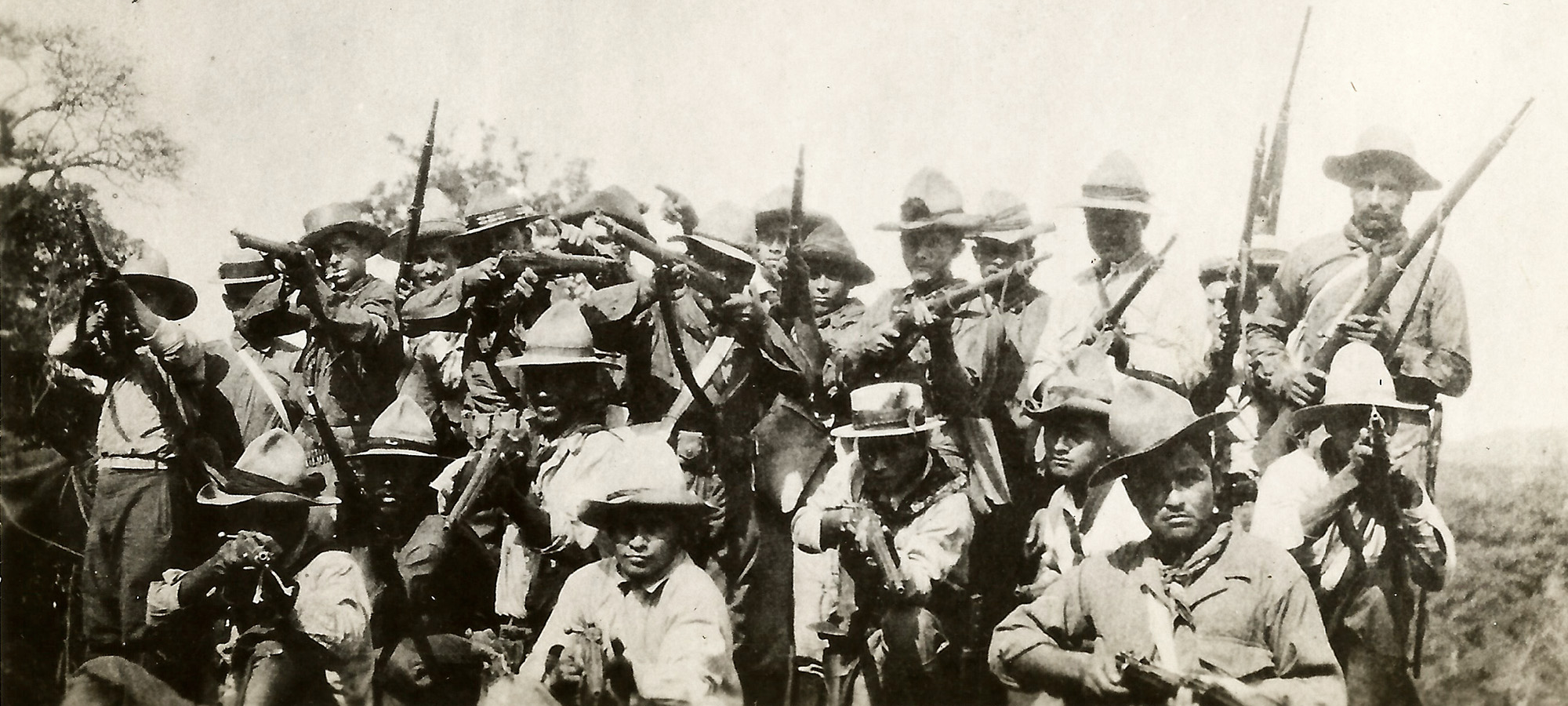
Sandinistas in Nicaragua, ca. 1928.

WHAT IT MEANS TO TRAVEL changes as you begin to travel faster. For toddlers, walking is not just fast crawling; walking comes with more dexterity, agility, and reach. Technologies of movement—boats, cars, bullet trains—alter what it means to go from one place to another. By shrinking the distance and time between places, good roads fundamentally changed how much and how fast U.S. commercial and military power could travel. Adopting faster and more flexible modes of travel changed the relationship between the U.S. empire and landscapes across the Americas.

But not all roads lead to power. When Major Samuel Harrington arrived in Haiti in 1922 to train the Gendarmerie d’Haiti as Hanneken had, Harrington was already beginning to question the power of roads. He realized in real time the limits of modern transportation for finding and fighting insurgents. Drawing from his own difficulties, Harrington insisted that “no matter what means of warfare modern science may invent, the man on foot must in the last analysis drive out the man on foot, and seize and hold the land because mankind lives on the earth.”

Harrington would go on to help write the Small Wars Manual (1940), which has shaped U.S. guerrilla warfare and counterinsurgency strategies and tactics since the Cold War. In small wars, the strategic use of good roads, motor vehicles, and eventually planes could not replace tactics of infantry who know the landscape. Small wars are not won assuming that the same roads built in the Philippines will work in Haiti or Mexico or Nicaragua. Roadbuilding without intimate, local knowledge is like drawing a map with “all thumbs, no fingers, no fine tuning.” The National Archives at College Park, Maryland, are full of documents from these occupations that praise good roads for catching rebels they never caught.

I wonder if Harrington and Hanneken crossed paths in Haiti, Quantico, or Nicaragua, where they both trained Marines and national guardsmen to hunt rebels. When they landed in Nicaragua in the late 1920s to track down the revolutionary Augusto Sandino, they surely carried lessons of Pancho Villa and Charlemagne Péralte. They saw remote, montane landscapes they could not fully control, but nevertheless hoped that good roads would weed out Sandinistas. But they were only partially correct. Hanneken rather quickly tracked down and assassinated Sandino’s chief of staff, Manuel María Girón Ruano. But he never found Sandino.

Good roads made for six long years of failure. The Sandinistas were a quick study of Marine tactics. They mastered the art of exploiting limitations of roads and other technologies of movements, such as small biplanes. Hanneken complained that Sandino’s forces had “cut a net-work of trails in [the] area to assist him in escaping from our patrols.” You can almost hear frustration in his description of their “bandit pack trains” moving supplies by the “mule load.” Roads offered Sandinistas everyday reminders of where to hide and where not to hide. In 1933 the Marines withdrew in defeat, tail between their legs, and the Sandinistas rejoiced in song and satire: “In Nicaragua, señores, the mouse catches the cat.”

More from our magazine

A man leaning on a laboratory bench with machines in the background
DISTILLATIONS MAGAZINE

A Nobel Adventure

A twist of fate thrusts a protégé into the limelight of the Nobel Prize.

Two men standing next to a plane propeller in a room with metal walls.
DISTILLATIONS MAGAZINE

Delayed Arrival

Can sustainable air travel get off the ground?

Woman holding a plate containing a hamburger and fries. A sign behind her reads: “Try our tasty uranium-burger.”
DISTILLATIONS MAGAZINE

Uranium Mania

The post-World War II mining rush that transformed a region.

    Republish

    Copy the above HTML to republish this content. We have formatted the material to follow our guidelines, which include our credit requirements. Please review our full list of guidelines for more information. By republishing this content, you agree to our republication requirements.