
Joanne Ivy’s job was to make sure people ate a lot of eggs, and in early 2013 she seemed to be doing a pretty good job. The average American had consumed 254 eggs the previous year, a six-year high, and farmers expected that number to keep growing. A campaign to overcome consumer concerns about eggs’ cholesterol content was succeeding. The future seemed bright.
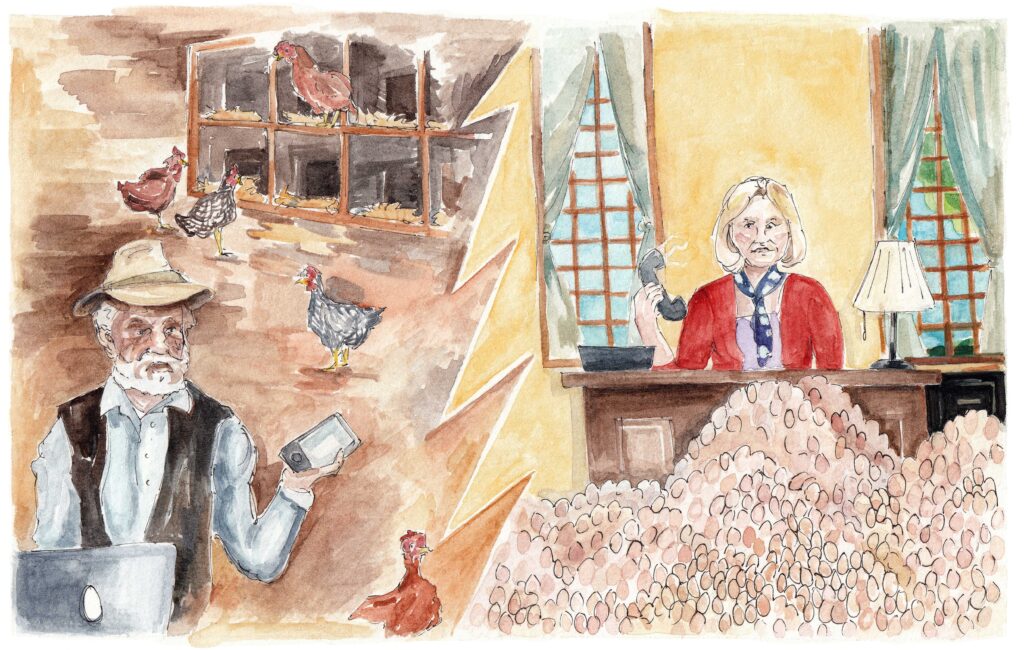
But that August a strange and ominous cloud loomed over Ivy, the president and CEO of the American Egg Board. She began receiving e-mails—“a lot of e-mails,” she told her public-relations consultant—from egg producers and processors panicking that their industry might soon go the way of bookstores and travel agencies.
“Silicon Valley’s Fake Eggs Are Better Than the Real Thing” read a post on Vice’s Motherboard blog. They “could one day disrupt the global egg industry,” Bloomberg reported.
The surge in publicity for high-tech egg substitutes included a big dollop of hype, but it seems to have worked on egg processors. They considered the new products “a serious threat to their business,” Ivy noted in an e-mail, and she was under pressure to solve the problem. “We need to have an answer!” she wrote. The board soon went into action, launching a public-relations campaign called “Accept No Substitutes.”
Why the alarm? Egg substitutes had been available for decades. But the industry was spooked by the sudden rise of a two-year-old California company called Hampton Creek and its charismatic leader, Josh Tetrick. The 33-year-old CEO made for an unusual bogeyman: a lawyer who had previously taught street children in Nigeria and South Africa, Tetrick had no food-industry experience before he became interested in animal-welfare issues and founded the company. He leapt to prominence in early 2013 thanks to an investment from a well-known venture-capital fund and an endorsement by Microsoft founder Bill Gates. A video Gates posted on his blog shows hundreds of scrawny, roiling chickens jammed into stacked-up cages as Tetrick describes the “massive” amounts of fertilizer and, ultimately, petroleum required to produce chicken feed.
“We see a system like that, and we say, ‘This is just absurd,’” Tetrick explains. “We see a system that is broken, and instead of trying to incrementally improve upon that system, we want to create a whole new model that makes the current system obsolete.” The video switches to an image of a lightbulb and a leafy stem, labeled with the formula “Innovation + Plants = Hampton Creek Foods, Beyond Eggs.” Beyond Eggs is the company’s egg substitute, a powder made of peas, sorghum, canola, and other plants, and is also its rallying cry as it seeks supporters for its lofty vision.
Tetrick’s core argument focused on Hampton Creek’s moral superiority. In many, many interviews in the succeeding months and years, he touted the start-up’s success at making appealing products using fewer resources than are needed to farm eggs, at lower cost, with less impact on the environment and no harm to animals. Its innovations, most prominently an eggless mayonnaise called Just Mayo, would help the world feed its burgeoning population more humanely, efficiently, and sustainably, he promised.
Hampton Creek would accomplish this revolution through the wonders of technology, Tetrick explained. The company set up shop in San Francisco and emulated its Internet giant neighbors, hiring away scientists from Google and other tech companies to create a plant database that would help its chefs formulate other sustainable foods in the future.
Tetrick cajoled millions from his first backer, Khosla Ventures, a high-profile Silicon Valley investment fund, and later from Peter Thiel and other tech-world billionaires. His staff tossed around buzzwords like “big data” to describe their work. Wired published a glowing write-up on the company, with the headline “Forget GMOs: The Future of Food Is Data—Mountains of It.”
“We can run our experiments in the cloud rather than always having to grind ingredients up and trying them out in a recipe,” Tetrick told the New York Times.
The narrative of radical innovation for a good cause seemed to sell well. Despite the American Egg Board’s efforts to undermine its eggless competition, Hampton Creek mayonnaise varieties, salad dressings, cookies, and cookie dough began to appear on the shelves of Whole Foods, Walmart, Target, Dollar Tree, and other retail chains. By the end of 2014, $120 million in capital poured into the company, a figure that has since climbed to at least $220 million. Rapid growth reinforced Tetrick’s conviction that Hampton Creek’s righteous cause had let it blaze a new and different kind of path to success, unlike other companies that had to start small and grow slowly. “We can look at all those rules and totally ignore them and do whatever we want,” he said in an interview.
Tetrick, of course, was not the first bright young thing to rattle an established industry with promises of revolutionary change. Like many before him, he used audacious marketing and appeals to consumers’ moral aspirations to vigorously promote moderately novel goods. As he set out to make his mark, the question was how well his bold approach would weather public scrutiny and the highly competitive and tightly regulated food industry. Reality has a way of blunting the salesman’s bluster; eventually new products must survive, or fail, on merit alone.
A Branding Miracle
Tetrick’s energetic hyping can obscure the modesty of his actual products. Mayonnaise is fundamentally an emulsion of oil in water and has its roots in very old sauces, such as the aioli of ancient Rome. The modern form was first concocted at least two centuries ago, probably in France or Spain. It’s made by vigorously whisking vegetable oil into egg yolk, which provides both the water and lecithin, the emulsifying agent. The base also typically includes acidifiers, such as mustard, vinegar, or lemon juice, to improve the taste and enhance the emulsification.
Other emulsifiers work as well, as an online search for vegan mayonnaise recipes shows. Various combinations of flour, starches, mustard, nuts, dairy, and bean derivatives (such as silken tofu, soy milk, or chickpea liquid) produce dressings very similar to traditional mayonnaise. Natural-food stores have stocked creamy eggless dressings for years. The better-known brands include Vegenaise, Nayonaise, Spectrum Light, and Mindful Mayo; some of them use pea protein as their primary emulsifier, as does Just Mayo.
Despite using similar ingredients to its eggless competitors, Tetrick claims his product is superior. Hampton Creek does seem to have improved on existing vegan mayonnaises. John Coupland, a professor of food science at Pennsylvania State University, examined a few of them and concluded that Just Mayo was the closest in color and texture to Hellmann’s, with less graininess than other eggless dressings, though it was still clearly a different product from regular mayonnaise. Coupland said he didn’t understand why the modified starch and Canadian yellow pea protein in Just Mayo work so well as emulsifiers and suggested that Hampton Creek’s systematic analysis of different protein combinations may have helped it achieve a breakthrough of sorts.
“Their bold business model and strong ethical position [may have] allowed Hampton Creek to attract some really talented food scientists to develop their product while previously vegan mayo has been a niche product with lower product development budgets,” Coupland wrote in a blog post.
The company also managed to use ingredients that made Just Mayo cheaper than its competitors. A 30-ounce jar costs about $3.48 compared with more than $8 for 32 ounces of Vegenaise. Just Mayo even beats Hellmann’s traditional mayonnaise, which runs about $3.98, or 14% more for the same volume of spread.
However, the actual sophistication of Hampton Creek’s work is disputed. One former employee called Hampton Creek a “food company masquerading as a tech company.” The company boasts of hiring dozens of scientists and engineers, and it initially said it had a database of at least 4,000 plant samples. But in 2015 former employees told Business Insider that the number of data entries generated by Hampton Creek itself was much smaller, probably closer to 400. After Tetrick responded by claiming the database includes more than 100,000 plant varie-ties, the website TechCrunch wrote, “Former employees also told us that Tetrick had a tendency to falsify or grossly inflate several metrics and research.”
Likewise, the company’s lab was reportedly something of a sham. It was set up with cool-looking but irrelevant instruments to impress visiting journalists and potential investors, an ex-employee told Business Insider. Tetrick has also admitted that two product-development firms, Mattson and Delve, came up with Just Mayo, though he said Hampton Creek overhauled the recipe three times before going to market.
“We just threw money at [Mattson], and they came back in the first week with a formulation. It’s just food starch with pea protein,” a former employee told Business Insider. “Josh got this, and he promoted it like it was an amazing invention.”
Hampton Creek’s actual innovation, the distinction that makes Just Mayo more than simply another sandwich spread, is its aggressive branding as an efficient, ethically advanced, high-tech product. Historically, that has not been a common message in the mass-marketing of food. Americans have cared primarily about getting meals that are tasty, filling, and cheap, especially in hard times; in the 20th century, quality, safety, and nutritional value also became important. In the last few decades concerns broadly related to the environment have become prominent, as seen in the messaging around organics and non-GMO (genetically modified organism) products, but the marketing of those foods still tends to focus on their supposed health benefits.
Just Mayo would seem to fit most closely in the niche market for vegan foods, but Tetrick often stresses that he’s targeting a much broader pool of customers in order to make a big impact on the global food system. Only a few foods, such as cage-free eggs and fair-trade chocolate and coffee, use comparable marketing messages. Their branding aims to evoke the social and ethical benefits for the animals and people involved in their production, or for humanity as a whole. These products don’t offer any special health benefits, but they implicitly promise to make you feel like you’re a good person, someone who cares about workers’ rights or animal welfare.

Hampton Creek’s focus on those issues thus helped it stand out from the crowd. That approach reflects Tetrick’s do-gooder interests. In addition to helping African street children, he had worked on legal-system reform in Liberia and briefly ran a crowd-funding website for socially minded start-ups, such as renewable-energy companies. Along with his friend Josh Balk, the senior director of food policy at the Humane Society’s farm-animal division, Tetrick decided to concentrate on improving global food production, and together they founded Hampton Creek.
The project was a perfect fit for wealthy tech folk eager to concentrate their profit-making prowess on challenges that might better the world. Khosla Ventures had already funded many clean-tech start-ups, such as solar-panel makers; Bill Gates, a Khosla Ventures investor, has spent billions on programs that combat hunger, poverty, disease, and other social ills.
“Silicon Valley has become the Jerusalem of the techno-optimist religion,” wrote Austin Kiessig, a food entrepreneur and industry analyst, in 2013. “In venture capital doctrine, the absolution of humanity’s sins begins with seed financing for the next spate of Big Ideas.” Venture capitalists love the idea of plant-based protein substitutes because raising animals is inefficient, he wrote, and the lucrative market for proteins is growing along with the global middle class. There were other alternative-protein companies out there, but Hampton Creek had “exceptionally promising early market traction.”
Delicious Audacity
Like the makers of more established products that imitate animal-based foods—almond milk, soy burgers, margarine—Hampton Creek walks a delicate line on authenticity. These companies distinguish themselves by what’s different about their offerings but strive to make them as similar as possible to the originals to appeal to consumers’ palates.
Names and labels reflect this tension, often alluding heavily to the originals they’re supposed to be different from. Unilever takes the dynamic to a comical extreme with a brand of margarine called “I Can’t Believe It’s Not Butter!” Just Mayo’s name is, in a subtle way, even bolder, suggesting that despite the jar’s actual content, it is purely, solely, real mayonnaise. The subtext of natural purity, of a lack of adulteration and industrial processing, is carefully delivered by its simple, brown matte label, which is dominated by a white egg shape over the word “MAYO” in bold black characters.
Only when you look more closely do you notice “just” written in delicate cursive script above “MAYO,” and the small, light-brown silhouette of a pea shoot set against the white ovoid. On the product’s original label the words “non-GMO, cholesterol-free, gluten-free, egg-free,” and so on appear in tiny letters to the side of the product’s name.
The label attempts the neat trick of portraying Just Mayo as a huge leap forward into the past, deploying cutting-edge methods to paradoxically create a simpler, purer, adulterant-free, and natural food.
Just Mayo, veggie burgers, and other alternative proteins are “products of extremely advanced and sophisticated technology—machines, materials, research, and different kinds of additives that make these things possible—but they’re also positioning themselves as natural and better and sustainable and good,” says Nadia Berenstein, a historian of science and technology and former CHF fellow who has written about Just Mayo.
Hampton Creek’s condiment is hardly the only eggless dressing labeled “mayo,” but its low price, its popularity, and the deliberately provocative rhetoric used to sell it set it apart from spreads that had come before. The sheer chutzpah of criticizing your competitor’s product as unethical and then pretending to be an even purer example of that product—and gaining market share as a result—was too much to bear for Uni-lever, the owner of Hellmann’s, the country’s ubiquitous and definitive mayonnaise brand. Attorneys for the Anglo-Dutch conglomerate sued Hampton Creek in October 2014, accusing its vastly smaller rival of unfair competition and false advertising.
“Despite its name, Just Mayo does not contain just mayonnaise,” huffed Unilever’s lawyers in the legal complaint. “In fact, it is not mayonnaise at all.” The product’s name was “literally false,” they argued: it tasted different, and unlike real mayonnaise it separated when heated.
Hampton Creek was diverging from the FDA’s standards for mayonnaise, the lawyers said, damaging the entire product category, which had “strived for decades for a consistent definition of ‘mayonnaise’ that fits with consumer expectations.” Worst of all, “Just Mayo already is stealing market share from Hellmann’s,” they complained, citing Hampton Creek’s statement on its Facebook page that it had become the “#1 selling mayo at Whole Foods Market!”
The press had fun with the dispute, dubbing it a “Mayo War” and a David-and-Goliath attack by “Big Mayo.” “Hellmann’s Seeks Justice vs. Just Mayo: Mayonnaise-Maker Unilever Accuses the Eggless Product of Spreading Falsities,” a Wall Street Journal headline read. The public was less amused and unswayed by Unilever’s arguments. Vegans and animal-welfare advocates in particular saw the suit as a simple case of a soulless, giant corporation seeking to crush a plucky, socially conscious competitor.
“Your lawsuit against Hampton Creek is wasting precious money that could be spent on developing your own product which does not involve animal cruelty,” raged one online commenter on the website Eat Drink Politics. “Thank you for the additional spotlight you have [cast] on this very issue with your ridiculous lawsuit.” A Change.org petition criticizing Unilever for “corporate bullying” accumulated 112,000 signatures.
Hampton Creek basked in a huge wave of favorable publicity. An investor in the company, Bart Swanson, later called the lawsuit a “godsend,” telling Wired that it boosted sales. Hampton Creek mocked Unilever, pointing out that the food giant had itself tried to make an eggless mayonnaise called Alleggra several years earlier but dropped the effort, apparently after struggling to get the emulsification right. Tetrick also noted that Unilever was selling products labeled as mayonnaise that didn’t meet the FDA’s standard, such as Hellmann’s Mayonnaise with Olive Oil, which contains potato starch, a banned ingredient. Unilever responded by modifying product names: you’ll now find Hellmann’s Mayonnaise Dressing with Olive Oil in supermarket aisles.
After being pummeled in the press for more than a month, the conglomerate decided that if you can’t beat ’em, join ’em. It abruptly dropped the suit and said it applauded Hampton Creek’s “commitment to innovation and its inspired corporate purpose.” Unilever even restarted its own eggless mayo effort, eventually releasing a modified starch-based version of Hellmann’s called Vegan Carefully Crafted Dressing. But the company said it expected Hampton Creek would still have to reckon with Just Mayo’s label issues.
Battling over PB&J
The federal government first tried to crack down on adulterated and misbranded products with the Pure Food and Drug Act of 1906, a time when Americans were increasingly living in cities and buying packaged, factory-made food in stores. Shoppers had no choice but to trust labels, especially on opaque containers like metal cans. Under the new law a jar labeled as strawberry jam had to contain jam, and imitations had to be labeled as such.
The statute had some crucial flaws. It didn’t specify what constituted jam or any other foods, and manufacturers succeeded in inserting a provision allowing otherwise illegal “distinctive names” on labels. In the 1920s companies used these loopholes to sell technically sophisticated but low-quality concoctions, such as Bred-Spred, a jamlike mixture of sugar and a small amount of fruit held together with commercially made pectin. Demand for cheap nutrition during the Great Depression only exacerbated the problem.
For years FDA officials and food-safety advocates, including First Lady Eleanor Roosevelt, lobbied vigorously for a stronger law. So did canning companies, which wanted a government-approved label testifying that their products were safe and could be trusted to include the promised ingredients. Congress finally passed the landmark 1938 Food, Drug, and Cosmetic Act, which eliminated the distinctive-name proviso and required that a label bear the food’s common name.
The new law let the FDA create strict “standards of identity,” resembling recipes, that spelled out the ingredients that jam, macaroni, canned tuna, and so forth must contain to earn the names on their labels. The goal was to hold food companies to “time-honored standards employed by housewives and reputable manufacturers,” according to the congressional record; foods should be “like mother used to make,” as legal scholars Richard Merrill and Earl Collier Jr. wrote in their analysis of the law.
The FDA also gained more power to ban unsafe ingredients, but protecting the public’s health was not the law’s primary purpose. After all, the problem with Bred-Spred wasn’t its lack of nutritional benefit. Rather, the standards were meant to prevent cheating and confusion. Consumers would no longer have to worry about accidentally feeding their kids a faux jam consisting of 80% sugar, or milk thinned with water, or plain pasta packed in yellow cellophane to make it look like egg noodles. Even those who might have wanted to save money by buying such products were “protected” from doing so.
The government went on a standards-setting spree—starting with tomato products, jams, and jellies—that continued for decades. The standard for mayonnaise was set in 1955: in addition to minimum percentages of vegetable oil and acidifiers, mayonnaise must include “egg yolk−containing ingredients” and could optionally include certain flavorings like salt, monosodium glutamate, and spices (except saffron, turmeric, or anything that could turn an eggless spread a yolk-yellow color).
The FDA’s regulations had some quirks. The standards went well beyond protecting health and food purity, codifying somewhat arbitrary cultural standards in the name of economic protection. Foods were judged by their adherence to old conceptions about home cooking rather than by the realities of modern food science and technology, Berenstein says. Yet the FDA enforced the rules strictly, even as some regulators recognized their inhibiting effect on innovation.
For example, the FDA settled on a recipe for enriched farina and subsequently banned a perfectly fine, decade-old Quaker Oats product called Farina with Vitamin D because, though nutritionally beneficial, it did not meet the standard. Quaker Oats appealed, but the Supreme Court upheld the FDA’s decision. In another case the agency prohibited a spaghetti product containing 20% protein rather than the mandated 13%.
“The food standards, both before 1938 and after, struggle with this framework where they have to model themselves on what a consumer might typically think is in a type of food,” Berenstein says. “But the fact is foods being produced in factories aren’t ‘just like mother used to make.’ Foods made in factories are fundamentally different even if they might bear the same name and even if they might resemble them in many ways.”
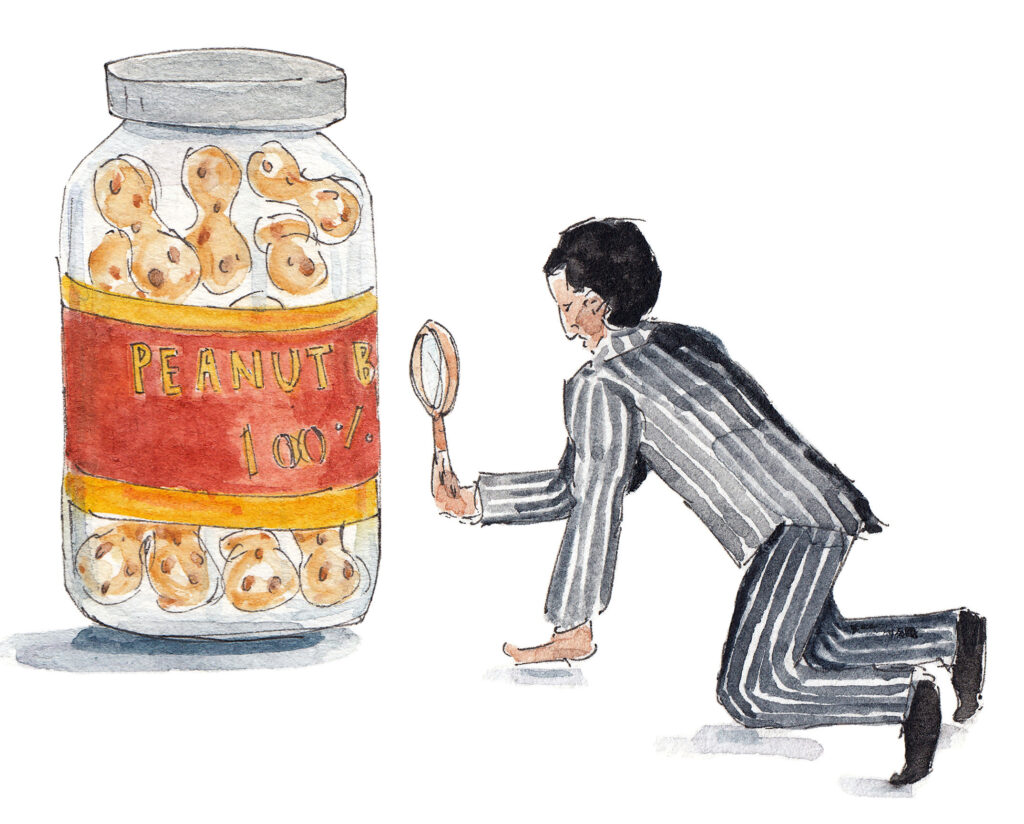
It was peanut butter rather than jam that most dramatically illustrated the law’s shortcomings. In the 1950s Procter and Gamble discovered that using a mix of hydrogenated peanut, cottonseed, and rapeseed oils created a smoother spread that consumers liked and began marketing the product as Jif. But soon after, in 1959, the FDA proposed a radically purist standard of identity for peanut butter requiring 95% peanuts—a “traditional” recipe perhaps but more than the leading store-bought peanut butters contained. The rule would have outlawed Jif and all its competitors.
Manufacturers and the government went back and forth on the proposed standard for several years. The FDA didn’t care about the exact peanut percentage, but it needed to fix the number somewhere. “We were asking, ‘But when does it stop being peanut butter?’ ” an FDA official said, as recounted in The Superlawyers, a book by journalist Joseph Goulden. “We weren’t saying it was a bad product, only that it was not what the consumer expected to find under that name. Does she expect to buy peanut butter, or a mixture of lard and peanuts, with maybe some turnip greens ground up in there besides?”
Hearings on the proposal didn’t get going until 1965 and then took months to complete, generating thousands of pages of testimony and evidence. The final standard basically defined peanut butter as Jif, mandating at least 90% peanuts and allowing hydrogenated vegetable oils. The makers of Skippy (87% peanuts and too much oil) and Peter Pan (87% peanuts and too much sweetener) sued, and the matter wasn’t finally settled until 1970, 11 years after it began.
Justifying Just
The peanut-butter hearings made it clear that strict standards “ultimately worked to the detriment of both business and consumers,” writes FDA historian Suzanne Junod. In the 1970s the era of food prohibitions gave way to a new emphasis on nutrition and more extensive labeling. Regulators now assume Americans can decipher ingredient listings, and the FDA tends to allow novel recipes as long as they’re safe and the labeling isn’t too misleading. Nonetheless, standards of identity still remain law, as the FDA, prompted by Unilever’s complaint, reminded Hampton Creek in August 2015.
In a warning letter the agency told Hampton Creek that while Just Mayo’s name suggests the spread is “all mayonnaise” or “nothing but mayonnaise,” its hallmark ingredients—food starch and pea protein—weren’t allowed by the mayonnaise standard, and it had none of the required egg yolk. Just Mayo even contains beta-carotene, which is forbidden because it can be used to simulate yolk color. The label also made unauthorized “cholesterol-free” and heart-health claims, didn’t disclose total fat content, and bore incorrectly formatted nutrition facts.
With the federal government breathing down his neck, fortune smiled on Josh Tetrick yet again. The following month the U.S. Department of Agriculture (USDA) released a cache of American Egg Board e-mails that an animal-rights activist had requested under the Freedom of Information Act. The activist, Ryan Noah Shapiro, described the e-mails as “stunning.”
The taxpayer-funded board, it turned out, had launched a smear campaign against Hampton Creek. The American Egg Board is tasked with promoting eggs, not attacking private companies, but e-mails written by CEO Joanne Ivy revealed she had privately asked a sustainability consultant to pressure Whole Foods not to stock Just Mayo. Furthermore, the e-mails reveal she had strategized against Hampton Creek with Unilever and tried to get the FDA to investigate Just Mayo’s labeling. Egg board executive director Mitch Kanter joked about beating up Tetrick, and an executive at a member company teasingly suggested killing him off.
“You want me to contact some of my old buddies in Brooklyn to pay Mr. Tetrick a visit?” Kanter joked in an e-mail.
“Can we pool our money and put a hit on him?” wrote Hidden Villa Ranch executive Mike Sencer.
The revelations brought a new surge of sympathetic publicity for Hampton Creek. Tetrick seized the opportunity, demanding an investigation by the USDA. The agency responded by saying it “does not condone any efforts to limit competing products in commerce” and launching a review of the egg board. Ivy took early retirement and refused to be interviewed by the USDA. The agency’s investigation eventually found “several instances of inappropriate conduct” but concluded the board had not broken any laws.
The FDA might have gone easy on Hampton Creek even without the egg board scandal. Warnings over labeling very rarely lead to enforcement actions; a product called Muscle Milk is still on the shelves despite a 2011 FDA letter noting that it contains no milk, and a spread called Better’n Peanut Butter that the agency called out in 2015 for its rather loose relationship to the peanut-butter standard is still being sold. But the final decision on Just Mayo in December 2015 is striking for its leniency. Remarkably, regulators allowed the egg drawing to remain on the label, albeit in a noticeably smaller size. “Egg-free” was bumped up in size and positioned more prominently, and “spread & dressing” was added in capital letters. “Cholesterol-free” was gone.
On the revised label the company also tries to defend Just Mayo’s ambiguous name. “What is just?” the label asks. The answer is, apparently, condiments “guided by reason, justice and fairness.” The opaque reasoning goes on: “Good food would be tastier and less expensive whether you’re a single mom in Alabama or a college student in Michigan. That’s just, and that’s the point of Hampton Creek.”
So justice stems from flavor and low cost, it seems. Somehow animal welfare and sustainability, concerns the company reputedly was formed to address, went unmentioned. The label changes are meant to pacify the FDA by suggesting that “just” does not refer to mayonnaise purity, but it’s hard to see how the new text better illuminates the contents of the jar. Sure, the stuff looks and tastes a whole lot like mayonnaise, but the FDA’s solution—blessing an eggless product with an egg on its label—feels a long way from promoting transparency in food marketing.
Hero or Hustler?
While Tetrick’s rapid success made him a star to vegans and Silicon Valley idealists, the business press and the broader food industry had a more jaundiced view. Food Processing lauded Tetrick’s “genius” for attracting investors and his focus on growing sales of sustainable products but also noted he had the “flair of PT Barnum.” The magazine headlined one article “Josh Tetrick: Hero or Hustler?” Another called him a “False Messiah,” saying he “is not the future of food.”
Hampton Creek’s apparently good revenues, market penetration, and sustainability profile remained its defenses against criticism. But now these too were showing cracks. In August and September 2016 Bloomberg published two articles that shredded much of the Tetrick mythos. It reported that two years earlier, as Tetrick was hunting for investors and boasting of Hampton Creek’s booming sales, the company sent more than 100 contract workers to Safeway, Costco, Walmart, and other retailers around the country to buy up jars of Just Mayo. The purchases allegedly inflated the company’s sales figures.
“The most important next step with Safeway is huge sales out of the gate,” a company executive wrote in an e-mail to contract workers, as quoted in a Bloomberg article. “This will ensure we stay on the shelf to put an end to Hellmann’s factory-farmed egg mayo, and spread the word to customers that Just Mayo is their new preferred brand. :)”
The resulting blockbuster sales led Hampton Creek to boast on Facebook that Just Mayo was the top-selling mayonnaise at Whole Foods—the very message that Unilever had cited in its lawsuit alleging unfair competition.
Tetrick responded to the report by saying the purchases were done to check the quality of mayonnaise in stores. But company data and employee interviews indicated the buyback operated separately from quality checks, and experts said that’s not how quality control works anyway. Former Hampton Creek contractors described being told to buy 120 jars in one day and to dispose of them however they wanted. One month the company spent more money on buybacks than it earned from sales, according to a Bloomberg report.
Pretending to be mayonnaise and fudging labels can bring warnings from regulators, but deceiving investors—by secretly buying up your own product and improperly reporting revenues—could be a serious offense. The Justice Department and Securities and Exchange Commission launched investigations, but Tetrick threaded the needle once again; in March 2017 he told employees the agencies had found no wrongdoing and closed their inquiries, Bloomberg reported.
As reporters sniffed around Hampton Creek, other strange happenings began to make sense. In 2014 a multimillionaire investor named Ali Partovi was so charmed by Hampton Creek’s pitch that he put a sizable stake into the company and went to work there, only to resign quickly for unexplained reasons. Bloomberg reported in 2016 that Partovi discovered Hampton Creek was lying to potential investors about its profit projections; while the company told them it expected to make $28 million in 2014, it really only foresaw $4 million in profits. The company declined to adjust the projection, and its board decided not to take any action, according to Bloomberg. But an investment fund that learned about Partovi’s discovery reduced a planned $20 million investment to a token $500,000.
As 2016 came to a close, Hampton Creek was still very much in business and continued to grow, but much of its pitch now smelled rotten. It had not invented vegan mayonnaise, and even the version it was selling was originally formulated by an outside company. Its research efforts were less sophisticated than advertised. Just Mayo had not been as instantly popular as claimed nor as profitable. According to Bloomberg, Tetrick had even embellished his own do-gooder credentials. While he often said he had worked in Africa for seven years, it was actually only three years, and he never completed his Fulbright program.
Despite all the hype, the popularity of Just Mayo and Hampton Creek’s other products doesn’t seem to have affected the egg industry at all. The United States produced 103 billion eggs last year, a 12% increase over 2006 figures, according to the USDA. The average American now eats about 275 eggs a year, 8% more than a decade ago.