Distillations magazine

Unexpected Stories from Science’s Past
August 20, 2026 Environment & Nature

Extended Family

Self-recognition was uniquely human. Then scientists put other animals in front of the mirror.

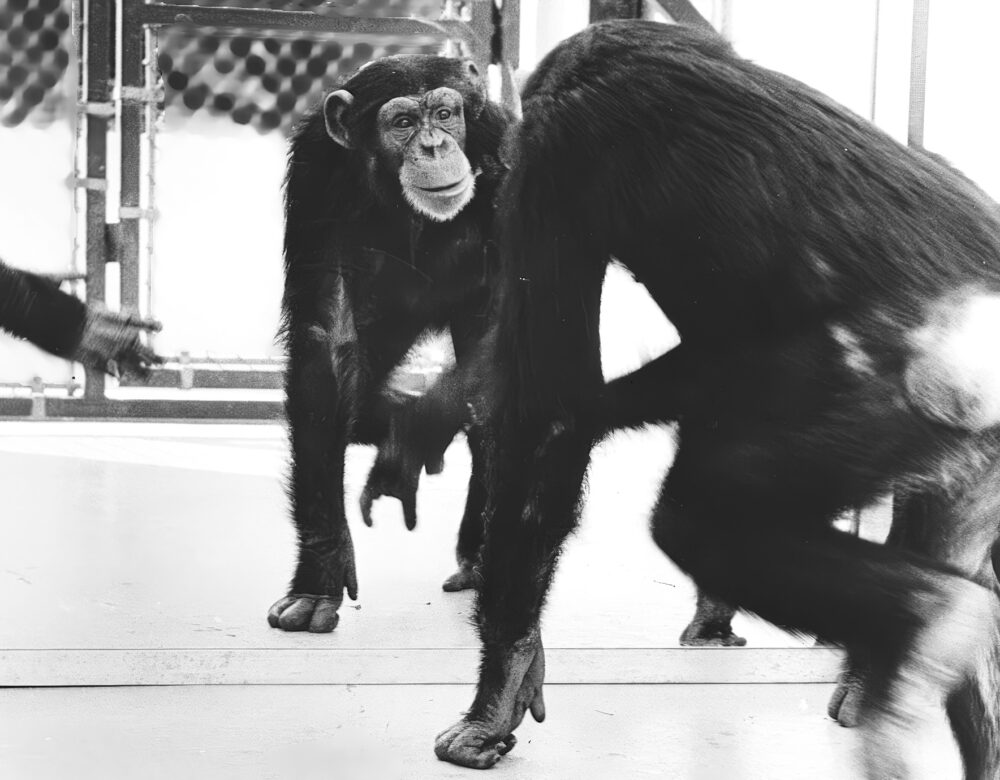
A chimpanzee looking into a full-length mirror.
About SUPPORT OUR WORK

THE CLEANER WRASSE charged toward the unknown fish, ready for attack. The stranger met her head-on. When she retreated, the stranger did too. In due time, she began darting, flipping upside down, and “dancing.” Eventually, she approached more slowly, turning her blue body sidewise, then sank, all the time watching.

What appeared to be a stranger was, in fact, her reflection peering back. Days after the first encounter, biologist Masanori Kohda placed his small research subject in a solution of eugenol, an anesthetic made from clove oil, and injected brown dye under the skin of her throat—a spot she couldn’t see directly. When, later, the wrasse again looked in the mirror, she swam to the bottom of her tank and began to scrape her marked scales against a rock. In nearby tanks, other fish that had been similarly marked did the same.

Kohda and his colleagues concluded that the fish had recognized their reflections, a claim that sparked an uproar when the team from Osaka City University released the findings in 2019.

The study made the cleaner wrasse the latest to join an expanding and controversial pool of animals reported to share a capacity once thought uniquely human. Great apes, dolphins, elephants, certain birds, manta rays, and, most contentiously, ants had all reportedly passed the mirror mark test, the standard gauge of self-awareness in animals since 1970.

The test itself is appealingly straightforward. Mark an animal somewhere it can see only with the aid of a mirror. If the animal then touches or investigates the mark on its own body, rather than on the mirror’s surface, it has recognized itself.

But recognition, scientists had long held, required a self-concept onto which the reflected image could be mapped. And that faculty was widely believed to be absent in most animals. They might experience color, pain, and pleasure, the thinking went, but without any sense of the self having the experience. They simply didn’t have the brains for it.
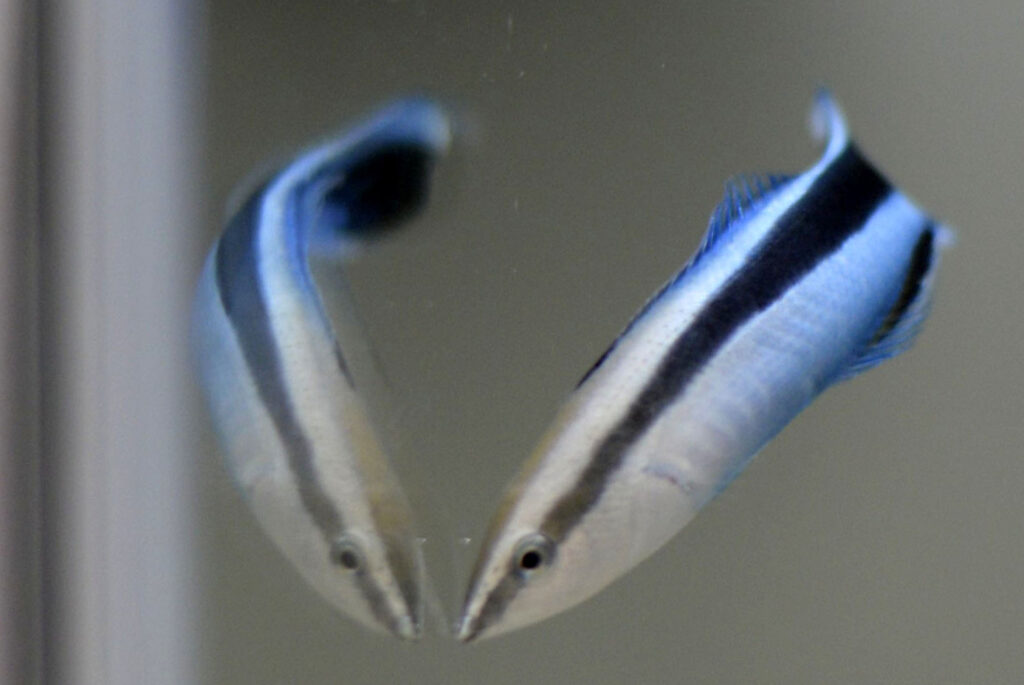
A small blue and black striped fish and its mirror image

After the fateful 2019 study, however, the wrasse went on to pass multiple variations of the mirror mark test, accumulating evidence that now surpasses that for any other nonhuman animal.

Many researchers who had previously accepted the mirror test as the standard measure of self-awareness now began to look at it askance. The tiny fish had unwittingly shaken faith in a hypothesis the test’s creator had defended for half a century and whose root reached back further still: that self-awareness had developed just once in the animal kingdom.

Reflections and Refractions

Until the 15th century, even the well-to-do in Europe lived and died without ever clearly seeing their reflections. Older, imperfect mirrors, made of copper, bronze, and even silver, were found in courts and palaces beyond the view of ordinary people. In the early 1400s, convex glass mirrors began reaching the most affluent European households. As the technology spread, people became increasingly aware of how they appeared in the eyes of others.

Before glass mirrors, “individuality as we understand it today did not exist: people only understood their identity in relation to groups—their household, their manor, their town or parish—and in relation to God,” writes historian Ian Mortimer. “The very act of a person seeing himself in a mirror . . . encouraged him to think of himself in a different way. He began to see himself as unique.”

The impact on self-perception rippled through art, religion, and culture, Mortimer argues. Self-portraits became more common, and people began framing their relationship with God in more personal terms.

Not everyone trusted the reflection in the glass mirror, or what it represented. In his 1576 satire, The Steel Glass, poet George Gascoigne champions older, rough mirrors for seeing through vanity and deception and returning a more honest reflection. Newton, too, put his faith in the old technology. When he completed his reflecting telescope in 1668, it used a curved alloy mirror to gather starlight, a heavenly glimpse, he believed, of God’s design.
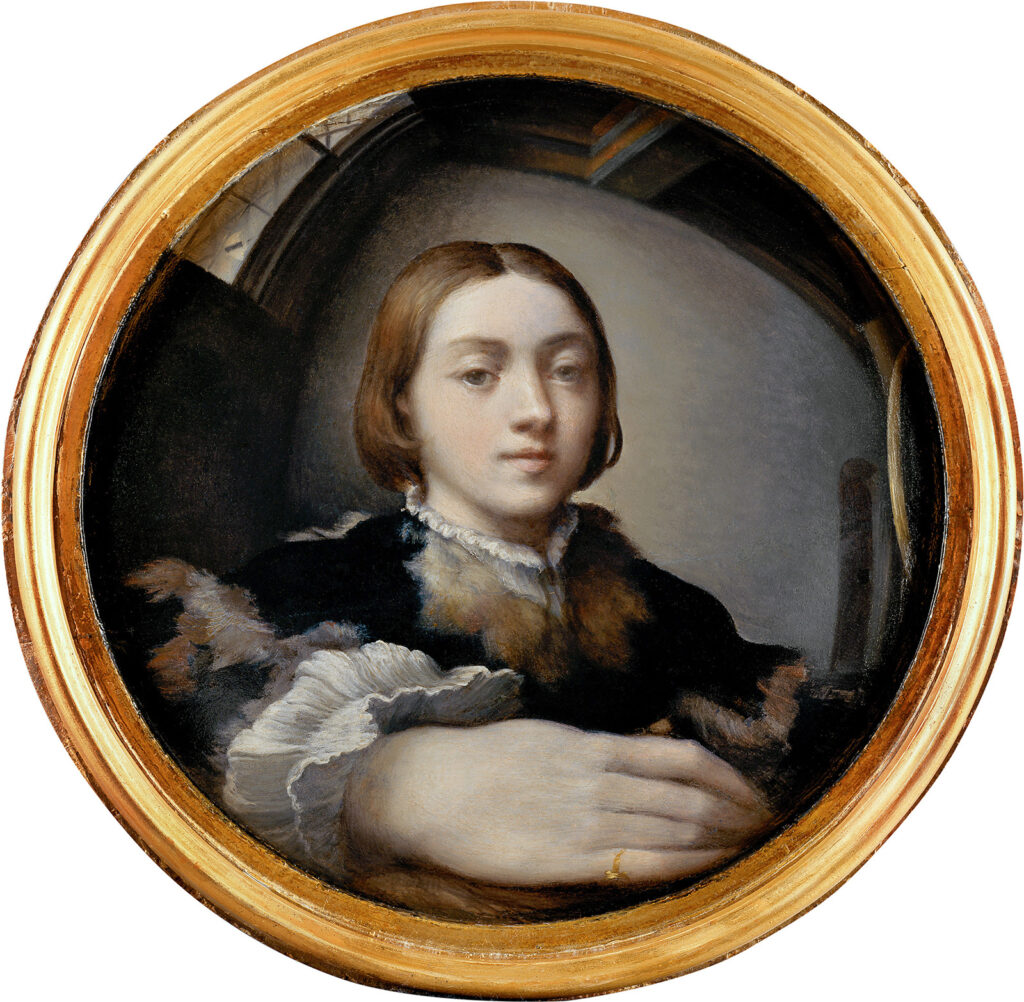
Circular painting of a young Renaissance-era man in a room with a window. Elements around the outer portions of the painting appear larger and distorted.

By the 1800s, divine providence was falling out of favor across the sciences. Still, when Western researchers studying the developing mind tried to pinpoint what made the human mind unique, it was the mirror they turned to.

In The Descent of Man, published in 1871, Charles Darwin laid out a theory of how human language came to be. At that time, language was widely considered humankind’s distinguishing ability—one that was not just more advanced than animal communication but categorically distinct. Darwin had a different view. For him, language development, like species evolution, would have happened incrementally. Seen this way, human speech was clearly on a continuum of animal communication.

In The Mirror and the Mind, historian of science Katja Guenther argues that this claim had far-reaching political ramifications. For a century, Enlightenment thinkers had argued for democratic rights on the basis of rationality, a capacity enjoyed by commoner and aristocrat alike. Unlike animals, humans could override their instincts and act according to reason. Since human language was perceived, in this view, to be the foundation of rational and ethical thought, placing it in lineage with the communication tools of other animals put the ordinary man’s claim to political freedoms on shaky ground.

Fortunately for philosophers, Darwin planted a new seed of human exceptionalism in 1877 when he recorded the contrasting responses of his infant son and higher apes when they looked in the mirror. Where the boy smiled, the apes grew angry and looked away.
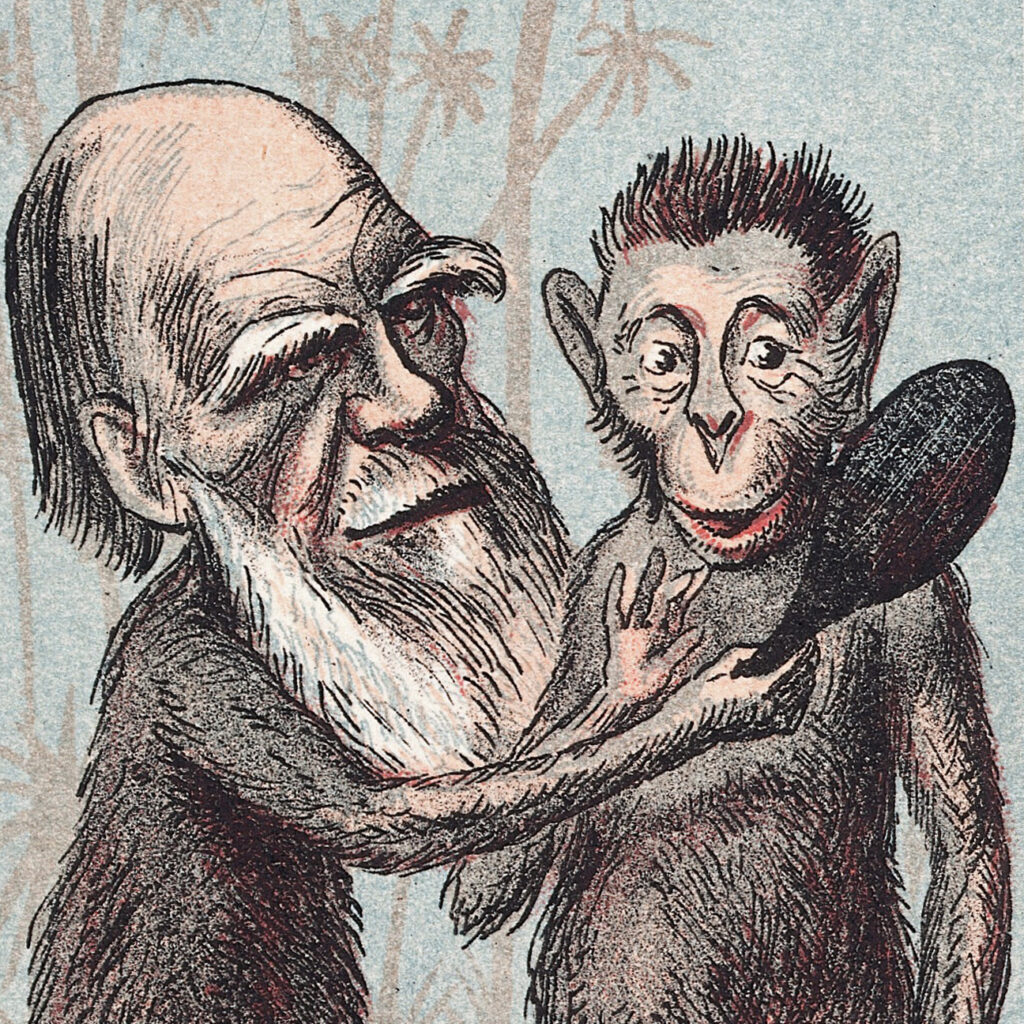
A bearded man covered in fur holding a mirror to an ape’s face.

Inspired by this observation, physiologist Wilhelm Preyer began observing his own young son’s responses to his reflection, part of research that would help found the field of child psychology. Preyer accepted Darwin’s contention that animals had some capacity for abstraction. A dog, for example, clearly understood certain words. But, he argued, only in humans did it culminate in introspection and, ultimately, self-awareness. When he saw his son begin to smile self-consciously and play dress-up in front of the mirror, Preyer believed he had found evidence of the ichbegriff (self-concept) emerging, a development he thought paralleled the evolutionary departure of humans from other animals.

For scholars looking to preserve human uniqueness without leaning on theology, it was an attractive theory. By granting humans individuality along with a unique capacity for higher thinking, Guenther argues, mirror recognition reinstated the divide between man and beast in a way that “flattered humans and endorsed the image they had created for themselves.”

A Mark of Genius

But when exactly did self-recognition occur? Even Preyer couldn’t say. In a letter to the American educator Emily Talbot, he acknowledged that pinning down the moment was “one of the most intricate questions to decide.” Self-consciousness, he wrote, “does not arise suddenly, but by degrees.”

One observer placed recognition at 12 months, another at 21, another not until 28. In the 1890s, developmental psychologist Milicent Shinn tried improving Preyer’s method by pooling hundreds of observations from a network of mother-researchers, but the ambiguity of mirror responses remained. Could one say for sure that an infant smiling in the mirror before turning away shyly believed it was looking at itself?
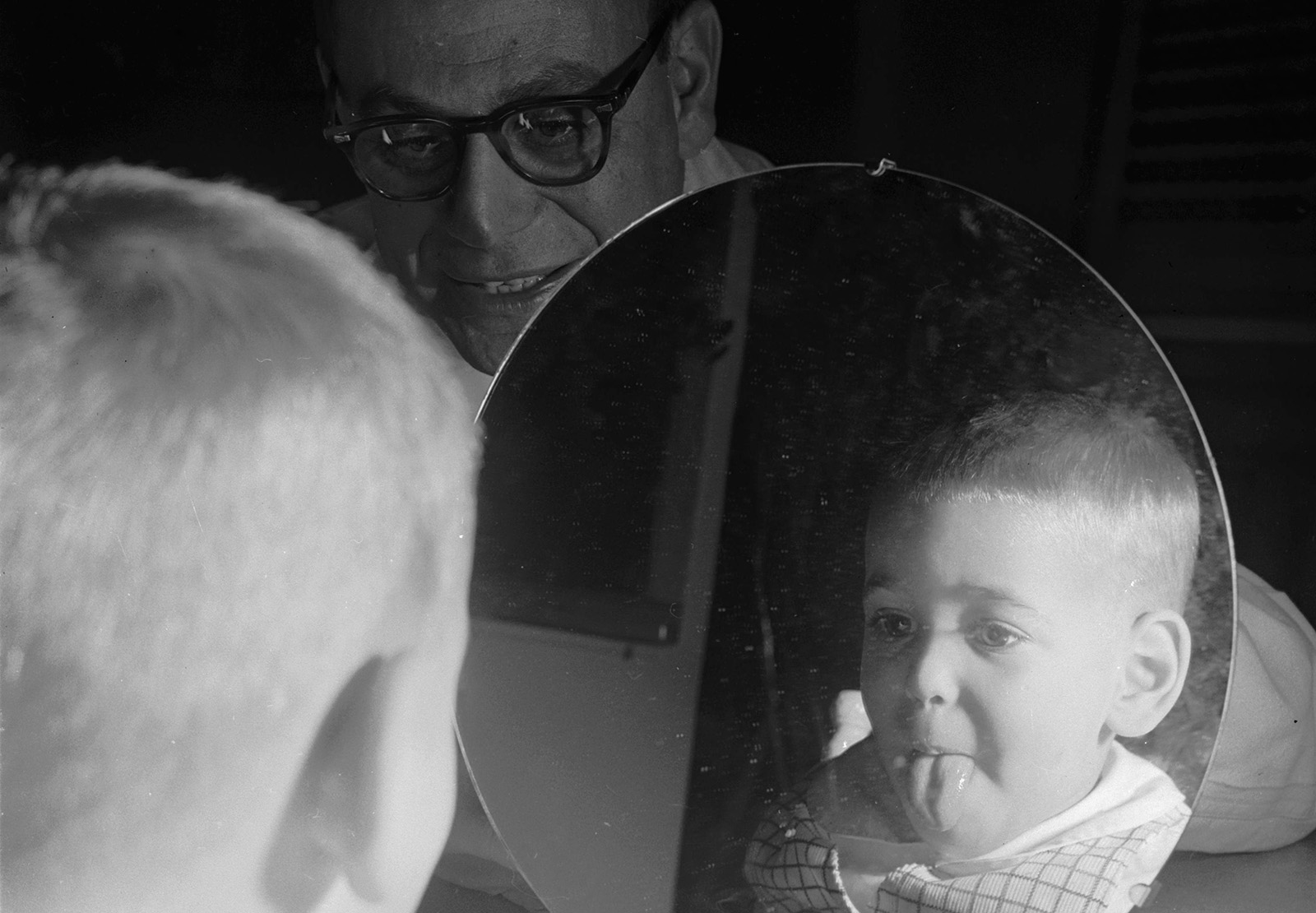
An infant sticks its tongue out and observes its reflection as a man looks on from behind the mirror

By the early 1900s, this subjective approach ran afoul of efforts to fold psychology into experimental science. Behaviorism, as the movement came to be known, demanded rigorous methodology and measurable results. As Guenther notes, the mirror offered neither.

While behaviorists rejected the very idea of mental states and, along with it, self-awareness, the notion that self-awareness set humans apart persisted among philosophers and developmental psychologists. And around 1970, two researchers, unaware of the other’s work, arrived at the same solution to the interpretability problem. One was developmental psychologist Beulah Amsterdam, who marked infants’ noses with rouge to see whether they would reach for their own faces. But it was a young comparative psychologist’s version of the test that would prove more consequential.
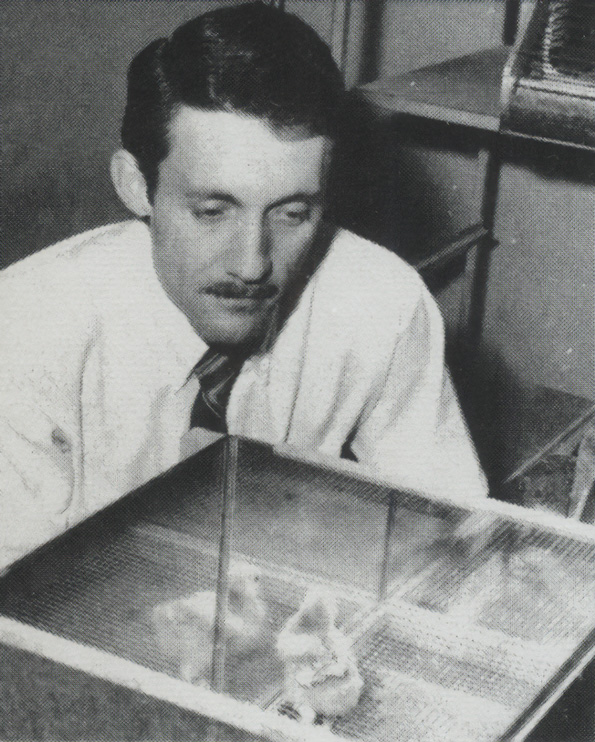
A man looking down at a chick in a box in a research setting

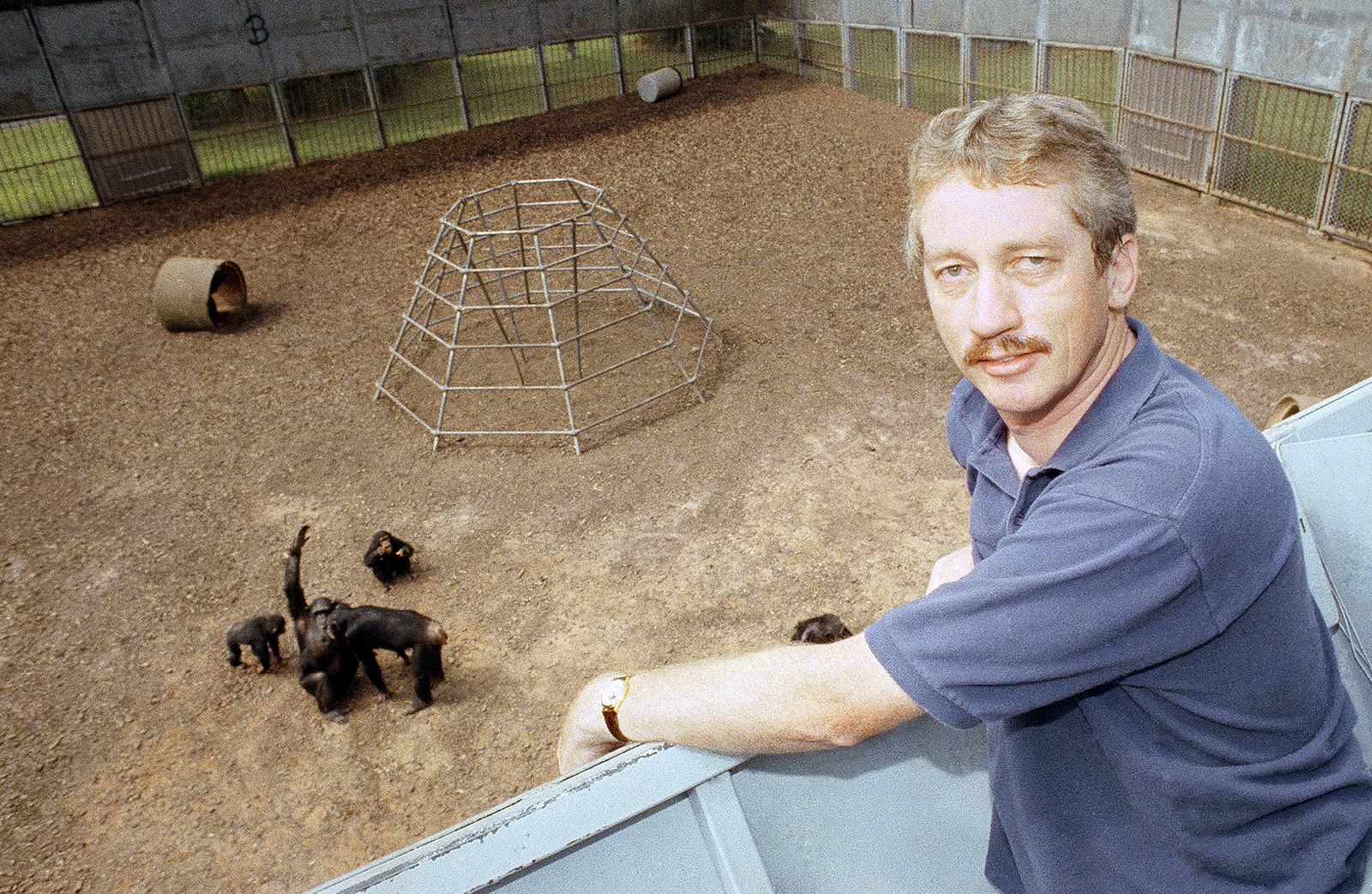
Gordon Gallup studied chimpanzee behavior and had been testing whether a mirror could stand in for another animal—a way to gauge a chimp’s social responses without needing a real partner on hand. Housed alone, each of his four chimps treated their reflection as a stranger at first, threatening it and calling out. After a few days, their behavior changed: they began using the mirror to groom themselves, pick food from their teeth, and examine parts of their bodies they had never seen. It looked like self-recognition. To confirm it, Gallup had the now-famous idea to mark them surreptitiously.

He anesthetized his chimps and marked one eyebrow and one ear on each with an odorless red dye. When subjected to the mark test, each of Gallup’s four chimps touched the dried dye with their fingers, one even bringing its hands to its nose to smell it. It was a monumental moment. He concluded that the chimps possessed self-awareness, which he later defined as the ability to become the object of one’s own attention.

The fact that the chimps could recognize themselves had broad implications, in Gallup’s view. He argued that self-awareness implied the ability to reflect on one’s goals, to think about oneself in the past, and imagine oneself in the future. And this ability produced, as a by-product, theory of mind—the awareness that other individuals hold beliefs and thoughts different from your own.

Directly afterward, he repeated his experiment with stump-tailed, rhesus, and crab-eating macaque monkeys. In his classic 1970 paper outlining this work, Gallup reported that, unlike the chimps, the monkeys treated their reflections the same way they would strangers. Monkeys, he concluded in the language of the time, were mindless.
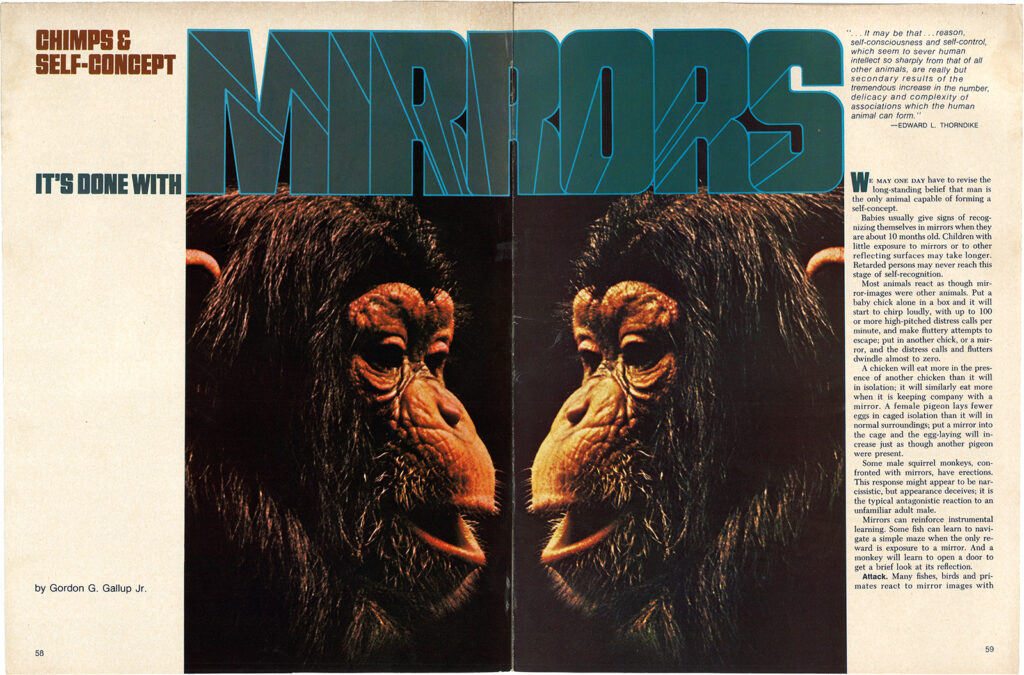
Magazine spread featuring mirror images of a chimpanzee’s face. The title of the article reads: “Chimps and Self-Concept: It’s Done with Mirrors.”
Article by Gordon Gallup published in Psychology Today, March 1971.

“Our data suggest that we may have found a qualitative psychological difference among primates, and that the capacity for self-recognition may not extend below man and the great apes,” he wrote.

On one reading, his research cracked human exceptionalism; on another, it widened the circle just enough to include the other great apes, with whom we share a common ancestor. The idea came to be known as “the big bang theory” of self-awareness. By defining mirror self-recognition as mark exploration, a distinct, measurable act, Gallup, who died in July 2026, had found a way to bring self-awareness into the methodological parameters of behaviorism while reinforcing the scientific case for human exceptionalism.

The Circle Widens

B. F. Skinner, arguably the most well-known behaviorist of the time, was not impressed. The mirror mark test might have made mirror responses measurable, but it did not solve the problem of interpretability that mirror self-recognition had always run into. In his view, actions that appeared self-conscious were actually, like all behavior, learned responses to environmental conditioning. Actions followed by rewards become more frequent; those followed by punishments decrease.

To illustrate this point, Skinner and his colleagues taught three pigeons to use a mirror to locate and peck at marks on the walls of their enclosure by rewarding them for doing so. They then marked the pigeons’ chests, concealing the dots from their view with a bib. Using the mirror, the pigeons were able to locate and peck at the marks on their own bodies. The researchers published the study in 1981 with the ironic title, “ ‘Self-Awareness’ in the Pigeon.”
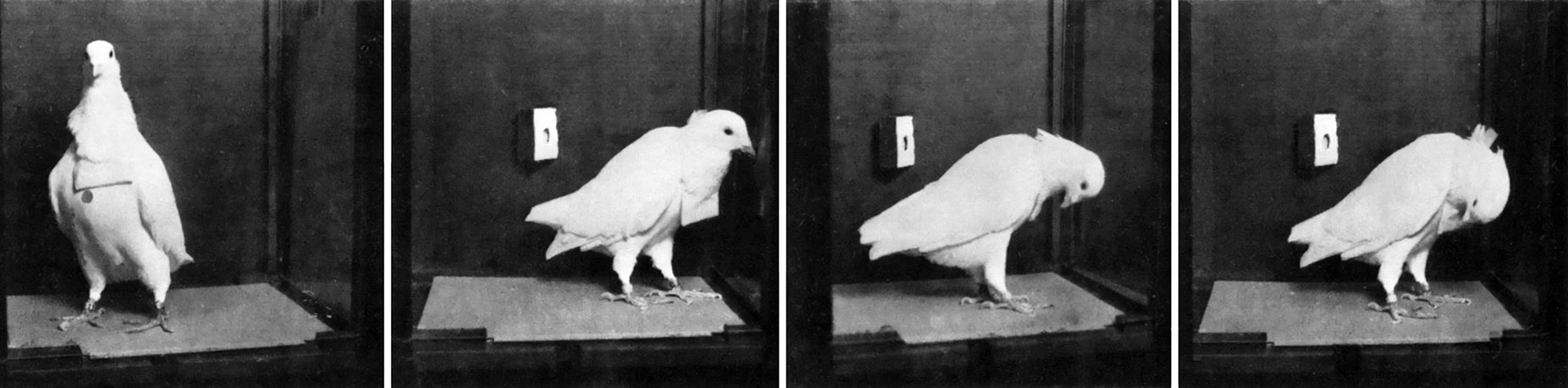
A series of four photographs of a white pigeon with a white bib in a small box.
Photos from B. F. Skinner’s “ ‘Self-Awareness’ in the Pigeon,” Science, May 1981.

Gallup pushed back: conditioning animals to behave in a particular way was like teaching someone which answers to mark on an IQ test; the results were invalid, but they did not invalidate the test.

He refined the test’s criteria. For an animal to truly demonstrate self-recognition, its mark-exploration needed to be spontaneous—the end point of a shift from treating the reflection as another animal to using the mirror to explore its own body. Had the pigeons truly recognized their reflection as a self (as opposed to an object in space like the walls of the enclosure), Gallup argued, the mark pecking would have been accompanied by other investigations of unseen body parts. It was not. Influential primatologist Frans de Waal, in fact, would later call Skinner’s paper “one of the greatest travesties in behavioral science.”

Gallup’s test thus emerged relatively unscathed from the attack. In the decades that followed, biologists who suspected their chosen species was smart increasingly reached for the mirror to demonstrate its self-awareness.

Although some critics contested whether the test did, in fact, measure self-recognition, the idea that self-awareness implied the capacity to introspect and empathize, among other higher-level functions, was, for the time being, largely left unchallenged. Ironically, it was the test’s growing popularity that would undermine its original claim: that self-awareness was the exclusive domain of the great apes.

In 2001, a group of researchers reported that dolphins painted with marks had twisted their bodies to view them in mirrors. This, the investigators claimed, was evidence that they had passed the test. The authors argued that self-awareness developed independently in dolphins—which were also social, large-brained mammals—in a case of convergent evolution. But because the dolphins couldn’t touch the marks, Gallup deemed the evidence lacking. Their prolonged gazing, he argued, might have arisen from mere curiosity rather than self-recognition. (He leveled a similar criticism at a 2018 follow-up study.)

Dolphin Bayley reacts to a two-way mirror at the National Aquarium in Baltimore, ca. 2008–2011.
Courtesy Dr. Diana Reiss

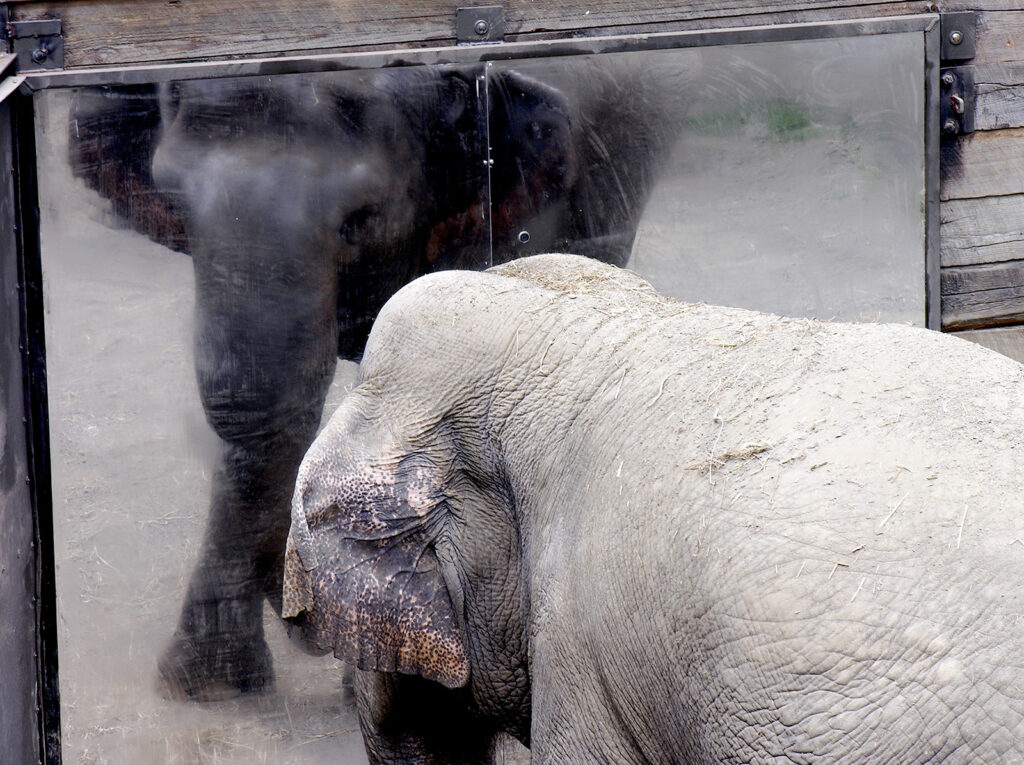
Things got more complicated in 2005 when a 34-year-old, wild-born Asian elephant named Happy, then living at the Bronx Zoo, passed the test by touching a painted white “X” on her temple with her trunk while peering into an 8-foot mirror. Since the other two elephants tested alongside showed no interest in the marks, and Happy herself ignored them when she was retested two months later, critics declared the test inconclusive.

But Happy’s results raised an onerous question for comparative psychologists: what does it mean if some members of a species pass and others do not? Even among chimps, pass rates range from 25% to 75%, with younger adults more likely to pass. And there was the question of the mark itself. What if some animals—including elephants, given their penchant for muddying themselves to cool down—recognized themselves perfectly well and simply weren’t concerned with a bit of paint?

Kohda’s Fish

In Osaka, researcher Masanori Kohda wrestled with this very question. After studying primatology in the early 1980s, Kohda had turned his attention to fish. Over years of observing coral reef species and cichlids from Lake Tanganyika in Africa, he came to appreciate their complex mating systems and social structures. Perhaps, he thought, fish and primates were not as different as they first appeared.

But when Kohda subjected masked julie cichlids to the mirror test in 2017, they, like the elephants, paid little attention to the mark. Kohda wondered if there was another kind of mark the fish would care about. “I searched everywhere to no avail,” he later recalled. “One day, I said to myself, ‘Hey, our focal fish didn’t have to be a masked julie. Any fish that would care about a mark on its body would do!’ ” He and his colleagues turned to the cleaner wrasse.

The cleaner wrasse (Labroides dimidiatus) is found among coral reefs across the Indo-Pacific, from the Red Sea to French Polynesia. Sporting a black stripe along its 2-inch-long, vivid blue body, it’s an attractive fish, but not one likely to attract a second glance from a passing diver.

What made the cleaner wrasse appealing to Kohda was its eating habits. Working in pairs, the little fish are constantly on the lookout for edible ectoparasites feeding on other fish. Their job requires working together and reading the behavior of client fish who do not always appreciate the wrasse’s “cleaning,” particularly when a mouthful of protective mucus proves more tempting than a parasite.

For their first study, Kohda’s team tested four wild-caught wrasses he bought from a tropical fish store for the equivalent of $4 each. They followed Gallup’s classic 1970 study to determine how long after first seeing their reflections the fish should be marked. When the fish were ready, they first injected colorless marks under their skin, as a control, and then repeated the experiment with brown marks.

Marking a cleaner wrasse with dye in Masanori Kohda’s lab, 2022.
Courtesy Masanori Kohda

All the fish ignored the transparent marks, but three responded to the brown marks by scraping their throats against rock and sand, hovering in front of the mirror, and then throat-scraping once more. “I was so surprised that I nearly fell out of my chair,” Kohda recalls.

They submitted the findings to Science, whose reviewers asked for additional testing of the fish for publication, which the team conducted. To the scientists’ surprise, the revised paper was still rejected. (They discovered afterward that Gallup had belatedly joined the review panel.) In 2019, it was finally published as a short report in PLOS Biology. While prominent researchers in fish cognition praised the work, it drew criticism straight away from the biggest names in comparative psychology.

In a paper published in 2020, Gallup and colleague James Anderson put forward two main criticisms. The first attempted to explain the throat-scraping. The authors suggested the behavior could simply be an instinctive response to a mark on another fish, akin to contagious yawning. The other dealt with the fish’s posturing in the mirror. Having learned that the fish seen in the mirror copied its movements, the critics suggested, each wrasse might have been trying to maneuver the other fish into positions to reveal potential parasites more clearly.

As Kohda and his colleague Shumpei Sogawa note, the latter argument, if true, inadvertently credits the wrasse with sophisticated cognition: such manipulation would suggest awareness of their own posture and an understanding of how their actions might read to another fish.

But the attack had a more fundamental problem—despite the potential explanations raised by Gallup and Anderson, the fish had met Gallup’s own criterion for self-awareness, the same he had used to defend the chimps against Skinner’s critique decades before. Nobody had trained the wrasse; they investigated the mark spontaneously. Now, however, it was Gallup side-stepping self-awareness. “Only some great apes and humans have shown clear, consistent, and convincing evidence that they are capable of correctly deciphering mirrored information about themselves,” the critics insisted.

It would be Gallup’s last major defense of the big bang theory. He was nearly 80, and by then it had been decades since he turned the focus of his work to topics that had nothing to do with primate cognition.

Primatologist Frans de Waal, meanwhile, tried to steer a middle path, arguing that Kohda’s findings supported a gradualist view of self-awareness. In this view, all animals have some basic knowledge of self, and different degrees of self-awareness had evolved independently in different species. That humans stood atop this self-awareness hierarchy wasn’t questioned.

De Waal suggested cleaner wrasse exhibit a level of awareness just below mirror recognition, on par with monkeys and other animals that could learn to recognize themselves “with assistance.” Throat cleaning was not distinctive enough, he wrote, to rule out that the fish hadn’t interpreted the mirror reflection as another fish.

A marked cleaner wrasse reacts to a mirror and scrapes it throat in the sand, 2022.
Courtesy Masanori Kohda

“True, self-scraping is not a behavior one would expect if these fish interpret their reflection as another individual, but is this enough reason to conclude that they perceive the fish in the mirror as themselves?” he wrote, adding that the most compelling evidence of self-recognition would be unique, never-seen-before behavior. “Whereas self-scraping, or glancing, is a fixed action pattern of many fish.”

The critique was puzzling: self-grooming was surely similarly common in chimps, and the original pass criterion for the mark test was mark exploration.

Kohda and Sogawa, however, took heart. “To us, the appearance of these critiques signaled that our work could not simply be ignored. Researchers felt compelled to respond to it,” Sogawa says. And, importantly, they helped to inspire research that would be watertight.

Face to Face 

In 2022, Kohda, Sogawa, and their colleagues published a larger study of 14 cleaner wrasse, addressing contentions that a sample of four was inconclusive. This time, all 14 fish passed—far exceeding the pass rate of any other animal. To rule out the possibility that the wrasses were throat scraping in response to what they thought were marks on another fish, the researchers exposed them to other wrasses with brown marks on their throats. The fish, as expected, did not respond by scraping their own throats.

But still, critics were not satisfied and suggested another possibility.

The so-called kinesthetic-visual matching (KVM) argument had first been raised by psychologist Robert Mitchell in the 1990s. Mitchell suggested Gallup’s chimps were merely noticing the match between their own movements and those of the mirror figure. The self-knowledge they were demonstrating with their mark exploration was a sensory, bodily sort that required no mental self-image.

A man standing on the observation deck of an enclosure containing five chimpanzees.

At the time, few researchers found Mitchell’s idea a compelling explanation. As Sogawa points out, it’s hard to imagine how an animal could recognize the mirrored movements as its own absent a mental self-concept. “I regard KVM as a moving of the goalposts designed to preserve the assumption that animals lack self-awareness,” he says.

Nonetheless, Kohda and Sogawa set about testing it directly. To demonstrate true self-recognition, the fish needed to show that they recognized their image, moving or not.

So, the scientists showed the fish photographs—some showing the fish’s own faces attached to other wrasse bodies, and some of their own bodies attached to other faces. All the composite fish images had brown-marked throats. The fish consistently performed the now-iconic throat-scraping action after seeing photos of their own faces but showed no response to the image of their bodies placed on a different face. Clearly, they were not responding to matching movements in identifying themselves. And they weren’t relying on body markings to identify themselves either.

Kohda concluded that they recognize themselves via a facial self-concept in a similar way to humans. What’s more, earlier research had already shown that wrasses distinguished other individuals in the same way.

It was, Kohda recalls, a “deeply moving” discovery.

Still, many skeptics were unmoved. Philosopher Alain Morin suggested the fish might have recognized themselves with some “other unknown underlying mechanisms” that did not involve a mental image. Kohda, Sogawa, and their colleagues responded that a claim of this type might be leveled at any experimental theory.

In 2025, the scientists found that fish marked before ever being exposed to a mirror demonstrated self-recognition within hours of encountering their reflections. In some cases, recognition happened within 30 minutes. This is far quicker than the 10 days of exposure that Gallup’s chimps enjoyed prior to the mark test and is not much longer than it generally takes a mirror-naive human to recognize their reflection.

A cleaner wrasse throat-scraping while being exposed to a photograph of itself with a mark, 2022.
Courtesy Masanori Kohda

That the fish were capable of self-recognition seemed clear. On de Waal’s gradualist hierarchy, that would seem to put the tiny cleaner wrasse level with chimps, at minimum. But rearranging that building block threatened to bring down the whole tower.

“For researchers who believe that advanced cognitive abilities require a large brain—or, conversely, that a large brain is what makes MSR [mirror self-recognition] possible—the idea that an animal with a brain weighing less than 1 gram could exhibit MSR is simply inconceivable,” Kohda suggests. “Accepting such a possibility would require them to reconsider a theoretical framework that has guided their thinking for decades. I am convinced that this is a major reason for the resistance our findings have encountered.”

Occam’s Razor

Rather than overhauling ideas about consciousness, the recent findings have prompted some researchers to scrutinize the test itself. They argue that, from the beginning, the mark test was not testing for something very significant after all.

Morin now concedes that it’s possible cleaner wrasse have a visual self-concept. However, he places recognition lower down on the self-awareness scale than others—low enough to make it uninteresting.

“In the end, it, to me, doesn’t make much of a difference,” he says. “Because it means that, at most, mirror self-recognition is associated with the very, very limited form of self-awareness.”

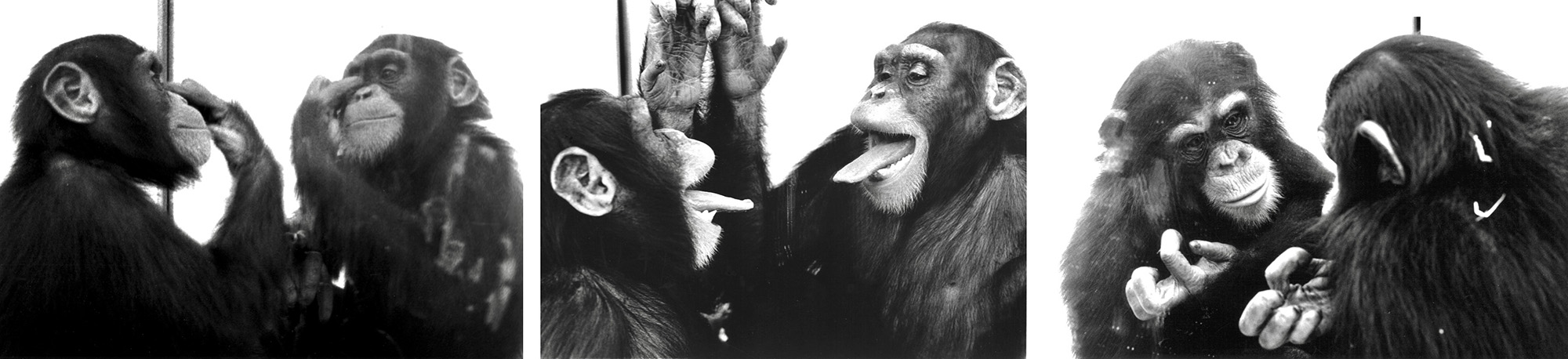
A series of three black and white photographs of a chimpanzee interacting with a mirror.
Chimpanzee Megan during a mirror self-recognition study led by comparative psychologist Daniel Povinelli at the University of Southwestern, 1992.

As Morin conceives it, that awareness (which he terms public self-awareness) is of the body as an object rather than a subject. It involves self-knowledge that is publicly available (size, appearance, position in space) rather than knowledge of internal states, such as thoughts, goals, emotions, and values (dubbed private self-awareness). Even if the photograph study shows what Kohda’s team claims, Morin wrote in his response, the fish would possess at most “one single, tiny, aspect of private self-awareness.”

Morin argues that “full-blown” self-awareness requires inner speech, something he believes other animals are unlikely to possess. But if, by definition, human language is required to examine and report on one’s mental states, is there any way that another animal could show self-awareness?

“There might be another mode of representation, besides visual, that would be nonverbal that nonhuman animals possess that we don’t know about that could account for them being aware of at least some mental states,” he suggests. “The bottom line is that we don’t know.”

In the absence of evidence, he evokes Occam’s razor—the rule of thumb in science that the simplest explanation is the more likely one. “If you can find a non-mentalistic explanation for a given behavior that you observe in the animal,” such as Skinner’s rewards and punishments, then you have to choose that explanation,” Morin says.

An elephant looking in a full-length mirror.

But explanations that rely on a behaviorist framework grow strained when faced with complex, context-sensitive behaviors.

A male wrasse who spots his cleaning partner biting a valuable “client” will punish her by chasing and biting her in return. At first glance, the dynamic appears thoroughly Skinnerian. But a 2011 study found that female wrasses are more likely to sneak a bite when the male is out of view, and they appear to sneak bites more strategically when paired with more punitive males.

What’s more, in the mark test, the wrasses return to check their reflections after scraping their throats, over and over. These are behaviors that, in chimps and other animals we already credit with self-awareness, would readily be taken as evidence of deception and of knowing one’s own intentions.

“Once self-awareness is allowed as a possibility in animals, the justification for applying fundamentally different explanatory frameworks to equivalent behaviors becomes far less clear,” Sogawa argues. “From my perspective, if one accepts the reality of self-awareness in humans, then self-awareness becomes the only candidate that can be treated as a genuinely existing explanatory system for animal behavior.”

Beyond Recognition

In 2025, based on the body of cleaner wrasse research, Kohda and his colleagues suggested that self-awareness may have evolved in the shared ancestor of fish, mammals, and birds, and that success on the mirror test may be just one indication of self-awareness.

Monkeys, for instance, exhibit many of the behaviors associated with self-awareness. A 2020 paper showed that Japanese monkeys passed a version of the false-belief test, the classic assessment of theory of mind. As far back as 1964, research showed that rhesus monkeys will willingly go without food if acquiring that food subjects another monkey to an electric shock.

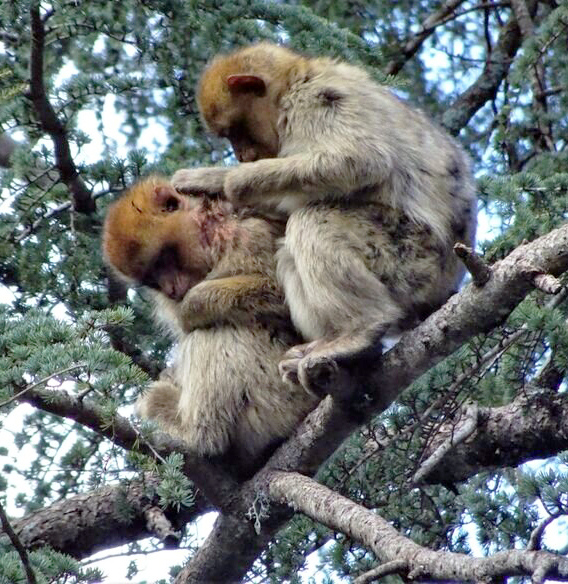
Two monkeys sitting in a tree. One of the monkeys has bloody injuries around its head and neck.

More recently, stump-tailed and Barbary macaques have been shown to console distressed groupmates, one of the clearest behavioral markers of empathy. Interestingly, male spider monkeys even anoint themselves with herbal plants, apparently just to make themselves smell better to potential mates. Altering appearance intentionally, de Waal once suggested, indicates a level of self-awareness higher than mirror self-recognition. 

Why then do most monkeys fail at the mirror? Evidence suggests that monkeys may require touch alongside vision for self-recognition, perhaps as a result of the critical role of touch in social bonding. In one case, monkeys with large, easily felt head implants spontaneously began investigating their bodies after seeing their reflections. Whatever the answer, the original test may simply show that the monkeys fail to map a mirror image onto a self-concept, not that they lack meaningful self-awareness.

The idea that a self-concept might take a nonvisual form is particularly relevant for animals that rely primarily on their noses, ears, and other, less familiar, sensory organs to make sense of the world. Dogs, for all their intelligence, do not pass the mirror test. But if a hound did recognize its reflection, who’s to say it would respond as we do? Its appearance may simply matter less than its scent.

In 2014 and 2015 , Alexandra Horowitz gave 36 dogs an olfactory “mirror test,” swapping scent for reflection. The dogs lingered over their own urine far longer when it was altered—Horowitz’s own analogue of mark exploration and suggestive, she argued, of self-recognition. Firmer evidence comes from a seemingly unlikelier source.

Back in 1992, herpetologist Allison Alberts found that desert iguanas tongue-flicked, or “tasted,” their tails after smelling their own pheromones, the kind of self-directed investigation Gallup would later require as evidence of olfactory self-recognition. Other lizards, wolves, and garter snakes have also joined the list of smell-recognition contenders.

Dogs taking Alexandra Horowitz’s olfactory “mirror test,” 2014–2015.
Courtesy Alexandra Horowitz

Since 1995, a series of tests has sought to detect so-called metacognition (“thinking about thinking”) by gauging whether animals make different decisions based on how certain they are about the outcome. Animals from dolphins to bees have been shown to choose a certain, smaller reward over the chance of a larger one, indicating an awareness of their own uncertainty.

These findings, too, have faced criticism. But while interpretations of behavior can always be contested, the more markers of self-awareness scientists collect and the more diverse they are, the more compelling they become.

This growing body of evidence is part of a more fundamental shift in how we understand animal experience. Even two decades ago, the idea that fish could feel pain or had any inner life at all was a fringe scientific position. In 2024, the New York Declaration on Animal Consciousness stated that there is a realistic possibility of conscious experience—in Morin’s terms, mere awareness, not any type of self-awareness—in fish, reptiles, and amphibians, and in at least some invertebrates, including insects. To date, it has almost 600 signatories.

In 2025, the authors behind the declaration proposed a method for studying this kind of conscious experience: identify a marker of it in humans, then search for the same marker in other species, the same logic that underlies the mirror test. The interdisciplinary study of animal sentience is only just emerging, prompted in part by the tiny wrasses that cleaned themselves with the help of a mirror. As understanding evolves, our treatment of other animals may begin to shift, too.

As for Kohda and Sogawa, they have long viewed fish as individuals. “I believe that they perceive the world not as a collection of meaningless stimuli,” says Kohda, “but as a meaningful space, much as humans do.”

More from our magazine

Advertising photo of a man and woman grilling on a beach
DISTILLATIONS MAGAZINE

Medium Scare

As temperatures rise, the threat of a tick-borne meat allergy grows.

A group of men gathered around a large fish in a crate
DISTILLATIONS MAGAZINE

Atomic Tuna

An ill-fated fishing voyage pulls back the curtain on U.S. nuclear testing in the Pacific.

Pink bacteria on a blue background.
DISTILLATIONS MAGAZINE

The Philly Killer at 50

Legionnaires’ disease has never been more prevalent. So how did we forget it?

    Republish

    Copy the above HTML to republish this content. We have formatted the material to follow our guidelines, which include our credit requirements. Please review our full list of guidelines for more information. By republishing this content, you agree to our republication requirements.