
Beneath the Lab Coat
Telling rich stories about lives in science.
Telling rich stories about lives in science.
“You know, when you are in first or second grade, they ask you what you want to be,” recalled the molecular biologist Ken W. Y. Cho in a 1999 oral history interview. “I drew myself wearing a lab coat and being a scientist.”
Cho’s childhood memory speaks to the white laboratory coat’s importance as a symbol of science. It is a useful piece of clothing designed to protect against accidents that also carries complex meanings. Women have used lab coats to navigate forbidden pregnancies while movie directors have employed them to legitimate atrocious science fiction. The collections of the Science History Institute include unique physical objects and rich stories, at turns playful and poignant, that reveal the surprising history of lab coats.
“It is curious that such an iconic feature of the laboratory as the white coat has received so little attention from historians,” historian of chemistry Peter J.T. Morris mused in his 2015 book, The Matter Factory: A History of the Chemistry Laboratory.
The lab coat is a relative newcomer to the chemistry lab, at least historically speaking. “For most of history, chemists have worn ordinary clothes in the laboratory,” Morris writes. Most did not wear any protective clothing before the mid-19th century. Morris argues that specialized lab clothing first became common in industrial labs, particularly in Germany, where industrial chemists “moved freely between the factory and the laboratory.”
Factory workers often wore brown aprons with bibs, or brown coats, while white coats were traditionally associated with millers, and later painters and doctors. Morris suggests the widespread adoption by medical doctors during the antisepsis drive of the late 19th century made white lab coats “available, cheap, and conspicuous.” Based on his survey of paintings, texts, and historical photographs that were available before he published in 2015, Morris argues that “most academic chemists continued to work in street clothes up until the 1930s.”
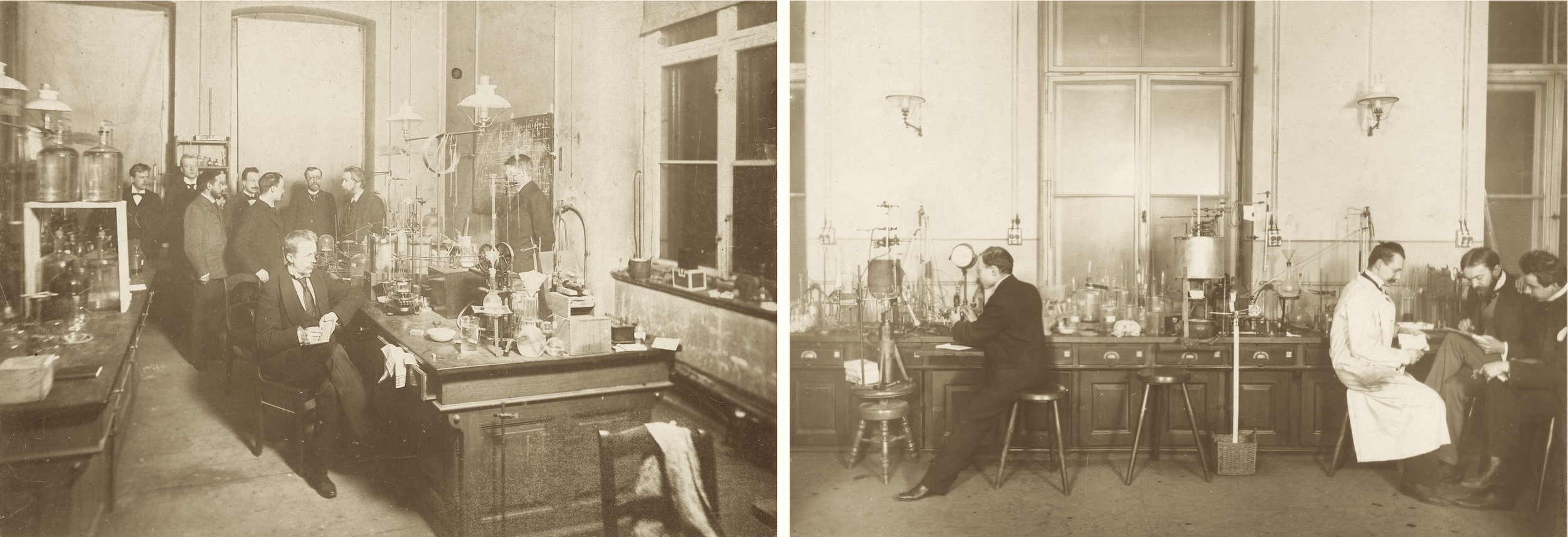
This chronology might be complicated by recently digitized photographs from the papers of father and son chemists Georg and Max Bredig. None of the nine men in a photograph from the mid-1890s titled “Scientists in a laboratory in Leipzig, Germany” are pictured wearing lab coats. Many of these men were graduate students studying under Wilhelm Ostwald. The 1901 photograph “Chemists in a laboratory at the University of Leipzig” shows a laboratory scene with only one of the four chemists wearing a lab coat, a man identified as “Flemming.” The other three are wearing business suits, including the chemist identified as “Friedlander,” who is seen working at the lab bench.
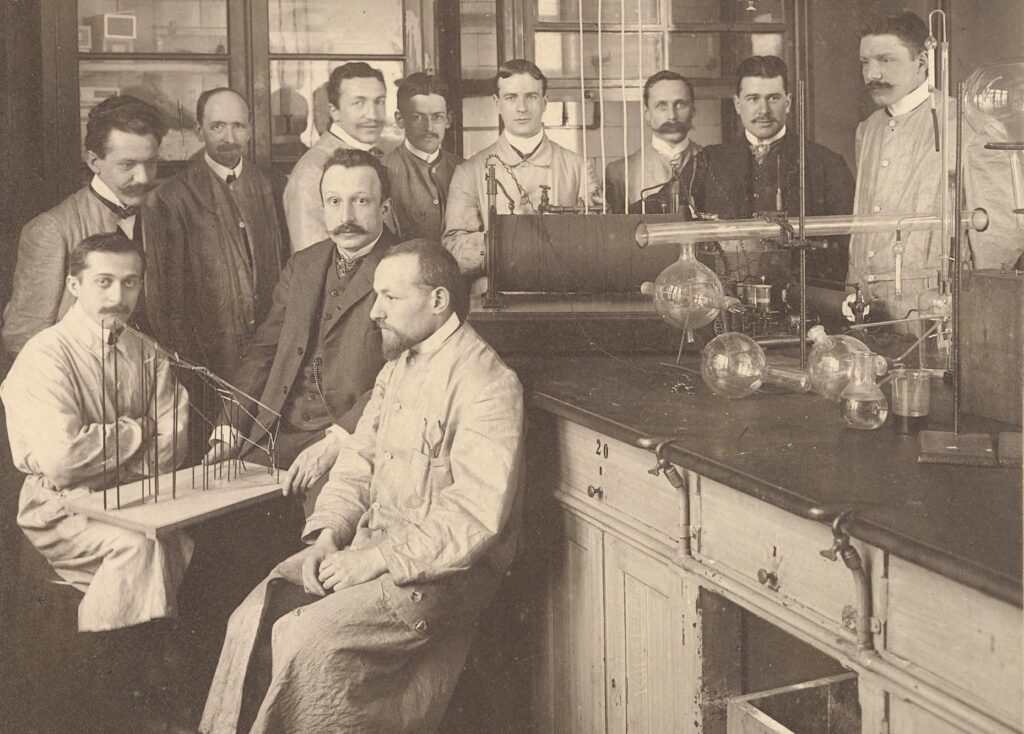
By 1906, however, a photograph of 11 physical chemists at the University of Heidelberg shows academic chemists in the lab wearing an interesting mixture of street clothes and specialized protective coats. It shows six, possibly seven of the men wearing white lab coats, while another wears a dark jacket that looks more like a raincoat. Three of the chemists are wearing suit jackets. Zooming in closely on the seated chemist at the foreground of the photo reveals tears in the pocket of his lab coat, along with a rip at about knee height, suggesting this lab coat received a significant degree of use.
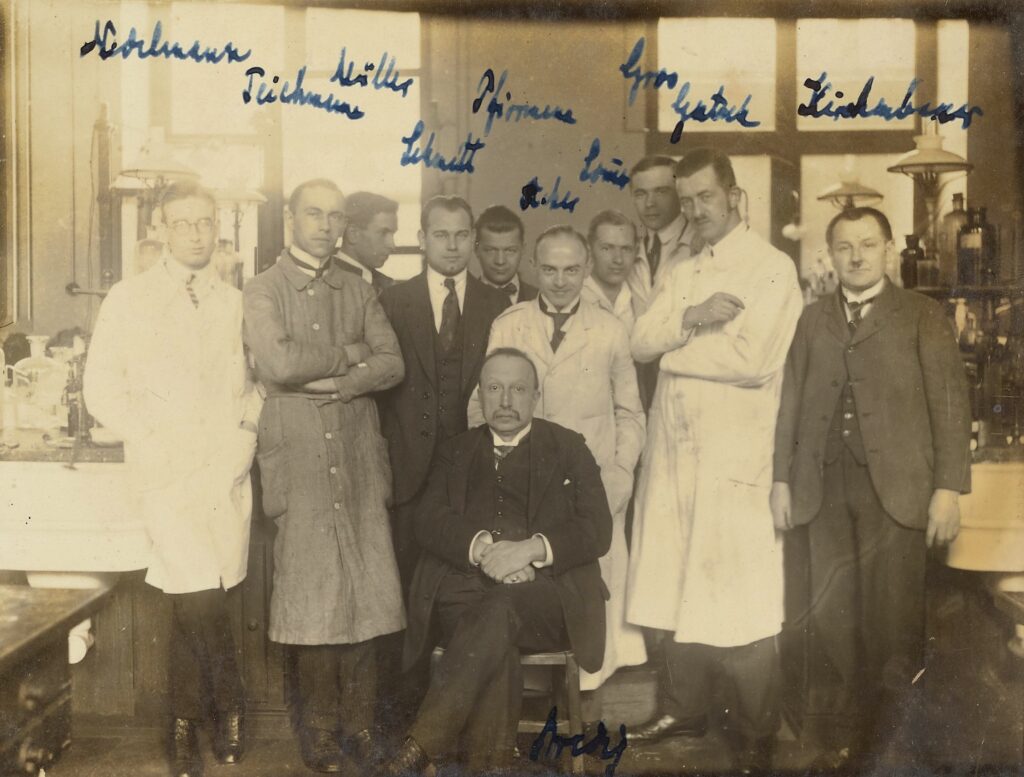
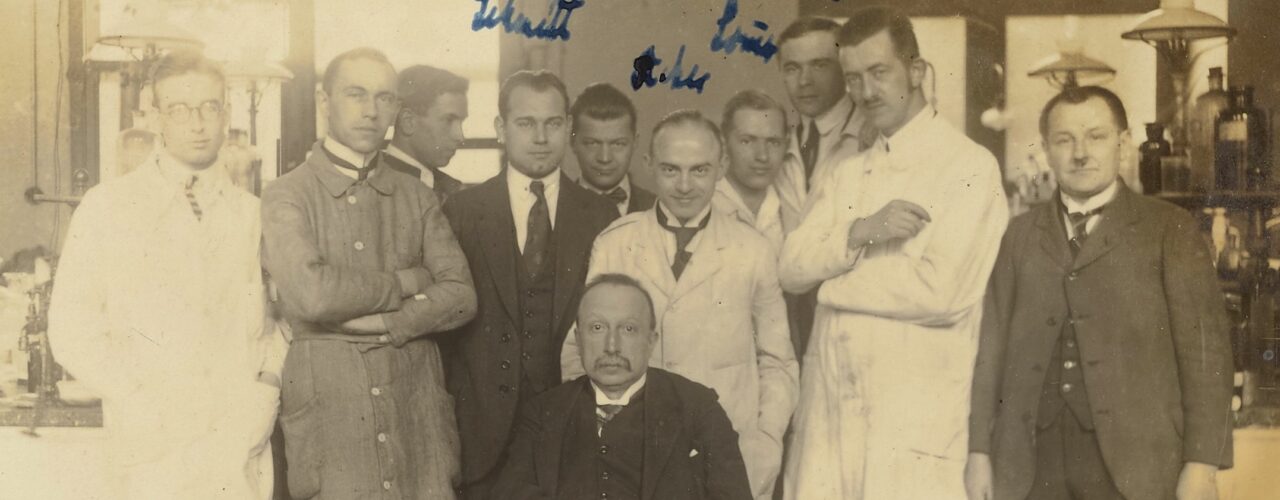
A photo from 1925 of Georg Bredig with fellow chemists in a laboratory at the Technische Hochschule in Karlsruhe, Germany (also featured at top) likewise shows the chemists wearing a mixture of lab coats and street clothes, with the older men in the picture dressed in ordinary suits and ties. These photographs from the Bredig Papers suggest that the first decades of the 20th century might mark a transitional era where protective coats were becoming regular lab wear, at least in Germany.
Lab coats play a very practical part in lab safety. “Let me tell you, lab coats work!” exclaimed chemist Edith Flanigen in an as yet unreleased oral history interview conducted by the Institute. While working in a laboratory at Syracuse University in the early 1950s, she had a mishap with an acetylene tank: “I went to light the torch and it blew up.”

Fortunately, Flanigen was wearing a lab coat. “You could see the line of demarcation where the lab coat was,” she recalled, “but the rest of my hands were third degree burns.” Flanigen later became a distinguished petroleum chemist celebrated for developing zeolites (absorbent minerals) used in oil refining, but “ever since, I have been extremely religious, shall I say, about laboratory safety.”
Historically, lab coats were generally made from cotton, and more recently out of cotton/polyester blends. Basic lab coats are meant to protect against chemical spills and flash fires. They are often closed with snaps so they can be quickly stripped off after contacting corrosive chemicals. More advanced protective coats in use today might include flame-resistant treatments or multilayered fabrics that include impermeable membranes to protect against chemical splashes.
But the protective qualities of lab coats can also make them uncomfortable to work in. The immunologist Ann Pullen recalled working in an un-air conditioned lab at Cambridge University during a hot English summer in the mid-1980s. “I mentioned that I was doing tissue culture in my bikini in the lab in Cambridge,” she told an oral history interviewer. “I omitted to mention that I always had a lab coat on top of my bikini” because of the strict lab safety laws in the U.K. at the time. Years later, Pullen met her future partner while in the lab. “I was wearing a lab coat, gloves, protective mask, and goggles, weighing out acrylamide. He always tells me my eyes sparkled through all this protective coating.”

Photographs and films demonstrate one of the lab coat’s most straightforward visual meanings: science. For example, today an embroidered lab coat is one of the symbols chosen by the Imhotep Institute Charter High School, an African-centered, STEM-focused school in Philadelphia’s Germantown neighborhood. News stories run photographs of Imhotep students wearing their lab coats far outside of laboratories.

Images from advertisements suggest the lab coat was understood as synonymous with science at least by the middle of the 20th century. A 1940 promotional booklet by DuPont depicts a man in a white lab coat lecturing a flower-holding woman, with the caption, “The chemist explains how he captures from coal the scent of lily-of-the-valley, though he cannot secure it from the flower itself.” A 1944 Dow ad that asked “Is Plastics the Word?” features a man in a white lab coat representing the modern scientist who works with plastic materials, building on a tradition of ancient Egyptian potters and medieval Venetian glassblowers. A 1950s advertisement claims “It’s Less Toil and Trouble When You Get It from Eastman” below a cartoon of three witches in lab coats brewing specialty chemicals in a cauldron.

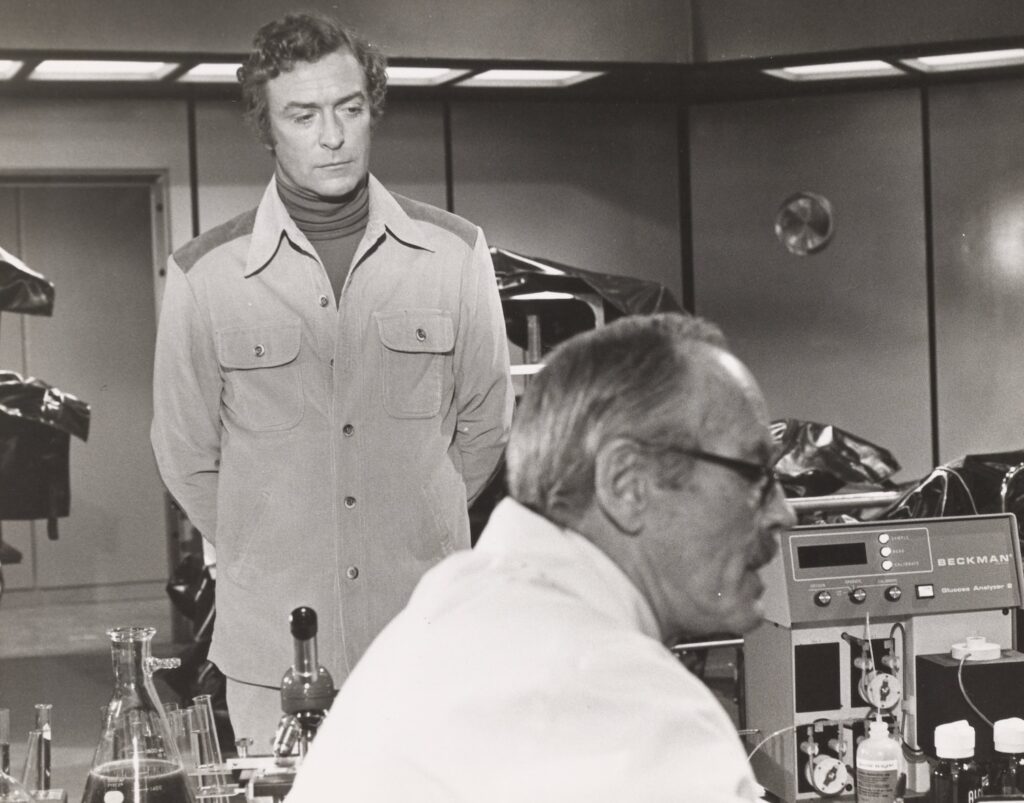
Lab coats also feature prominently in science fiction films as shorthand for serious science, as seen in the publicity photographs taken on the set of the sci-fi disaster movie The Swarm from 1978. Researchers in lab coats stand amongst authentic chemical and biomedical instruments as they help Michael Caine and Henry Fonda science their way out of a killer bee attack that blows up a nuclear power plant. The film is as epically terrible as it sounds.
A mercifully shorter film in the Institute’s digital collections shows the University of Idaho marching band wearing lab coats in their 1987 tribute to National Chemistry Day. Performing “Fanfare for the Common Element,” several flautists seem to be playing graduated cylinders instead as the band forms various atomic diagrams, two sousaphone players occupying the 1s orbital, before fissioning into a round-bottomed flask and three stars.

Lab coats can also create an illusion of uniformity that might temporarily grease the mechanism of social interactions and perhaps protect people who have been marked for social discrimination. The Jewish chemist Georg Bredig wrote to his son Max as the Nazis tightened their control over German life in October 1936. He bid Max to stay well shaven while wearing a clean collar and a handkerchief, continuing, “always wear a clean lab coat that is not torn. It is important for non-Aryans to make a good impression!”
Though they may appear uniform and plain, lab coats have been used to express identity, both the wearer’s individuality as well as their allegiances to groups. Our collections capture a variety of sometimes poignant, sometimes funny examples of how scientists have used lab coats to express themselves.
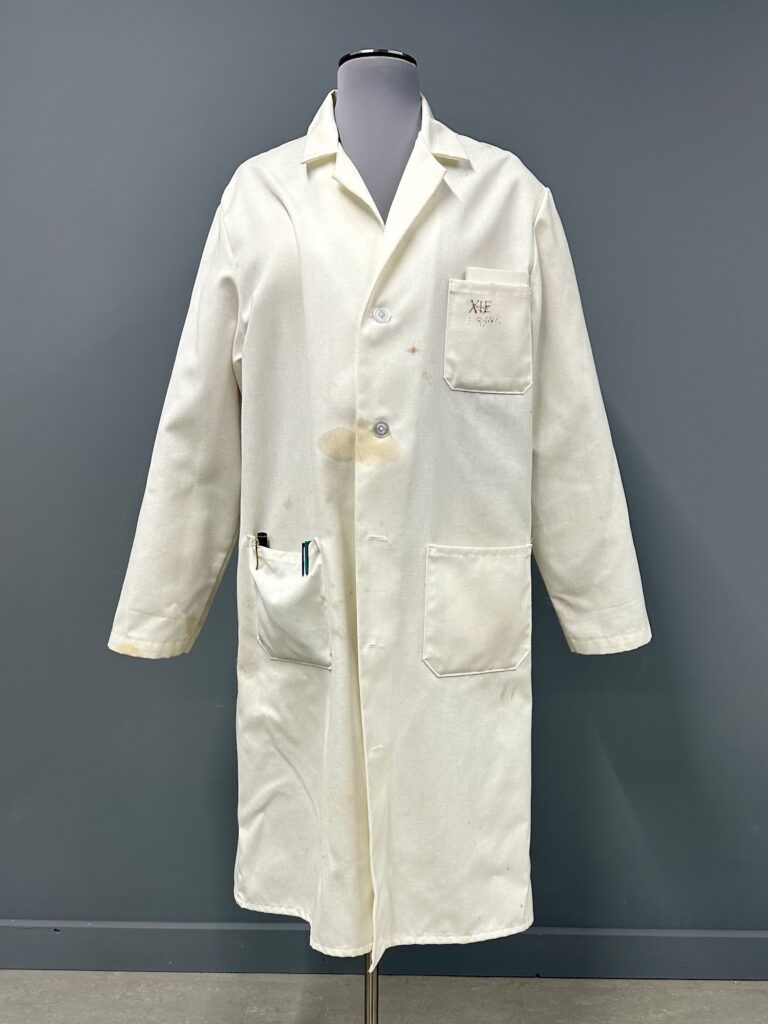
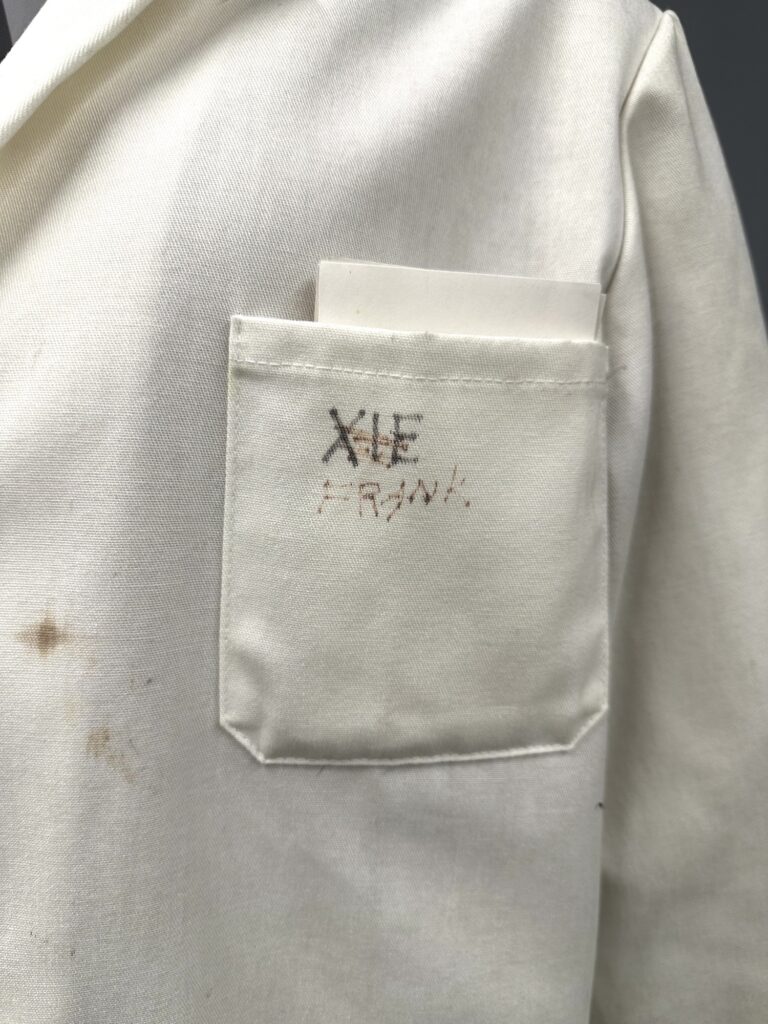
Lab coat worn by Nobel Prize-winning chemist Alan MacDiarmid in honor of his graduate student Xie (a.k.a. Frank), who passed away before completing his degree.
Sometimes appearances can be deceiving. At first glance, this lab coat looks like a normal, well-used coat, stains and all, with pens and blank notecards still in the pockets. Upon closer inspection, we see the name “Xie” crossed out, with “Frank” written underneath. These words reveal quite a poignant story about the coat’s second owner, Dr. Alan MacDiarmid, and one of his graduate students to whom the coat originally belonged. The story comes from Dr. MacDiarmid’s daughter, Heather, and Dr. Laird Ward, a friend of MacDiarmid’s. Xie was a former graduate student of Dr. MacDiarmid’s, who took the name “Frank” to blend in more in American society. Unfortunately, Frank passed away from leukemia before completing his degree, and Dr. MacDiarmid wore Frank’s coat in his honor.
Lab coats can also communicate contempt. Biochemist Bradley Olwin attended graduate school in the pharmacology department at the University of Washington in the early 1980s. The department was split between the younger faculty members who were using molecular tools to do pharmacology research and the older pharmacology faculty who mostly taught medical and pharmacy students. Olwin and his fellow graduate students noticed a curious pattern in the way these older faculty dressed. “We always found it very amusing that they wore lab coats and were never in the lab.” The young faculty “were interested in teaching you about science,” Olwin remembered, and would talk to graduate students “as a colleague, as someone who was going to be important to them.” But the older faculty members treated graduate students as “second-class citizens.” So the graduate students expressed their contempt through costume: “We wore lab coats to distinguish ourselves from the medical students, but we made sure they had all sorts of stains and stuff on them. We wanted them as dirty and ugly as possible.”
The presumption of authority and professionalism that is inherent in a white lab coat was useful for medical research assistant Claire Shultz, as she recounted in an oral history conducted by the Institute. In 1946, Schultz interviewed with the director of the Wistar Institute, Edmond Farris, for a job supporting his work with infertile couples. Schultz recalled that Farris was “concerned that I would look too young (I was 21 now) to be talking with men about their sex lives, and dealing with the ins and outs of the [sperm] donation program, but after I promised to always wear a lab coat, and reminded him that I was a mom, he consented to try me out.” In this case, a lab coat conveyed enough professionalism to overcome one aspect of sexism of the 1940s.
Schultz also told a story that points to how the history of lab coats is also entwined with the ways bodies change during pregnancy. The Institute’s oral histories capture how women utilized lab coats to try to continue their professional lives while being pregnant, during an era when some people saw pregnancy as immediately disqualifying someone from professional life.
From 1949 to 1983, Shultz had a distinguished career developing computer-based methods for coding and retrieving scientific information. But before that time, she had hoped to become a doctor and medical researcher. She became pregnant during her first year at the Women’s Medical College of Pennsylvania in 1944. Her classmates and one professor found out after Shultz was chosen as a “guinea pig” to demonstrate how fluoroscopy worked. Fluoroscopy uses a continuous stream of X-rays to show the structures of the human body hidden beneath clothing and skin. Shultz’s professor exclaimed, “I thought I saw a head!” as he scanned her belly. Afterwards she wore a lab coat to hide her pregnancy, which worked to keep her in med school until the dean found out following a random blood draw for a physiology lab. Once the dean knew about her pregnancy, Schultz was not allowed to return to finish her degree.
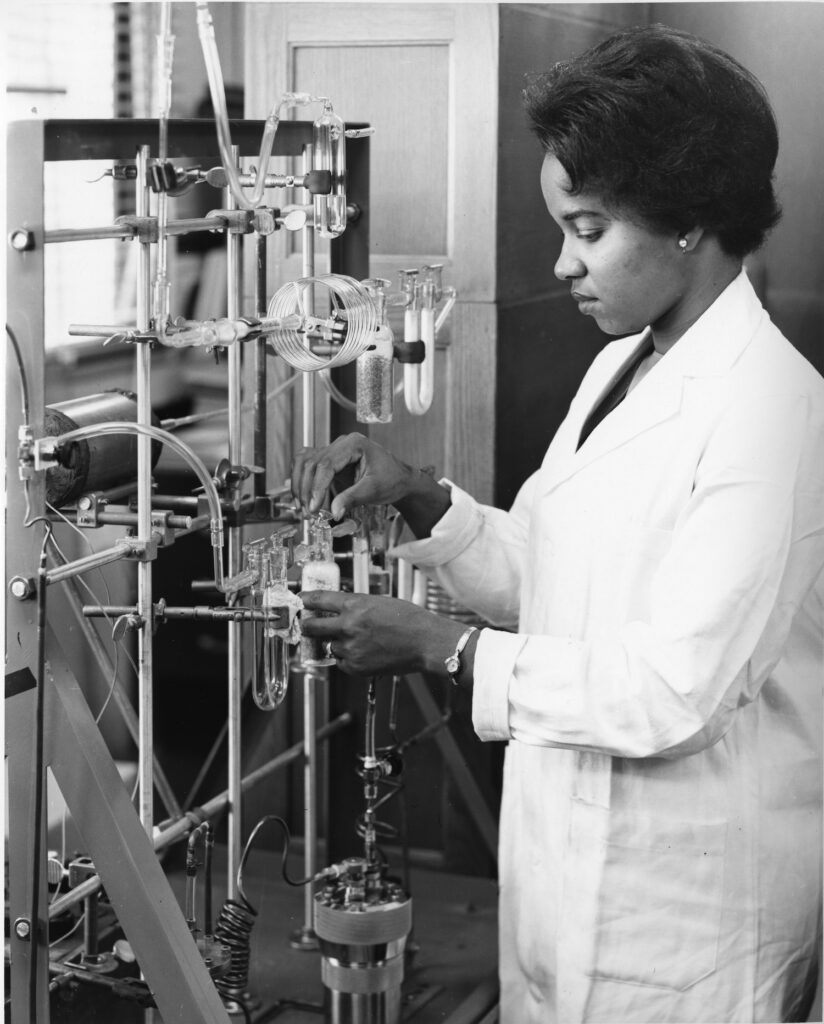
Chemist Reatha Clarke King had two children while working at the National Bureau of Standards (now the National Institute of Standards and Technology) between 1963 and 1968. In a male-dominated workplace, her pregnancy required her to carefully manage both employment benefits and clothing, as she recalled in an oral history interview: “I saved my leave so that I could use it for maternity leave. We had no such thing as parental leave then, and you wore a lab jacket, so you were not a particular distraction to someone because you were pregnant.” As King recalls, a now widely published photograph of her wearing a lab coat standing in front of a flow system was likely taken while she was pregnant with her first child.
Changing attitudes towards pregnancy and women in science can be seen through one of the Institute’s newest museum objects, a maternity lab coat recently developed by Genius Lab Gear. Dubbed the “Alma,” the lab coat is named after Alma Levant Hayden, an American chemist, mother, and one of the first African American women to work as a scientist at a government agency in Washington, D.C., according to the American Chemical Society.
The Alma coat is designed to expand and be adjustable so that as the body changes during and after pregnancy, the coat adjusts to still fit properly and provide the same level of protection. Some examples of these small but significant changes include pleats in strategic areas to allow for expansion, as well as a hidden adjustable belt. The coat in our collections is a preproduction sample; it still bears the markings of the assembly process, with small “M”s written on parts to indicate they are part of a size medium coat. The coat is now in full production after several rounds of prototype testing by women working in laboratories.
The Institute’s collections reveal how white lab coats have come to symbolically mark who counts as a professional scientist. While advertisements, movies, and even marching bands use lab coats to shout “science,” the garments can have more complicated uses and personal meanings for their wearers. Food and drug chemist Judith Summers-Gates recalled that as her career shifted into management and administration, her lab coat symbolized her enduring sense of herself as a scientist. “You couldn’t take me out of the lab coat or the lab coat out of me.”
Curating an exhibit on student notebooks.

Bringing the past to life with an obsolete video format.

Highlighting the research projects of our current resident scholars.
Copy the above HTML to republish this content. We have formatted the material to follow our guidelines, which include our credit requirements. Please review our full list of guidelines for more information. By republishing this content, you agree to our republication requirements.