
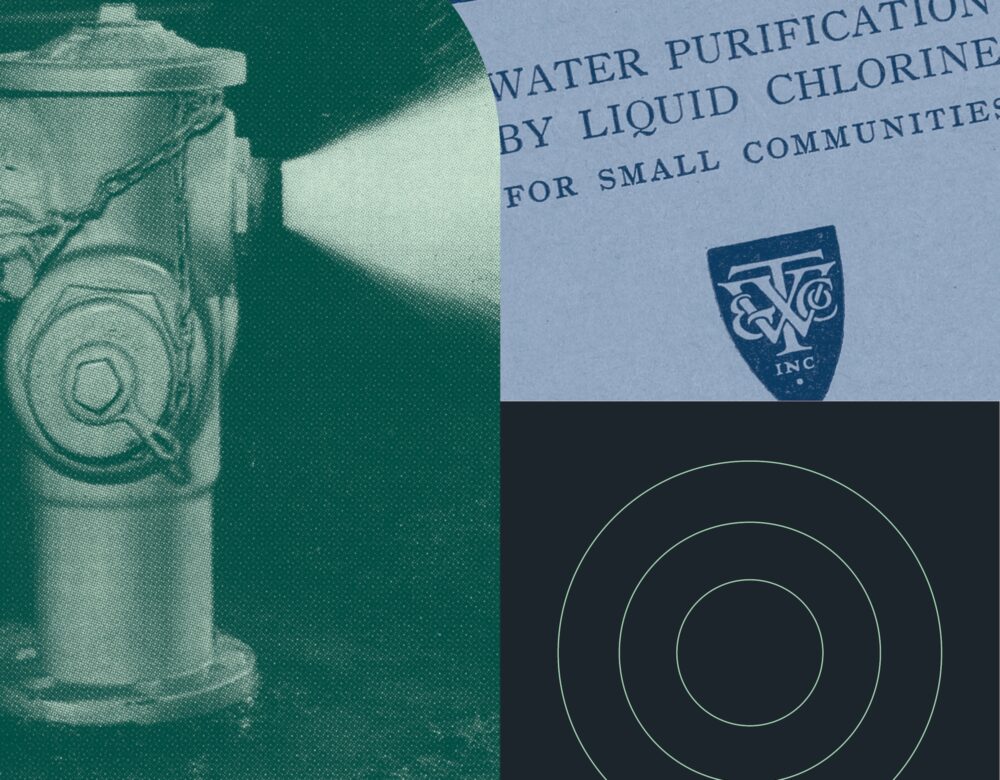
In 1908, two men, John L. Leal and George Warren Fuller, spent 99 days secretly constructing something that would fundamentally alter the Jersey City water supply. Their decision to add chlorine is one that continues to impact our lives for the better, but there was no large-scale testing or approval process. In this episode, brought to us by producer Caitlin Faulds, we’ll explore the big questions about Leal and Fuller’s great experiment. Do the ends justify the means? What if it hadn’t worked? And how did people react when they found out?
Credits
Host: Alexis Pedrick
Reporter, Producer: Caitlin Faulds
Executive Producer: Mariel Carr
Senior Producer: Rigoberto Hernandez
Sound Design: Seth Samuel
Fact-Checking: Alexandra Atiya
Resource List
A New Method of Purification. Passaic Daily News, December 7, 1908.
About Water Disinfection with Chlorine and Chloramine. February 14, 2024.
Dechlorination Process Discovered in England; Intermittent Complaints about Too Much Chlorine in Water. The Morning Call, May 8, 1913.
Disinfecting Insufficient, Says Expert. Passaic Daily News, May 12, 1909.
Dr. Leal on Boonton Waterprocess. East Jersey Man Defends the Bleaching Powder Treatment. The Jersey Journal, June 8, 1909.
Emerging Trends in Disinfection: Lessons From AWWA’s Disinfection Survey. Journal – American Water Works Association, 113(1), 20-28. January 19, 2021.
EPA. Drinking Water Regulations. EPA, February 24, 2026.
Erikson, Matt. How Two Men Helped Rid the U.S. of Typhoid: A Q&A With Drexel Alumnus Michael McGuire. March 31, 2014.
Expert Shows Water Supply is Putrescent. Jersey Observer and Jersey Journal, May 12, 1909.
Expert Witness for Water Co. Admits Chlorine. Jersey Observer and Jersey Journal, October 5, 1909.
Golden State Film Productions, “The ABC’s of Pool Care” in the 1960s
Jersey City Water Declared Polluted, Experts in Great Battle Before the Chancery Court. Passaic Daily News, April 29, 1909.
Library of Congress. City Life in the Late 19th Century.
Library of Congress. Immigration to the United States, 1851-1900.
McGuire, Michael. The Chlorine Revolution: Water Disinfection and the Fight to Save Lives. American Water Works Association, 2013.
Mother Jones. How One Man Poured Chemicals Into New Jersey’s Drinking Water and Changed Women’s Fashion Forever. October 17, 2014.
New Germicide Said to Purify Boonton Water. Jersey Observer and Jersey Journal, December 7, 1908.
Proceedings of the 29th Annual Convention of the American Water Works Association. 1909.
Rotary Club Hears of Uses for Chlorine. Jersey Journal, August 10, 1928.
Sewerage Commission’s Busy Year. Jersey Journal, December 16, 1907.
Spackman, Christy. The Taste of Water: Sensory Perception and the Making on an Industrialized Beverage. University of California Press, 2024.
State Press Comment: Newark Star. Evening Courier, December 12, 1908.
Through Other Eyes: Treating the Water. Jersey Journal, December 17, 1908.
Typhoid Fever in City Water: The State Board of Health Has Completed Its Analysis of the Delaware River Water. The Times, January 31, 1900.
Vox. Flint’s Water Crisis Explained in 3 Minutes. January 21, 2016.
World Health Organization. Typhoid Fact Sheet. World Health Organization, March 30, 2023.

Transcript
Alexis Pedrick: From the Science History Institute. I’m Alexis Pedrick, and this is our new season of Distillations, American Vice: Risk, Science, and the American Experience.
Alexis Pedrick: Away from the bustling streets of Jersey City lies the Boonton Reservoir. Boonton, if you’ve never heard of it, is a 700-acre expanse of water fed by the Rockaway River in northern New Jersey. In 1908, two men, John L. Leal and George Warren Fuller, spent 99 days scheming, secretly constructing something that would fundamentally alter the Jersey City water supply. A one-story building containing concrete tanks, pumping devices, boilers, engines, and a storeroom capable of holding three carloads of chemicals. The view inside was somewhere between a factory floor and a mad scientist’s lab.
Alexis Pedrick: On September 26th, 1908, at Leland Fuller’s direction, the valves opened. Water streamed through the contraption, mixing and stirring and whirring before rushing down into a gravity-fed aqueduct 23 miles long. Listeners, it was kind of a big deal. When the people of Jersey City turn on their taps and take a drink, now their water will contain trace amounts of a freshly applied chemical: chlorine.
Alexis Pedrick: Theoretically, this chlorine, added in powdered form, will destroy the bacteria in the water with no harm to consumers downstream. But these men, water engineers with degrees from MIT and Columbia, sure War have just sent an unsanctioned chemical into the homes of 200,000 people. No large-scale testing, no approvals. This is an experiment on a grand scale. They must have wondered, will this work? Will this be safe? It was a huge gamble, and the people of Jersey City had no idea.
Alexis Pedrick: Now, spoiler alert: it worked. That decision to add chlorine is one that continues to impact our lives for the better. But the question remains: do the ends justify the means? What if it hadn’t worked? And how did people react when they found out? For answers, we’re turning to producer Caitlin Faulds, who brought us this story. So, Caitlin, where does this start?
Caitlin Faulds: Well, like any piece of history, that’s a little bit up for interpretation. But to borrow words from historian Claas Kirchhelle:
Claas Kirchhelle: The history of chlorine is, to a certain degree, associated with the history of typhoid.
Caitlin Faulds: And the history of typhoid is tied to contaminated drinking water.
Alexis Pedrick: Oof! Well, I guess we’ll go there now.
Chapter One: Water, Filthy Water
Caitlin Faulds: In the late 19th century, increases in industrialization and immigration meant American cities were growing drastically and quickly densifying. Jersey City was one of those boom towns.
Michael McGuire: It was chock-a-block full with folks.
Caitlin Faulds: This is water engineer, historian, and author Michael McGuire.
Michael McGuire: Every block had a couple of industries on it, or warehouses or whatever. Smoke was belching out of everything, and it was a major railway terminus. All of the railroads from the west came into Jersey City. They then either loaded ships that would go out across the oceans. Or they would take stuff to New York City across the way because if you stand on the docks of Jersey City, the Manhattan skyline is right in front of you.
Caitlin Faulds: But among other things, this growth put enormous pressure on the city’s water infrastructure and increased anxieties about diseases like typhoid.
Claas Kirchhelle: Typhoid is a disease of human civilization.
Caitlin Faulds: This is Claas Kirchhelle again, historian of “bugs and drugs” and associate professor for the French National Institute of Health and Medical Research.
Claas Kirchhelle: So typhoid, the primary mode of transmission is fecal-oral.
Caitlin Faulds: Fecal-oral, as in poop.
Claas Kirchhelle: It needs us to be in close contact with other human beings in order to proliferate in order to survive.
Caitlin Faulds: At first, we didn’t really know what typhoid was or how it worked.
Claas Kirchhelle: For a long time, it was nearly indistinguishable from a huge amount of other fevers that would just kill you and that were associated with gastrointestinal symptoms. It’s really only in the 19th century that we start getting an understanding of typhoid as a distinct disease.
Caitlin Faulds: It’s a British physician, William Budd, in the 1850s who links typhoid to contaminated water.
Claas Kirchhelle: He actually speaks of the sewer as a kind of extension of the diseased intestine. In this context, he’s doing this almost in parallel exactly to John Snow.
Game of Thrones, HBO: You know nothing, Jon Snow.
Caitlin Faulds: Not the illegitimate son of Ned Stark. The 19th-century physician who was considered one of the founders of modern epidemiology and did a lot of work tracing the source of a cholera outbreak.
Claas Kirchhelle: And it’s really this kind of joint double punch of cholera and typhoid that really changes perceptions.
Caitlin Faulds: Although typhoid was first observed under a microscope in 1879 and then isolated and cultivated in 1884, there wasn’t really widespread awareness of this disease.
Claas Kirchhelle: Typhoid is only really just becoming visible as this bacterial disease around the turn of the century. 1896, you get the first point-of-care diagnostic, the Widal test surrounding typhoid. So it’s still a very exciting novel public health entity.
Caitlin Faulds: In the 1900s, people’s awareness of typhoid and its transmission grew.
Claas Kirchhelle: Typhoid Mary or, you know, the really sad story, really, of Mary Mallon is one of the iconic stories of public health.
Caitlin Faulds: Mary was an Irish immigrant working as a cook for some of the wealthy families in New York City, and she was found to be the common denominator in 47 typhoid cases, some that even resulted in deaths.
Claas Kirchhelle: You don’t necessarily need to show clinical symptoms to be infected with typhoid, and she was a healthy carrier. She’s found to be the cause of typhoid outbreaks that have been ongoing in the New York area. She’s arrested because she resists public health authorities. And the first thing people do is they just lock her away for not an inconsiderable amount of time.
Caitlin Faulds: She was far from the only asymptomatic carrier in the city, but she was a woman and an immigrant, and perhaps doubly suspect to the epidemiologists at the time, who were:
Claas Kirchhelle: Quote-unquote, male microbe hunters. So the person gets reduced to the presence or absence of a microbe in this context. On the one hand side, it’s a story of a triumph, right? You are able to track down a carrier and shut down that public health risk. And another one raises really uncomfortable questions about who is being blamed for disease.
Caitlin Faulds: Nevertheless, some good may have come from her story and that of others. Each headline expanded awareness of typhoid transmission, germ theory, and larger-scale mitigation strategies, including ones that focus on water supply, filtration, and treatment.
David Sedlak: People got interested in getting their water from a new, cleaner source?
Caitlin Faulds: This is David Sedlak, a professor at UC Berkeley.
David Sedlak: Historically, the approach was: if your water supply became fouled by some nearby activity, you found another water supply. You built a canal from a pristine watershed, or you put in a well in a new place, maybe deeper underground to make it safe. But in some places, that just wasn’t possible. And so that forced people to get creative and find ways of treating water.
Caitlin Faulds: This was true in Jersey City, where typhoid fever cases were high. The death rates were regularly above 60 per 100,000 between 1880 and 1895. A state Board of Health report in 1900 showed that they had 44 typhoid deaths, the most of any city in the state. For comparison, Newark, a city of approximately the same size, had only 25 deaths, and sourcing clean water in Jersey City was already a challenge because of its location.
Michael McGuire: Jersey City spent a lot of money to develop a new water supply on the Passaic River.
Caitlin Faulds: This is Michael McGuire again.
Michael McGuire: And they built it, and they were operating it. But that was downstream of all the sewage discharges for Paterson, New Jersey. And that’s how people got sick. So they had to get off of the Passaic River where they were, and go way upstream to a tributary of the Passaic River called, I think it was, Rockaway, and build a reservoir.
Caitlin Faulds: So in 1899, the city contracted with a New Jersey businessman, Patrick H. Flynn, who would eventually create the Jersey City Water Supply Company. The contract was for building a new reservoir that could supply 50 million gallons of water daily as part of the project. The company had to undertake a multiyear process of clearing part of the land in Boonton, New Jersey, shifting the location of the old village. Private homes, churches, and factories were either relocated or destroyed. It was the largest project ever undertaken by the city, and it faced challenge after challenge.
Caitlin Faulds: The city was wary of the company’s cost-saving measures, like tunnels lined in gravel rather than concrete. But the reservoir began filling in early 1904, and despite some setbacks, by late May, Boonton water was fresh in Jersey City taps. But there were problems. Although the engineer in charge reported excellent quality at the top, some initial complaints emerged about muddy, sediment-filled water, and worries seemed to multiply over time. The city took notice, suing the water company in 1905.
Michael McGuire: So there was the first trial to determine whether or not the water was pure and wholesome, and the judge decided that it was not–that there was bacteria in there, and that bacteria everybody knew could make people sick. So he said: put sewers up in the watershed.
Caitlin Faulds: Which would theoretically help keep pathogens out. But the water company did not love this idea. It was an extremely expensive proposal. We’re talking a large-scale project outside the scope of the original agreement to build the reservoir, and there was warranted concern that this would not be a foolproof solution, since bacteria and other pollutants would still have an opportunity to enter during storm runoff events. So intentionally or not, the judge added a clause with just enough room for interpretation, allowing for sewers or, quote-unquote, other plans or devices to correct the state of the water.
Michael McGuire: Term of art, right? That’s what Leal took and ran with.
Caitlin Faulds: As he was doing research for his book, The Chlorine Revolution. Mike thought about writing a screenplay about this moment.
Michael McGuire: I could just see it. The judge goes into his chambers. He’s taking off his robe. The defendants come into his chambers. Leal and the lawyers—a guy by the name of Corbin, by the way. And they come into his chambers, and he says, “Boys, you’ve got a real problem. You’re gonna have to do something. I’ll put some language in there. But if you can do something that’s better than a sewer, yeah, go ahead. But I’m only going to give you three months.”
Caitlin Faulds: That’s right. Three months. Three months to correct whatever was wrong with the system, create a whole new sewer or method, and make the water certifiably pure and wholesome.
Michael McGuire: Three months, of course, is insane. You can’t take out a permit now in three months. Forget building a treatment plant that had never been built before, you know?
Caitlin Faulds: The clock was ticking for John Leal.
Chapter Two: Betting on Lives
Caitlin Faulds: Before John Leal changed American water. He was a physician.
Michael McGuire: As was his father. And he grew up in a small town in southern New York State.
Caitlin Faulds: Andes, New York, actually, at the edge of the Catskills.
Michael McGuire: His father went to serve in the Civil War, came back from the Civil War, and they moved to Paterson, New Jersey. And the father, who was again a doctor, opened up a practice in Paterson.
Caitlin Faulds: Leal would go on to graduate from Princeton in 1880 and Columbia’s College of Physicians and Surgeons in 1884.
Michael McGuire: So this guy had a couple of smarts to rub together. It was obviously very, very bright. And he grew up at a time and went to school at a time when microbiology in water, especially, was exploding.
Caitlin Faulds: In Germany and other places. They were developing these microbiological techniques, some of which we still use today. And Leal was learning them at a lab that he had put together when he returned to Paterson. He eventually became a public health officer, which meant dealing with typhoid fever epidemics, so he knew what contaminated drinking water could do. At some point in the 1890s, he began advising water companies serving cities and townships in the New York and New Jersey area.
Michael McGuire: And that’s where he got involved in the lawsuit for the Jersey City Water Supply Company and the city of Jersey City. So that’s John Leal.
Caitlin Faulds: But remember, John was not the only one involved in the reservoir project at the beginning of our story. There was another man, George Warren Fuller, and he was more of a water scientist.
Michael McGuire: The finest sanitary engineer in that period. There’s no question.
Caitlin Faulds: Fuller was born in Franklin, Massachusetts, and had trained in germ theory and chemistry at MIT before spending time studying bacteriology in Berlin and working at the Berlin Waterworks. In 1890, Fuller brought those European techniques back to the US to begin designing major waste and wastewater treatment plants. What European techniques, you ask? Well, first, it might be helpful to understand chlorine, our real main character, a little bit better.
David Sedlak: First of all, let’s not get confused with chloride, which is the element in the periodic table.
Caitlin Faulds: That is David Sedlak.
David Sedlak: Again, chlorine refers to, at its most basic, the molecule Cl2, or diatomic chlorine, as you might have learned if you took high school chemistry. That’s two of these chlorine atoms just attached to each other, the way our air is full of two nitrogen atoms attached together and two oxygen atoms attached together.
Caitlin Faulds: I fear I remember little of this from high school chemistry, but David, in addition to being a UC Berkeley professor and director of the Berkeley Water Center, is a:
David Sedlak: Water chemist through and through. If someone asks me what I’m qualified to do. That’s all I’m qualified to do in this world.
Caitlin Faulds: So we’ve come to the right person. David says when you attach two chlorine atoms together, you get a very reactive molecule. This is different from nitrogen, which is almost completely inert, and oxygen, which is somewhat reactive, but basically stays as oxygen when it goes inside our bodies. Chlorine is relatively unstable.
David Sedlak: When chlorine goes into water, it undergoes a chemical reaction to produce something called hypochlorous acid.
Caitlin Faulds: If you remove a proton from hypochlorous acid, you get hypochlorite, and you’ve actually encountered this pretty regularly.
David Sedlak: If you’ve ever bought a bottle of bleach, you bought a bottle of chlorine, but the form you bought was sodium hypochlorite.
Caitlin Faulds: Chlorine can be manipulated into many forms. Household bleach is one tool; tablets are another.
“The ABC’s of Pool Care”: A beautiful warm day, and the water looks clean, clear, and sparkling. But hold it right there. There are no swimming pool chemicals on the market that kill bacteria faster than Perchloron or ChlorTabs.
Caitlin Faulds: Back in 1908, a common form of chlorine was a powder called chloride of lime. You could find it advertised in newspapers or buy it in a store. Its use is—
Claas Kirchhelle: Fairly old, actually. I mean, people are using chloride of lime for a really long time in order to ward off infection risks, even though they don’t have any concept of bacteria for loads of different forms of infection.
Caitlin Faulds: Here’s our “bugs and drugs” guy, Claas again.
Claas Kirchhelle: So we already see this in 1892 where, for example, the city of Hamburg, following the cholera epidemics, they disinfect the entire sewage system, they disinfect water canals, etc..
Caitlin Faulds: Glass actually traces chlorine application to drinking water in typhoid epidemics to around that time, too.
Claas Kirchhelle: The technology is first used to chlorinate drinking water in the Austrian-Hungarian Empire on the Adriatic. But one year later, in the context of a large-scale typhoid outbreak in Maidstone, it’s also used in the UK for the first time.
Caitlin Faulds: But in these instances, chlorine was more of a reactionary measure. The chlorine-heavy water was pumped through systems temporarily to kill any bacteria, but it was not meant for people to drink. They would have noticed that it was treated with chemicals, and the levels being used were actually dangerous. At this point, there was still a lot more work on physical infrastructure and dosage required to make chlorine a viable long-term solution.
Caitlin Faulds: In Louisville, Kentucky, Fuller had witnessed an early experiment with a device that could create chlorine gas, and he had also learned the basics of how to create a chemical feed system. Historian Michael McGuire speculates that Leal must have had some experiments up his sleeve, too. Maybe that’s why when Leal showed up at his New York office one day after the court’s mandate, Fuller agreed to join the project.
Michael McGuire: He would never have done it on his own, though he was an engineer. Engineers don’t do stuff like this. Engineers do what the client wants them to do. However, Leal had the vision and the courage to make it happen.
Caitlin Faulds: And that vision? To create a delivery system for chlorine and use that to treat the water in Jersey City. But for this project, they needed a reliable system capable of adding chloride of lime to roughly 50 million gallons of water per day, enough for 200,000 people. No blueprints existed for a project of this scale. But they drew on their broad experience and used feed systems designed for other chemical additives as a guide. They also tracked down pipes, tanks, boilers, and engines all the stuff needed to channel heavy water flow and introduce precise chlorine dosages.
Michael McGuire: They built a whole building right next to what they call the valve house, and that’s where they put all the equipment. And there was a whole bunch of equipment.
Caitlin Faulds: Passerbys must have known that something was afoot, but exactly what the project entailed was still a mystery. On September 26th, 1908, with just a couple days left on the countdown, Leal and Fuller said the word. Water from the Boonton Reservoir moved through the dam intake, met the chlorine, and followed gravity through the 23 miles of aqueduct into Jersey City. There was no certainty in what would happen next, but also no one knew about it, and so no one could stop it.
Chapter Three: Chemistry vs. Chemophobia
Caitlin Faulds: Today, chlorine treatment has become so commonplace in the US that many of us hardly even think about it.
Christy Spackman: But what it does do is it changes the flavor profile of your water.
Caitlin Faulds: This is Christy Spackman, an associate professor at Arizona State University who studies the sensory perception of water. Whether we acknowledge it or not, chlorine fundamentally alters our experience of each sip.
Christy Spackman: It can essentially wipe out a lot of tastes and smells.
Caitlin Faulds: Christy says that is basically due to its role as an oxidizing agent. For example, some water has organic compounds called phenols, which get introduced through plant and animal decomposition. In some cases, if you add chlorine to water containing these phenols—
Christy Spackman: It’s going to make those phenols free, which means your water’s going to get this really medicinal smell and it’s going to be really, really unpleasant.
Caitlin Faulds: Safe, perhaps, but not that tasty. And that flavor, Christy argues, really matters.
Christy Spackman: As people use their bodies to evaluate, is this water good or not? They’re also making judgments that are a lot like, is this water safe? Which then becomes a judgment of: Do I trust the people producing water? Because if my body tells me that the water is not good and not safe, then no matter how much science you throw at me, I’m still going to trust my body in 99% of the cases.
Caitlin Faulds: So back to Jersey City in 1908. The lack of regulation allowed Leal and Fuller to take this risk and add chlorine, but it also allowed them to risk making people reject it because their senses might tell them something was off.
Michael McGuire: People hated chemicals because they were being put in their food and medicine at very, very high concentrations and making people sick.
Caitlin Faulds: This is Michael McGuire again.
Michael McGuire: There was this fear of chemicals in drinking water, and nobody wanted to do anything, even though they knew it was causing typhoid fever and killing people. So they were very untrusting; the citizens were. But the water utilities. I mean, as long as nobody ever found out about it, they could do anything pretty much they could get away with.
Caitlin Faulds: We don’t know if the public was tipped off through their sensory experience. If the initial dose was small, as Leland Fuller reported, people may not have noticed. Or they might have associated some slight chemical note with cleaning products of the day as a subconscious sign of safety. But if phenols and other chlorine-reactive materials were high, their water may have turned more foul, while, counterintuitively, being safer. Mike’s research didn’t show any obvious instantaneous reaction.
Michael McGuire: I did not find any, you know, of citizens with torches and pitchforks, you know, marching on City Hall or, you know, raising a ruckus in the newspaper.
Caitlin Faulds: But as he said, people were very untrusting, and that chemophobia, that fear of chemicals, especially unknown chemicals, could be deep-set and difficult to undo.
Christy Spackman: We have, over the 20th century, created a world that is a chemical playland. If you’re a chemist, where like, there’s been all these amazing advances in chemistry and these discoveries. But that doesn’t necessarily mean that just because we can make something, it’s safe for the bodies that are ingesting it. And there’s been plenty of evidence emerging over the 20th century around that. When I think of chemophobia, I think of the idea that you shouldn’t buy a food that has something listed on it, that you don’t know how to pronounce that word or you don’t recognize it. So some of it’s a familiarity question like, what are the things that I feel safe and comfortable around and that I’m familiar with?
Caitlin Faulds: Whether or not an initial change was noticed. The news gradually broke out. By early December, papers had headlines like “A New Method of Purification” and “Secret Experiments at the Rockaway Intake.” And you might be thinking that after getting a surprise chemical in their water, after everything we told you about Chemophobia, that people started to freak out. But you would be wrong. If the papers are an indication, they mostly seem to withhold judgment. Some noted the water companies claim that chlorine, or chloride of lime, was an effective way to clear microorganisms and fungus from the supply.
Caitlin Faulds: One article even pointed out that although the exact effects on consumers were not known, lime water in small doses was said to be good for the stomach. So the chlorine treatment might be all right. So what was going on here? Maybe the level of familiarity with chloride of lime really did help. Or maybe after many years of debate, delay, and dirty sourcing, people were just ready for clean water.
Michael McGuire: Plus, pure speculation on my part. But there was a legal process going on, and probably people were waiting to see what the resolution of that was. It’s not like they had to pick up the phone and call the police. I mean, the courts were already involved.
Caitlin Faulds: Right. Remember when the reservoir project started in 1899, and the Jersey City Water Supply Company faced all those challenges? Well, one of them was that Patrick H. Flynn was a pretty shady business owner. He was out of the picture by the time the court cases started, giving Leal and Fuller their chance to chlorinate the water. But the damage was done. The project had been long drawn out and cumbersome. The city wanted out of paying so much money. Or maybe they wanted to get more out of the company. Either way. Besides the initial case to determine the quality of the water, there is a second case to find out if the company had met expectations and what obligation the city had to pay their dues. And that is where Chemophobia was really on display.
Michael McGuire: The lawyers for the city were trying everything they could in order to win their case.
Caitlin Faulds: Specialists were brought in from the community and from renowned institutes like MIT. Some scientists showed concern that it was too soon for an experimental system to be rolled out at such a large scale. Others cited doctors in Lincolnshire, England, who had reported cases of colic, diarrhea, skin irritation and conjunctivitis in an area where limited chlorination had also been done, thus insinuating that chlorine might be a health hazard. It seems most of the doubt disappeared in cross-examination. But beyond the courtroom, scientific debate about the method also raged at water conferences around the country; scientists presented evidence for and against.
Michael McGuire: You know, it was pretty brutal. One guy you just said, hey, we might consider this or here’s some of the possibilities. And he was practically drawn and quartered as a result.
Caitlin Faulds: All of this meant that chlorine was getting a thorough examination, even without a public call for review. In the end, basic but extensive testing proved chlorine’s worth.
Michael McGuire: The methods that they had, which were pretty basic, showed that the water was free of all of the disease-causing organisms and the organisms that we call indicator organisms. They were gone too. So that means that there was no indication of fecal contamination because the chlorine had killed all of those bacteria.
Caitlin Faulds: Through the court proceedings, details on the exact dosage of chlorine came out: less than one milligram per liter. When you compare that to the modern recommendation from the EPA of 4 milligrams per liter—
Michael McGuire: There’s no indication of any problems. There hasn’t been. And back then I don’t think there was. You know, people get very upset, as they should, when they think government’s not doing anything to protect them. But in this case, there was a mechanism ongoing that was testing the degree of protection that the citizens had.
Caitlin Faulds: So on May 9th, 1910, nearly two years after Leal hatched his plan, the judge issued his decision: “I do therefore find and report that this device is capable of rendering the water delivered to Jersey City pure and wholesome for the purposes for which it is intended and is effective in removing from the water those dangerous germs.” The city appealed, but the ruling was upheld. Chlorination officially had its stamp of approval.
Michael McGuire: All the water utilities and engineers across the country were watching Jersey City. They were waiting for someone to say, it’s okay. Once that came through with the decision by the New Jersey Supreme Court, everybody started putting it in. And I don’t mean within ten years; I mean within ten days.
Caitlin Faulds: Chlorine was inexpensive and, as Leal and Fuller had shown, could be set up and implemented at speed.
Michael McGuire: Some turned it on. Honestly, you know, within weeks, at the most, after Jersey City, they were just waiting because they knew it would cause so much public health benefit. Children weren’t going to be dying in the hundreds of thousands. Can you imagine? To be an engineer with the responsibility of the public health of the city, and you can’t do something that you know is going to solve the problem?
Caitlin Faulds: But the question remains: if the people of Jersey City knew, would they have consented to this experiment? Is the moral of the story that it’s all right to do something this big without public approval if it works?
Chapter Four: A Monument to Chlorine
Caitlin Faulds: Speculation again, but the proof of protection probably went pretty far in securing the public’s approval. As our sensory scientist Christie Spackman says:
Christy Spackman: Our municipal water systems put us in these relationships of trust with people we may never encounter. And they put us in relationships of trust with material infrastructures like pipes and pumps and even the ground around us. And saying all of that is being monitored well and managed well, and that those are safe.
Caitlin Faulds: Then and now, we’re required to have faith that these systems will function, and the people behind them have our best interests at heart. And sometimes that feels difficult, especially as science and technology evolve to improve our options while also revealing the flaws of the systems that came before.
Christy Spackman: There’s this ongoing history of the 20th century that says, yeah, you should be nervous. It used to be pipes were made with lead. And lead pipes can result in lead in your water, which can result in damage to your brain or your child’s brain. The biggest, most spectacular one, of course, is if you go back and you look in the early 20th century at the discovery of radioactivity; there are all these amazing advertisements.
Christy Spackman: My favorite is an advertisement from Evian that I saw in my archival work that says Evian a radioactive Water good for your baby. From a 21st-century perspective, we all think if I saw an advertisement for water saying it was radioactive, I would run screaming because our understanding of what those chemicals do in the body has shifted. And so we’ve gone from seeing this as a miraculous thing that can help heal lesions in the body to yes, but the dose is really important to pay attention to.
Caitlin Faulds: As we saw in the case of chlorine, Leal and Fuller did get the dose right. And although the acceptance of chlorine’s biochemical safety may have taken time, the impact on public health was detectable within months.
Michael McGuire: Their detection methods were pretty, uh, not great at the time. Well, we had telephones back then, so maybe they get on the phone and call doctors and say: hey, do you have any typhoid fever cases? I don’t know how they collected the data, but it decreased within months.
Caitlin Faulds: If any water company or municipality hadn’t taken notice of the chlorine experiment itself, this disease drop off made an impact and the method spread like wildfire.
Michael McGuire: Within a few years, like 75%, 80% of all municipal water supplies were using chlorine, which is remarkable.
Caitlin Faulds: Now, typhoid was not the only thing that water sanitation improved. Dysentery, cholera, legionnaires’ disease, and other illnesses caused by bacteria, viruses, and parasites. But typhoid was generally accepted as a benchmark for public health success. As Claas explained, it had turned into a notifiable disease.
Claas Kirchhelle: So there are legal requirements to report it. And this means that in already very wealthy contexts where you have investment in the ability to collect data, etc., it is one of the indicators that you can track over time.
Caitlin Faulds: Public health officials could see the typhoid rate was dropping from around 50 per 100,000 in the late 19th century to less than 5 in 100,000 in just a few decades. But of course, chlorination was not happening in isolation either. The sanitary awakening of the 19th century meant broad attention on public health concerns into the 20th, and a slew of advances.
Claas Kirchhelle: Clearly, investment in sand-based water filtration, chlorination, pressurized pipe water supplies do make a huge difference, together with sewage treatment and then also in parallel food hygiene measures. So I think it is fair to say that investment in a series of measures—there’s no one golden or magic bullet against this—do lead to sustained reductions of typhoid incidence, specifically initially in urban high-income settings.
Caitlin Faulds: This is an important note from Claas because these advances certainly weren’t universal. And typhoid continues to be a major global health challenge impacting millions around the world each year. But at least in the U.S., those early 20th-century investments proved their worth. Disease rates plummeted and then remained low.
David Sedlak: As I recall, it was pretty clear that water treatment, filtration, and chlorination really were the main thing that was resolving the typhoid fever epidemics because they were known to be a waterborne disease. And so this was a very direct measure.
Christy Spackman: The number one public health achievement, the thing that has had more impact, perhaps, than anything else on extending human life, has been the discovery of an ability to treat water in a way that people don’t get sick anymore from the microbes present in it. Take away cholera, you take away dysentery, you take away all these things, and people’s lifespans just went way up.
Caitlin Faulds: But when you look back at it, this progress seems precarious. There was still no safeguard behind the scenes, and the effects, while positive, still happened after the fact. Leal did something incredible, but it was still a public health risk that no one knew about.
Michael McGuire: He didn’t ask permission from EPA because EPA didn’t exist. There was no state health department. There was no local health department. And he didn’t even tell Jersey City he was doing it.
Caitlin Faulds: And when it comes down to it, we ultimately did decide that it’s not okay to do something like this without oversight. The first attempt at National water regulations came in 1914 with the Public Health Service drinking water standards. These were extremely limited in scope. They applied microbiological quality standards, but only to water served on interstate carriers like trains or buses. Over the years, these standards were reshaped to include some physical and chemical parameters. But prior to the Safe Drinking Water Act of 1974, science-based standards were a patchwork of state and local initiatives.
Michael McGuire: The 1974 Safe Drinking Water Act gave the federal government the power to regulate drinking water systems throughout the United States, and that changed everything. They would set the standards, and then they would require the states to implement those regulations.
Caitlin Faulds: Even then, chlorine wasn’t part of this broad regulatory move.
Michael McGuire: It did not come into play until the Coliform Rule in 1989, I’m pretty sure. So it took a while. It took some time also to do the toxicity studies. And they discovered that chlorine up to 4mg/l was safe, no two ways about it. As long as you keep your concentration below four, you’re good.
Caitlin Faulds: And that brings us to today. As a 2017 report from the American Water Works Association shows, chlorine is still by far the most commonly used Disinfectant in drinking water treatment plants. This isn’t true all over the world. In parts of Europe, for instance, countries rely more heavily on ultraviolet sanitation and deep aquifers. But in the U.S., roughly 70% of community water systems rely on chlorine. And these systems work in ways not so different from Leal and Fuller’s prototype more than a century ago.
Christy Spackman: So I’m going to use the Phoenix, Arizona region, where I live at the moment, as my case study. So with Phoenix, we’re largely served by either the Colorado River or the Salt River. This is water fish are swimming in. This is water. Horses are standing in. It’s an amazing resource, but it’s also not water that you or I should be drinking without some additional treatment. So, you know, when it comes into the water treatment facility, the first thing that folks working there have to do is kind of evaluate what’s going on with the water today and have a pretty good idea how things change seasonally. But then it’s just the standard processes of filtration, of testing for different things and treating appropriately.
Christy Spackman: And in fact, the municipal water we get from these water systems has been tested so many more times and for so many more things than the water you ever buy in a bottle. So bottled water tends to fall under the Food and Drug Administration, and our municipal water falls under the EPA. And so the EPA has a much larger set of things that are tested for and much more stringent requirements around making certain that water that’s coming to you is safe.
Caitlin Faulds: Tap water at this point is so standardized and regulated that Christie sees it as an industrialized beverage, something overseen by a broad regulatory body and produced, packaged, and delivered at scale.
Christy Spackman: And in the case of water, what I think is so interesting is it is the only food that’s, at least in large cities, produced at scale, that is sent directly into someone’s home via pipes.
Caitlin Faulds: This gives it real value and influence over people’s lives and health. Here’s “through and through water guy” David Sedlak again.
David Sedlak: The water systems that we built in the 20th century, and even some of the ones that we continue to build in the 21st century, are the unappreciated monuments of modern civilization. When the National Academies of Engineering was asked to identify the top ten innovations of the 20th century, they put water treatment forth after electrification, automobiles, and airplanes. And so it even came out ahead of the internet.
Caitlin Faulds: In 1928, William Orchard, a general manager of a company that manufactured chemicals and equipment for water treatment, gave a speech at the Belleville Rotary Club. “I could imagine some sculptor creating a memorial to gold, to the element lead. Or I can imagine the building of a monument to iron. But to imagine the appearance of a monument building to the element chlorine is more difficult. Such a monument would have to be built of 270,000 living persons. Persons who are alive today because their lives have been saved through the purification of drinking water.” Today that count must be closer to millions. All lives that have been saved, lengthened, or exist because of chlorine. But that doesn’t mean this history has been without incident.
Christy Spackman: One of the coolest things that did happen in the 20th century was this idea of saying, we want our entire community to be healthy. And one of the fastest ways we can do that is to make sure everyone has good water. And one of the biggest heartbreaks, perhaps, of the 20th century are the failures when that happened, when certain parts of cities didn’t get access to good water. Like it took longer for the infrastructure to get built, or when that infrastructure was built, maybe it wasn’t serviced as well.
Caitlin Faulds: There are also the situations where high-profile failures happen because science was the thing that was discounted. When Flint, Michigan, changed its water sourcing in 2014 and neglected proper treatment and testing, lead levels skyrocketed, exposing more than 100,000 people to long-term health risks.
“Flint’s Water Crisis Explained,” Vox: The images of the water are shocking enough.
“Flint’s Water Crisis Explained,” Vox: Would you drink that? People have dumped in this river forever. It’s like we’re in this cesspool.
“Flint’s Water Crisis Explained,” Vox: My tub. You should see it. It’s brown.
“Flint’s Water Crisis Explained,” Vox: And then come the headlines. An American city failed to provide basic protections to its citizens. And now the children of Flint have much higher than normal levels of lead in their blood. Rick Snyder, governor of Michigan, has apologized.
“Flint’s Water Crisis Explained,” Vox: I am sorry, and I will fix it.
“Flint’s Water Crisis Explained,” Vox: President Obama declared a national emergency.
“Flint’s Water Crisis Explained,” Vox: You can’t shortchange basic services that we provide to our people.
Caitlin Faulds: Just recently, close to my home in Austin, Texas. Water samples in one neighborhood showed contaminants, including lead and arsenic, likely introduced through some combination of the neighborhood’s plumbing and water sourcing. Things like this make us—make me hesitate at the tap and question our trust in those behind the scenes. Maybe that’s why some of us form these little rituals, little habits, moving water from tap to fridge, or adding a faucet-mounted filter to gain some sense of agency in the process.
Caitlin Faulds: Maybe it sounds silly, but in many cases, a very real history of government inattention. Divestment and discrimination may make people decide that interactions with industrialized tap water just aren’t worth the risk. Sure, regulation and follow-through on regulation may help ease the sentiment, but not everyone has that privilege of trusting their systems will secure their safety and well-being.
Christy Spackman: The reason policymakers and politicians, and even everyday folks, should want to pay attention to the tastes and smells of their municipal water is because those tastes and smells link us together as communities and invite us into investing in or divesting from the systems that make available healthful water to everyone.
Caitlin Faulds: At the top of the story. We asked if the ends justify the means, if it was okay to do things without public approval, if the public really needed it. And an argument could be made that drinking poopy water and dying from typhoid is certainly something that the public needed science to step in and fix.
Michael McGuire: Everyone who is in public service, who is involved in drinking water, has the potential to do great harm or great good. There are going to be situations when you just have to stand your ground and risk your job to protect public health. Will you have the courage, like Doctor Leal, to do the right thing today? No one in their right mind would do something like this. You know, add a whole new treatment process, a whole new chemical to drinking water, and not get it approved. Some people call him courageous. Some people call him reckless. But hundreds of thousands of people were dying all across the country due to contaminated water.
Caitlin Faulds: But still, when people voiced concern about their water, it’s worth listening. It’s worth the extra explanation or revisiting the data because these systems are not stagnant. Science is always advancing, and technology is forever changing. Yes, sometimes we need someone like Leal to step out ahead, to take a calculated risk and pull society forward. But we shouldn’t make a habit of risk without reanalysis.
Alexis Pedrick: Thanks to producer Caitlin Faulds for bringing us this story. In our next episode, we’ll talk about pinning our hopes and dreams for society on a different chemical.
Susannah Cahalan: There was this belief that not only could psychedelics change the individual, it could change society. Certain people believed that psychedelics could end war.
Alexis Pedrick: Tune in next week on October 6th.
Alexis Pedrick: Distillations podcast is produced by the Science History Institute and recorded in the Laurie J. Landau Digital Production Studios. Our executive producer is Mariel Carr. Our producer is Rigoberto Hernandez. This episode was fact-checked by Alexandra Atiya, and the sound design was by Seth Samuel.
Alexis Pedrick: Support for Distillations has been provided by the Middleton Foundation and the Wyncote Foundation. You can find all of our podcasts, as well as our videos and articles on our website at sciencehistory.org. And you can follow us on social media @SciHistoryOrg for news about our podcasts and everything else that goes on in our free museum and library.
Alexis Pedrick: For Distillations, I’m Alexis Pedrick. Thanks for listening.