
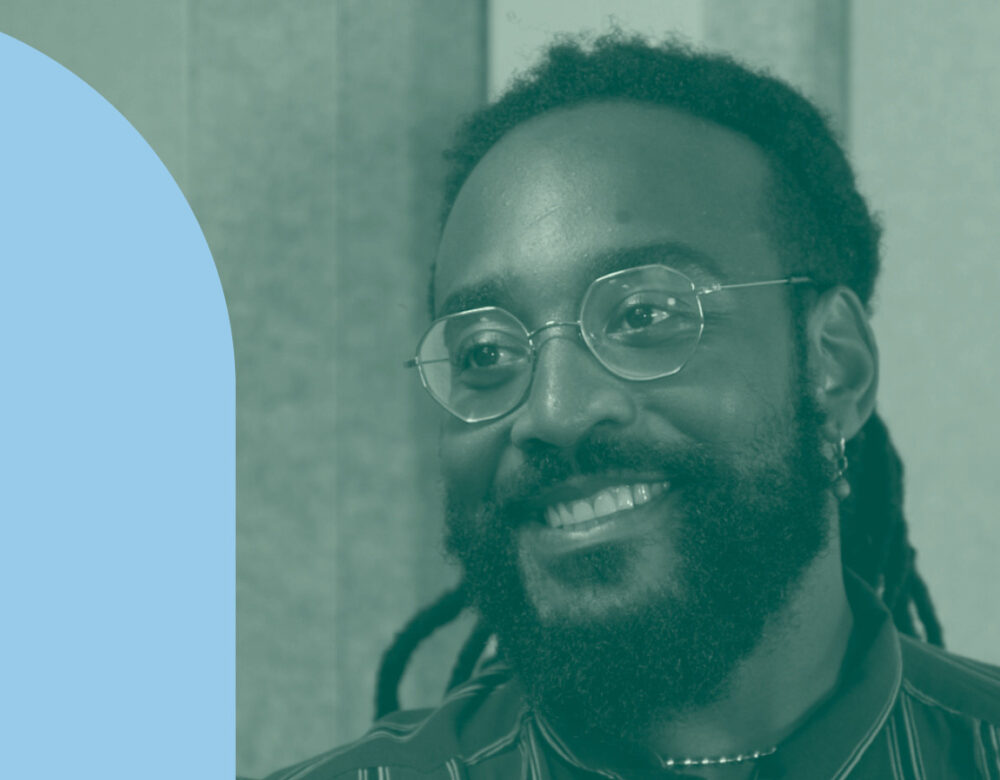
Jayson Porter has written for Distillations magazine on topics ranging from mules and sesame seeds, to arsenic and porgy fish. At first, these things might sound kind of random, but they share a common thread. Together they reveal hidden stories about the black experience in Mexico and the United States. Join us for a conversation with Jayson about using the traces left by everyday objects to examine histories that weren’t always written down.
Credits
Host: Alexis Pedrick
Executive Producer: Mariel Carr
Senior Producer: Rigoberto Hernandez
Sound Design: Seth Samuel
Fact-Checking: Alexandra Atiya
Music by Blue Dot Sessions
Resource List
Porter, Jayson. Rings of Fire, Distillations magazine. February 1, 2024.
Porter, Jayson. Mule Power, Distillations magazine. October 16, 2025.
Porter, Jayson. Sesame Plots, Distillations magazine. April 17, 2025
Porter, Jayson. Fish Hacks, Distillations magazine. November 17, 2023

Transcript
This interview has been edited for clarity.
Alexis Pedrick: From the Science History Institute, I’m Alexis Pedrick, and this is our new season of Distillations, American Vice: Risk, Science, and the American Experience.
Alexis Pedrick: Jayson Porter is an environmental writer and assistant professor of history at the University of Maryland, College Park. He’s written articles for Distillations magazine. I think you’re on your seventh, about to be your seventh article, right? And he writes about the intersection of race and agriculture. So today we’re going to talk to you about mules, sesame plots, arsenic. And if you’re thinking that’s going to take an unexpected turn it is. So Jayson, welcome.
Jayson Porter: Thanks for having me, Alexis. It’s a pleasure.
Alexis Pedrick: One of the through lines in your work is you talk about nature and agriculture as being used by empire, right? By people in power to basically rule over people and whether that’s using mules or agrochemicals, the point is to subject people. But what I thought was really interesting is that a lot of times those same people who are being subjected kind of turn around and use these very tools to kind of fight or to thrive. So can we talk about that tension?
Jayson Porter: Yeah. The reason why I get into the kind of questions around material culture is because those kind of provide me material witness into the past. As a historian, one of the things that’s really difficult when you go on the archive is it’s a lot easier to tell stories of injustice than justice. You know, there’s no shortage of records that talk about orders that generals gave or talk about the things that enslaved people had to do. But very few records asked enslaved people what they wanted for themselves or if they had a dream last night. Very few records talk about what soldiers did as opposed to what they were told to do.
Jayson Porter: So there’s always gaps and silences in the archive. And to some extent, I rest on these material witnesses, like mules, or arsenic, or porgy fish, or sesame, as an angle into understanding people who didn’t have the same benefit to leave their own records behind. So for me, in many ways, in those three pieces is a way for me to better understand the Black experience, not just in the United States, but across the diaspora in the Americas.
Alexis Pedrick: Yeah, yeah. And it feels like, you know, you’re talking about sort of the written word or kind of like what’s left in the archives. And I feel like there’s a lot of really careful attention to language in your work. So when you were writing about sesame plots, you were mentioning that seeds are diaspores. Am I saying that correct? You can like [correct me].
Jayson Porter: Sounds good to me.
Alexis Pedrick: Okay. And that means they’re–well, actually, what does that mean?
Jayson Porter: I’m pretty sure it means to like, move across–diaspore–on some way to talk about move or translation across space. So to some extent, the word diaspora, when we talk about like people or other animals moving across space, that comes from the idea of seeds as being diaspores. Usually we imagine plants as being fixed in a particular place, but understanding their seeds as diaspores helps us understand how they move from place to place and continue to succeed generationally and evolve.
Alexis Pedrick: Interesting. Yeah. I mean, so does it feel like for you, it’s important to pay attention to language like that? To words like that?
Jayson Porter: Absolutely. I mean, oftentimes it’s again, as Edda Fields Black writes about, sometimes language allows you to kind of upstream backwards to get the sense of origins where you wouldn’t necessarily understand otherwise where those origins come from. And when you’re oftentimes dealing with a lack of evidence, going to origins helps you kind of see where to find evidence elsewhere.
Jayson Porter: And oftentimes that’s going back to this tension that you mentioned, trying to understand the plantation as a space or as an archive–understanding its etymology. But also understanding its physical landscape, its geography helps you understand that power didn’t necessarily exist evenly across that landscape. And there were particular spaces where, you know, enslaved people or indigenous people had relative access to more autonomy or, you know, control of their own maybe diets or maybe on some level what recreation might have looked like. So I think oftentimes etymology can help you see these archives as something new. Because if you just follow historical archives that have been written by the quote unquote victors, you know, of history, you oftentimes don’t necessarily get to the root. Or to the people who lived out those scenes of violence or life.
Alexis Pedrick: Yeah. I mean, why would they? Right? They’re not concerned with that, right? So I really, I like that a lot. So I want to dive into something we always have to dive into on this show, which is definitions, right?
Jayson Porter: Definitions are important.
Alexis Pedrick: So I think that would be helpful. So what, what is a mule?
Jayson Porter: I mean, so a mule is essentially kind of a kind of combination: the offspring of a horse and a donkey. And it’s particularly the offspring of a female horse and a male donkey. And essentially it was one of the first kind–if you want to say–hybrid technologies that people created to do labor. And now we have AI, which is a new technology that we use to lift things that don’t necessarily need lifting, but like it’s still labor. And in many ways, the mule was this first kind of hybrid that combined the qualities of a donkey and the qualities of a horse, because they’re two very, very different things.
Alexis Pedrick: Yeah, I was gonna say. What makes the mule special or like, why wouldn’t you just get a horse?
Jayson Porter: Right, right. And you know, so there are a lot of different types of horses, but by and large, horses are a little bit more scary than mules. Horses require more food. They’re a little bit more finicky. They’re much faster than mules, but their steps aren’t necessarily as consistent. So if you were trying to, let’s say, dredge, or plow a field, for instance, the footsteps of a mule are a little bit more consistent. And in a plantation landscape feeding a mule is a little bit easier. So throughout the colonial period, you see horses and mules and other beasts of burden, including people, you know, moving and shaking things. But it became pretty accepted in the 17th and 18th century that mules were probably the best beasts of burden for plantation landscapes and also for like mining landscapes.
Alexis Pedrick: Okay, because in the article, you were talking about how they’ve been around for a while, like they’re mentioned in the Bible. There’s record of them going all the way back, but where are they mostly concentrated now?
Jayson Porter: So that’s a funky story that has a lot to do with imperial context. But essentially, I think the majority of mules today live in the Americas–so in Latin America and in the Caribbean–and I believe almost a third of all mules that exist today live in Mexico. And a lot of that just has to do with historically, the Spanish, because of the relationship with the Moorish Islamic conquest of the Iberian Peninsula back into the 14th century. They had kind of established a relationship with mules–mules that was distinct from what you see in both Europe and Asia.
Jayson Porter: So by and large, the donkey was first domesticated in Africa, whereas the horse was first domesticated in Europe. And this kind of combination of the two, as the mule happened in either Ethiopia, Turkey or other parts of North Africa. And essentially, you know, there was not really a mule culture in Great Britain or in France. So when they established their empires and started moving enslaved people from Africa to the Caribbean to, you know, create tobacco and cotton and sugar plantations, they weren’t using mules in the same way the Spanish were.
Jayson Porter: And interestingly enough, the Spanish Jesuit culture was really, really fundamental in kind of connecting this mule breeding to both the plantation landscapes and the mines of Latin America. So there are mules all throughout the world. There are very few countries, I would imagine, that don’t have their chunk of mules, but the grand majority are in the Americas.
Jayson Porter: And so about that context: essentially, the Spanish did not allow the trading of mules. One of the funny things, I guess because it’s 250 years of celebrating the United States–I have no investment in that celebration whatsoever. But, you know, George Washington became the father of the American mule because after the United States defeated Great Britain, the Spanish king actually presented him with a mule from the Iberian [Peninsula]. And said, now you guys can have mules, and from that point forward, the United States became a breeder of mules to send to the Caribbean throughout the first part of US history. So we became one of the biggest mule breeding populations, mostly in the northeast, until it ended up shifting down to Kentucky and the Midwest.
Alexis Pedrick: Who knew? So in your Distillations article, you talk about the people who rode and bred mules–the mule tier. And two of the most famous were–let’s see if I can remember this and get this right–Vicente Guerrero and Jose Maria Morales.
Jayson Porter: Exactly.
Alexis Pedrick: So who are they? What did their skills with animals help them do? They’re fighting off the Spanish, right?
Jayson Porter: So I don’t always know where to start with this, but both Vicente Guerrero and Jose Maria Morelos were what they called Arrieros or Muleteers. And they were both also what’s called Afro descendientes. So they were of African descent. They weren’t full on African. They were like mestizo and within the kind of the Afro mestizo. So they were a mix of the Spanish, the African and Indigenous ancestries that kind of created what we know as Mexico and a lot of Latin America. And so essentially, Arrieros were the people who connected communities to plantations, plantations to ports, and plantations to each other. So how did products move from place to place, had everything to do with these kind of mule tears that created these mule trains.
Jayson Porter: So they would bound together mules–from 20 mules to 200 mules–and they would use them. They would pack on their backs, you know, from 50 lbs to 200 lbs worth of materials. And you were able to bring bales and bales of cotton from, let’s say, a cotton plantation on the coast of Guerrero to Acapulco to then be shipped out to, let’s say, China, or San Francisco. So that became one of the most accessible occupations for people of African descent across the Americas, both in the Mexican context and the Peruvian context and the Brazilian context and the Colombian context.
Jayson Porter: These kind of Arrieros–people of African descent–oftentimes were able to manumit themselves or buy their freedom through their access to landscape. And it was really by being Arrieros that they were able to learn like: one, if you have a pack mule train of 200, you need to know where the watering holes are. You need to know what the climate is and the weather. So you see if that watering hole is even going to be filled with water. You need to know that climate and weather to know whether or not to forage or the grasses are going to be available that time of year. If not, you’re going to need to know the communities where you can pick up the corn in lieu of such forage. So being an Arrieros meant that you knew the landscape and you knew the languages of the communities in this place.
Jayson Porter: So when the Mexican independence movement started in 1810, Arrieros became these massive important figures because one, a lot of them were of African indigenous descent. So they knew the struggles of living in essentially a caste system where they weren’t afforded the same opportunities.
Jayson Porter: But they also had an incredible ecological, economic and linguistic wherewithal that gave them the capacity to undermine Spanish power. So both Vicente and José Maria Morelos were crucial. And when Morelos was killed, Vicente Guerrero and the sharecropping communities of what’s now the coast of Guerrero became the only contingent in all of Spanish America to outlast the Spanish.
Jayson Porter: So let me rewind this back. So the Mexican Independence War lasted from 1810 to 1821. From 1814 to 1821, there was only one contingent that was still fighting the Spanish. So we’re talking about all the way from present day Guatemala to almost the top of California. All other contingents had lost. There was one. And that was led by an Afro descendant, Guerrillero, and his Afro descendant Arrieros and sharecroppers. They were able to, through their knowledge of where to hide out, where to get the water–this was guerrilla warfare. And by reading through the mule, you can better understand how they were able to take care of a mule that–say it gets scratched. They would need to know how to heal it if it [got] bit by a snake. You know, I’ve spent time down there, there are lots of snakes, you know. So you can just kind of read that they were veterinarians, they were blacksmiths, they had to fix their hooves.
Jayson Porter: So you could read so much knowledge. When you’re writing environmental history, oftentimes, particularly people that don’t have records of themselves; ecology and biology help you write about what had to have happened, what could have happened, what might not have happened, what could not have happened. So I can say this could not have happened in a particular area because I know that that plant doesn’t exist. So the environment helps you triangulate possibilities where you otherwise might not understand. A lot of “old back in the day” people used to write through what’s called environmental determinism, where they used to write that: oh, Chinese people could only do this because they only had access to this and they didn’t have coal or something like that. They created these environmental determining factors, but I am more inspired by writers like Case Watkins who think about “environmental possibilism” like what can we write that was possible or not possible through our understandings of ecology?
Jayson Porter: So the Arrieros helps me better understand how people of African descent helped Mexico become independent when it did, how it did, and largely through their multifaceted forms of knowledge.
Alexis Pedrick: Right, right. So it’s like, it’s interesting because again, I’m so used to thinking about archives only in terms of literally what’s there, right? And you’re talking about things that are not there, but that we still have a pathway like into. And I find that really interesting, but also sort of comforting and settling that nothing is completely gone, if that makes sense? So I guess, when you talk about blackness shaping Spanish conquest of America–that’s what you’re looking at it through, right? Like through the mules and sort of what’s left behind in that story.
Jayson Porter: That’s one of many ways that you can do it for sure. And that’s how I do it in my region in southern Mexico, which is a distinctly difficult place to kind of narrate histories of blackness across time in a consistent, coherent way. But there’s no shortage of ways to narrate the importance of black history or the diaspora across the Americas. I think just plants and biology and ecology are one particular one that’s fascinating to me and important to me, and I think resonates a lot with students. And I think it resonates in this moment right now where we’re dealing with climate and environmental crisis, and black people are taking the lead around the world on that work, particularly black women. So to me, the timing of it makes a lot of sense.
Alexis Pedrick: Yeah.
Jayson Porter: It is important.
Alexis Pedrick: Yeah. So another thing you talk about in the article is that there’s this caste system in Mexico that’s eventually abolished, but the government rallies around the group that’s mixed race Spanish and Indigenous. And the result of that is Mexicans of African descent–that history is obscured. So do you feel like the mule or even biology and ecology, those things that you write about–do you feel like that helps you fill in that void?
Jayson Porter: A little bit. A little bit. There’s only so much you can do. As someone who is not Mexican and does not have that ancestry, there’s only so much I feel comfortable reading into too much because U.S. Black Americans don’t have a monopoly on what blackness is like in the Americas. And there’s only so much that just my perspective on blackness can lend itself to. But I would say that from 1829, when Vicente Guerrero abolished slavery–he was the first president of Afro and Indigenous descent in Mexico–to 2020, after decades of local grassroots organizing, between those almost 200 years, there was no official demarcation of blackness in Mexico. So in archives unless someone spoke an indigenous language to say Amusco or Tlapanec or Nahua, that might show up as a distinction like this is a Nahuatl speaking Mexican. And that might they might call them then Nahua, right? But a lot of people of African descent that didn’t necessarily speak an indigenous language. They weren’t necessarily marked as mulatto after 1829. They were just marked as mestizo. So it’s really hard to demarcate individual black folks and to isolate what they went through as something distinct.
Jayson Porter: So by looking through the environment and particularly the different types of oil seeds, like sesame that black people worked on it allows me to like triangulate a little bit more. To talk about what people went through at the community level, even if I can’t necessarily say that at the individual level, you know, “Danielle” went through this, right?
Alexis Pedrick: Exactly. You can’t get that specific. It’s interesting because you said that word: mulatto. And I think people have heard it before, but don’t always like know what it means–that someone who’s African descent and European descent. But it comes from the word mule, right?
Jayson Porter: They are related. They are related. Absolutely. So just like the first, again, it’s this idea of like a labor oriented hybrid, right? That’s like it’s a hybrid for particular, you know, it’s, and how we can understand its capacity to do work or its capacity to think. So there are all these racist, white supremacist ways to define a mulatto as someone that was not as intelligent as a “blanco,” but maybe stronger. But not or more intelligent than someone who had even more like a “quadroon” or something like that. They had all these levels to it.
Jayson Porter: And if you look across time, there are a lot of different mules. So the first hybrid that predated the cotton gin was combining–I think I go into the article a little bit–with two cotton spinning technologies to created the mule Jenny, which was this new kind of hybrid technology that could do something faster. So if you look across history, there was a lot of different mules technologies that were essentially just kind of hybrids, if you will.
Alexis Pedrick: Right. I mean, again, that’s like that theme of like language coming back up.
Jayson Porter: But you got to be careful with it because I do think historically white supremacy has used a lot of references to animals to depict black people. There’s no shortage of that in the archive. So I do think that scholars have to be careful not to reinforce these kind[s] of associations as they’re writing. So again, you have to be careful with the language and show where associations may or may not be. Zora Neale Hurston famously said that black women are the mules of the world, right? But she meant that in a very distinct way, right? She definitely wasn’t calling black women mules. So I think there’s a fine line of, you know, using the analogy in painting the pictures and showing these connections. But I do think there’s a fine line between talking about how animals were treated and how people were treated.
Alexis Pedrick: Right, we want to definitely approach it with nuance for sure. It makes me think of this other term or phrase that we hear all the time: the 40 acres and a mule. And it’s funny, I think I’ve always understood obviously like the emotional meaning of what that is, but I realized that, it’s something I grew up hearing and the thought–I just was like a mule? I don’t know, I guess mules are there. I never really understood what mules actually represented to free black people so I’m wondering if we can like talk about that for a little bit.
Jayson Porter: So one again, a lot of it goes back to that first question you mentioned about tensions between the materials that both undermine power and create potential for resistance too. So one of the main reasons why black people had proximity to livestock in general was this racist notion that indigenous people would succumb to diseases. Which has some truth to it. The way diseases spread from Africa and Europe and Asia into the Americas had a lot to do with diseases–zoonotic diseases, essentially that were coming from pigs and horses and cows. But it’s still–there was an association that black people weren’t succumbing to these diseases in the same way. So similar to like how black people were put in like malarial zones because they didn’t think that black people get malaria in the same way.
Jayson Porter: So historically black people were given those tasks as the muleteers And as the cowboys, because they were trusted in a way that indigenous people weren’t. Plus, the idea was that indigenous people knew the landscape better, and that you give an indigenous person a horse and they already know where the waterhole [is], they lived in this place for millennia. Right? So again, I mean, that’s just a history of plantations. Plantations work better with labor that’s been removed from their home and plants that have been removed from their home.
Jayson Porter: For very different reasons, but for reasons that are very similar, right? So again, this kind of notion, this racist notion controlling the black experience and black bodies led to 200 years later, a really widespread muleteer kind of culture. A lot of places, black people were not allowed to ride horses, but they were allowed to ride mules. That kind of creates an association. And if you go up to in the wake of slavery–you know, Tuskegee, before it became a big agricultural school, it started with a mule. But again, a mule was something that could get a black person out of debt. But it’s also something [that] could put a black person in debt. So again, it’s a very, very fine line. But because we’re in Nick’s Orange right now, shout out to Spike Lee because Spike Lee’s I believe his movie or film company has been “40 acres and a mule” for my whole life.
Jayson Porter: Again, it’s a symbol. And, you know, oftentimes it was one of the first things that black people had access to. They might not have owned the land, but they might have owned the mule. And that went a long way. It was never enough. Like I said, it’s something that could have put a person in debt as well. But it was, I do think, across the Americas, black people have really, really close associations with these animals that were also part of the plantation landscape.
Alexis Pedrick: So I want to pick up on something you mentioned earlier. You mentioned sesame plots, right? So who introduced sesame seeds to America?
Jayson Porter: I mean, I think it was a mix of things. I think by and large, sesame is something that’s been growing in Western Africa for a long time. So it’s one of the plants like hibiscus and okra and millet and oil palm that crossed the Atlantic with enslaved people. Scholars like Judith Kearney have [written in] really, really complicated and beautiful ways, like how this these histories took place. So I think it was probably a mixture of enslaved people bringing things over by themselves. But then also enslavers were invested in their captured labor, and they oftentimes, established plantations in the coast of Africa to feed people. So they were intentional about bringing crops oil palm and sesame on the ships to make sure that people can make it across the ocean. And by no means extended great care or anything along the lines, but basic[ally], they wanted them for their labor, and they had to both fatten them up and bring them across. So it was definitely a mix. Going back to again this tension right? You go to any community of diaspora be it in Jamaica or Colombia or Cuba, and black people are going to talk about how rice was hidden in hair and brought across.
Jayson Porter: And, you know, Judith Kearney, who writes about that, received a lot of backlash from academics who questioned whether or not there was evidence for that that was undeniable in the archive. And I think, you know, begging the question, if that’s what communities believed and if the plants got over here. So it’s always a question on who. But I do think that it’s important to know that sesame wasn’t something that in most places outside of South Carolina planters didn’t grow in row crops for commercial value. It was something that enslaved peoples could grow in their dooryard gardens or in their small kind of like provision grounds to feed themselves. And sesame had many, many purposes. So it had spiritual ones–planting it to like ward away bad spirits and things along those lines. So sesame is definitely something that people of African descent planted on their own once in the context of the Americas. So I think they helped the proliferation more than any other community for sure.
Alexis Pedrick: It’s interesting because you mentioned their own plots that they might [have] planted on their own. And I’m curious because you talk about this a lot: how do you look at something like an enslaved persons garden, right? And use that to teach you about how they navigated racism?
Jayson Porter: I mean, a lot of it is for me is asking questions. So one of the things I’ve been really kind of thinking about quite a bit was if you look at bird feed today, a lot of bird feed has sesame in it.
Jayson Porter: And I kept on finding these records from the early 20th century hunting guides that were talking about finding wild- occurring sesame in Louisiana and South Carolina and North Carolina, because it’s where doves and quails concentrated. Because they were hunting these birds. And so it made me want to ask the question: one, how wild occurring is sesame in the Americas? Because sesame doesn’t grow here.
Jayson Porter: So like one: could you map out plantation zones or plot spaces through what they’re calling wild-occurring sesame seeds? And then two: if sesame attracted edible birds, is it possible that sesame wasn’t just good luck? It actually brought more calories to the life of enslaved peoples. Now do I or will I know this? No. Is there archaeology that’s being done now and trying to understand looking at the types of bird fragments and bones that are around plots? Absolutely. So I do think as the records and the studies get thicker and thicker and thicker, it gets easier to do comparative work and build off other people’s work. I even have a colleague at my university that does a lot of archaeological work around bones and former plots to understand the meat that enslaved people consumed. So I do think there are ways. It’s just starting by asking these questions because every generation of scholar gets to ask questions together to improve what questions we ask. So that’s kind of where I’m at–a very preliminary stage. But sesame in Mexico very much follows a different kind of trajectory, as it does in the United States.
Alexis Pedrick: Okay, so I’m going to shift us a little bit or maybe a lot actually, given where we’re going next. I want to talk about arsenic.
Jayson Porter: Arsenic is definitely the one of these three that I’ve studied the longest and most closely.
Alexis Pedrick: Oh, good. I’m excited. So we know it’s an element on the periodic table. It occurs naturally, which I think is sort of surprising for a lot of people because it’s famously a poison. It kind of seems like it’s something that would be made, but it’s not made. So what drew you to arsenic?
Jayson Porter: Well, I think I knew I wanted to study pesticides because another one of my dad’s brothers passed away because of Agent Orange complications. And Agent Orange was one of many rainbow chemicals that we use to fight in quotations in Vietnam. And I think Agent Blue and Agent White were all derivatives of arsenic, so there were other agents and they were arsenic-based. And arsenic to me, it kept on coming up. So my PhD is in Mexican history–Mexican agriculture in particular. And we talk about the green revolution in the United States. And it was kind of the way the United States spread a postwar, Cold War way of capital-intensive, chemical-intensive agriculture to demonstrate to developing countries if they were between communism and capitalism, that we can make sure you stay full. So the whole idea of the Green Revolution has nothing to do with photosynthesis or chlorophyll or green things associated with plants and had everything to do in contrast with the red of the Soviet Union.
Jayson Porter: I argue in a lot of my work that the Green Revolution’s origin is in Mexico, because it was very much a US-Mexico project that started in 1943 in the Pacific coast. Mexico had everything to do with long-standing relations between the United States and Mexico through arsenic, because arsenic is naturally occurring, but it’s usually pretty faraway from people. So how it’s brought into people’s lives is oftentimes as a byproduct of mining. So as we started to expand copper mining and silver mining in the American West and down in Mexico, and we were burning off the ore… Because as our technology has gotten better and we can get deeper and deeper and deeper into mountains, we’re getting ore that has a has less and less concentration of what we want. So as a higher and higher concentration of things, we have to burn off. So as the technology gets better to get deeper into mountains, we’re getting more toxins that we’re actually burning off as we’re smelting them, right? And that kind of created a problem because everything around these smelters was dying. People talk about Theodore Roosevelt all the time and his national parks. And I’m not getting into those because those things were racist and violent. But he did one thing that was interesting: he forced mining companies to actually capture their sulfur and their arsenic in like 1907, 1909, to stop it [from] killing surrounding farms, livestock, and plants.
Jayson Porter: And it wasn’t until World War I that really became clear. And Adam Romero writes about this. I’m very grateful I just got to publish with him about how people realize that arsenic didn’t just kill things, but it could also be bio selective. So you can bio-selectively choose what you want to kill. In many ways that’s what agriculture is. It’s a simplified landscape that says that we don’t want these weeds to live. We want these plants to live. We don’t want those trees to live. We don’t want that to get water. We want the water to come here. Like everything about agriculture is a simplified landscape of necropolitics essentially saying what lives and what dies. And to some extent, arsenic becomes this first kind of byproduct that becomes a product. And by and large–actually, I remember talking about this here in this building at a huge science conference with science industry: is that the whole chemical industry in the United States is all turning byproducts into commodities. Because when you’re making a chemical, you’re oftentimes your byproduct. Are these really harmful chemicals that have nuance value or nuisance value? Excuse me.
Jayson Porter: They’re essentially these big, toxic, harmful things that you either need to hold on to and store separate from everything else, or you find a place to put it and make money from it. So if you hold on to it, it costs you money. If you sell it, it makes you money. So it has double-money of selling it, right? So arsenic became this kind of byproduct that made double value by getting rid of it and kind of sinking it into agriculture. So agriculture became a sink through which we dumped our chemical wastes. And we still do this. Agriculture is still a huge sink through which we dump chemicals. So arsenic was kind of the first one that helped me narrate why the Green Revolution started in Mexico when it did, how it did, and how agriculture became an extension of US mining and expansion.
Alexis Pedrick: I guess that makes me ask, really, what is agrochemical racism? Because you write about this. How does arsenic tie into that and help shape agriculture in the US?
Jayson Porter: Well, one, I think it starts the precedent of agriculture being a place where farm labor are going to be exposed to harm. So historically, agricultural labor has been exposed to harm as enslaved people or as indentured servants or as just undervalued laborers. But with the rise of chemical-intensive agriculture, it became clear that some people are going to just be exposed to harm. Through chemical harm. And arsenic kind of set that tone. And so in the wake of enslavement in the US South, cotton was kind of the first big guzzler of arsenic because arsenic is still–for the first part of its history–it’s still what’s called phytotoxic.
Jayson Porter: So in the sense that it still harms the vegetation it touches, and it took awhile for them to create a delayed mechanism through lead to connect to arsenic so the release of the toxin didn’t happen when it touched the plant. But it happened when it was chewed by an insect and it released their stomach and then it released. And that’s called a delayed, you know, when you take an aspirin? And the release is delayed so it doesn’t hit you all at once, but it delays over a course of like four hours?
Jayson Porter: That was kind of started with arsenic to create something that was phytotoxic through the combination of another chemical to like delay its reaction. But initially for the first 30 years, not just the USDA, but farmers in general are trying to teach formerly enslaved Africans and sharecroppers how to use arsenic to now catch boll weevil. Which was a huge agricultural pest that came from Mexico. There was all racism there about it coming from Mexico. And it’s an immigrant creating all these problems. But no longer did you have enslaved people to pick off all the bugs or chop down new trees to create new plantation land. They had to reckon with how to one resuscitate exhausted soils through fertilizers. And two: cotton. It simplified agriculture in a way that attracted a lot of pests so they had to figure out how to reckon with that. And black people were some of the first to do that. So in the 1920s, Bryan Williams writes about this–about how USDA puts out films on how to train black people to use arsenic. And before that, you had some planters that were elected officials that got young black children with molasses combined with arsenic to go and pick up bugs by hand.
Jayson Porter: But then you see anti-Blackness figure into the narratives around whether or not you could even trust black people to use arsenic or whether they hurt themselves or harm each other or harm white people–consumers. And interestingly enough, there was a company in the 1920s, 1924 in particular called Huff-Daland that became a crop dusting company because it tried to teach farmers: don’t worry about training black people and using mules to spread arsenic across your cotton fields when you could just hire an airplane to do it. So Huff-Dahlan became a big crop duster traveling around the south, eventually getting hired by California cotton growers to go into Mexico and the same places where the Green Revolution started and experiment with cotton and arsenic. And then they went to Peru by invitation in 1927.
Jayson Porter: So Huff-Dahlan from 1924 to 1927 is making this whole tour across country. I don’t know exactly when they changed their name, but today we call this company Delta Airlines. So the term “delta” actually comes from their relationship with working in the Delta. And within these landscapes of racially-divided labor and they used arguments like: why train black people to do this? Why even feed them to do this? They used this kind of language of anti-Blackness to say: you can move beyond that and use arsenic in a different way. We talk a lot about how the cotton harvester–the mechanical harvester–displaced a lot of cotton sharecroppers, right?
Jayson Porter: And it was a big component of the Great Migration. But if you look at those records, you also see people feeling like they were displaced by these airplanes. So black people became a fixture within this agrochemical kind of divide. And to this day, people of African descent, particularly in this unit in the United States, Guatemalan and Mexicans are exposed to harmful chemicals at a much higher rate. And if you look around the world, I think it’s tens of thousands of people commit suicide every year through their own pesticides because of the debt that they’re in, through pesticides and the exposure that they have. So there’s still a very racialized divide between who gets harmed by these chemicals. And I think a lot of that starts with arsenic.
Jayson Porter: And the last thing I’ll say on this is, you know, today when you go out into agricultural field, there are hundreds of different agrochemicals being used. And starting in the 40s, you had the rise of DDT and other organochlorines, which were a type of neurotoxin that instead of hurting a bug through contact, it actually neurologically impacted them.
Jayson Porter: And you start seeing a shift from organochlorines to organophosphates. But now you have so many different generations of chemicals, right? But between the 1870 and 1930, you really only have one. You only have one chemical that’s really establishing, by and large the precedence for what the agrochemical industry is going to look like. And that’s arsenic. So that’s why I really focus on that period.
Alexis Pedrick: It’s such this dominant thing in a way that, again, is not something we like talk about a lot. So I’m interested in this idea. You were talking about the boll weevil and it feels like it’s part of this cycle of blame. But I’m curious because the arsenic that they were using to kill the boll weevil was coming from Mexico, right? But at the same time, they were also insisting that this was a Mexican problem. And that’s how it was coming to us. So is that more of just that tension, that cycle of: it will be someone’s fault, but not ours?
Jayson Porter: It still exists today. There’s a divide between places that produce raw materials and places that manufacture them. And I still think there was that idea that even if people knew that raw arsenic–white arsenic–was coming from Mexico, what they saw as the new lead arsenic and the calcium arsenates that were being used against boll weevil were something that was modern, didn’t necessarily come from the mountain. And even if they did, they would maybe think that, well, the United States owned the mining industries in the first place that were driving it out and smelting it out. So again, I just think that there was a lot of ethnocentric notions around and we still have this. We use terms like the “global North” and “global South” and “developing countries” and “undeveloped countries.” We still have these kind of temporal ways of talking about places like we’re not all in 2026. And we don’t often situate our understanding that the modern is literally filled with what we might think are un-modern. Violences is still. There’s still child slavery right now. There’s still all these things that are, you know, our modern world is a gilded un-modern one, right?
Jayson Porter: And I think we don’t always acknowledge that. So there was tons of blame. So once the US kind of loses its dominance around cotton and especially around the racialized labor for cotton in the US South, cotton producers in the South start spreading cotton production throughout Texas and eventually into northern Mexico. And it’s through northern Mexico that the cotton boll weevil, which is originally from Mexico, is able to move from cotton plantations that the United States planters established up into the United States. So it had everything to do with the expansion of cotton plantations in the wake of slavery. But they didn’t blame themselves for that. They created these images of a Mexican immigrant who crossed the border and had millions of cotton boll weevil children. They used this violent, anti-immigrant, anti-Mexican language. That is not that different than what you see today.
Alexis Pedrick: So I am curious because you write for Distillations magazine. You’ve written some really great articles and we’ve been talking about insecticides. But you have written about fertilizers in a way that’s actually very local here to Philadelphia. So can you talk to us for a second about that story?
Jayson Porter: Yeah. So I wrote about Porgy. Anybody from Philly who’ve been to either Acme or Shoprite, you’ve probably gotten Porgy Fish. And that word actually comes from Narragansett word pokagon, which means I believe it’s “oily fish” or “fish with many bones.” But essentially porgy was a fish that was used to fertilize fields because they multiply in such masses on the eastern seaboard and estuaries, and they can be caught in mass. They’re really easy to catch and they’re kind of thrown out.
Jayson Porter: And so interestingly enough, a lot of the early big fertilizer industries coming out of first New England and eventually down to South Carolina–have you ever heard of fish guano? That was mostly Porgy. And here in Philly it’s a really popular fish, particularly in the black community. And it’s also not a very expensive fish. So it’s one of those kinds of foods like oysters and lobster [that] went from food for enslaved people and indigenous communities and was kind of frowned upon by white community. And now it’s something that everyone eats.
Jayson Porter: But my grandfather, who would have turned 100 next month, lived most of his life in Philadelphia when he worked for the Nation of Islam. The Nation of Islam used to have these fish trucks that used to sell Porgy in the community. And once he retired, he would get black men together to go out fishing together in either Atlantic City or Cape Cod. And what they would do is they would bring all their sons and nieces and nephews with these coolers, and we’d go out and we’d catch as many Porgy as possible. And they would then sell those fish as hacks.
Jayson Porter: So my grandfather used to sit outside of Shoprite before Uber and Lyft. And when people would take public transportation to the grocery store, but didn’t want to like take public transportation with all the grocery stores back home, he would drive them home. But he would always tell people: hey, I got you some Porgy. I got Porgy, and the fish. Already cleaned them. I got Porgy in the car. You don’t have to go buy that, I got you. So he was a fish hack. So that was kind of how I wrote about him here. And it was really cool to have my first piece for Distillations that’s rooted here in Philly to be about my grandfather.
Alexis Pedrick: Look at that. You did it. You survived.
Jayson Porter: Yep.
Alexis Pedrick: Thank you so much.
Alexis Pedrick: Distillations podcast is produced by the Science History Institute and recorded in the Laurie J. Landau Digital Production Studios. Our executive producer is Mariel Carr. Our senior producer is Rigoberto Hernandez. This episode was produced by Mariel Carr. It was fact checked by Alexandra Atiya, and the sound design was done by Samia Bouzid. Support for
Distillations has been provided by the Middleton Foundation and the Wyncote Foundation. You can find all of our podcasts, as well as our videos and articles on our website at sciencehistory.org. And you can follow us on social media at @scihistoryorg for news about our podcast and everything else going on in our free museum and library.
For Distillations, I’m Alexis Pedrick. Thanks for listening.