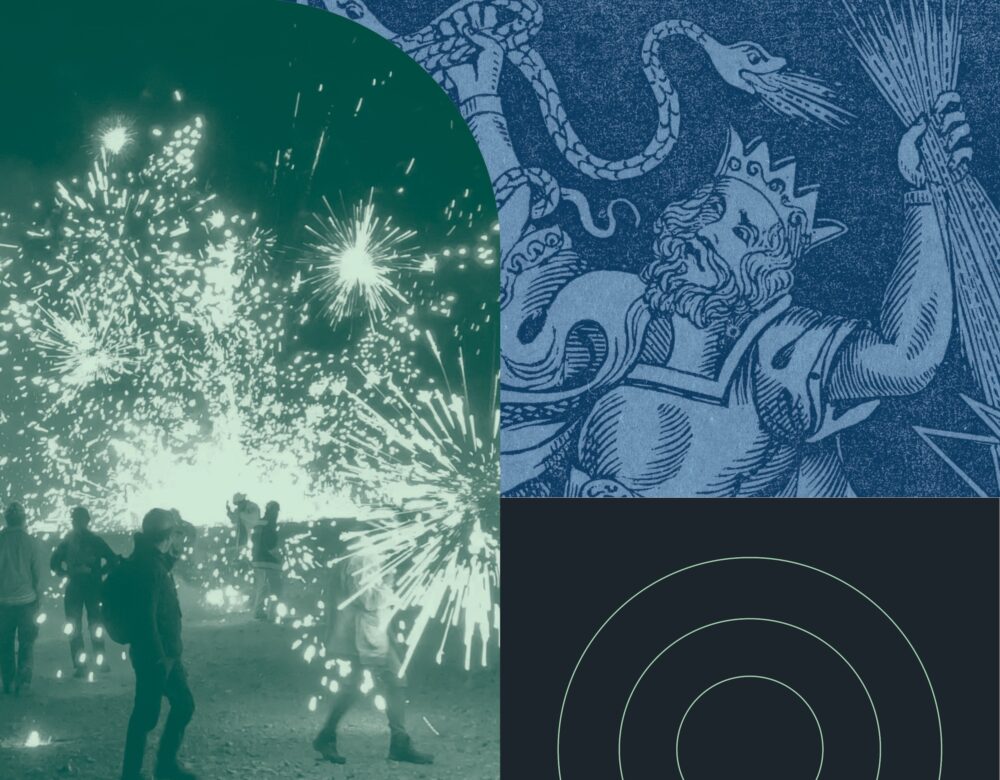
Throughout history, there has been continual negotiation over who gets to access fireworks. Control over them has swung like a pendulum between ordinary people and institutions of power—like monarchies, the church, and the ATF (Bureau of Alcohol, Tobacco, Firearms and Explosives). And this ongoing tension begs the same question as the myth of Prometheus: who should really be in control of the fire? Join us as we explore the history of our fascination with making things explode and go behind the scenes with both professional and amateurs from the Western Pyrotechnic Association.
Credits
Host: Alexis Pedrick
Executive Producer: Mariel Carr
Senior Producer: Rigoberto Hernandez
Sound Design: Seth Samuel
Fact-Checking: Alexandra Atiya
Music by Blue Dot Sessions
Resource List
Chaldu, Michael. From morning to night, Santa Ynez Valley celebrates nation’s 250th birthday. Santa Ynez Valley Star. August 7, 2026
Dig Deeper: Fireworks and Pyrotechnics. Flash! Bang! Boom! Resource Guide
Flash! Bang! Boom! A History of Fireworks
National Fireworks Association: Tariff Updates
Seven people missing after explosion at fireworks facility. NBC News.
Tauszik, Brandon. Chasing the Light. Distillations. June 30, 2023.
Waters, Michael. The 1900s Movement to Make the Fourth of July Boring (but Safe). Smithsonian Magazine. July 2, 2019.
Western Pyrotechnic Association
Withington, John. A History of Fireworks. The University of Chicago Press. 2024.
Transcript
Alexis Pedrick: From the Science History Institute. I’m Alexis Pedrick, and this is Distillations, American vice: Risk, Science, and the American Experience.
Alexis Pedrick: This past February, we traveled to Lake Havasu City, a town on the dusty border between Arizona and California. We were there for Winter blast, a fireworks convention in the parking lot of the Havasu 95 Speedway. Every year, fireworks enthusiasts meet at Winter blast to hang out, learn some new tricks of the trade, and make things explode.
Winter Blast Audio: This is the 48 shot long silver waterfall with red.
Gina Papini: It’s just it’s very therapeutic to blow stuff up.
Alexis Pedrick: This is Gina Papini, an amateur pyrotechnician.
Gina Papini: I used to be a nurse. I’m retired now, but I used to say, you know, you get the stress and then you go blow something up. It’s like, oh, okay, this is cool.
Alexis Pedrick: Winter blast is organized by the Western Pyrotechnic Association, or WPA, which is made up of several different pyrotechnic groups. Some are professionals, others are amateurs.
Jackalope Billy: I’m Jackalope Billy, and I guess I’m almost a ringleader or something. I’m chief instigator for the Jackalopes.
Alexis Pedrick: The Jackalopes are a group from Nevada. They’ve pitched a tent on the outskirts of the parking lot.
Jackalope Billy: We approached pyro as like an art form where we’re not going to make money. We’re just like, we’re just going to do it. It’s an expensive hobby, but we have fun.
Alexis Pedrick: Yeah, the Jackalopes don’t do typical “ooh” and “ahh” fireworks that shoot up into the sky and explode. They’re inspired by both Maltese and Mexican fireworks. Think pinwheels that spin in place. They’re also well known for their girandolas, spinning, wheel shaped fireworks that build speed on the ground before they take off.
Jackalope Billy: We jokingly refer to this as the horizontal fireworks area because a lot of stuff goes sideways.
Alexis Pedrick: The Jackalopes also specialize in creating elaborate papier mache sculptures that they then blow up. This is our senior producer, Rigoberto Hernandez.
Rigoberto Hernandez: I noticed that there’s like a giant brain over there.
Jackalope Billy: Well, one of our members has brain cancer.
Rigoberto Hernandez: Oh.
Jackalope Billy: And he’s going to blow up his brain.
Alexis Pedrick: Jackalope Billy is talking about Keif Adler, a professional pyro of more than 30 years.
Keif Adler: I shoot 4th of July shows and I’ve shot Sea World and Magic Mountain and for orchestras in Southern California and so on.
Alexis Pedrick: Last September, Keif got a devastating diagnosis. He had glioblastoma.
Keif Adler: It is literally brain cancer. It’s the worst of the brain cancers. It’s terminal.
Alexis Pedrick: Keif was told he had just 15 months to live. So he decided to focus on doing the thing he loves.
Keif Adler: I thought it would be fun to build a brain and blow it to kingdom come. It’s kind of my way of saying F-U to cancer.
Alexis Pedrick: Over the course of five days, Keif and the other Jackalopes have been stuffing the brain with thousands of firework shells.
Keif Adler: Right now, what I’m working on is loading fireworks in and around a papier maché brain. That’s about oh, roughly three feet in diameter. You know painted and shaped much like a natural brain with a brain stem. From the day of my diagnosis. I thought, you know, I could be miserable for the rest of my life, or I could enjoy my life to its fullest and, you know, learn to live with cancer as opposed to dying with cancer.
Alexis Pedrick: Keif can’t control the outcome of his disease, but he can control how he deals with it. And he’s turned to something he does have some agency over. A thing humans have been trying to control for a very long time: Fire.
Alexis Pedrick: There’s a famous line in the Tom Robbins novel Still Life with Woodpecker that gets right at the heart of it: “Every smoker is an embodiment of Prometheus stealing fire from the gods and bringing it on back home. We smoke to capture the power of the sun, to pacify hell, to identify with the primordial spark. To feed on the marrow of the volcano. It’s not the tobacco we’re after, but the fire.”
Alexis Pedrick: We’re talking about fireworks, not cigarettes. But the truth is the same. Fire is inherently hard to control. And you might get punished like Prometheus did just by trying. But when you do bend it to your will, when you successfully pacify hell, it’s magic. The danger is part of the appeal.
Keif Adler: You obviously don’t want to be too close to this thing when it’s lit, You know.
Alexis Pedrick: Throughout history, there’s been a continual negotiation over who gets access to fireworks. Control over them has swung like a pendulum between ordinary people and institutions of power, like monarchies, the church and the ATF. And this ongoing tension begs the same question as the myth of Prometheus: who gets to hold the fire in their hands, us mere mortals or only the gods?
Alexis Pedrick: Chapter One: Gods and Kings
Alexis Pedrick: Fireworks have been around for nearly 2000 years, and like so many inventions, they came to be by accident.
John Withington: The first fireworks were really aware of were natural bamboo firecrackers.
Alexis Pedrick: This is John Withington, author of A History of Fireworks.
John Withington: If you throw a hollow stick of bamboo on a fire with most types of bamboo, it’ll bang. Make a pop.
Alexis Pedrick: Exactly how fireworks got started isn’t known, but we think they began in China as a way of scaring off wild animals.
John Withington: Indeed, it was said for decades, maybe centuries, that no self-respecting Chinese traveler would leave home without a stash of natural bamboo firecrackers. They also increasingly were used to scare off spirits. There was a book about 550 AD in China, which said that on New Year’s Day, people let off bamboo firecrackers to frighten away evil spirits.
Alexis Pedrick: These bamboo fireworks were simple, but things got more sophisticated in the 10th century. Withington shares a theory that when Daoist alchemists were searching for an elixir for immortality, they stumbled upon something quite different.
John Withington: So first thing is the invention of gunpowder.
Alexis Pedrick: Yeah. You could say they found an elixir for mortality instead.
Nadia Berenstein: Fireworks and bombs are closely related in terms of history and materials, even if their purposes are very, very different. Hopefully.
Alexis Pedrick: This is our colleague Nadia Berenstein, who co-curated an exhibit at the Science History Institute called Flash! Bang! Boom!, all about the history of fireworks. Gunpowder, which is sometimes known as black powder, is the earliest known chemical explosive. The classic recipe called for this ratio 75% nitrate, usually potassium nitrate, 15% charcoal, and 10% sulfur.If you want to know more about the chemistry and engineering of fireworks, including how we went from black powder to pyrotechnics. Our friends over at the Tiny Matters podcast have a great episode on fireworks.
Alexis Pedrick: Around the 13th century, fireworks left China and made their way to Italy.
John Withington: Some people think Marco Polo brought them. Others think that they came by different routes that maybe Arabs brought them via the Iberian Peninsula. I think the answer is it’s not certain. But what is pretty clear is that Italy emerged fairly soon as the main initial fireworks power.
Alexis Pedrick: Fireworks are still incredibly popular in Italy. In some parts, it seems almost anything as an excuse to set them off.
John Withington: In some parts of Italy, if somebody buys a new strainer for the spaghetti, they’ll let off fireworks in celebration.
Alexis Pedrick: But back in their early days, a fireworks display wasn’t merely a spectacle. It was a shared, wondrous and powerful experience.
Nadia Berenstein: But what exactly is the power?
Alexis Pedrick: This is Nadia Berenstein again.
Nadia Berenstein: There is something that happens when you are with a group of people, and you’re all experiencing the same event. Everybody’s attention–everybody is kind of sensing the same things at once. And there are strong feelings connected with them.
John Withington: The great thing about a firework display was that if you looked at a child–seven year old child–looking at the display and a 70 or 80 year old adult looking at the display, both would have the same expression of delight and wonder.
Alexis Pedrick: Considering how awe inspiring fireworks were, it’s not so surprising that some of the earliest uses in Italy were religious.
John Withington: The first account that I could find of a firework display in Europe was in Italy, Vicenza in 1379, and that was part of a church service. A mechanical wooden dove went along a line powered by a rocket and set fire to some fireworks at the end of the line.
Alexis Pedrick: In fact, a very similar ceremony exists to this day in Florence for the same reason. It created a sense of awe amongst the congregation. Fireworks and religion were pun very much intended. A match made in heaven. Think about it. A firework launches into the air and then stars fall to earth.
John Withington: Stars falling to earth is one of the signs of the Second Coming of Christ mentioned in the Book of Revelation. And so that again was seen as being part of this symbiotic relationship between religion and fireworks.
Nadia Berenstein: If you think about like the kind of force and power of fireworks, which, you know, in the early modern period especially were seen as analogous to natural phenomena, especially cosmic phenomena like comets or sublime phenomena like thunder and lightning and lava.
Alexis Pedrick: Nadia says that in this time, the king was not only a political ruler, but also head of the church. And controlling fireworks displays was a way of saying only the king and the church should have access to the divine.
Alexis Pedrick: And it wasn’t just the church. Look at who else, or rather what else has historically put on fireworks displays.
Jesse Smith: Authoritarian governments. Ostensible democracies. For most of human history, people did not have access to these.
Alexis Pedrick: This is Jesse Smith, director of the museum at the Science History Institute and co-curator of Flash! Bang! Boom!
Jesse Smith: It’s the state. It’s the church. It’s these really powerful institutions that either have the means, have the resources to do this or are able to do it because they prohibit the technology from existing outside of the state, right? They put limits on who can do this.
Alexis Pedrick: Once the control over fireworks was established as belonging to the rulers. They used them to try and gain power over one another.
John Withington: There was a constant power struggle going on in Europe. Italy was divided into lots of small states, principalities, etc. and each one had a royal family which was vying to impress its subjects. And so when a relatively new technology like fireworks appears, it’s probably no great surprise that this was deployed as one more weapon in the power game.
Alexis Pedrick: Fireworks became popular in other areas of Europe, too. They came to England by at least 1487 when they were used at the coronation of Elizabeth of York, wife of King Henry. Nope, not that one. This was King Henry the Seventh who didn’t run around beheading his wives. He used fireworks to commemorate his wedding slash political merger.
John Withington: This was a very important marriage because England had 30 years of the wars of the roses, the Lancastrians versus the Yorkists. And so Henry VII, who was a kind of Lancastrian, was marrying Elizabeth of York. And that was meant to put an end to the enmities of these 30 years of war. And there was a spectacular procession along the River Thames. One element of this was a dragon that would breathe fire from one of the ships.
Alexis Pedrick: Terrifying, right? But that was also kind of the idea. Fireworks brought people together and hammered home a message about who was in power. And the fact that most people didn’t know how they worked helped reinforce the authority of the powerful person or institution who set them off.
John Withington: We have an account of a display at La Rochelle in France in 1629, where it said that the ordinary people were stunned and frightened, but the courtiers present were undaunted. So there is this division, if you like, between the more sophisticated people who probably couldn’t explain to you the science of how a firework worked, but nevertheless could see it was a natural phenomenon of some kind, didn’t require any supernatural intervention. And ordinary people who maybe often thought it did require supernatural intervention of some kind. There was a French explorer saying that once they’d demonstrated the fireworks among the native populations, the indigenous populations, they were so overawed that they would do anything that the French wanted them to do. The first engineer of New France or French possessions in America, did a similar thing in Quebec with the Huron, and he thought that the French were more powerful than demons because of their mastery of these mysterious fireworks.
Alexis Pedrick: And shouldn’t anyone more powerful than a demon be in control? But if you really wanted to see an astounding fireworks display, then you needed to see one. Hosted by the Sun King himself.
John Withington: Louis the 14th, the most powerful man in Europe, arguably the most powerful man in the world, used the economic power at his disposal to pull in the best firework display people, which were usually Italians at that time. So he had the biggest checkbook, and he got the best firework displays that he could. You know, he was the Sun King. So this is part of this idea that I am very, very special. But also, I suppose it’s a bit like bread and circuses as well, isn’t it? So they also were giving something to the population in terms of entertainment.
Alexis Pedrick: For a long time. Fireworks dazzled and entertained the masses, all while making sure they knew their place when fireworks came to America. Though, things started to change.
Alexis Pedrick: Chapter Two: The Experts
Winter Blast Audio: Oh say can you see by the dawn’s…
Alexis Pedrick: We all know the biggest day for fireworks in the U.S. The day that makes all dogs run under the bed with their tails between their legs. The 4th of July. Even when it’s not the 4th of July, fireworks have a strong association with patriotism. In fact, each night during Winter Blast, the evening fireworks display opened with the national anthem. It was far and away most people’s favorite part.
Winter Blast Audio: And the rocket’s red glare, the bombs bursting in air…
Rigoberto Hernandez: What did you think it was?
National Anthem Audience: It was actually unreal. It was absolutely beautiful. So wonderful to start out with the patriotic stuff, I loved it.
National Anthem Audience: I loved how it represented our country.
Rigoberto Hernandez: What was your favorite part?
National Anthem Audience: The drones with the country and the USA and all the colors.
Alexis Pedrick: The marriage of fireworks and patriotism has been going strong since the very founding of the United States.
John Withington: On the 3rd of July, 1776, John Adams wrote to his wife, saying that the next day would be the most memorable in the history of America. And he believed that it was going to be celebrated by succeeding generations as a great festival to be marked with what he described as “parades, bonfires, and illuminations” by which he meant fireworks.
Alexis Pedrick: The following day, there were fireworks in Philadelphia, and by the end of the Revolutionary War in 1783, people could set off fireworks on their own. That’s right. We might have the internet and cars and modern plumbing, but our forebearers got full access to pyrotechnics.
John Withington: And then what happened after that was that enterprising American politicians started distributing fireworks at some of their speeches to try to attract a crowd.
Alexis Pedrick: Sun kings be damned, right?
John Withington: Except what they sometimes found was the crowd started letting off fireworks during the speeches. So I think they drew back on that a little bit.
Alexis Pedrick: In other words, the gods gave us a teeny bit of fire and then immediately took it back. 18th century American politicians found themselves asking the same kinds of questions they did in early modern Europe.
Nadia Berenstein: What kind of people should be able to get a hold of fireworks?
Alexis Pedrick: On the one hand, why should only kings get to set off fireworks? But on the other, letting people set them off willy nilly was undeniably dangerous. By the early 1900s, fireworks catastrophes were adding up in the U.S. and most of them happened around the 4th of July.
John Withington: In 1901, for example, 17 people were killed in Paterson, new Jersey, when a fireworks store at the bottom of a tenement block exploded. The next year, 17 people were killed in New York City when a mortar fell over during a firework display. And in 1903, on the 4th of July, apparently 466 people were said to have been killed in firework accidents. So there was a problem.
Alexis Pedrick: Later that year. A lawyer named Charles Pennypacker from West Chester, Pennsylvania, started a campaign.
Nadia Berenstein: A movement for safe and sane fireworks and safe and sane 4th of July.
Alexis Pedrick: He encouraged people to spend their money on picnics and have a relaxing day instead of setting off explosives. Many cities took him up on it and banned the sale of fireworks.
Nadia Berenstein: It was a ban on commercial sales to consumers in particular focused around like child safety.
Alexis Pedrick: These safe and sane advocates publicized gruesome body counts, tallies of children killed by fireworks on the 4th of July.
Nadia Berenstein: And yet they believed in civic fireworks displays. They saw fireworks as something that should be in the hands of experts for formal events, and not recreationally in the hands of children or others.
Alexis Pedrick: These experts were, by and large, Italians who emigrated to the United States during the great arrival between 1880 and 1920, and many of them brought their country’s fireworks traditions with them.
Jesse Smith: Some folks brought that knowledge over and started companies here in the States, and some of them are still in existence.
Alexis Pedrick: This is Jesse Smith again.
Jesse Smith: A company called American Fireworks in Hudson, Ohio. The Gruccis of Long Island that’s still a family run company. The Zambellis out in western Pennsylvania. That’s a multi-generational company.
Alexis Pedrick: They knew that surviving in this business meant mastering a craft where many interactions could be dangerous.
John Withington: One of the great American firework families as the Gruccis. And one of them said that if you work with fireworks. You always feel that there’s a nuclear weapon pointed at you, which could go off at any moment. And he said, just hearing a car door slam might make you jump. Grucci family members have been killed in firework manufacturing accidents.
Alexis Pedrick: Even the experts were getting hurt. Perhaps Prometheus should have handed over fire with a very strongly worded warning label. Not that it would have stopped us, because remember, the thing about the fire is that we all want to get our hands on it.
Alexis Pedrick: Chapter Three: The Amateurs.
Alexis Pedrick: From the start, controlling who had access to fireworks was tricky. It was all easier said than done.
Jesse Smith: The knowledge is out there.
Alexis Pedrick: This is Jesse Smith again.
Jesse Smith: I mean, there’s no kind of getting that back in the box. It’s been developed across centuries around the globe.
Nadia Berenstein: And there is something very simple about it.
Alexis Pedrick: This is Nadia Berenstein again.
Nadia Berenstein: Samuel Pepys, writing in the 1600s, says every boy knows how to make firecrackers. You wrap up a little bit of black powder and paper and then you throw it. You can cut that out. If we shouldn’t say that on the air.
Alexis Pedrick: We are definitely by no means suggesting that anyone do this, despite what 17th century English writer Samuel Pepys says. And in fact, disclaimers like the one I just gave are nothing new.
Jesse Smith: I remember encountering mid-century U.S. materials about making fireworks that were explicit about. This is for informational purposes only. This is not to be used to actually make fireworks. And in some ways, that mirrors some of the earlier European works that we saw, which were books about pyrotechnics that were made for so-called men, of letters that were just meant to learn.
Alexis Pedrick: There’s an assumed temptation surrounding fireworks, maybe gods. And, you know, advanced scholars can resist it, but us mere mortals don’t stand a chance even writing down how they work or gasp, saying it aloud on this episode feels dangerous and only heightens their appeal.
Nadia Berenstein: No matter how much control and design and precision pyrotechnicians try to exert over them, there’s always a kind of wildness to them. There’s always a risk simply because of the nature of the materials.
Alexis Pedrick: And that wildness that hazard has a uniquely American allure.
Nadia Berenstein: Fireworks in the United States have been associated with childhood, particularly with boyhood. And I think that also goes along with the themes of freedom.
Alexis Pedrick: And what makes people seek out freedom more than when they sense their freedom is being limited.
Nadia Berenstein: The restriction and the kind of sense of danger around these objects also gives this kind of interesting edge to the curiosity and interest in these objects.
Alexis Pedrick: John Withington shared a great illustration of this dynamic.
John Withington: In 1968, Keith Moon of the British rock band The Who, known as Moon the Loon, threw a cherry bomb down the toilet at his New York hotel. It blew the toilet off the wall and just left the piping. What’s interesting about that is this was in 1968. In 1966, cherry bombs had been banned.
Alexis Pedrick: It doesn’t get more rock and roll than that. As fireworks became more heavily regulated, interest in making them actually grew after the U.S. started restricting consumer fireworks in the 1960s. The amateur pyrotechnic community took off.
Nadia Berenstein: So in a way, even the way that they took on the mantle of a guild, these members from the beginning saw themselves as people who are sharing like particular, specific knowledge and kind of preserving it among themselves. Knowledge that is also highly supervised or restricted, in some ways.
Alexis Pedrick: A guild exists to oversee the practice of a craft or a trade, but also to train and pass on knowledge.
Nadia Berenstein: There are different kinds of expertise at different levels. I mean, there’s like a very low level fireworks or firecracker making. And then there’s the kind of expert masterwork that devoted, dedicated artisans do. That’s one of the things about it that’s so interesting that it kind of spans from the most common experience in a way, to like the most rarefied.
Alexis Pedrick: It’s artisans training, other artisans passing on expertise. Which brings us back to Winter blast and that pesky question who should control the fire?
Alexis Pedrick: Chapter Four: The ATF
Winter Blast Audio: We are only going to be able to do one song, so let’s make it count. How about some AC DC?
Winter Blast Audio: No.
Winter Blast Audio: But it’s so cool when they go.
Winter Blast Audio: Yeah.
Winter Blast Audio: That part is pretty good, but it’s really overused. How about some Katy Perry, baby?
Alexis Pedrick: Back in the Jackalope tent in Arizona, Jackalope Billy says that this year is not as good as last year.
Jackalope Billy: You’re dealing with a lot more restrictive regulatory environment. So a lot of the stuff that we used to normally do, we can’t do.
Gina Papini: So unfortunately you picked a slow time.
Alexis Pedrick: That’s Gina Papini, the retired nurse we met earlier.
Gina Papini: It’s just unfortunate slow, but you know, we’ll make the best of it and see what happens.
Alexis Pedrick: Gina says this year, Winter blast was almost canceled. The Bureau of Alcohol, Tobacco, Firearms and Explosives, or ATF, is usually at the event.
Gina Papini: They come all the time. Yeah. Oh, yeah. They’re here every year to inspect. They inspect our bunkers, our boxes that we have the right locks on, the placards, the fire extinguishers. You know, they inspect to make sure the fire department comes, inspects, police come and inspect.
Alexis Pedrick: But they came down especially hard on the WPA this year.
Gina Papini: The ATF came and said that they weren’t sure we were following to their opinion of the letter to the law, and so they wanted to come and inspect. And so for them to do that, we had to sort of suspend all our manufacturing activities. And so until the ATF decides that, yes, we are following the rules, then they’ll let us back. So just for this year, they decided to say, okay, unless you’re making things from scratch, you know, from the very beginning, like you make your own black powder, you make your own stars. The stars are the pretties and the shells. You have to make your own of everything from scratch with chemicals, which takes an extraordinary amount of time to do that. And we only have the five days here, so they pretty much just shut everything down until they did. Because like this year we can’t buy black powder. And we used to be able to come here and buy it on the club’s license, use it to build our shells, shoot it off and go home with nothing. And so now this year they’re just saying, no, you have to make your black powder from scratch. You’re not allowed to buy it.
Alexis Pedrick: And so this meant groups were limited to shooting consumer grade fireworks, which are smaller and mostly pre-constructed. The catalyst for the heightened regulation was a high profile accident in California last year.
NBC News Clip: The building storing commercial fireworks was already up in flames. Our Sacramento station covering it live when the blaze triggered a massive explosion. That warehouse turning into an inferno.
Alexis Pedrick: On July 1st, 2025, a fire broke out in a fireworks warehouse near Sacramento. Seven men were killed and two others were injured.
NBC News Clip: I can say I have not seen anything like this. This is obviously an incident of great magnitude.
NBC News Clip: And tonight, authorities say seven people are still missing at the fireworks company in this rural community outside Sacramento.
Alexis Pedrick: The Sacramento incident put everyone on high alert, but the folks at Winter blast are used to intense safety precautions. In fact, everyone we talked to constantly referenced safety.
Darell Fiss: You’re supposed to have a long sleeve shirt on. Oh, okay. We need all the safety gear, glasses, long sleeve shirt, long sleeve or long pants. What fireworks are. Yes, they are explosive, but if they’re handled properly, they’re relatively safe. Riding a bicycle and driving a car is dangerous. But if it’s handled with a little respect, it’s good. You know, as long as everybody gets to go home safe at night, that’s what that’s what counts.
Alexis Pedrick: On the last night of winter blast, Keif Adler and dozens of other people gathered to blow up his papier mache brain. Everyone wore a helmet, long sleeves, pants and protective eyewear and watched the £70 brain get wheeled in.
Winter Blast Audio: Where’s the brain? The brain.
Alexis Pedrick: They hoisted up the papier maché brain like a pinata. Keefe was holding a torch.
Keif Adler: You guys might want to get a little further back.
Winter Blast Audio: I think all of us. Yeah.
Alexis Pedrick: Instead of a rocket or spear launching into the air, the ground itself lights up as a massive chain reaction of fireworks goes off. It’s a ground level fireworks eruption. Dozens of white hot sparks flood the field, lighting up the ground.
Keif Adler: Thank you. Great. Nobody got hurt. Unbelievable. That was beautifully done. Beautiful. That worked great. Oh my God. Thank you. I love how fast it became.
Alexis Pedrick: Maybe it’s not just about taming a volatile chemistry. Maybe it’s about reshaping it into a shared experience. The danger is still there, but we face it together. From the deserts of Arizona to the streets of Philadelphia.
Jesse Smith: The person setting off fireworks in South Broad Street after an Eagles win isn’t looking to either demonstrate that kind of connoisseurship like, I know fireworks. Look how beautiful this is. Nor are they trying to kind of have the same effective experience of seeing a huge finale. Rather, it’s something about that proximity to danger. Don’t get too close, but you want to see it. Launching fireworks. You are assuming a kind of power of bringing together again, for these diverse purposes, whether it’s religious or, you know, go birds.
Eagles Fans: Go birds.
Alexis Pedrick: Is it a stretch to say that the Eagles fan on Broad Street is not so different from the Greek Titan? Maybe. But the myth of Prometheus is partly about the risk of unintended consequences, and whether or not those consequences are worth it. And there is nothing we mere mortals seem to love more than a little bit of risk. So yeah. Go birds.
Alexis Pedrick: Distillations podcast is produced by the Science History Institute and recorded in the Laurie J. Landau Digital Production Studios. Our executive producer is Mariel Carr. Our senior producer is Rigoberto Hernandez. This episode was produced by Rigoberto Hernandez. It was fact checked by Alexandra Atiya and the sound design was by Seth Samuel.
Alexis Pedrick: Support for Distillations has been provided by the Middleton Foundation and the Wyncote Foundation. You can find all of our podcasts, as well as our videos and articles on our website at sciencehistory.org. And you can follow us on social media at @scihistoryorg for news about our podcast and everything else that goes on in our free museum and library, including the exhibit Flash! Bang! Boom! Open through July 2027.
Alexis Pedrick: For Distillations, I’m Alexis Pedrick. Thanks for listening.