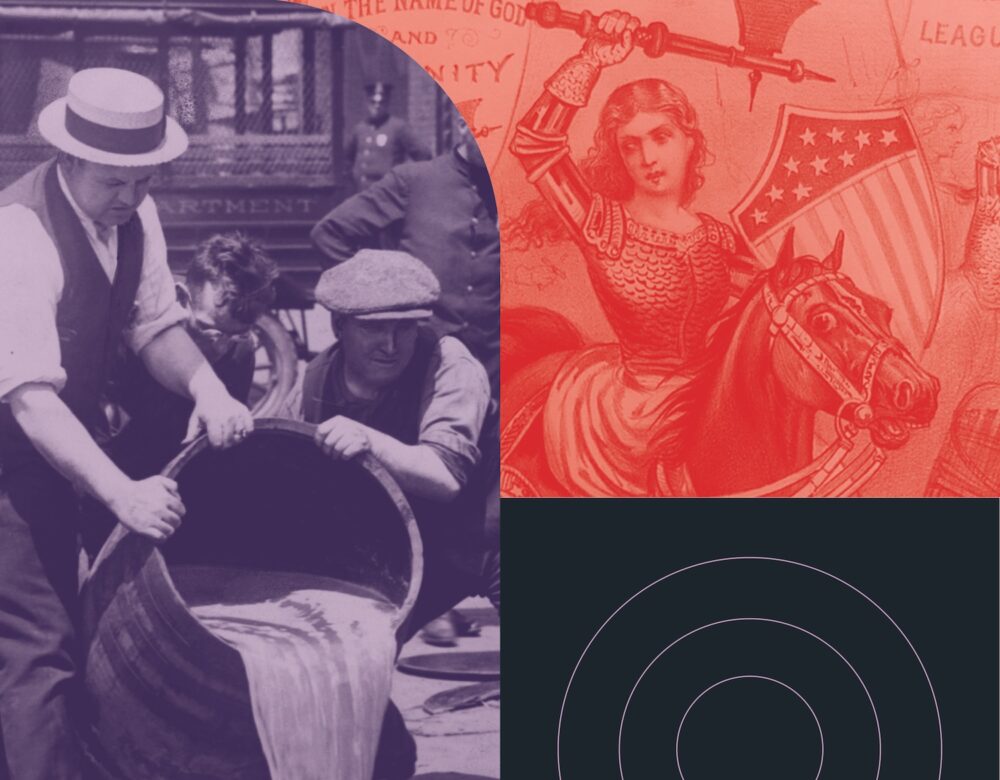
The roaring twenties were a time of huge political, scientific, and cultural change. In the U.S., women finally won a hard-fought battle over the right to vote, medicine was forever transformed by the discovery of penicillin, and the jazz age was fully underway. And in the background of all of this was a not-so-small new law: the 18th Amendment. But six years into Prohibition, people were drinking as much as ever. In response, the U.S. doubled down by tasking government chemists to poison the liquor supply. And the most shocking part? People drank it anyway.
Credits
Host: Alexis Pedrick
Executive Producer: Mariel Carr
Senior Producer: Rigoberto Hernandez
Sound Design: Seth Samuel
Fact-Checking: Alexandra Atiya
Music by Blue Dot Sessions
Resource List
BOOKS
Blum, Deborah. The Poisoner’s Handbook: Murder and the Birth of Forensic Medicine in Jazz Age New York. Penguin Books: 2011.
Okrent, Daniel. Last Call: The Rise and Fall of Prohibition. Scribner: 2011.
ARCHIVAL CLIPS
PeriscopeFilm. (2017, May 19). YESTERDAY’S NEWSREEL WOMEN’S SUFFRAGE 19th AMENDMENT 54334 [Video]. YouTube.
FamilyTime. (2013, June 5). Lindbergh, Sacco and Vanzetti, and Coolidge – Three Historic Newsreels from the 1920s [Video]. YouTube.
Reuters Connect. (2026, April 22). 1957 FRANCE: FASHION: 1920’s “Waistless Dresses” Style Influence Modern Fashions [Video]. YouTube.
Critical Past. (1920) Post World War I Political Issues in the U.S.A. including Red Scare, Anarchists, Labor Strife, and KKK [Video]. Critical Past.
G. Robert Vincent Voice Library Collection. William McAdoo Speaks about Plan to Revise Taxes [Audio]. MSU Libraries Digital Repository.
American Experience, PBS. (2021, January 16). Prohibition and the Suffrage Movement | The Vote | American Experience | PBS [Video]. YouTube.
ArchivesFoundation. (2015, April 10). Spirited Republic: Prohibition [Video]. YouTube.
Wellcome Library. (2010, February 10). The Discovery of Penicillin (1964) [Video]. YouTube.
Critical Past 1927 (source for LaGuardia) https://www.criticalpast.com/video/65675032139_changes-in-America_Herman-Ruth_Charles-Augustus-Lindbergh_Herbert-Clark-Hoover
YESTERDAY’S NEWSREEL PROHIBITION & BOOTLEGGING 59354
ARTICLES/OTHER
Alexander Gettler. (2023, February 21). Wikipedia.
Joint Resolution of Congress Proposing a Constitutional Amendment Extending the Right of Suffrage to Women, approved June 4, 1919.; Ratified Amendments, 1795-1992; General Records of the United States Government; Record Group 11; National Archives.
Wikipedia Contributors. (2019, May 11). Spirit of St. Louis. Wikipedia; Wikimedia Foundation.
Prohibition Now a Chemical War; Battle Between Government Laboratories and Bootleggers Reaches a Critical Stage—General Andrews Reviews Situation. (1927, January 9). The New York Times.
National Institute of Environmental Health Sciences. (2023, November 13). Arsenic.
Meyer, M. (2011, April 30). An Everyday Poison. Science History Institute.
Przybylek, L. (2018, April 16). Of Beer and Taxes: Prohibition’s Connection to the National Income Tax. Heinz History Center.
Woodward, S. (2025, January 17). Prohibition Turns 105: A Brief History of the Unpopular Dry Spell in American History. USA Today.
Zeitz, J. (2025). The Roaring Twenties | Gilder Lehrman Institute of American History. Gilderlehrman.org.
Transcript
Alexis Pedrick: From the Science History Institute, I’m Alexis Patrick, and this is Distillations: American Vice: Risk, Science, and the American Experience. The roaring twenties. It was a time of huge political, scientific, and cultural transformation in the US, a time that many consider to be the beginning of the modern era. It was a decade packed with big historical moments. There were major political shifts, like when the 19th Amendment was ratified on August 18th, 1920, finally giving women the right to vote.
Yesterday’s Newsreel, Women’s Suffrage: Alice Paul, suffrage leader, is first to vote by mail in New Jersey. Ms. Paul, a dramatic campaigner, had gone on a hunger strike earlier in an effort to force congressional action.
Alexis Pedrick: There were some big scientific moments, too. In 1922, we got insulin. In 1927, we got the first solo nonstop transatlantic flight.
Historic News Reels, 1920s: 33 and a half hours after takeoff in New York, Charles Lindbergh on the Spirit of St. Louis landed at Le Bourget Airport near Paris on May 21st, 1927
Alexis Pedrick: In 1928, penicillin
The Discovery of Penicillin: Fleming noticed that some mold, such as appears on decaying food, had begun to grow.
Alexis Pedrick: And also cultural shifts, like in fashion.
Reuters Historical News Collection: That’s it, the all-over look. No waistline, no curves, and no worries about vital statistics
Alexis Pedrick: And of course, there was the music.
I wanna be loved by you, just you. Nobody else but you. I wanna be loved by you alone. Boo boo ba doo.
Alexis Pedrick: And in the background of all of this, a small thing was taking place, a thing that led to gin-soaked tap rooms that required secret passwords.
Alexis Pedrick: I’m talking about Prohibition.
Boo boo ba doo.
Alexis Pedrick: On January 16th, 1919, the 18th Amendment to the US Constitution was ratified, banning the production, importation, transportation, and sale of alcoholic beverages. Nine months later, Congress passed the Volstead Act, a federal law which established the legal definition of intoxicating liquors and introduced penalties for production.
Reuters Historical News Collection: Twice in a few weeks, the government has struck. This time, a brewery on South State Street said to belong to Al Capone. It’s a scene of joy or sorrow, depending on how you feel about it.
Alexis Pedrick: There was a lot going on. As Nick Carraway says in The Great Gatsby, quote, “I was within and without, simultaneously enchanted and repelled by the inexhaustible variety of life,” unquote.And I haven’t even mentioned the social turmoil.
Post World War 1 Political Issues, Critical Past: In the backwash of war, depression, and a rising hysteria. In a single year, 61 murders by lynching. Revolution in Russia touching off panic at home.
Alexis Pedrick: And through it all, despite what the law said, Americans kept drinking. Now, maybe you’re thinking, “Okay, that’s interesting. But how is Prohibition a science story?” And that’s what we thought, too, until we stumbled across a shocking piece of information. During Prohibition, government scientists were tasked with helping to enforce the law, and they did it by poisoning the liquor supply. It was six years into the prohibition experiment and things weren’t going great.
Deborah Blum: It was like, well, prohibition is failing. People are still drinking. What if we use chemical enforcement?
Alexis Pedrick: This is Deborah Blum, a toxicology journalist and author of several books about poison. If the fact that the government poisoned the alcohol supply didn’t shock you enough, maybe this will. They poisoned it…and people drank it anyway.
Alexis Pedrick: It’s baffling. But as we so often say, the reason was also complicated. And to understand it, we have to start with poison itself.
Chapter one: The Inheritance Powder.
Alexis Pedrick: To understand how prohibition, chemistry, and poison became strange bedfellows, we need to go back to the 1800s, when apparently a lot of people were, well, poisoning each other.
Deborah Blum: If people who were poisoned would put their hands up in cemeteries, you would see hands rising out of graves all over the cemetery. Right?
Alexis Pedrick: Arsenic was a popular poison because it was tasteless, odorless, and colorless. It’s a broad spectrum cellular poison that mimics the symptoms of a natural illness.
Deborah Blum: So you’re poisoned with arsenic you get an upset stomach. You get a sore throat. Your muscles ache, right? So especially in the 19th century when they were barely figuring out how to find it in a corpse, it just got diagnosed as all kinds of natural illnesses.
Alexis Pedrick: Arsenic was nicknamed the inheritance powder. Your rich aunt isn’t dying quickly enough for your liking? Arsenic to the rescue. And it was widely available.
Deborah Blum: I mean, it used to be super easy to get your hands on arsenic. It was in cosmetics. It was in tonics.
Alexis Pedrick: And because it was hanging out in your average medicine cabinet and in household goods, women especially had access to arsenic, and they put it to use.
Deborah Blum: Women choose poison as a weapon about seven times as often as men. That’s another FBI statistic, actually. And it suits us. We’re planners.
Alexis Pedrick: But don’t get me wrong, we’re not trying to say Victorian-era women were just going around murdering people for fun.
Deborah Blum: In the 19th century in particular, women had very little power, surprise, surprise. If you were married, you couldn’t own property, et cetera. And so if you were in an abusive situation, arsenic was one of your ways out of it. And there was a really famous science historian from Caltech, Dan Kevles, who called poison the great equalizer for women of the 19th century. It was the one thing they could use to get themselves out of a bad situation. So you saw a lot of that, too. It wasn’t just inheritance, it was escape.
Alexis Pedrick: But soon, poisons like arsenic would stop being so hard to detect. Scientists had been working on isolating and identifying the chemical compounds and basic elements that make up our world. In 1804, the culmination of all that research was published. Maybe you’ve heard of it: the Periodic Table of Elements. It became a crucial tool for chemists working on poisons.
Deborah Blum: There was a quite famous Spanish chemist based in Paris named Orfila who wrote the first textbook on detecting poison.
Alexis Pedrick: Given that Orfila was such a fan of short book titles, like Directions for the Treatments of Persons Who Have Taken Poison, and Those in a State of Apparent Death, Together with the Means of Detecting Poisons and Adulterations in Wine, Also of Distinguishing Real from Apparent Death, we trust this was a short one.
Deborah Blum: If you look at that book, which I have in my very nerdy way, um, you know, he basically acknowledges that we can’t detect almost any poison in a corpse, but, you know, we’re figuring it out.
Alexis Pedrick: Mathieu Orfila thought that metallic poisons like arsenic would be the easiest to detect in the body’s tissues, so that’s where he focused his research, and he was on the right track. By the late 1830s, we had the first test for isolating arsenic. Over the next 10 years, scientists developed reliable tests that could be used in criminal prosecutions.
Deborah Blum: Arsenic is a metalloid poison. The elemental arsenic shares qualities with metal. It’s not a true metal like, say, a lead, but it has some metallic qualities and it’s, so it’s classified as a metalloid poison.
Alexis Pedrick: Once they could detect that in a corpse, they figured out how to identify other metallic poisons. Plant poisons were more difficult. That was a very different chemistry. It wasn’t until a French chemist, Jean Servais Stas, figured out how to isolate nicotine from a corpse that we made progress.
Deborah Blum: So you start seeing in the 19th century this kind of bedrock of all the natural occurring poisons, the arsenics and the antimonies, which are found in the Earth’s crust, and the cyanides and the strychnines, which are found in plants, all of them now kind of revealing their secrets.
Alexis Pedrick: But as fast as scientists figured out how to detect a poison, poisoners would find new ways to disguise their crimes. In her book, The Poisoner’s Handbook: Murder and the Birth of Forensic Medicine in Jazz Age New York, Deborah calls it a deadly cat and mouse game.
Deborah Blum: Poisoner’s Handbook is really about the invention of forensic toxicology in the United States and, you know, by implication everywhere.
Alexis Pedrick: In 1918, New York City got its first trained medical examiner, Charles Norris, and boy did he have his work cut out for him. It wasn’t just the intentional poisonings, but also the unintentional ones too. This stuff was just around. It wasn’t just arsenic in cosmetics.
Deborah Blum: Cyanide used to be in every household. It was used in silver polish. It was used in photo processing.
Alexis Pedrick: Morphine went into teething medicines for infants. Opium was in sedatives. All of this made discerning intention very hard for New York’s new medical examiner.
Deborah Blum: The year that Norris came into office, New York City had actually published a report that stated that the clever poisoner could operate with impunity in New York City. They did not know how to catch a poisoner.
Alexis Pedrick: But Norris was up for the job. Despite his charming public persona, he was a deeply intense man with a perfectionist streak a mile long. He was fascinated by science and had a commitment to public service, and importantly for the corruption the city was battling at the time, he was insanely rich. He didn’t need the money that came with the job. Norris did it because he was committed to the ideals.
Deborah Blum: And he hired Alexander Gettler, who was the first forensic toxicologist ever to work in the city medical examiner’s office.
Alexis Pedrick : Norris and Gettler were operating in a difficult environment. Historically, the coroner’s office had been politically appointed in the United States, and New York was run by a corrupt political machine in the early 20th century. So the nascent field of toxicology was contending not only with rapidly developing science, it was also struggling with cases that were lost because of negligence and corruption.
Deborah Blum: And this is the other thing that is going on with the politically appointed coroner system, is a lot of times they just don’t show up. And when they do show up, they don’t know what they’re doing, and they were fine with just guessing. Could be diabetes or possibly an auto accident.
Alexis Pedrick: Norris and Gettler had to rebuild a lot of relationships. Norris even sent Gettler and his other forensic experts to do trainings at police departments so they could understand how things worked. And the effort paid off.
Deborah Blum: By the 1930s, you can find defense lawyers complaining that, you know, if Alexander Gettler testifies, they’ve already lost the case. He’s gotten such a reputation for being really good at what he does.
Alexis Pedrick: Alexander Gettler was a very talented chemist. In her book, Blum describes him as a, quote, “cigar-smoking gambling enthusiast from Brooklyn.” His background was very different from Charles Norris. He emigrated to the US at the age of seven with his father and sister.
Alexis Pedrick: He went to the City College of New York, got his PhD in biochemistry from Columbia, and was a clinical chemist at Bellevue Hospital. He got along with Norris, though, because when it came to the work of the medical examiner’s office, he also believed in perfection.
Deborah Blum: He was a Hungarian immigrant who married into a fairly rowdy Irish family who made bootleg whiskey during all of Prohibition in their home in Brooklyn, and he bet every day on the horse races. You know, in his private life, he was kind of a fun guy, but in the laboratory, he was deadly serious. I actually saw one interview, some magazine interviewed him at one point, and they described him as having the personality of table salt, which is definitely an insult. But I think, like, when he was talking about chemistry, he was so precise and so careful.
Alexis Pedrick: He had to be. Remember? The office needed to be above reproach. Gettler was dedicated. He created new tests to isolate poisons, including regularly experimenting by poisoning raw liver and attempting to isolate increasingly smaller amounts of poison from it. And it was that attention to detail, that familiarity with poisonings both purposeful and accidental, that made Gettler the exact right person to notice a problem brewing with the amendment that was about to pass, the one that was about to establish the prohibition of all alcohol in the United States.
Chapter Two: Hide the liquor, hide the beer
Yesterday’s Newsreels – Prohibition and Bootlegging: World War I is over, and so are America’s days of legal alcoholic drink. Convinced self-sacrifice and sobriety will bring prosperity and peace as it won victory and war, Americans praise passing of the dry law.
Alexis Pedrick: Prohibition was the result of a decades-long campaign that was organized, politically active, and dedicated to the mission of outlawing alcohol. And the temperance movement, as it was called, brought together a huge coalition of people, a big part being women fighting against domestic violence. Here’s women’s rights activist Eleanor Smeal on a PBS documentary called Prohibition and the Suffrage Movement.
Women’s Suffrage – PBS American Experience: I don’t think that many people realize that Susan B. Anthony was a leader in the temperance movement. The temperance movement was all about men’s behavior, by the way. It wasn’t not just alcohol, it was the abuse of alcohol and the beating of women, uh, by drunken men. And they would also spend an inordinate amount of money on it, and on pay day, they’d go to the bars, and what would be left for the wife and the kids?
Alexis Pedrick: The movement also included Christian groups, people who were anti-immigrant, particularly anti-German immigrants, and people who wanted income taxes. Yeah, that might seem out of left field.
William McAdoo: The question of taxation touches every home in America.
Voice Actor: The question of taxation touches every home in America.
William McAdoo: There is no man, woman, or child who can escape the relentless tax law.
Voice Actor: There is no man, woman, or child who can escape the relentless tax law.
Alexis Pedrick: That’s William McAdoo giving his famous revised taxes speech in 1919. He was criticizing Congress, which was Republican-controlled at the time, for not reducing the burden of wartime taxes after World War I had ended.
William McAdoo: Between the high cost of living and the high load of taxation, the masses are carrying a heavy burden these days.
Voice Actor: Between the high cost of living and the high load of taxation, the masses are carrying a heavy burden these days.
William McAdoo: And they have a right to demand that the Republican majority in Congress carry out its promises to give relief.
Voice Actor: And they have a right to demand that the Republican majority in Congress carry out its promises to give relief.
Alexis Pedrick : There was something relatively new in that taxation load income tax. The sixteenth amendment, which made it possible for the government to levy a national income tax, had only been ratified a few years earlier, in 1913. The temperance movement was in favor of it because it helped break the government’s reliance on the alcohol excise tax, which was bringing in more than two hundred million a year by 1910. They were joined by progressives who wanted a way to make the government more effective and increase its power, and racially motivated southerners who wanted to exact some revenge for reconstruction. Like we said: huge coalition, big tent. Or, Daniel Okrent says in his book Last Call: The Rise and Fall of Prohibition, quote “The various factions of the growing anti-alcohol alliance could be encompassed by no imaginable organization. Billy Sunday, meet Jane Addams. You may never realize it, but you’ll be working together now. Industrial workers of the world, shake hands with the Ku Klux Klan. You’re on the same team.” Unquote. Anyway, the national income tax paved the way for prohibition because it made the loss of revenue less of a concern.
Alexis Pedrick: It was a huge win for the temperance movement, which had been steadily gaining steam. Prohibition had already been passed by some states before the amendment, and there was even a temporary restriction on alcohol in 1918 as part of a wartime act to save grain. All of that is to say the 18th Amendment was not a surprise, and people were preparing for it the best way they knew how.
Deborah Blum: So once we start easing into prohibition, Gettler actually wrote an article in 1918 saying, “We are starting to see people distilling whatever they can to get alcohol,” you know, preparing for the alcohol apocalypse.
Alexis Pedrick: You can distill almost anything, and frankly, people did.
Deborah Blum: They would distill their shoes. There was some shiners, I think they were in Tennessee, who ran out of an easy availability of other products and pulled poison ivy vines off trees and distilled the poison ivy. People distilled their furniture. People would, like, distill their kitchen table. But if you’re distilling products related to wood, you’re gonna get wood alcohol.
Alexis Pedrick: And this made Alexander Gettler worried.
Deborah Blum: He said, “This is really dangerous.” Because wood alcohol is really poisonous.
Alexis Pedrick: Wood alcohol is methyl alcohol. It had a lot of practical uses as a solvent, to make varnish. It was even an ingredient in dyes and used as a fuel.
Deborah Blum: So you can distill wood, it’s called destructive distillation of wood, and make a form of alcohol that we call methanol today. And at one point in the United States, they had wood alcohol factories all along the East Coast. Just thousands of trees were sacrificed because this alcohol could be used in all kinds of industrial processes.
Alexis Pedrick: But now that alcohol was illegal, some people were willing to drink pretty much anything.
Deborah Blum: And you see people starting to die from wood alcohol poisoning or going blind.
Alexis Pedrick: This is what happens.
Deborah Blum: So really quickly, if you went home tonight and had a cocktail there’s an enzyme that breaks down alcohol. It’s called alcohol dehydrogenase, and it starts this metabolic pathway that eventually turns the ethanol into carbon dioxide and water. Completely harmless. But when the same thing happens and alcohol dehydrogenase starts breaking down methanol, this turns into formaldehyde and formic acid. So eventually what happens is that formic acid metabolizes to formate, and that is taken up by the optic nerve. Your optic nerve is a really busy nerve because it’s always processing images, and it, so it takes up a lot of this formate, and that destroys the optic nerve, and that was why you started seeing so much blindness during this period.
Alexis Pedrick: And it wasn’t just the blindness. It also caused so many deaths.
Deborah Blum: When you first drink methanol, you get the buzz. Sure, you feel dizzy, but you also get that kind of happy little buzz you get from drinking, you know, a normal cocktail. But then gradually, the poison builds up in your body. It’s not a reversible process. Because it’s such an internal chemical cascade, there’s really nothing you can do to stop this process, and so people died. When you go and you look at some of the things that are going on then in New York City, you find that almost every day, the coroner’s office or the medical examiner’s office is collecting bodies from around the city, especially in the poorer neighborhoods where the only alcohol people had access to were wood alcohol kind of products.
Alexis Pedrick: Gettler knew these deaths were caused by alcohol because of that same attention to detail he used to develop his liver test for poisons.
Deborah Blum: And he was the first person in the world to figure out how you could tell someone was drunk at time of death, which is harder than you think because our body naturally makes ethanol. You’re always gonna have some amount of ethanol in the brain. So if you die and you find ethanol, big whoop. Our body makes it. But how much is in there that actually can be tied to intoxication? He looked at 8,000 brains to figure that out.
Alexis Pedrick: Plenty of people made themselves sick from accidental alcohol poisoning, but they kept drinking anyway.
Deborah Blum: I mean, there was a cocktail called Smoke that was Sterno mixed with alcohol. So people were drinking these terrible things, and that was killing them. I think it says something about the American character that nobody wanted the U.S. government telling them they couldn’t have a glass of wine after dinner if they wanted one. And I would feel that way today. Please, this is my bad habit. I get to have it.
Alexis Pedrick: But the thing that Gettler and Norris had to deal with next was not accidental at all.
Chapter Three: Surely They’ll Stop.
Alexis Pedrick: Enforcing Prohibition across the entire country was a massive undertaking, and the government did not have the manpower or resources to support it.
Changes After WW1 – Critical Past: Congressman Fiorello La Guardia says that to enforce Prohibition, the city of New York alone would need ‘250,000 police and another 200,000 to police the policemen.’ The most respectable citizens frequent illegal speakeasies. There is a growing breakdown of respect for the law.
Alexis Pedrick: Not only had people kept on drinking, but Prohibition had led to some unintended consequences, including the proliferation of organized crime. And this seedy underbelly of society wasn’t hiding in dark alleys. It was seeping into everyday life, mingling with polite society, because organized crime controlled the majority of bootlegging operations.
Yesterday’s Newsreels – Prohibition and Bootlegging: It’s against the law to drink, so drinking is suddenly smart. There’s bootleg liquor on every American lip, shiny flask on every hip. By the middle of 1920s, nightlife is having its heyday, for America’s dry and high.
Alexis Pedrick: Six years into Prohibition, the writing was on the wall.
Deborah Blum: Prohibition is failing. People are still drinking.
Alexis Pedrick: And some of them are drinking things that were never meant for human consumption. Since the Pure Food and Drug Act of 1906, the government had required businesses to denature industrial alcohol or else pay liquor taxes on it. This meant that if you wanted to sell ethanol as a solvent, first you had to add chemicals to it to make it smell bad, taste bad, or even make it poisonous to discourage people from consuming it. By the 1920s, somewhere around 70 denaturing formulas existed. Some of them used wood alcohol, which we now know was deadly, but other formulas were mostly made up of contaminants that made them awful to drink. But during Prohibition, this denatured industrial alcohol became a target.
Deborah Blum: Everyone wants illegal alcohol, so the Al Capones of the world are organizing to get illegal alcohol into the system, and they start stealing industrial alcohol.
Alexis Pedrick: But even if it didn’t kill you, it was nasty stuff.
Deborah Blum: I’ve never talked to a single person who was sitting around drinking isopropyl alcohol out of their rubbing alcohol bottle. We all know it’s gonna be bad. And so what the bootleggers hired chemists to take the contaminants out and make it taste better again.
Alexis Pedrick: Right. Rather than denaturing alcohol, these bootlegger scientists were working through the list of formulas and renaturing it. Formula 39B was a favorite because it was used for the production of alcohol in perfume and cosmetics. Since it wasn’t particularly dangerous, the scientists found it was pretty easy to make it drinkable again. Eventually, bootlegger scientists were able to work their way through a huge portion of the list. Even formula number six, which included mercury bichloride, was able to be renatured. As all of this was going on, the government didn’t give up. It doubled down.
Deborah Blum: What if we use chemical enforcement?
Alexis Pedrick: You see, Alexander Gettler heard a rumor that government chemists were working on a secret project to create new denaturing agents, formulas that would require much more methyl alcohol and would even add new poisons to the mix like kerosene and benzene. In other words, they made the industrial alcohol supply even more dangerous. The industrial alcohol supply they knew people were drinking. And so was born a lethal game of cat and mouse. To the government, it was a simple solution to a straightforward problem.
Deborah Blum: They wanted people to not drink. Eventually, they just asked the makers of industrial alcohol to put wood alcohol in the mix so that it would be so dangerous that people would be afraid to drink it. You can actually go find these government formulas where the government keeps inching up the amount of wood alcohol because getting wood alcohol out of the mix is almost impossible.
Alexis Pedrick: Instead of forensic toxicologists versus poisoners, it was government scientists versus those that were working for bootleggers. The government saw using wood alcohol to poison the liquor supply as striking a decisive blow and fixing Prohibition. But this solution was putting people in danger.
Deborah Blum: People were calling them the Borgia government by this time, but their intention was not murder. I’m trying to be really fair here. Their intention was they would poison the alcohol, they would get that information out, and people would go, “Oh, I shouldn’t touch this because it might kill me.” And so they held press conferences. They invited reporters to the Treasury Department headquarters in Washington, D.C., showed them the different formulas, talked about what was going in it. ‘Get the word out, people should not be drinking this.’ People drank it anyway.
Alexis Pedrick: Norris and Getler began sounding the alarm.
Deborah Blum: Norris and Getler now are going out and saying, “You’re poisoning Americans.” I mean, I told this whole story of, like, a particular Christmas where people just start dropping dead or hallucinating because they have accidentally drunk this government-contaminated alcohol.
Alexis Pedrick: She’s talking about the Christmas of 1926. In her book, Blum describes a man running drunkenly into Bellevue’s emergency room, claiming that Santa Claus had chased him from Fifth Avenue with a baseball bat. And he wasn’t the only one confused. He was one of 65 people who had come into the hospital over the last two days, sick from celebrations that had poisoned liquor. By the time the holiday was over, 23 people were dead, 89 were hospitalized, most of them vomiting and hallucinating. Some had gone blind.
Deborah Blum: Norris wrote an article called “Our National Essay in Extermination” based on the government policies. And you can see this in newspapers of the time. The Chicago Tribune said that the amendment was the only amendment carried the death penalty with it because of the government poisoning its own citizens.
Alexis Pedrick: Norris did not mince words. Quote, “The government knows it is not stopping drinking by putting poison in the alcohol. It knows what the bootleggers are doing with it, and yet it continues its poisoning processes, heedless of the fact that people determined to drink are daily absorbing that poison.” Unquote. Which brings up a really important question. Why in the heck did people keep drinking it?
Chapter Four: Informed Decision-Making.
Alexis Pedrick: It’s a really good question. Why did we keep drinking? The government didn’t make what they were doing a secret. They tried to get the word out. And to dry advocates, those who were in favor of not drinking, the answer seemed obvious.
Deborah Blum: You see the dry politicians saying, “Are you gonna go into a hardware store and gamble that if you drink pesticide it won’t kill you?” These people are making a choice. They’re making a choice to drink this when we have done everything we can to get this information out.
Alexis Pedrick: Remember, as far as the temperance movement was concerned, alcohol was the true public health crisis. So Gettler and Norris’ many op-eds, their railing against this policy fell on deaf ears, in part because of where they were calling it out from.
Deborah Blum: If you look at kind of the origins of the Prohibition movement, some of it is based in organizations like the Women’s Christian Temperance Union. There’s the Anti-Saloon League. And they really grow not out of big urban areas like New York. I think the Anti-Saloon League was Columbus, Ohio. And so you have in the politics of this, again, you have what I think today we would sometimes call the redder states looking at these lefty liberal urban areas and saying, “Uh, yeah, you know, New York is really unhappy, but you know, New York is the den of inequity.”
Alexis Pedrick: The head of the Anti-Saloon League was a man named Wayne Wheeler, and he didn’t buy Norris and Gettler’s arguments at all.
Deborah Blum: Wayne Wheeler was just like, “Well, you’ve always been New York scum. New York, you sold its soul to the drinking devil a long time ago, and you’re just representative of that.”
Alexis Pedrick: “New York sold its soul to the drinking devil” isn’t really a satisfactory answer to why people kept drinking, not least of all because people weren’t only dying in New York.
Deborah Blum: People are being poisoned around the country. You’re seeing it, like I said, in places like Missouri and Southern Illinois and Arkansas.
Alexis Pedrick: So why? Well, first of all, let’s think about how information traveled in that day.
Deborah Blum: It was newspapers, which if you were on Skid Row, you were probably not reading. Or it was the radio, which if you had no money, you were not necessarily having access to radio. I think the information got out there. There was certainly word of mouth about it. The medical examiner’s office in New York City was doing constant messaging about this. So does everyone know this? No.
Alexis Pedrick: That might be hard for us to wrap our head around, living in our modern era of the internet and news updates by your TV, radio, phone, Instagram feed. And also because our view of prohibition is probably a bit skewed.
Deborah Blum: I realized that a lot of my idea of prohibition was like F. Scott Fitzgerald, right? Happy little parties. But the Fitzgeralds had money, and they partied with their bootlegger, and so they got the really good stuff. Whereas the people who really suffered in this period were people who couldn’t afford to get the good stuff, and they got the Russian roulette forms of alcohol. It might kill you, it might not.
Alexis Pedrick: Determining risk is crucial to our survival, but sometimes we’re not that great at it, even when we have the information we need. But in this case, even that wasn’t a given. So in their desperate attempt to solve a problem, the government made a miscalculation, not just about how people would react, but about how much they knew.
Deborah Blum: Busting up stills wasn’t working. Closing down speakeasies wasn’t working. But if you could just scare people enough, they wouldn’t drink, and you would now succeed in creating a dry America. Some people knew it and drank anyway. That’s also human. And people who didn’t really have access to information, they were just out of luck.
Alexis Pedrick: Norris especially believed it was easy for those in power to discount the people who were out of luck because they were working-class or poor.
Deborah Blum: And he pretty much said this directly, that you had people in government of wealth and power who didn’t care about those people. They were collateral damage in this particular holy war. And it’s interesting because if you actually look at that period, so many people died in New York. So many, like homeless or struggling people were killed by alcohol, wood alcohol, or, you know, government poisoned alcohol in New York. They were digging these mass graves in, you know, in the paupers fields, cemeteries, because they had nowhere else to put them.
Alexis Pedrick: And then there’s perhaps a sentiment that feels more recognizable to us.
Deborah Blum: It’s really an interesting study in human behavior, and I do think some of it is that they didn’t know. And I think some of it is, you know, they didn’t trust the government, so the government might be telling you this, but do you really trust the government?
Alexis Pedrick: So how devastating was this policy?
Deborah Blum: This is a very rough calculation because no one ever really tallied up which deaths were caused by just you drank from the wrong still, and which deaths were caused by government poisoning. But when you look at the outbreaks that followed the government poisoning, you can pretty much find by going from at least major city to major city, that a good 10,000 people were killed by this government poisoning program.
Alexis Pedrick: That’s a lot of loss of life, and it brought the government a lot of ill will.
Deborah Blum: One of the things that’s interesting about the period is that you also saw newspapers labeled as wet newspapers and dry newspapers. And so some of the newspapers from, you know, states that were sort of holy roller states had been very for prohibition. They start changing. And so you start seeing some of those newspapers coming out and saying, “Listen, this is not worth killing Americans. Yes, we want a more sober country, but not at the cause of random death.”
Alexis Pedrick: It wasn’t the only thing that led to the repeal of prohibition. Other factors, like the stock market crash, fed it too. And people aren’t a monolith. Even as the legislation was clearly failing, there were still dry advocates who wanted to see it saved. There was lots of debate, which is, well, very American.
Yesterday’s Newsreel – Prohibition and Bootlegging: And prohibition heads for doom. At Faneuil Hall, Boston, thousands demonstrate against the folly of the Volstead Act. Upon talk of repeal, champions of dry laws storm Senate headquarters in Washington. Leader of Women’s Christian Temperance Union, Mrs. Ella R. Poole, has this to say. We call attention to the fact that women are not suffering from the blows of drunken husbands as in the days when the saloon had right of way.
Alexis Pedrick: But the end was nigh.
Deborah Blum: Everyone is waiting. You know, everyone by this time knows it’s gonna happen. And, and if you look at New York, you know, people had been, like, secretly stockpiling. Even Macy’s, the department store, set out, like, alcohol carts for their customers. It was like, yeah, people couldn’t wait to drink openly, and freely, and on their own terms again. It was like one big national party, which I kinda love.
Alexis Pedrick: The 21st Amendment was ratified on December 5th, 1933, officially repealing prohibition. The twenties were over, but the decade had a huge impact.
Deborah Blum: I’ve always thought of the 1920s as one of the most anarchistic decades in U.S. history because you pass a constitutional amendment, and the whole country rebels against it. I mean, New York wasn’t the only state where people were drinking illegally. All of these different kind of cultural shifts, women smoke more openly, and all of this other stuff. So in ways that I think the people who started Prohibition didn’t intend, it shifted some of the ways that people behaved because they felt like they were rebelling anyway, and they could rebel against all these morays. Skirts got shorter famously during the 1920s. All of these things.
Alexis Pedrick: And after all this time, seven episodes later, what have we learned about risk and science in the American experience? Is it just that we’re stubborn, full of that indomitable American spirit, and we only want science to prop that up?
Deborah Blum: This is the way I want to live my life, and by God, I’m gonna live it this way.
Alexis Pedrick: Could be. But maybe our attraction to risk isn’t American. Maybe it’s just human.
Alexis Pedrick: Distillations podcast is produced by the Science History Institute and recorded in the Laurie J. Landau Digital Production Studios. Our executive producer is Mariel Carr. Our senior producer is Rigoberto Hernandez. This episode was produced by me, Alexis Pedrick. It was fact-checked by Alexandra Atia, and the sound design was by Seth Samuel. Support for Distillations has been provided by the Middleton Foundation and the Wyncote Foundation. You can find all of our podcasts, as well as our videos and articles, on our website at sciencehistory.org. And you can follow us on social media @scihistoryorg for news about our podcasts and everything else that goes on in our free museum and library. For Distillations, I’m Alexis Pedrick. Thanks for listening.