

The escalators at Chicago’s McCormick Place are so packed that my view consists primarily of a middle-aged man wearing khaki business casual and grooving to the classic disco song “Funkytown,” blasting on the sound system. Next to him, a colleague is laughing at him in feigned horror as we all approach the food industry’s largest science and technology expo like cookies on a conveyor belt. Overhead, the DJ segues to Bryan Adams’s “Summer of ’69,” much to the delight of my khakied compadre.
Personally, I’m grateful for the loud music because it’s drowning out the sound of my growling stomach. My rationale for skipping breakfast before an all-day convention is strategic: With nearly 900 exhibitors at the Institute of Food Technologists’ annual gathering, I’m expecting more samples than any human can reasonably try. My solution: I will attempt to dine entirely on free wares over the next three days. Given that the convention theme is “Food Improved by Research, Science, and Technology,” what could go wrong?
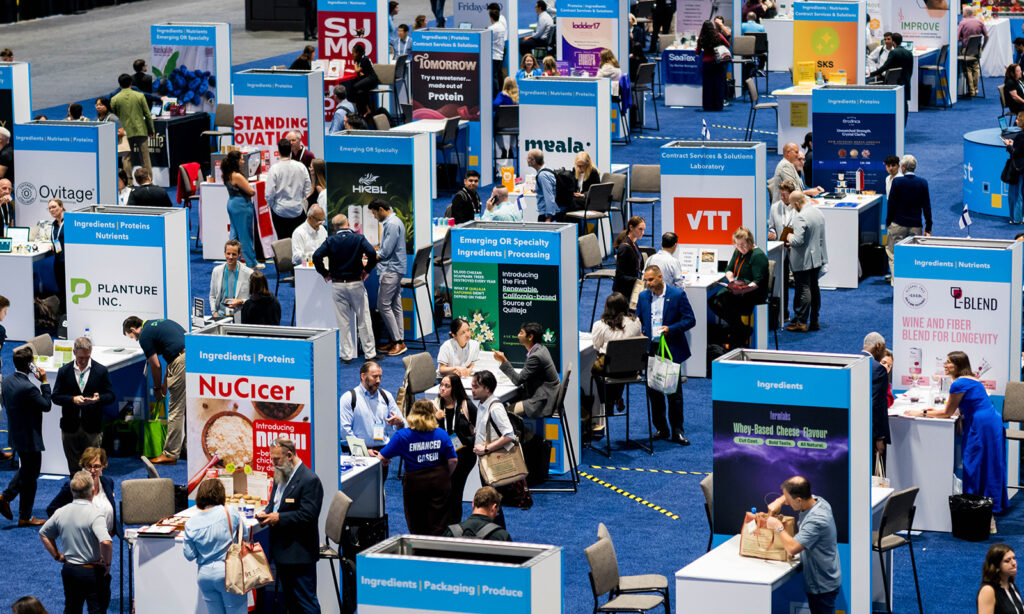
At the expo entrance, the DJ, dressed entirely in black, moves on to AC/DC’s hit “Thunderstruck” as security checks my badge. Fortified by a guitar solo, I strut into what can best be described as sensory overload. Above me, a profusion of rotating carousels hang from the ceiling advertising food brands. There are selfie stands—one framed by enormous decorative marshmallows, another by cheese chunks—with lighting to satisfy the vainest of food influencers.
I am pulled by the crowd—the event typically attracts some 15,000 attendees—toward a dairy booth, where a friendly employee hands me a stress ball in the shape of a cheese wedge. I come to the immediate conclusion that the squishy chunk of plastic curd will be my key to surviving three days of hyperstimulation.
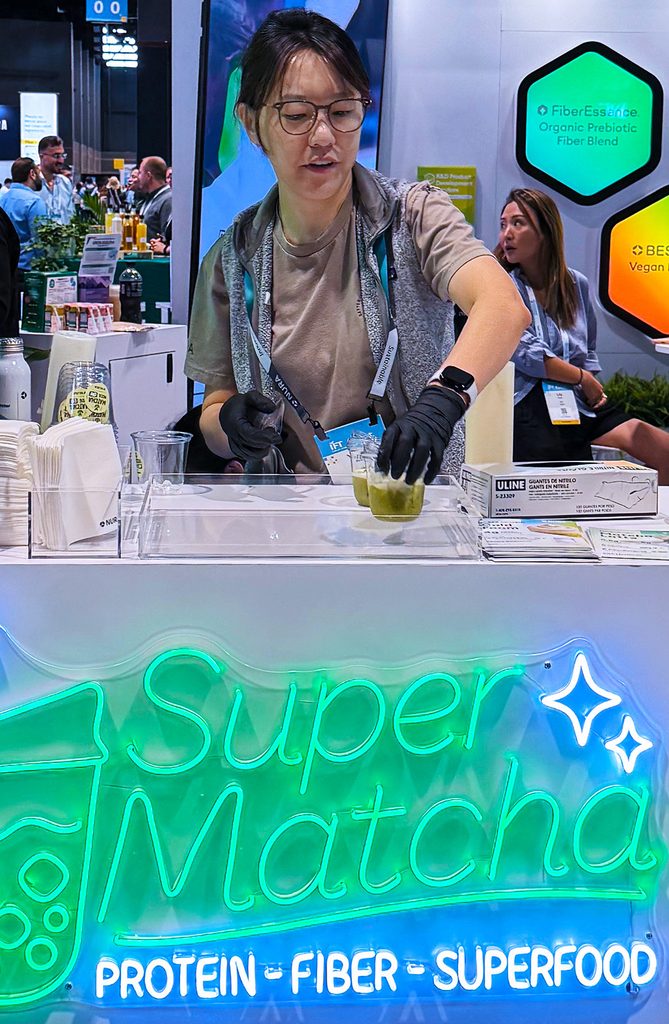
I pause for a selfie under a cheese arch before going in search of caffeine, with options as diverse as the DJ’s playlist: protein-fortified matcha, a canned energy drink featuring a caffeine metabolite (paraxanthine) that promises focus without jitters, and several pre-made lattes with fancy flavor sweeteners, including rose, rosemary, and cardamom. I grab a caramel macchiato that advertises “prebiotic protein and two grams of soluble fiber,” and start my breakfast sampling with poblano-tamarind–flavored chips.
IFT FIRST is the place where ingredient suppliers—the middle managers of the food industry—flaunt new flavors, colors, texturizers, and other additives that kowtow to consumer fads—from protein maxxing to snack gummies boosted with micronutrients. Amid the profusion of booths are stages where speakers and panelists discuss the disruptive phenomena currently captivating the food industry. For one, there’s the nearly 20% of American adults experimenting with GLP-1 weight-loss drugs; their decreased appetites could tighten the belts of food industry profits or equally could be a new business opportunity.
“It took Weight Watchers 20 years to get to 10% of the American population. It took GLP-1 less than two,” says food tech entrepreneur Alon Chen, who argues that deploying AI agents to design new food products will help the industry navigate rapidly changing consumer and regulatory trends.
The industry isn’t just grappling with GLP-1 users and how best to use AI. It’s also fixated on Robert F. Kennedy Jr.’s Make America Healthy Again (MAHA) movement. The MAHA movement has inspired many consumers to seek so-called “clean” labels on their processed food and ushered in regulatory changes: under Kennedy’s direction, the FDA has banned several long-standing synthetic food dyes, with more in his sightline.
“Food used to just have to look good, be available, and be cheap,” says Brendan Niemira, IFT’s chief science and technology officer. “Now, [consumers] want it to work with our gut health or have [another] functionality. We want it to come in different flavors. We want it to be more convenient. We want one-off servings. We want to be able to take it on a road trip—or serve it at a family dinner . . . have extended shelf life, but still look good and taste good.”
En route to the event’s opening keynote, where celebrity chef and self-described food nerd J. Kenji López-Alt will cook mapo tofu and ruminate on food as family, history, culture, and community, I’m struck by the number of booths offering tiny gummies and bars marketed as mini meals. They’re not just diminutive portions sized small for roving expo attendees; their tiny size is, apparently, the point. At first, I wonder if this is the latest version of shrinkflation. I’ll soon discover they cater to a trend called snealing: when consumers intentionally replace meals with nutrient-dense snacks.
Many of the bite-size meals are targeted to busy people and those taking GLP-1 weight loss drugs, whose appetites are smaller and who physically cannot consume as much food as they once did. That requires food scientists to pack more nutrients into smaller portions—think fiber, protein, bioactive lipids, vitamins, says Carolina Betancourt, a scientific director for oil and fat maker Alianza, at the panel “GLP-1 and the Future of Food.”
It’s what “we call ‘benefit stacking,’ ” explains panelist Anke Golde, who works in R&D at grain-milling giant Ardent Mills. “It’s really not about the quantity of the food anymore. It’s truly about the value.” In the first six months of 2026, GLP-1–marketed products increased by almost 50%, Golde adds.

To ignore the GLP-1 trend is to risk the upheaval the food industry faced in the 1990s, adds Stephanie Mattucci, principal strategist for the market research firm Mintel. At the time, foods advertised as low in cholesterol were en vogue.
American public health officials had recommended low-fat diets since the 1950s, and by the 1980s and 1990s the advice reached a fevered pitch. Low-fat and low-cholesterol diets were touted as the way to fight rising rates of heart disease. The food industry jumped on board, offering a cornucopia of low-fat and low-cholesterol products that claimed to be heart healthy. Then in 1987 the FDA approved a drug called Lovastatin, which could drastically decrease levels of cholesterol and thus reduce rates of heart disease. In the next decade, a whole family of these drugs—called statins—was launched, including Lipitor, which became one of the best-selling drugs in history.
When statins came to the market, “there were a lot of functional food products out there to lower cholesterol,” Mattucci says. “Those products did well at first, but they really had a hard time sticking with consumers’ behavior. It was much easier to take a pill.”
With the launch of GLP-1 medications, there’s now an efficient, pharmaceutical option for weight loss. Although the drugs are hard for some people to tolerate, those who continue to take them are less hungry and thus less likely to buy as much food as before. It’s left some in the food industry spinning.
“My market research team at Nestlé wouldn’t give our business team the projections because it’s such a volatile market,” says Marlene Schmidt, a senior nutrition and wellness manager tasked with growing Nestlé’s GLP-1 food and beverage products.
My appetite, unchecked by modern medicine, tugs me back to the expo floor and toward a booth outfitted with a treehouse and enormous plastic mushrooms.
A man sporting a purple Willy Wonka smoking jacket, top hat, and jaunty cane approaches me from the treehouse and gallantly bows. Then he bequeaths me a vanilla fudge–flavored smoothie boosted with omega-3 fats in the kind of tiny, sippable pouch usually reserved for toddlers. The dapper gentleman, who I discover is an actor-for-hire, tells me that the healthy fats in the pouch are derived from algae instead of fish oil. “It’s brain food without the fishy burps,” he asserts.
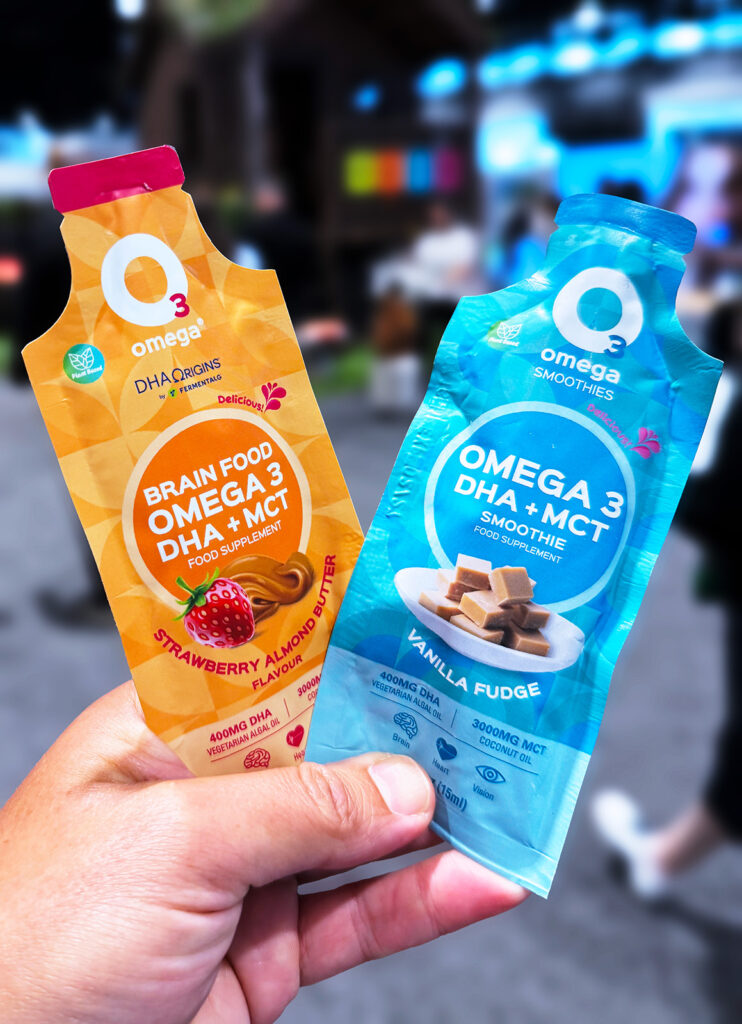
Although some booths, like Mr. Wonka’s, are promoting products enriched in healthy fats or other niche micronutrients, most samples on offer seem to be boosted with protein, fiber, or both.
“Protein has moved beyond sports nutrition and become a mainstream wellness habit,” says marketing executive Angie Rimel, at a company-sponsored session about the future of snacking. Today, 63% of consumers include protein in their daily routine, she says.
Rimel leads North America marketing for Gelita, a company that sells ingredients to fix unpleasant gritty textures and disagreeable flavors wrought by high-protein, low-sugar formulations.
GLP-1 users and health-conscious consumers more broadly don’t just want added protein in a meal, she continues, many also prioritize less sugar, additives, and fat.
But, she warns, “GLP-1 reduces appetite, not expectations. . . . If the chew is tough, the bar is dry, [or] the gummy doesn’t live up to expectation, then the nutrition claim cannot compensate for this.” The consumer simply won’t buy the product again.
It’s a sentiment I’ll hear a lot: it’s not hard to add protein to serve the protein-maxxing crowd, but it is hard to make the resulting product palatable—more so if the customer wants the added proteins to be plant-based.
Consider pea flour, which has roughly twice the amount of protein as wheat flour. “One of the big things with pea flour is that you sometimes [get] off notes” reminiscent of grass, explains Niemira, IFT’s chief science and technology officer. “I might make pasta out of that, but I would not use it to make a cake.” Food scientists are working with new pea strains, he says, and trying different kinds of milling to keep [the pea’s] starch granules intact, so they don’t release off notes during factory processing or when cooked at home.
Before long I try some pea protein–boosted crackers at the expo that taste less like grass and more like toasted cardboard, a description whispered to me by a fellow attendee as we sneak to a nearby garbage can to toss our remaining portions. It feels cruel to return a half-eaten sample to the enthusiastic food scientist who invented it. Yet other companies are protein boosting with pea flour without destroying the sensory experience. I’m quite taken by a “miso tomato pie pasta crisp,” a snack made from rice, corn, tapioca, and pea flour that looks like a red corn chip and claims to have six grams of protein and five grams of fiber in every serving.
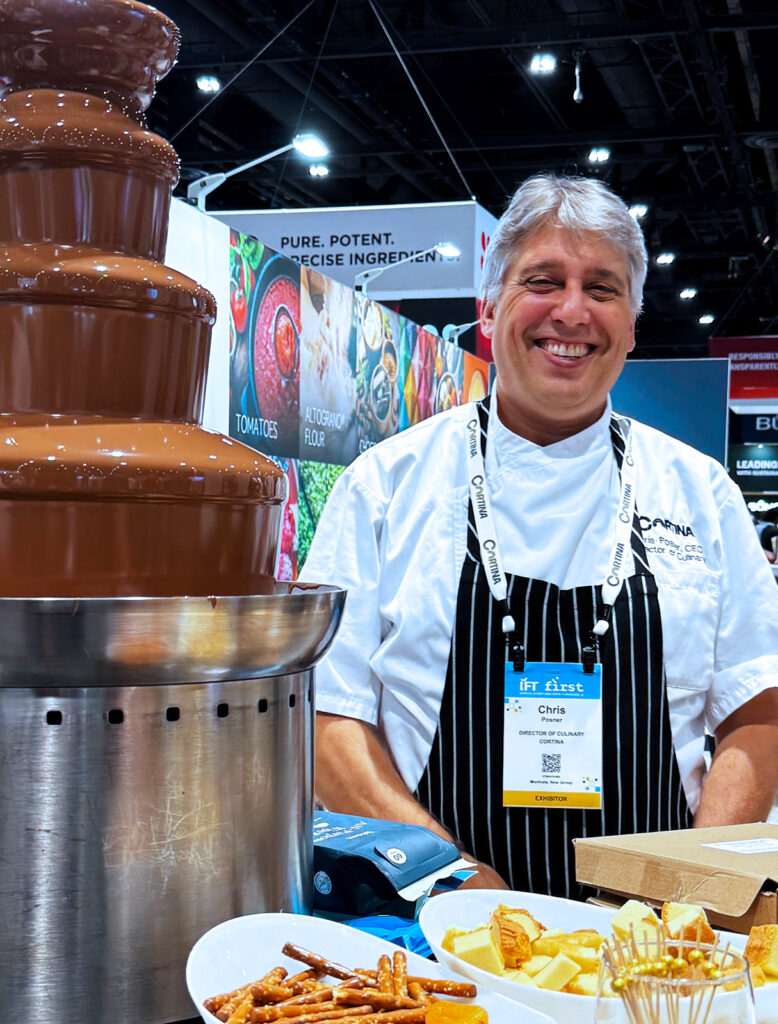
In the distance I see an enormous chocolate fountain and its beaming overseer, Chris Posner, director of culinary for food ingredient wholesaler Cortina. When I ask Posner whether I’ll get my daily allotment of protein if I stick my head directly into the chocolate fountain, he laughs and offers me a hard chocolate sample that is 30% protein by weight. I ask him if the protein-boosting trend is still on the upswing. He shrugs.
“It’s got to give—I mean we are putting protein in chocolate chips. Food trends ebb and flow. Ten years ago, we had the vegan craze, then everyone wanted meat again. The pendulum swings back and forth.”
He offers me another chocolate sample with 20% soluble fiber, and I head back into the fray.
“The future belongs to fiber,” announces Melissa Kaczmarczyk, a nutrition scientist for Tate and Lyle, a British ingredient company, at a nearby stage. “We think fiber is the new protein.”
People should consume somewhere between 25 and 38 grams of fiber every day, she says, but in the United States, 95% miss that mark, “and they don’t even know it.” Globally, most people have a 15-gram fiber deficit, close to half the recommended intake. Kaczmarczyk thinks part of the problem is public perception. “We need marketing to get fiber out of the bathroom.”
Her solution: push fiber’s benefits to the gut microbiome, weight management, and satiety, as well its possible links to improved cognition, research her company is pursuing.
When I tell other attendees that I’m planning to eat solely at the expo, I get a lot of chuckles followed by repeated admonitions to monitor the added fiber I am consuming. “You could have a bunch of samples and accidentally have 500 grams of fiber without realizing it,” says Bonnie Stetz, senior director of event strategy for IFT FIRST, while leading a tour of the expo floor for first-timers.
Earlier in the day, I heard a panel moderator wax nostalgic about her first IFT conference. She divulged that her newbie mistake was to accidentally overindulge in fiber-fortified foods. “I went home and I couldn’t button up my pants that night because my stomach was so bloated.”
I pull out six of the fiber-enriched gummies I grabbed earlier. They look and taste like Swedish berries. I am tempted to eat them in one go, but then I’ll hit half my daily recommended fiber intake. Now anytime my stomach growls, I’ll wonder whether it’s hunger or an imminent fiber incursion.
Only one person at the convention tells me my decision to dine entirely on expo samples is a mistake. At a hot sauce and pepper flavor booth, I strike up a conversation with a salesman standing next to a McDonald’s takeout bag. He’s unapologetic when I mention the comic absurdity of smuggling fast food into a processed food expo. “The food here is terrible,” he says, laughing, as he wishes me well on my culinary experiment.
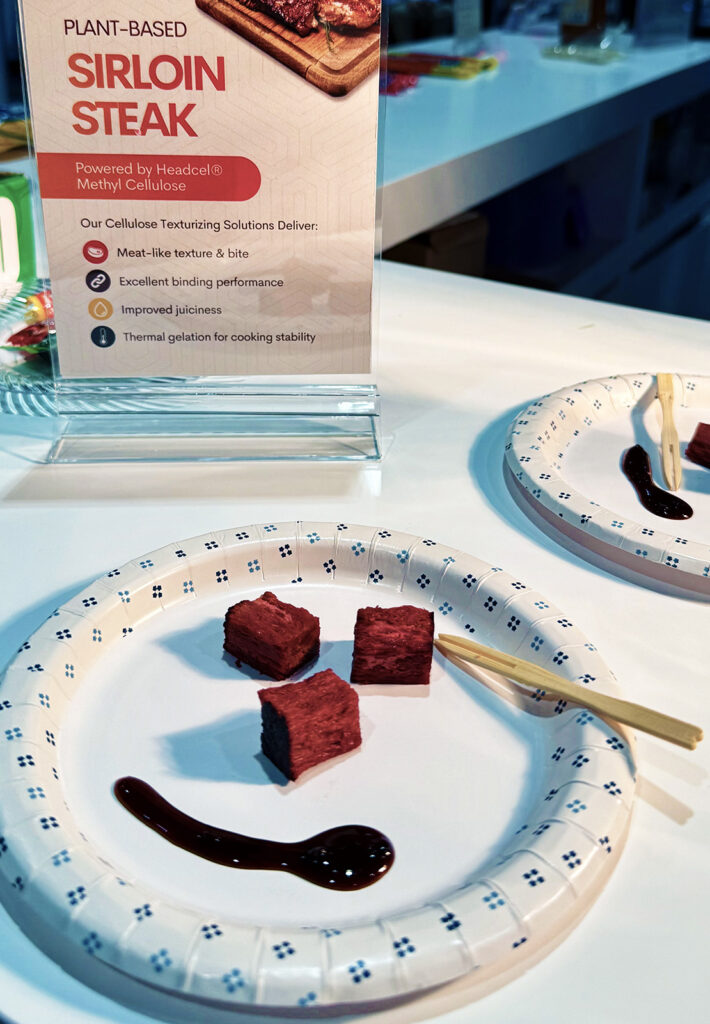
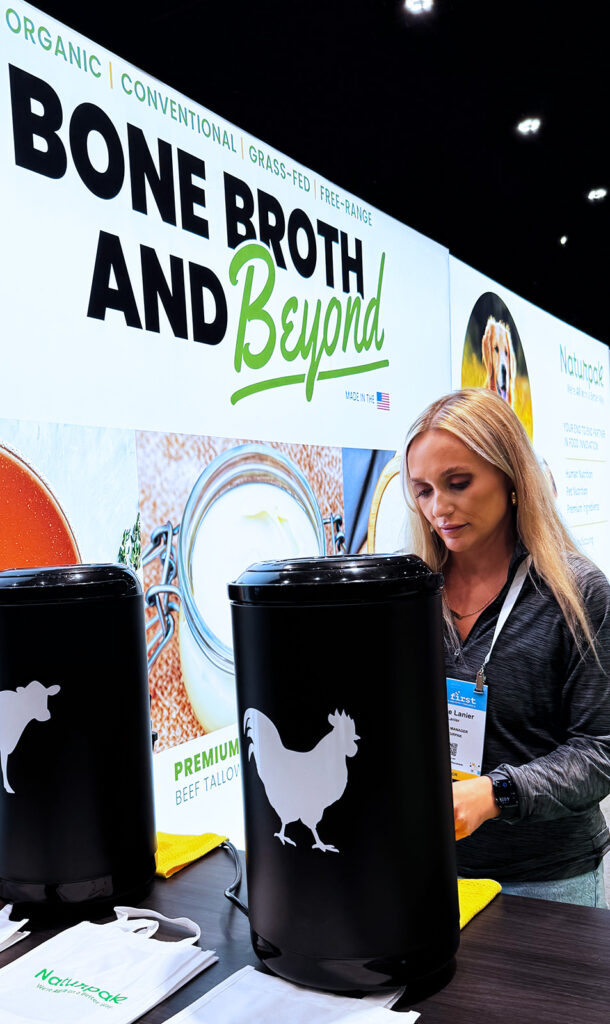
I decide to focus my next round of snacking on two ends of the meat spectrum: I try a concentrated bone broth for companies catering to the cold-plunging bro market (it’s hearty and delicious) and then move on to a booth offering vegan sirloin steak. The cube of material looks remarkably like beef, but it’s made from modified pine and cotton cellulose protein and has faux-fat marbling courtesy of coconut and palm oil. Although the meat substitute tastes barely like steak, it’s got an utterly delicious roasted umami flavor and a pleasant, mushroom-like texture.
Enthusiastically, I try their next sample, a plant-based chorizo. It’s a choice I immediately regret. I strike out again with a smooth pistachio spread but keep its dipping implements—fresh carrot and celery sticks. After all the fiber-maxxing, I’m craving the nutrient prototypes.
I sit down at an empty booth and take a moment to rest my feet, snack on my veggies, and write down some of the jargon I’ve learned.
One charming food scientist described his primary skill set, unironically, as “pretzelizing.” That is, he turns non-pretzel food—say, a fish cracker—into a fish cracker with a pretzel surface, a feat achieved by coating the cracker surface with a strong base and then adding salt, all without messing up the taste of the snack below. At another booth, a salesperson characterized their company as “pond-to-plate” because their protein is derived from a water plant.
When it comes to advertising product, I notice that companies really lean into the original botanical source of their wares, especially if it’s esoteric. Case in point: a stand promoting a new sweetener originally isolated from the underground mycelium of a Hungarian honey truffle.
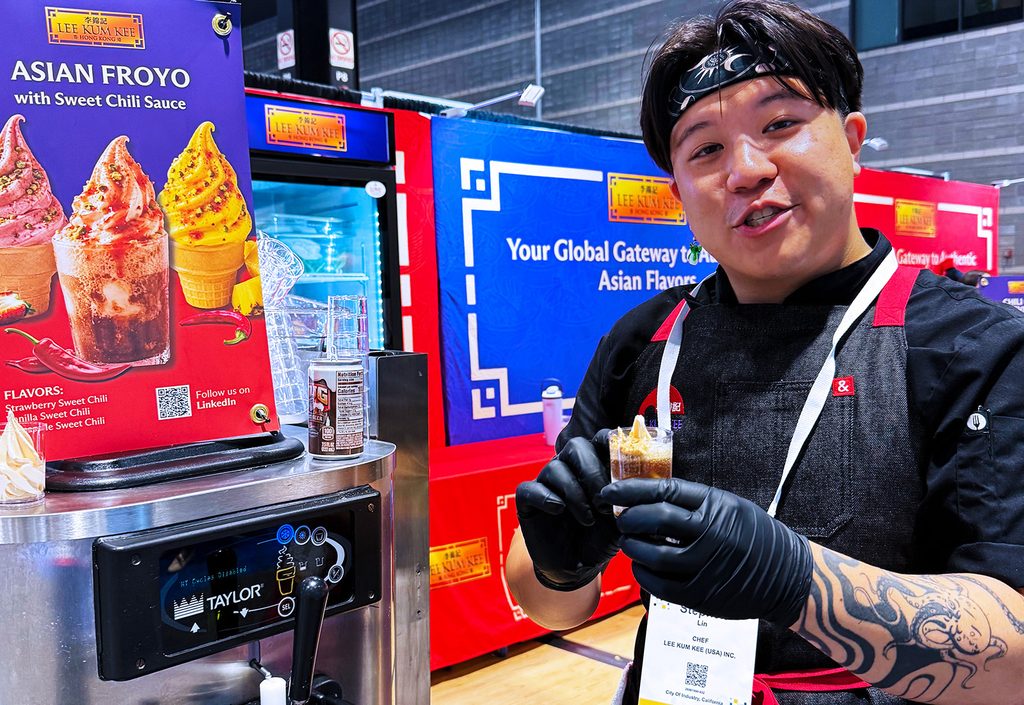
Sweet-tasting molecules like sugar are often carbohydrates, but this sweetener is actually a protein. The company is advertising the sweetener as a two-in-one perk for consumers wanting to consume more protein and reduce sugar simultaneously. (Benefit stacking!) Competitors are commercializing sweet-tasting proteins originally extracted from two West African plants, the oubli fruit and the serendipity berry.
Protein sweeteners typically take a bit longer than sugar to be recognized by our taste buds but then come on strong and leave a bit of an aftertaste; as a result, many in the industry don’t present these alternatives as single replacements to sugar but talk about blending sugar alternatives with, say, Stevia, an older sugar replacement that falls into a different chemical family altogether (glycosides).
I try a crepe covered in a hazelnut topping that has been 80% sweetened with the Hungarian truffle protein. The sweetness in the topping is clearly not traditional sugar, but I am struck by how little I regret getting the understudy instead of the lead actor. My main complaint, and frankly one applicable to many other booths, is the marketing: “Nature’s sweet secret.”
Instead of harvesting this new sweetener directly from nature, where growing seasons, extreme weather, and geopolitics can disrupt availability, scientists pluck out genes for making the “natural” fungal ingredient and insert them in yeast or bacteria that can then produce the ingredient in a factory. Many impressive, and in my mind laudable, feats of biotechnology are needed to produce these sweet ingredients through factory fermentation—precision genetic engineering and chemical purification, to name two.
But the word “nature” evokes bucolic farm fields, a total disconnect with how the ingredients are actually produced. If consumers discover this disconnect, it’s easy to imagine the distrust and antiscience aftertaste that might linger.
Perhaps the only word vaguer and more disingenuous than “nature” is “clean.” Though there’s no industry definition of the term, it’s among the most popular marketing descriptors at booths across the expo.
I’m not the only person to feel dismayed by “clean” semantics. In a 2022 review, University of Ottawa nutrition researcher Nicolas Bordenave took issue with the clean-label trend, arguing that it’s an “ineffective heuristic that disserves both consumers and the food industry.”
Although the trend has its roots in the early 2000s, originating with a demographic of consumers who wanted foods with fewer, simpler, and more recognizable ingredients, the MAHA movement has helped make the term mainstream. As Bordenave points out, though, “tentative definitions of clean-label foods are vague, subject to multiple interpretations, and clean label remains an informal denomination for foods, making consumers’ demands and food manufacturers’ offerings hardly compatible.”
So it’s with resigned curiosity that I head to a panel asking: “What are the challenges with increased demand for natural and clean-label ingredients?”
The session is packed, but I manage to ask the panel to define “clean” in a sentence or two, given both its vagueness and popularity.
After a moment, Cordell Hardy, an R&D executive for food ingredient giant Cargill, takes a stab at answering: “Ingredients that, to the best of our knowledge, do not have any offsetting negative consequences upon ingestion and are aligned with our best practices for sustainability in a holistic way.”
“It’s formulating out ingredients that consumers distrust,” says Jay Bunte, senior director for global corn and clean-label texturizers at Ingredion. “The inverse of that is a clean label.”
The impression I’m getting is that you’ll know “clean” when you see it.
Many attendees are more concerned with what “clean” means for the bottom line. To assuage those fears, Bunte offers a case study. His company worked with a tomato sauce manufacturer that wanted to simplify its ingredient list—that is, “clean” it up—without increasing the cost of production.
“So, as most folks know, in a tomato sauce, there’s a high level of usage of tomato solids, right? And those are not the cheapest things to formulate with.” By reformulating the tomato sauce “with one of our waxy corn Novation cleanable starches alongside a citrus fiber. . . we were able to actually lower, pretty significantly, the amount of tomato solids and [remove] the other dirty ingredients out of the formulation. So the overall end result was a 10% cost and use savings along with an elevated and more clean label.”
It’s interesting—and a bit surreal—to see industry players putting a brave face on the Trump administration’s efforts to “clean up” the food business. For many compliance officers and food chemists working with products that use petroleum-based synthetic dyes, life’s been a roller coaster since Trump took office in January 2025. The FDA has banned the widely used Red No. 3, as well as rarely used dyes Citrus Red No. 2 and Orange B. It also has requested voluntary phaseout of an additional six widely used dyes, initially by 2026 and now by the end of 2027.
Meanwhile, the FDA approved Galdieria extract blue (extracted from hot springs algae), butterfly pea flower extract (which can range from blue to purple), and calcium phosphate (a common white mineral that is allowed in chicken products and some confections) as new food colors. Beetroot red and spirulina (blue-green algae) extracts, and other colors derived from “natural” sources are in the approval pipeline.
The challenge is that replacing synthetic dyes with natural dyes is no cut-and-paste operation. The natural dyes may not have the color longevity of synthetic ones, or they may taste of the source, particularly in the case of pea- or beet-based dyes. Alternatively, the replacement dye may interact negatively with other ingredients in the food. Consider the anthocyanins, a family of primarily blue, purple, and red pigments sourced commonly from grapes. They can lose color when in the presence of vitamin C, a common food additive.
“Every chemical is going to behave in a certain way, have certain thermal stability, a certain susceptibility to oxidation. [The color] will either last or it might fade, or it might change,” Niemira says. “You start off with a nice, bright, vibrant red, and then it kind of morphs to kind of a brick red, right?”
Another challenge to reformulating colors: natural origins do not inherently make products safe for human consumption. Nature can be a toxic minefield.
Consumers “don’t understand that synthetic colors are often manufactured in more controlled environments,” says Anna Benevente, a director of labeling and regulatory compliance for Mérieux NutriSciences, at a panel about reformulating with natural colors and flavors. In the case of dyes extracted from beets, for instance, the growing plant can absorb hazardous amounts of lead or other heavy metals in the soil.
One way to avoid the risk of sourcing dyes in the wild is to extract the genes for the plant’s pigment and then insert them into a microorganism. Then that microorganism is grown in a fermentation factory and used to produce the dye ingredient, similar to how the sweet truffle protein was produced. Not only does this sidestep unexpected environmental harms; fermentation also allows suppliers to produce exact amounts of a dye (or other food ingredient) on demand and in a factory where “clean” claims can be supported by hygienic specifications rather than insincere illusions of pastoral production.
I’m left wondering how die-hard MAHA fans would square the biotechnology used to make these “clean” products with their raw-milk mores.
The expo’s final keynote speaker is Alon Chen who has the confidence, stride, and skin care routine of a Silicon Valley executive. He was previously Google’s chief marketing officer for Israel and Greece, but he’s now the CEO and co-founder of Tastewise, which builds AI agents that cater to the food and beverage industry.
“When it comes to agentic solutions,” Chen tells the audience, “you basically have two kinds of jobs to be done and challenges to be solving. The first one, the left-hand side, is the science. Can I get a faster formulation? Can I get something for my new claim? Can I reformulate, renovate my products and brands?”
The second way to deploy agents in the food industry, he says, is to monitor demand.
“What are the moms in Chicago having for breakfast recently? What are the rising diets for Gen Z or Generation Alpha? Is there a new culinary trend or new flavor that is dominating snack bars, new dessert lines?” Companies can use AI agents, he says, to identify and fill “white spaces” in the food industry. That’s jargon for gaps or unmet consumer needs that ambitious companies can target with new products.
When asked about his 10-year projections, Chen is bullish. “All the food we’ll be eating will keep us young, fresh. . . . Everything’s really bright and optimistic, and it’s clear that the companies’ marketing teams will be 100% agentic. . . . It’s not going to be optional.” I look around the audience. Some seem keen and engaged; others are giving him serious side-eye.
Chen’s slides, which feature tubs of dill- and pumpkin spice–flavored cottage cheeses—presumably devised by an AI agent for seasonal launches—have me yearning for something futuristic I can actually chew on. I head to the expo’s start-up area.
The future I am most impressed by comes from a British scientist who has put the iridescent blue color of Morpho butterflies into gummy bears—sadly not approved yet for taste-tests. At another booth, a U.S. company has used CRISPR to engineer out three allergens in peanuts. The company received USDA approval to grow the modified peanut plants this year and will harvest their first yield at the end of the 2026 growing season. Thereafter, they hope to apply for FDA approval, so it’s still more of an idea than a product.
Moving on, I chat up Mick Riley, the co-founder of Forever Harvest, a New Zealand company growing fruit and nut flesh in petri dishes to sidestep the challenges of growing actual trees. After experimenting with 25 different kinds of tree fruit, they prioritized the commercialization of lab-grown almond cells for nut milk and orange cells for juice.
When I ask how they landed on these two tree fruits, Riley tells me that it was a mix of market potential and hedonics. Among the prototypes they tried, almond cells were among the best tasting. But also, growing almonds is environmentally taxing. And if the end goal is to have a source of almond milk and not an intact almond, growing cells in a dish that can be squeezed for milk may be more efficient than investing resources to grow whole nuts on a tree, harvest those nuts, transport them to a crushing facility, and then package the milk for distribution. Forever Harvest is hedging that food companies may make the same calculation. The company was also able to grow almond cells that don’t have some of the nut’s allergenicity, which could be an add-on benefit, Riley says.
Why orange cells? One reason, Riley says, was to provide options for food companies dealing with juice shortages wrought by a bacterial infection called citrus greening disease, which has hurt orange crops in both Florida and Brazil. I’m bummed that I can’t try either the orange juice or almond milk, so I head to one of the few start-ups offering samples to eat.
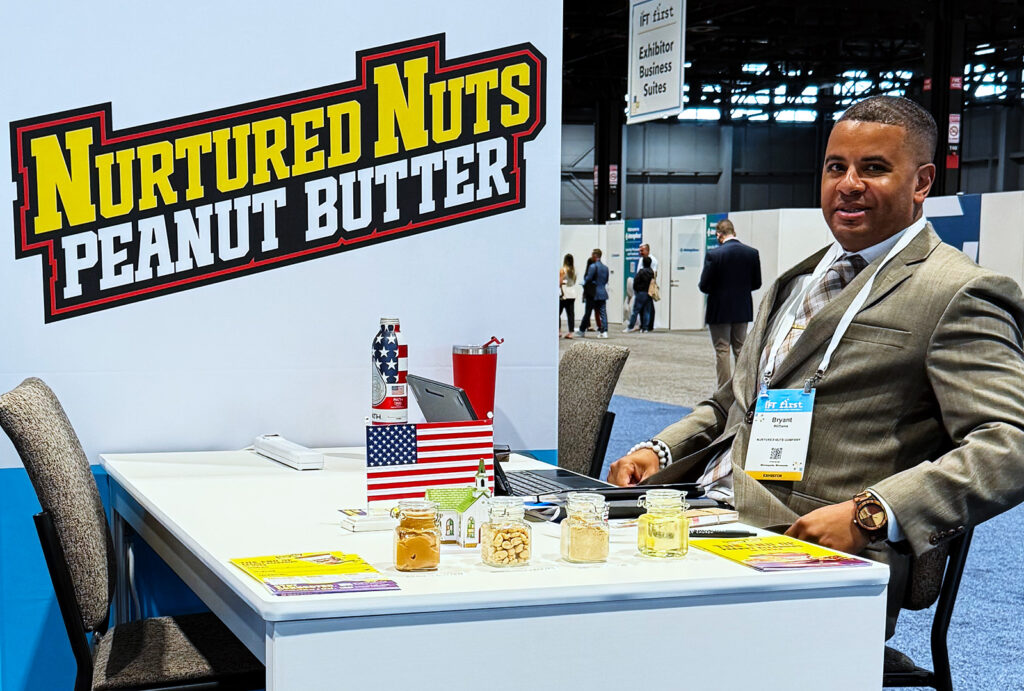
The French start-up Standing Ovation has taken the gene for casein, a common protein in cow’s milk, and inserted it into a variety of microorganisms. The company uses the microorganisms to produce the casein protein in a fermenting tank. The end result is an animal-free ice cream, and there’s a crowd around the soft-serve dispenser. Based on the number of presentations I’ve seen about overcoming chalky mouthfeel problems in foods bulked up with protein, I am expecting the frozen treat to have a gritty texture, but it is delicious. Since the soft-serve was produced without an animal, it technically can be called animal-free. But it’s not dairy free, given that it’s made from a cow gene. It’s an entirely new genre of protein product, says the sales representative, who has grappled with how to market it.
After all the walking, I’m still . . . hungry. So, I stop by a booth whose tagline is “dairy concentrates and beyond” for some comfort food. I try a mac ’n’ cheese made with three cheese “pastes”—Cheddar, Parmesan, and “bleu type”—and then follow up with a spicy margarita mocktail in a cute cactus-shaped cup. The beverage, honestly, does not taste like it contains dairy concentrates. But by this point the novelty is lost on me. I have shed the expectation that the inspiration for the food will match the subsequent flavor profile of the item I place in my mouth. I’m tired and moderately delirious. It’s clearly time to go home.
As I head toward the exit, I notice the DJ has opted for a Latin vibe (Elvis Crespo’s 1998 hit “Suavemente”). With a few shoulder thrusts, I surrender momentarily to the merengue beat before regaining my gravitas. I’m pleased to be leaving with only a scintilla of digestive discomfort plus a potpourri of bizarre merch.
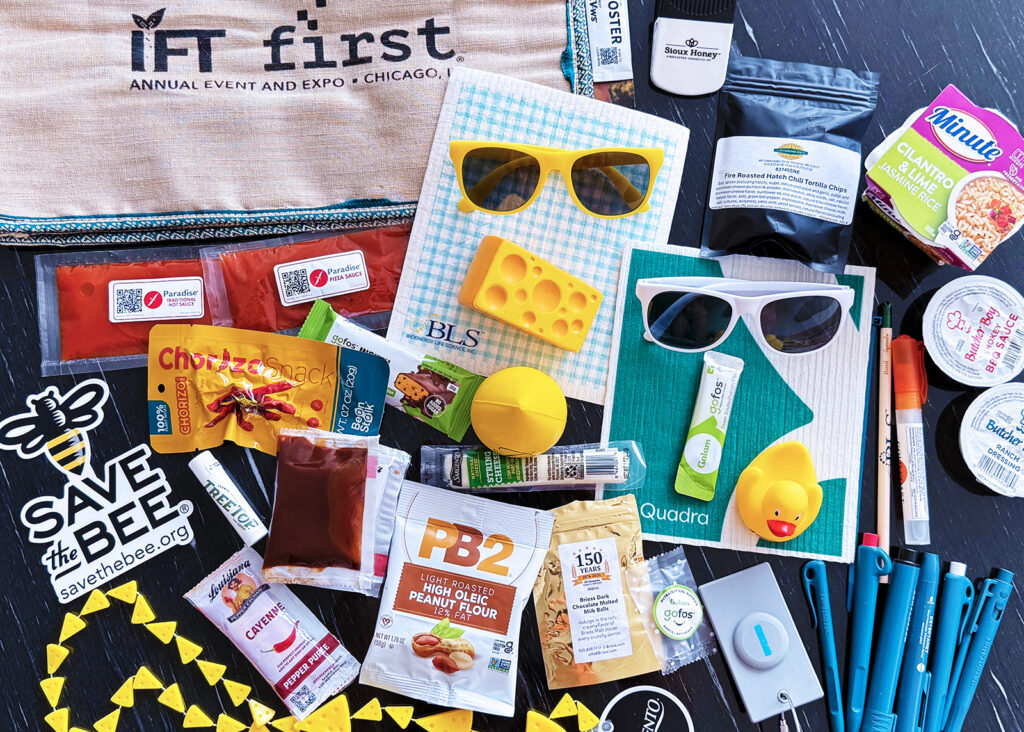
Back at my temporary abode, I sort out the items desirable—or absurd—enough to stuff into my carry-on luggage. I select a flamboyant necklace made from enormous chunks of yellow plastic Parmesan; a second stress ball, in the shape of an oil droplet; a handsome wooden pencil containing a capsule of basil seeds instead of an eraser; markers that can be tracked by X-ray should they accidentally fall into a vat of food in a processing facility; peppermint lip balm; two pairs of jaunty sunglasses; a rubber ducky; and the official conference hemp bag advertising an additive that claims to “reduce stress,” “enhance endurance, strength and immunity,” and “improve sexual function in men and women.”
I spend a long time looking at the bag. A Gen Z cynic might say it’s giving snake oil. Instead, it reminds me of all the overhyped claims I’ve encountered over the past days and their counterproductivity—how they undercut many things the attendees presumably value, whether it’s engendering trust in science, the food industry writ large, or their own company’s credibility.
Certainly functional food exists: from the idea’s origins in ancient China and India to its Japanese revival in the 1990s, certain foods have been shown to do more than sate hunger and provide nutrition; they can help reduce the risk of disease and improve health. Think probiotics in kefir and kimchi, antioxidants in berries, or omega-3 fatty acids in salmon and algae.
But it’s as if the entrepreneurs and marketing departments hawking them today cut their teeth selling the promise of the philosophers’ stone—now available with all-natural potash and clean-label cinnabar—and haven’t learned any new tricks since.
As enjoyably intense as IFT’s expo was, it exposed a disconnect between the food scientists trying to design palatable show-stoppers from available ingredients, the marketing teams leveraging influencer fads and health concerns to sell those products, and the C-suite directives to do so. I’m not convinced AI agents can resolve these conflicts, but I’m pretty sure those cheese wedge stress balls could be a game changer.